Introduction: Green manufacturing ideas India
The ecosystem of Indian manufacturing is in process of major transformation. New entrepreneurs create their businesses through sustainability practices which include resource efficiency and circular economy principles instead of using conventional heavy industries as their base operations. The aquaponic agriculture and recycled plastic manufacturing and biodegradable consumer products sectors are developing into scalable business opportunities which will experience strong market demand.
The shift toward greener production methods receives acceleration through government policies which promote green production and the rising environmental awareness among consumers and the worldwide demand for sustainable products. For MSMEs and startups, the option is to select manufacturing models that integrate predictable demand with manageable capital investment.
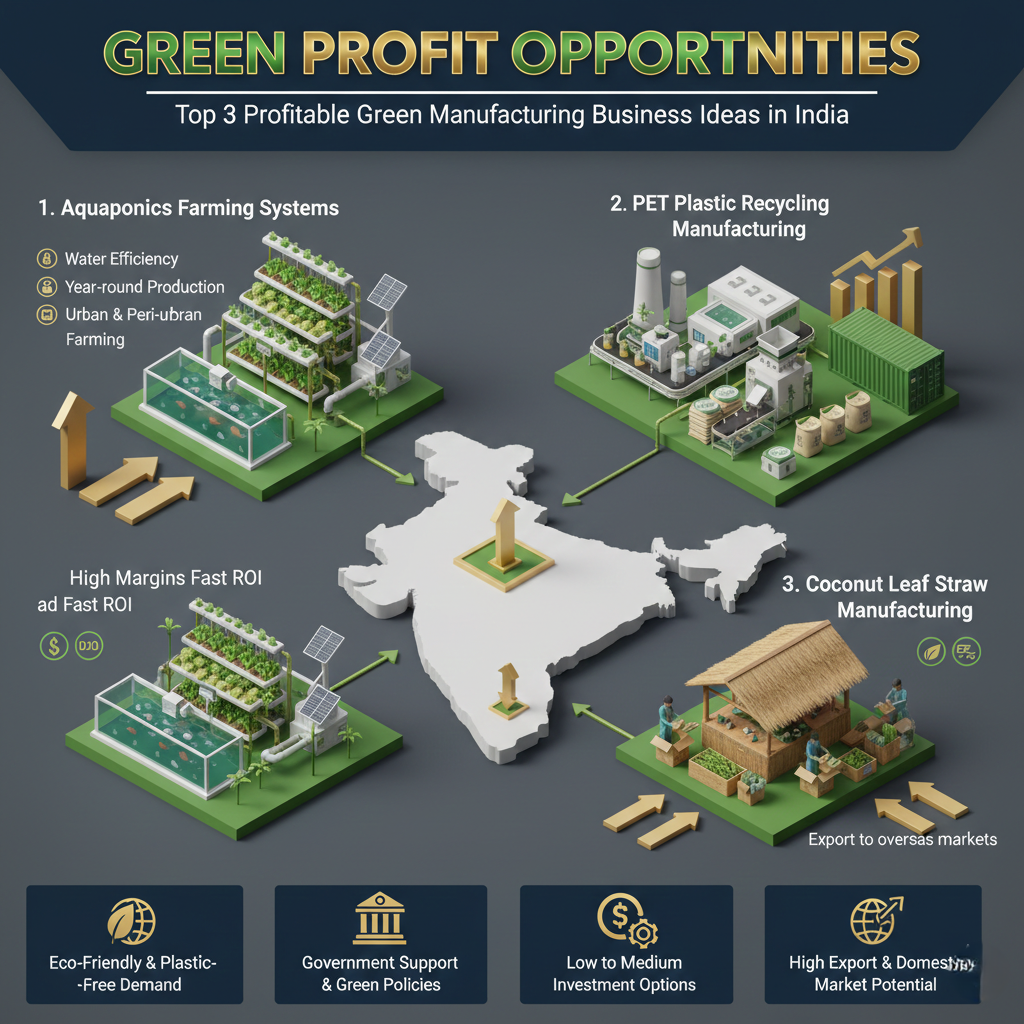
This article investigates three such promising sectors, namely the vegetable farming using fish aquaponic systems, hot washed PET flakes manufacturing and coconut leaf straw production, and provides insights into the operations, market potential, profit and growth outlook for each sector.
Read More: PET Recycling – Manufacturing Plant, Detailed Project Report, Profile, Business Plan, Industry Trends, Market Research, Survey, Manufacturing Process, Machinery, Raw Materials, Feasibility Study, Investment Opportunities, Cost and Revenue, Plant Economics
1. Aquaponic Farming: High-Efficiency Food Production with Two Revenue Streams
What Is Aquaponic Farming?
Aquaponics combines raising fish with the cultivation of vegetables using hydroponics in a closed-loop system. The plants receive nutrients through fish waste while the plants perform natural water filtration for fish. This system enables up to 90% reduction in water consumption in traditional farming, and produces two saleable products: vegetables and fish.
Common produce include leafy greens, herbs, cucumbers and tomatoes as well as fish varieties such as tilapia and pangasius.
Model for Manufacturing and Operational
Aquaponics is more of a system integration business instead of a typical manufacturing unit. The tanks, growing beds, pumps, filtration units, and automated irrigation systems are put together by entrepreneurs. Units can be as small as urban farms, or as large as multi-acre controlled environment facilities.
The greatest challenge is for biological balance – water quality, nutrient cycles and stocking density. However, once stabilized, the cost of operation is reduced a great deal.
Read More: The Complete Book on Coconut & Coconut Products (Cultivation and Processing)
Market Demand and Growth
Urban consumers are more and more demanding pesticide-free produce, and hotels and high-end retailers are demanding consistent supply. With the dwindling land available for agriculture and increasing water scarcity, aquaponics is becoming a viable option for high density food production.(Green manufacturing ideas India)
The market of protected agriculture in India is currently booming and aquaponics is one of the fastest-growing segments of controlled environment farming.
Profitability Outlook
Well-managed mid-scale aquaponic systems usually have EBITDA margins of between 25 and 35%. Break-even typically occurs between 24 and 36 months, depending on the choice of crops and access to markets.
2. Hot Washed PET Flakes: Making Industrial Raw Material from Plastic Waste
Understanding PET Flake Manufacturing
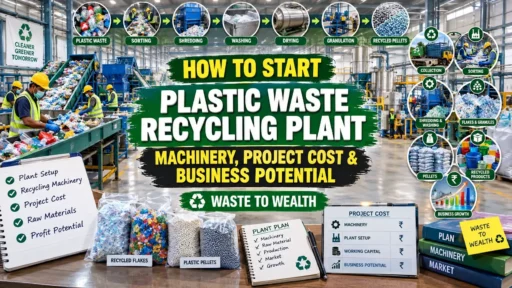
Hot washed PET flakes are recycled plastic granules from post-consumer bottles. Through the waste plastic processing steps of sorting and shredding and hot washing and drying waste plastic transforms into a valuable raw material which manufacturers use to produce textiles and packaging sheets and strapping materials.
The demand for high-quality PET flakes is increasing because global brands are working to achieve their recycled packaging goals.
Manufacturing Process Breakdown
This production cycle often includes:
- Collecting and sorting bottles
- Label removal and crushing
- Hot washing using caustic solutions
- Rinsing and drying
- Quality grading – packaging
Although the technology is mature, operational discipline and quality control are important to profitability.
Read More: RECYCLING OF PET – Manufacturing Plant, Detailed Project Report, Profile, Business Plan, Industry Trends, Market Research, Survey, Manufacturing Process, Machinery, Raw Materials, Feasibility Study, Investment Opportunities, Cost and Revenue, Plant Layout
Raw Material and Supply Chain
The principal input is used PET bottles from scrap aggregators, recycling networks and waste channels from municipalities. Consistent sourcing is the key. In addition, power use, water use and effluent treatment must be in accord with environmental regulations.
Market Demands and Industry Drivers
Recycled PET material constitutes a major part of India’s textile industry production process. International buyers are more and more demanding sustainable materials and there are domestic rules that promote the use of recycled content in packaging.(Green manufacturing ideas India)
With increased opportunities for exports, and stable demand from polyester fibre manufacturers, the PET recycling business is relatively low risk in terms of market for many manufacturing ventures.
Profitability Outlook
A mid-scale recycling unit can have EBITDA margins in the range of 15% to 25%. Strong volume demand and the anticipated growth in this industry over the long term make this a stable manufacturing opportunity.
3. Coconut Leaf Straws: An Inexpensive Manufacturing Opportunity That Is Biodegradable
Product Overview
Coconut leaf straws serve as eco-friendly replacements for plastic and paper straws. The straws which people make from naturally fallen coconut leaves are both biodegradable and chemical-free and they possess enough strength to handle beverages.
Coconut leaf straws maintain their strength through use before they completely decompose in a composting environment while paper straws begin to lose their strength immediately.
Read More: Top 3 Manufacturing Opportunities in Bitumen Emulsion, Waste Tyre Pyrolysis & Recycled PET Fiber
Manufacturing Process
The process operates as a decentralized production system which functions effectively in rural cluster areas. The process includes:
- Collecting fallen coconut leaves
- Cleaning and sanitizing
- Pressing and moulding into shapes of straw
- Heat treatment and trimming
- Packaging for the domestic or export markets
The machinery needs remain low which enables both MSMEs and women-led businesses to access the system.
Market Demand and Export Potential
The demand for products has increased because of two factors which include the Indian states single-use plastic ban and the worldwide environmental awareness. The primary customers of the company include cafes and hotels and airlines and events companies and eco-friendly brands.
The global biodegradable straw market is growing at a rapid rate, and coconut-based straws are popular because of their durability and sustainability advantages.
Profitability Outlook
Gross margins are more than 40% (especially for export oriented units) Break-even is usually quicker when compared to large capital-intensive manufacturing industries because of low machinery costs.
Policy Support and Government Subsidies
India’s policy environment is becoming supportive for sustainable manufacturing. Ministries that support agriculture, MSME and environmental initiatives provide subsidies, training programs and market linkages.
Entering green manufacturing sectors is often less burdened by regulation, and entrepreneurs can gain from schemes designed to assist startups, as well as for export-oriented manufacturing.
Read More: 10 New Manufacturing Business Opportunities in India for Startups and MSMEs
Strategic Lessons for New Entrepreneurs
Successful manufacturing ventures are operationally disciplined rather than hype driven. Entrepreneurs should:
- Secure stable raw material supply chains
- Invest early in quality control and design of processes
- Align products to long-term sustainability trends
- Building relationships with institutional buyers
- Start small, validate markets, and scale from there
By concentrating on irreversible changes in demand, such as eco-friendly materials and resource-efficient agriculture, business can construct resilient growth models.
Conclusion: Creating Future Ready Manufacturing Businesses
Aquaponic farming, hot washed PET flakes manufacturing and coconut leaf straw production are three separate but complimentary sustainable manufacturing opportunities. Together, they embody the wider shift in the industrial landscape of India towards circular economy and eco-conscious consumer markets.
Entrepreneurs who adopt new models of production, exploit policy support, and have high standards for quality, can grow scalable ventures with good long-term demand. As sustainability becomes one of the driving forces of industrial growth, these sectors are poised to provide both profitability and environmental impact.(Green manufacturing ideas India)
Frequently Asked Questions (FAQs)
1.Is aquaponic farming profitable for beginners?
Yes, but beginners should start with smaller systems, gain operational experience, and secure local buyers before scaling operations.
2.How much investment is required for a PET flake recycling plant?
Investment varies based on capacity, but MSME-scale units require moderate capital compared to heavy manufacturing industries.
3.Are coconut leaf straws only for export markets?
No. Domestic demand is growing quickly in hospitality, eco-events, and food service sectors, though export markets often offer higher margins.
4.Which of these businesses has the fastest break-even?
Coconut leaf straw manufacturing generally achieves the fastest break-even due to low startup costs and strong demand.
5.What are the biggest risks in sustainable manufacturing?
Supply chain disruptions, inconsistent product quality, and lack of market access are the main risks. Proper planning and reliable sourcing reduce these challenges.