Introduction: Climate Tech Opportunities India
India’s Union Budget 2026-27 is signalling a significant shift in India’s approach to clean energy. Earlier debates on the policy mostly centered on renewables capacity targets and emission reduction targets. The latest budget goes beyond targets to strengthening domestic industrial capability, enhance competitiveness of manufacturing and reduce long-term dependence on imports.
For startups, MSMEs, and climate tech investors, this is a very significant transition. Industrial policy induces predictable demand, stable economics, and long-term infrastructure needs – which provide for the development of scalable business models, not short-term, experimental ventures.
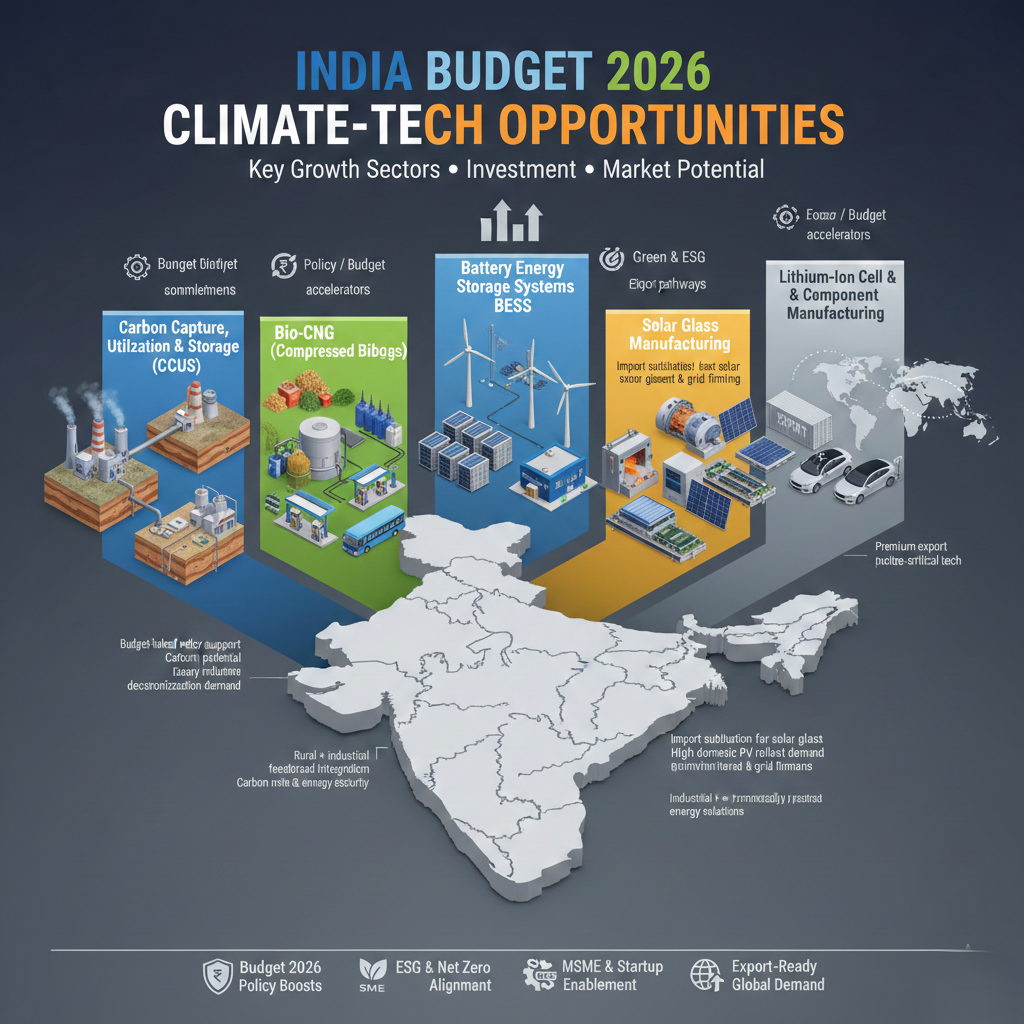
The budget showcases deep technology sectors across the entire clean energy value chain. Carbon Capture, Bio-CNG, Battery Energy Storage Systems (BESS), Solar Glass manufacturing and Lithium-Ion cell ecosystems are forming as potential opportunity areas with policy incentives and supply chain reforms.
Read More: Dual Feed Distillery (Ethanol as Bio-Fuel): A High-Potential Venture for Startups
Why Budget 2026 Opens Up Business Gaps on the Spot
Climate-tech businesses scale most quickly when three factors come together: policy support, reduction in cost and high market demand. Budget 2026 enhances all the three through targeted fiscal measures and industrial incentives.
Key policy signals include:
- Support for Carbon Capture, Utilisation and Storage (CCUS) pilots through Government funding
- Duty exemptions on some of the materials used in solar glass manufacturing
- Extension of the duty exemptions on capital goods for the manufacture of lithium-ion cells till 2035
- Incentives for domestic critical mineral processing
- Tax clarifications to favour the economics of blended biogas based CNG
These measures reduce the barriers to entry, enhance the viability of financing and reduce the risk of operation for new climate-tech ventures. For startups, the biggest opportunity is not only limited to building infrastructure but also offering specialised engineering services, software solutions and operational technologies.
Read More: IRON ORE MINING – Manufacturing Plant, Detailed Project Report, Profile, Business Plan, Industry Trends, Market Research, Survey, Manufacturing Process, Machinery, Raw Materials, Feasibility Study, Investment Opportunities, Cost and Revenue, Plant Layout
Carbon Capture (CCUS): An Emerging Market for Industrial Decarbonisation
Heavy industries like cement, steel, chemicals and fertilisers come under more pressure to contain emissions. CCUS functions as a fundamental technology for decarbonization because electrification methods fail to eliminate all industrial emissions.
Startups can enter large-scale capture facilities through the development of particular solutions because these facilities require substantial investment expenses. Industrial clusters generate demand for modular technologies and service based business models.
The potential startup business areas include:
- Modular carbon capture units for mid-sized plants
- CO₂ compression and purification systems
- Carbon utilisation technologies that include mineralisation and synthetic fuel production inputs
- Emissions monitoring and measurement software
The government plans to fund pilot projects which will create testing and deployment opportunities for initial demand. However, industrial environments require very reliable systems. Companies entering this sector must focus on the quality of engineering, excellent service support and operational safety to succeed.
Bio-CNG: Converting Agricultural and Urban Garbage into Income
Bio-CNG is one of the most naturally scalable climate tech sectors in India due to high availability of organic waste from agro, livestock and municipal sectors. Budget policy improvements to enhance blending economics are likely to encourage fuel distributors to take bio-based gas in long-term gas supply agreements.(Climate Tech Opportunities India)
Entrepreneurs are increasingly looking beyond building plants to innovations in operations and in the supply chain. Feedstock aggregation, gas purification technologies and decentralised plant management systems are becoming areas that startups are critical in.
Common revenue streams are:
- Sales of compressed bio-gas fuel
- Biofertilizer made from digestate
- Operations and maintenance services for distributed plants
- Technology licensing – optimisation of processes
The main difficulty is maintaining regular feedstock supply and quality. Businesses investing in logistics systems, farmer networks and standardised collection processes often enjoy better margins and stability of operations.
Read More: India Solar Glass Market
Battery Energy Storage Systems (BESS): Critical Infrastructure for Renewable Growth
As India ramps up solar and wind generation, energy storage has become crucial for the stability of the electrical grid and peak demand management. Battery Energy Storage Systems are advancing fast from pilot projects to a mainstream infrastructure.
The extension of exemptions of capital goods duty for manufacturing of lithium-ion cells gives long term policy stability and encourages domestic production. The solution provides advantages to startups which focus on integration and analytics and operational support development.
Key opportunity areas are:
- Integration of containerised energy storage systems
- Battery management technology and thermal safety engineering
- Energy analytics platforms and dispatch optimisation software
- Predictive maintenance and lifecycle performance monitoring
Service-based revenue models are becoming very common, where companies ensure uptime or performance. The organization needs to establish strict engineering standards which require compliance testing and risk management procedures because battery safety risks and warranty liabilities create dangerous situations.
Solar Glass Manufacturing: Meeting an Important Missing Link in the Supply Chain
Solar glass serves as a critical upstream material needed for the production of photovoltaic modules. The market for low-iron high transmittance glass which is used in specialized applications keeps growing because India pursues its ambitious solar deployment targets. Policy incentives and duty exemptions of key manufacturing inputs are helping to enhance domestic cost competitiveness.(Climate Tech Opportunities India)
Full-scale glass manufacturing requires significant capital investments but startups can enter the market through niche technologies and services that assist module manufacturers.
Possible points of entry are:
- A few key factors that have made the recent progress in solar panel efficiency possible include: – Advanced coating technologies, which increase light transmission
- Automated inspection systems that make use of AI for defect detection
- Recycling and upcycling of solar glass wastes
- Elements of precision processing and finishing services
Energy consumption together with production quality maintenance establishes the primary difficulties which operators must solve. Entrepreneurs need to create good manufacturing processes and long-term relationships with suppliers in order to keep margins stable.
Read More: Starting a Lithium-Ion Battery Assembly Business: Key Considerations and Challenges
Lithium-Ion Cells and Materials: strengthening India’s battery ecosystem
The production process for lithium-ion batteries relies on materials science and precision engineering and strict quality control measures. The government offers budget incentives which support capital equipment and mineral processing initiatives to enhance India’s domestic battery supply chain capabilities.
Most startups focus their business activities on developing specific components and supporting services instead of building full cell production facilities. Companies can build their technical skills and customer connections through this method before they start developing their capacity for mass production.
Promising areas of opportunity are:
- Production of cathode and anode material
- Electrolytes – Separator technologies
- Testing and certification laboratory
- Cleanroom Equipment and Consumables
- Manufacturing processes automation
The primary operational threat that affects production at new facilities stems from production processes which show extremely low output levels, and this threat creates serious financial losses for companies. The pathway to sustainable success requires organizations to implement incremental growth processes while establishing stringent quality control systems and developing successful technical alliances.
Key Things to Consider as a Startup and MSME
While policy support enhances the market conditions, climate tech industries remain very technical and capital intensive. The following are some of the things that entrepreneurs should consider before they enter the sectors:
- Focus on service-based or niches technology segments before large infrastructure investments
- Develop strong engineering and compliance capabilities
- Develop long-term supply-chain partnerships
- Prioritise safety standards and certification procedures
- Start with pilot projects and to scale as operational performance
Companies with a blend of technical expertise and rigorous operational management are likely to be more successful in industrial climate tech markets.
Conclusion: A New Industrial Growth Cycle for Climate Technology in India
India’s Union Budget 2026 is a shift from policy driven climate commitment to industrial ecosystem development. By boosting domestic manufacturing, lowering capital costs and incentivising the localisation of supply chains, the government is setting the right environment for scalable climate tech businesses.
The most promising opportunities were not only in the building of large infrastructure but also in the resolution of practical industrial problems – engineering services, supply chain solutions, advanced materials and operational technologies. Start-ups and MSMEs with focus on reliability and cost-efficiency along with applications in the real industrial world are likely to be well positioned to benefit from this evolving market.(Climate Tech Opportunities India)
As India enters a new phase of clean energy industrialisation, there is a unique opportunity for climate tech entrepreneurs to create sustainable businesses that will contribute towards both economic growth and environmental resilience.
FAQ
Which climate tech sector has the most start-up growth potential?
Bio-CNG operations and battery storage integration services are often more rapidly scalable because they have reduced capital needs and service-based contracts.
Is CCUS Suitable for Small Start-ups?
Yes. Modular capture technologies, monitoring tools and carbon utilisation innovations provide realistic points of entry.
What is the greatest challenge in battery storage business?
Safety risks and liabilities regarding warranty. Good engineering design and testing processes are important.
Can solar glass be a startup business?
Yes especially in coatings, inspection technology, recycling and processing services rather than full scale manufacturing.
Why is Budget 2026 important for climate tech investors?
It lowers project costs, and helps make manufacturing more economical, while also indicating to the clean energy industries at home long-term government support.