Non ferrous recycling business
The industrial requirements of today which need recycling because it serves as their main operational method. Rising cost of raw materials, growing dependence on imports and tightening environmental regulations is driving industries towards efficient utilisation of resources. As a result, the recycling of non-ferrous metals like aluminium, copper and zinc is making one of the stable and most lucrative industrial sectors.
The essential metals support complete infrastructure systems which power renewable energy sources and enable transportation operations and construction projects and electronic device production. Their demand is closely related to economic development and industrial expansion. As urbanization and industrialization continue to speed up, the demand for recycled metals is expected to steadily increase during the next decade.
Another factor that is hugely in Favor of this industry is the constant production of scrap materials. Manufacturing units, construction projects, electrical installations and end-of-life vehicles generate huge amounts of reusable metal waste each year. Entrepreneurs and investors find recycling to be a sustainable business model because it provides them with continuous raw material supply.
Get Detailed Insights from This Book: The Complete Book on Ferrous, Non-Ferrous Metals with Casting and Forging Technology
Driving Factors in the Recycling Industry
The requirement for non-ferrous metals initiates industrial and infrastructure development activities. Copper is vital for electrical wiring and power transmission systems, aluminium is commonly used in lightweight manufacturing and zinc is most commonly applied to galvanizing steel to protect it from corrosion.
Several major trends are causing this sector to grow:
- Expansion of infrastructure and construction
- Rapid increase of renewable energy installations
- Increasing demand from the Automotive industry
- Increasing emphasis on sustainability and circular economy practices
- Government support of domestic manufacturing
These factors guarantee that there will be a long-term demand for recycled metals and that businesses conducting business in this sector will have stability.
Access Complete Business Plan: Ferrous and Non-Ferrous Metals Projects
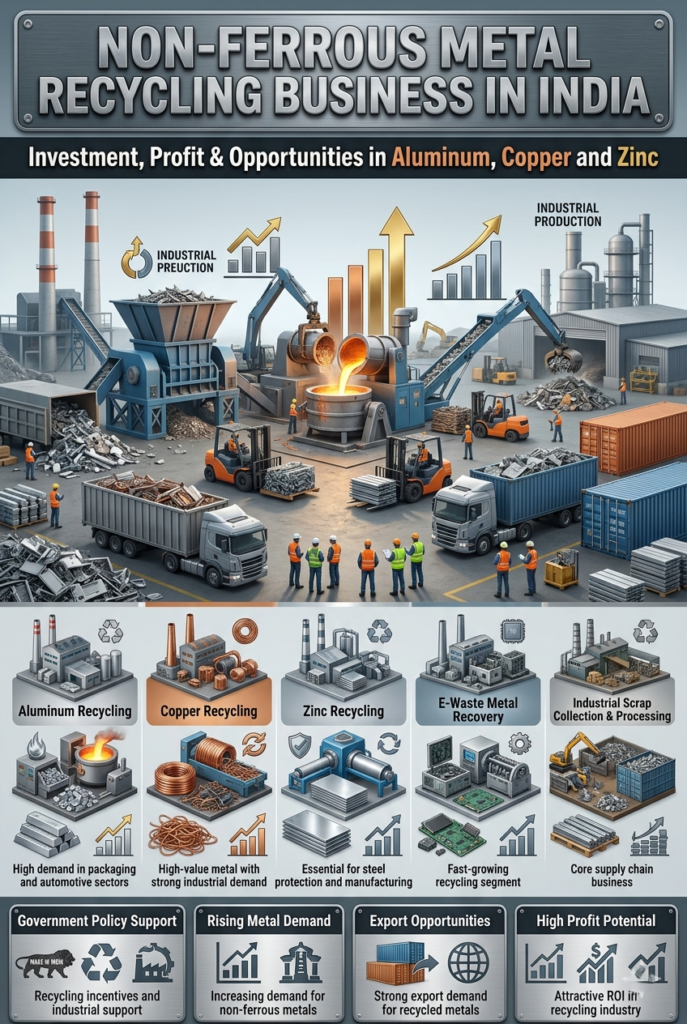
Understanding the Non-Ferrous Metal Recycling Process
A typical non-ferrous metals recycling plant has a sequential process in place to optimize recovery and ensure product quality. Each stage has a very important role to play in determining efficiency and profitability.
The major stages of the recycling process are:
- Scrap Collection from industries, scrap dealers and dismantling units
- Sorting and Segregation in order to separate metals and remove impurities
- Shredding or Cutting to shrink the size of the scrap material
- Melting and Refining using industrial furnaces
- Casting into ingots, billets or rods
- Quality Testing to ensure standards of the product
Efficient process management enhances recovery rates and lowers production costs, directly adding to a higher level of profitability.(Non ferrous recycling business)
Investing and Making Profits in Metal Recycling
One of the most attractive features of the recycling industry is that the investment need is relatively modest compared with primary metal production. Entrepreneurs may begin with a small or medium scale plant and progressively increase the scale of operations as demand grows.
The profitability of a recycling business depends on operational efficiency, energy management and supply chain discipline. The difference between the buyback price of the scrap and the selling price of the refined metal makes up the margin.
Common financial characteristics of recycling enterprises are:
- Stable demands for the whole year
- Moderate capital investment compared to a heavy manufacturing
- Consistent cash flow once operations become stable
- Payback period, general between 2 to 4 years
- Profit margins that may be between 15% to 30%
Businesses that have a consistent source of scrap and have mastered the cost of energy usually perform well financially.
Profitable Business Opportunities in Non-Ferrous Recycling
The non-ferrous recycling industry has a number of business models that can be adapted to various levels of investment and market conditions. Selecting the right model is dependent on available capital, technical expertise, and local demand.
Aluminium Scrap Melting and Ingot Manufacturing has been widely regarded as one of the easiest ways into the business for small and medium-sized enterprise. The demand for secondary aluminium is high in the casting and automotive sectors, hence, it is a reliable source of revenue.
Copper Recycling Plants earn huge profits considering the metal’s high worth and usage by myriad industries for electrical and infrastructure purposes. Recovered copper can be turned into rods or cathodes and delivered to the cable manufacturers.
Zinc Recycling Units are used in industries which work with galvanized steel especially the construction and manufacturing industries. Recycling of zinc saves on production costs and contributes to sustainability goals
Some entrepreneurs also set up mixed processing scrap facilities that specialize in sorting and upgrading various kinds of metals and then selling them to refineries. The investment model requires less financial pressure because it generates continuous revenue through value-added processing operations.(Non ferrous recycling business)
Find high-return business ideas based on your budget & ROI
Major Expenses in a Recycling Business
Understanding operating costs is essential to financial planning and long-term profitability. Most recycling facilities share specific operational costs which depend on their plant dimensions and selected technologies.
The main operating costs are:
- Scrap procurement
- Electricity and fuel consumption,
- Labor and workforce expenses
- Equipment Maintenance and Spare Parts
- Transportation and logistics
- Environmental compliance and safety measures
Careful monitoring of these costs is useful to ensure that businesses maintain healthy profit margins and stability.
Why Non-Ferrous Recycling is Perfect for MSMEs and New Entrepreneurs
The non-ferrous metal recycling industry is a viable way for first-generation entrepreneurs to break into the industrial manufacturing sector. Recycling plants require less time to establish than industrial production facilities while their capacity increases through gradual development.
The industry works best for small and medium-sized enterprises because it provides them with multiple business advantages:
- Lower investment than primary metal production
- Faster setup time and operational start
- Continuous supply of raw materials
- Strong domestic and export demand
- Scalable production capacity
The manufacturing industry today provides its best business potential through recycling operations.
Related Article: Metal Recycling Business in India: Lead, Copper & Zinc Profitable Manufacturing Guide
Step-by-Step Guide on How to Start a Metal Recycling Business
Starting a recycling business needs proper planning and compliance with regulations. F A structured approach enables organizations to achieve risk reduction and efficiency gains.
The basic steps include:
- Perform market research and feasibility analysis
- Choose the type of metal to recycle
- Prepare a detailed project report
- Arrange investment/financing
- Acquire licenses and environmental approvals
- Purchase machinery and equipment
- Recruit and train workers
- Start production and market operations
Entrepreneurs who have a systematic process are more likely to have stable growth and long-term success.
Conclusion
The non-ferrous metal recycling industry is flourishing fast to become an integral part of sustainable industrial development. With increased demand for aluminium, copper and zinc, recycling businesses hold good profitability potential, guaranteed raw material supply and long-term growth potential.
For entrepreneurs wanting to get into manufacturing, this sector offers an even mix of investment that is not a lot of money, operations that can be scaled out, and demand for the product in the market. Businesses that prioritize efficiency, quality, and compliance with regulations will be able to establish resilient and profitable operations in the years to come.
Frequently Asked Questions (FAQ)
- Is Non-ferrous metal recycling profitable in India?
Yes, the industry provides for stable demand and good profit margins, especially for aluminium and copper recycling businesses.
- What is the smallest amount you can invest in a recycling plant?
Small scale recycling plants tend to be relatively expensive depending on the capacity of production and technology.
- What is the most profitable metal recycling business?
Aluminium and copper recycling are generally regarded as the most profitable because their market demand is so high.
- How long does it take to repay investment?
Most recycling businesses pay for themselves within 2 to 4 years, depending on the efficiency of the business operation.
- What are the required licenses for starting a recycling business?
Businesses typically require environmental clearance, pollution control, and industrial registration before they may commence their operation.