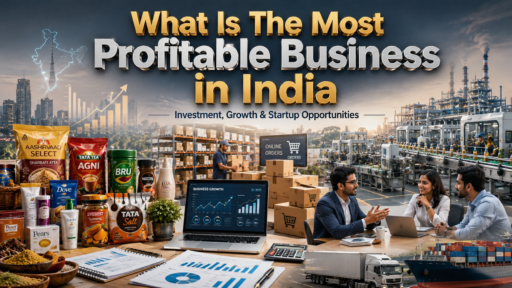


Most Profitable Business in India
Every serious investor or first-generation entrepreneur eventually confronts the same fundamental question: which business can generate durable, scalable returns in an economy as complex and layered as India’s? The answer is rarely a single sector — but it almost always involves a combination of structural demand, policy tailwinds, and the kind of operational leverage that separates sustainable business ideas from speculative bets. India today is no longer just a market of one billion consumers. It is a production base, an export engine, and an innovation hub. It is rewriting the playbook for what profitable enterprise looks like across the entire value chain. For entrepreneurs willing to look beyond the obvious and engage with the data, the opportunities are both vast and verifiable.
Why India Represents an Unmatched Profitability Window
Demographics, digital infrastructure, and deliberate industrial policy have converged. This has created conditions that most economies take decades to produce. India’s manufacturing cost base remains competitive versus Southeast Asian peers on a unit-output basis, even as labour productivity improves. More importantly, domestic consumption is no longer driven by a narrow middle class. It now spans aspirational Tier-2 and Tier-3 markets that are digitally connected and value-conscious. Businesses serving local demand can reach profitability levels that would be impossible in saturated Western markets. At the same time, they can build strong export capability.
From an investor’s perspective, sectors such as agro-processing, specialty chemicals, renewable energy components, healthcare consumables, and light engineering have demonstrated gross margins between 28% and 52% at the project level, depending on capacity utilisation and raw material security. In India it’s not the business choice, which differentiates the most profitable ventures from the rest – but the extent of backward integration, the nearness of the operation to raw materials sources, and flexibility to switch between export and domestic market. Entrepreneurs who understand these dynamics and conduct thorough feasibility analysis before committing capital consistently outperform those who rely on market enthusiasm alone.
Government Policies and Incentives Powering New Business Formation
Few countries have matched India’s current pace of industrial policy reform, and the direct beneficiaries are entrepreneurs setting up new projects across manufacturing, services, and agri-business. The Production Linked Incentive (PLI) Scheme covers fourteen priority sectors — from mobile electronics and pharmaceuticals to white goods and specialty textiles — and offers turnover-linked incentives that can meaningfully improve payback periods for new entrants. The Pradhan Mantri Formalisation of Micro food processing Enterprises (PM FME) scheme extends capital subsidies and credit-linked support specifically to food processing units, a sector with enormous rural entrepreneurial potential. [Source: Press Information Bureau, Government of India — PLI Scheme Performance Data, Feb 2026]
All Micro, Small or Medium sized Enterprises (MSME) registered under MSME Development Act, and updated framework for Udyam registration, enjoys the benefit of priority sector lending; obtain credit free from any collateral under Credit Guarantee Fund Trust for Micro and Small enterprises (CGTMSE); obtain preference in Government procurement contracts. Startup India schemes, driven by DPIIT, are characterized by the benefit of tax exemptions; easy procedures for compliance and an option to gain access to Fund of Funds capital. For manufacturing businesses, the Make in India mission has driven substantial improvements in ease-of-doing-business metrics, including single-window clearance systems in multiple states. Entrepreneurs are encouraged to consult the official MSME Government Portal at
For official MSME scheme details and registration, visit: https://msme.gov.in
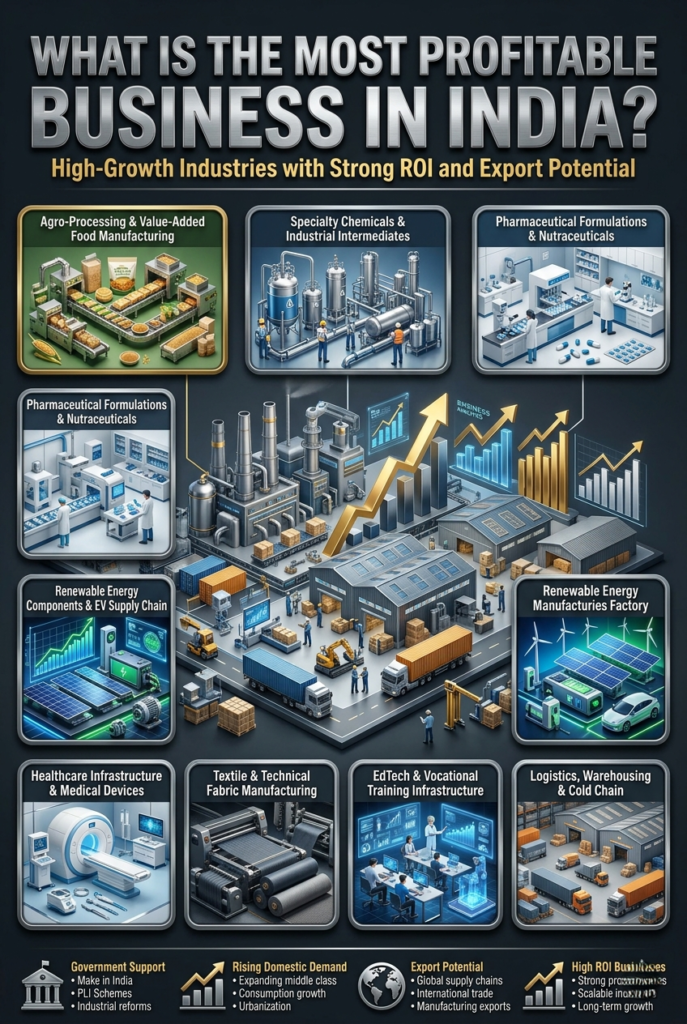
High-Profit Business Ideas for Startups and Industrial Investors
1. Agro-Processing and Value-Added Food Manufacturing
India’s agrarian base is simultaneously its greatest raw material advantage and its most underleveraged economic asset. Entrepreneurs who enter agro-processing — whether through spice grinding and blending, pulses milling, edible oil refining, or ready-to-eat food production — tap into a supply chain where raw material costs are structurally contained and domestic demand is growing at a reliable clip. The real profitability driver here is value addition: a farmer selling raw turmeric realises a fraction of what a processor earns on packaged turmeric powder sold under a brand in modern retail or exported as a functional ingredient. With cold chain infrastructure improving and organised retail expanding into smaller cities, the window for establishing a well-positioned food processing brand has never been more commercially compelling. Projects in this segment can recover capital investment in three to five years under conservative assumptions.
Get Detailed Insights from This Book: Modern Technology of Agro Processing & Agricultural Waste Products
2. Specialty Chemicals and Industrial Intermediates
India’s chemical industry is undergoing a significant structural upgrade, driven partly by global supply chain diversification away from China and partly by rising domestic demand from sectors like pharmaceuticals, agrochemicals, textiles, and construction.
Specialty chemicals — including surfactants, polymer additives, water treatment chemicals, and dye intermediates — command significantly higher realisations than commodity chemicals, and the barriers to entry, while real, are manageable for a well-capitalised and technically qualified entrepreneur.
Margins in this business stream depend entirely on the efficiency and consistency of processes and products. Businesses that spend in Quality control processes, infrastructure and in signing off-take contracts with large industrial customers for the long term can achieve high EBITDA margins of higher than the industry levels. Export potential in this sector looks very attractive; the export reputation for Indian specialty chemicals, both in the European and American market is being gradually built. [Source: Virtue Market Research — India Specialty Chemicals Market 2025–2030]
3. Pharmaceutical Formulations and Nutraceuticals
Few sectors offer the combination of recurring demand, pricing power, and export optionality that pharmaceuticals provide. India is already the world’s largest supplier of generic medicines by volume, and the domestic market for branded generics, over-the-counter wellness products, and nutraceuticals is expanding as health awareness deepens. For new entrepreneurs, entry into tablet and capsule formulation manufacturing, herbal extract processing, or contract manufacturing for established pharma brands offers a lower-risk pathway than innovator drug development. Nutraceuticals — including vitamin supplements, ayurvedic formulations, and sports nutrition products — occupy a particularly attractive space because regulatory barriers are lower than prescription drugs, consumer willingness-to-pay is higher, and the brand-building opportunity is genuine. Projects in this segment with WHO-GMP certified facilities attract institutional buyers domestically and internationally. [Source: IBEF — Pharmaceutical Industry India]
4. Renewable Energy Components and EV Supply Chain
Moreover, The energy transition is not a future trend for India — it is a present-tense industrial restructuring with measurable investment flows. Solar panel module assembly, lithium-ion battery pack manufacturing, electric vehicle (EV) component production, and energy storage system integration are all sectors where domestic demand is strong, PLI incentives are available, and early movers are securing long-term procurement contracts with state electricity boards and EV OEMs. The business case for entrepreneurs in this space rests on the convergence of capital subsidy access, a growing pool of technically trained talent, and the structural inevitability of the energy transition. While the sector does require technical competence and quality certifications, the long-term earnings visibility for well-established projects is exceptional. Supply chain localisation mandates from the government add further pricing protection against imported competition.
Access Complete Business Plan: Renewable Energy Sector and Green Power
5. Healthcare Infrastructure and Medical Devices
To begin with, The Indian healthcare system has a structural deficit in diagnostic equipment, disposable devices, hospital consumables and affordable imaging technology. Each of these segments represents commercially promising manufacturing prospects. The Government’s Atmanirbhar Bharat push has highlighted medical devices as an important manufacturing sector in India with the aid of PLI incentives and import bans on a few of the devices. A budding entrepreneur interested in manufacturing disposable syringes, surgical instruments, diagnostic kits, or ophthalmic devices will benefit from an abundance of domestic institutional procurement and simultaneously tap the export markets in Africa, Southeast Asia, and the Middle East. CDSCO pathway to regulatory approval is stringent but achievable and once acquired these certificates do act as a significant competitive advantage.
6. Textile and Technical Fabric Manufacturing
Overall, India’s textile sector is at an inflection point. The rationalization of the production-linked incentive framework for man-made fibres and technical textiles has opened investment opportunities that were previously unviable. Technical textiles — including geotextiles, medical textiles, protective clothing, and agro-textiles — represent the high-margin frontier of an industry that most investors associate only with commodity garments. Entrepreneurs who invest in technical textile manufacturing serve government infrastructure projects, industrial safety markets, and agricultural supply chains simultaneously. For those entering conventional textile manufacturing, the focus should be on differentiated fabric development, branding for domestic retail, or building export capacity for high-quality apparel fabrics. The twin factors of rising wages in Bangladesh and changes in global sourcing strategies is indeed a real opportunity for Indian manufacturers to steal further export share.
Related Article: Technical Textile Business Ideas in India: Profitable Manufacturing Opportunities for Entrepreneurs
7. EdTech and Vocational Training Infrastructure
Moreover, The infrastructure for digital education has developed quite fast in India and the most sustainable business models seem to be those that links skills training to proven jobs in employment. Invocators starting skill centers, hybrid schools or B2B skills partnerships with manufacturing industries provide a service which is both commercially imperative and politically opportune. With the backing and certification offered by the NSDC, the infrastructure requirements can be significantly reduced and the demand for formal skills training is effectively limitless. Business models that combine online content delivery with physical skill labs or industry placements command premium pricing and exhibit strong word-of-mouth referral dynamics.
8. Logistics, Warehousing, and Cold Chain
Firstly, India’s e-commerce boom and agricultural modernisation have created parallel demand for logistics and cold chain infrastructure at a scale the country has never previously required. Moreover, Entrepreneurs investing in temperature-controlled warehousing near agricultural clusters, last-mile delivery operations in Tier-2 cities, or multi-modal freight logistics solutions are positioned in a sector with structural tailwinds and strong institutional procurement. Additionally, The Pradhan Mantri Kisan Sampada Yojana and the Agricultural Infrastructure Fund both provide concessional financing for cold chain projects, substantially improving project economics. Furthermore, What makes logistics particularly attractive from a business planning perspective is the relatively predictable cash flow once capacity utilisation stabilises — it is a sector where disciplined operations translate directly and rapidly into EBITDA. [Source: Mordor Intelligence — India Cold Chain Logistics Market Report 2025]
Import-Export Opportunity Analysis for Indian Startups
Moreover, India’s trade position offers entrepreneurs a genuinely dual opportunity: the import substitution mandate creates protected domestic markets for new manufacturers, while export promotion schemes provide direct financial support for businesses building international customer bases. Furthermore, For new startups, the most immediately actionable export opportunities lie in sectors where India has structural cost advantages and established quality credibility — pharmaceuticals, organic chemicals, engineering goods, agro-processed foods, and textiles.
Firstly, The Merchandise Exports from India Scheme (MEIS), now replaced by the Remission of Duties and Taxes on Exported Products (RoDTEP), provides duty credit scrips that meaningfully improve export realisations. Moreover, The Export Promotion Capital Goods (EPCG) scheme allows capital equipment imports at zero customs duty against export commitments — a powerful tool for capital cost reduction in the initial project phase. In addition, Entrepreneurs in food processing, handicrafts, and light engineering who register with the Export Promotion Councils for their respective sectors gain access to buyer-seller meets, trade fair subsidies, and market intelligence that would otherwise require considerable independent investment to develop. Furthermore, The import side offers opportunities in components and intermediates that India still imports in large volumes — electronic components, specialty polymers, precision engineering inputs — where domestic manufacturers who can reliably substitute imports at competitive quality are assured of institutional demand.
Indian MSME Leaders: Lessons from the Ground Up
Patanjali Ayurved — Baba Ramdev and Acharya Balkrishna
Patanjali Ayurved’s journey from a small pharmacy in Haridwar to one of India’s largest FMCG enterprises is striking. Moreover, It is a strong example of what happens when consumer trust, distribution scale, and product positioning come together in one company. Furthermore, Baba Ramdev and Acharya Balkrishna observed that Indian consumers had a latent demand for genuinely Ayurvedic and natural products. However, incumbent FMCG companies focused on Western-style formulations were not meeting this demand. Aggressive price positioning and building an in-house retail capability, instead of relying on distribution margins, created a flywheel effect. Incumbents on existing wellness platforms could not easily compete with it. The lesson for new entrepreneurs is the importance of authentic positioning combined with execution: customers cannot buy trust from advertising; they buy it from product consistency and traceable sourcing.
Borosil — P.K. Kheruka
First, Borosil started as a single borosilicate glass manufacturing facility. Over time, it evolved into a diversified consumer and scientific glassware brand. Moreover, This journey reflects patient capital allocation and deliberate brand building in a category most investors would have seen as commoditized. In particular, P.K. Kheruka’s decision to invest in manufacturing quality and pursue premium positioning — rather than competing on price with cheaper imports — created a brand identity that now commands genuine consumer loyalty. Subsequently, The company later expanded into lab ware, solar glass, and consumer kitchenware. Furthermore, This was driven by a similar strategy of using its manufacturing capabilities in related markets. Therefore, For MSMEs considering diversification, Borosil’s story shows that adjacency matters more than scale of business. Venturing into segments where manufacturing capabilities already exist can significantly reduce capital requirements and shorten the time to profitability.
Vinati Organics — Vinati Saraf Mutreja
Firstly, Vinati Organics is an enterprise that reshapes expectations of what Indian specialty chemical manufacturing can achieve on the global stage. Under Vinati Saraf Mutreja’s leadership, the company grew from a single-product manufacturer into a global leader in niche chemical intermediates. In particular, These include IBB (Isobutyl Benzene) and ATBS (2-Acrylamido-2-Methylpropane Sulfonic Acid). The company now holds dominant global market shares in both products. The strategic logic was elegant. Specifically, It focused on identifying chemical products with few global manufacturers and building world-class process efficiency. In turn, The aim was to supply global pharmaceutical and specialty chemical companies that value reliability over price. Indeed, Niche dominance in a complex technical product is more valuable than broad participation in a commodity market. Consequently, Export revenues now constitute a significant share of Vinati’s total sales, validating the export-first philosophy for the right industrial product.
Discover business ideas that actually make money
How NPCS Supports Entrepreneurs at Every Stage of Project Planning
At Niir Project Consultancy Services (NPCS), we help transform entrepreneurial ideas into bankable, investable projects through structured, data-backed insights. We provide assistance in preparing a Market Survey and a Detailed Project Report (DPR). This is for entrepreneurs, investors, and promoters of industrial projects. We support the establishment of new industries across the Indian manufacturing and services sectors.
Our reports extend beyond generic template analysis. Our DPRs contain an in-depth manufacturing process description and comprehensive process flow charts.
They also include detailed plant and machinery requirements, along with shortlisted vendors.
We provide raw material and cost analysis, capacity planning, and optimal product mix analysis.
Additionally, we present a detailed project financial model covering all aspects.
It includes CAPEX requirements, working capital needs, and projected income statements.
It also includes break-even analysis, IRR, and NPV calculations. Primary and secondary market research are performed to understand the demand, competition and realistic price assumptions. Our objective is simple: to give entrepreneurs a professionally validated foundation for their investment decisions. This ensures capital is deployed with confidence, not assumption.
Indicative Profitability Benchmarks Across High-Return Sectors
| Sector | Typical Gross Margin (%) | Avg. Payback Period (Years) | Export Potential | PLI Benefit Available |
| Agro-Processing & Food Mfg. | 28–38% | 3–5 | High | Yes (PM FME) |
| Specialty Chemicals | 35–52% | 4–6 | Very High | Yes |
| Pharma Formulations | 42–58% | 3–5 | Very High | Yes |
| Renewable Energy Components | 22–34% | 5–7 | Medium | Yes (Solar PLI) |
| Medical Devices | 38–55% | 4–6 | High | Yes |
| Technical Textiles | 30–45% | 4–6 | High | Yes |
| Cold Chain / Warehousing | 25–35% | 5–8 | Low | Partial |
| EdTech / Vocational Training | 40–60% | 2–4 | Medium | No |
Note: Margins and payback periods are indicative estimates based on project-level feasibility benchmarks and vary with scale, location, and operational efficiency.
References and Useful Government / Institutional Links
The following official government and institutional resources are recommended for further reading and for direct application to the schemes discussed in this article.
- Startup India – Official Portal –https://www.startupindia.gov.in/
- Ministry of Micro, Small & Medium Enterprises (MSME) –https://msme.gov.in/
- Udyam Registration Portal –https://udyamregistration.gov.in/
- Department for Promotion of Industry and Internal Trade (DPIIT) –https://dpiit.gov.in/
- Small Industries Development Bank of India (SIDBI) –https://www.sidbi.in/
- MUDRA / PMMY Official Portal – https://www.mudra.org.in/
- CGTMSE Official Portal –https://www.cgtmse.in/
- Ministry of Micro, Small & Medium Enterprises –https://msme.gov.in/
- JanSamarth Portal (Government Loan Schemes) –https://www.jansamarth.in/
- Niir Project Consultancy Services (NPCS) –https://www.niir.org/