

Madhuban Bapudham Industrial Hub
A Market Development That Deserves a Founder’s Full Attention
When it comes to business opportunities, most of them are discovered once they’re already saturated. The ones that make real money are known early — at the time of the formation of the infrastructure and the market hasn’t fully competed. This is a report about Navbharat Times which falls in the second category. The report brings to light how Madhuban Bapudham in Ghaziabad is being formally developed as a ‘biggest industrial area’ by the Ghaziabad Development Authority with 200+ factories in the area planned and 5,000+ jobs promised.
For the current times, the question for the founder of the company reading this is not “Is this real?” — it is a government authority and it is operational; and the township is already in existence at scale. The key question is: “What type of business am I creating here, how am I going to get it started, and what does the journey towards first revenue look like?
This article provides a clear and unequivocal answer to this question. It focuses on the Navbharat Times market signal, which is presented in a practical format for the entrepreneur who wishes to go from reading about an opportunity to creating a business within it.
What the Navbharat Times Report Means for a Founder — Specifically
Industrial zone announcements are more than just the headline numbers. The Navbharat Times Madhuban Bapudham report is a founder interpretation of what it actually says:
The GDA Commitment is about the predictability of infrastructure.
Formal agreement by a statutory government authority for an industrial zone implies planned roads, power supply, water and drainage – not informal agreements. This predictability makes for a lot less surprises in running a business than in informal industrial clusters.
Two Hundred Factories = Captive B2B Customer Base
No marketing budget. No cold calling campaign, whatsoever. and No need to implement any SEO strategy. 200 factories in one zone translates to a supplier of packaging, safety, canteen or logistics being able to walk from one client to the next. For good services, the cost of acquiring a customer in a dense industrial cluster is virtually zero.(Madhuban Bapudham Industrial Hub)
Five Thousand Jobs = Labour Market Opportunity AND Consumer Market
Each person who has a job is also a person in need of employment that your staffing agency can fill and also a person who consumes food, retail and service businesses in your zone for food, retail and services. These 5,000 jobs demand two entirely different business models at the same time.
Navbharat Times Coverage = Market Validation for Stakeholders
Being able to show that the market opportunity you are going to be addressing is backed up by the reporting done by Navbharat Times is a useful thing to have when you go to bank for a loan, supplier for credit terms or co-founder for equity. Media coverage of any industrial zone development – credible – is a third-party market validation that would give every conversation that you will have with stakeholders a boost.
Related Article: Ghaziabad’s ₹500 Crore Industrial Push: 6 Manufacturing Units Smart Entrepreneurs Are Setting Up in Madhuban Bapudham
Why This Zone Will Outperform Expectations — A Structural View
The Delhi Land Crunch Is Permanent
Delhi cannot expand. The land is fully booked and costly for industrial uses and is subject to increasingly strict pollution limits. More manufacturing units, which would have liked to be on Delhi or inner NCR boundaries, are pushed out of the area every year. Madhuban Bapudham is right on the way of that “outward flow” — truly faring better than most of the other options in terms of rail connectivity.(Madhuban Bapudham Industrial Hub)
The RRTS Changes the Labour Market Equation
A Madhuban Bapudham factory can attract skilled labour from Metro and surrounding areas of Delhi, Meerut and RRTS corridor with no need to provide onsite housing. This is a huge blow to the availability of skilled workers for zone factories, and can make manufacturers more inclined to locate in the zone because of the access to skilled workers. Good factories bring good businesses in the supply chain.
State-Level Manufacturing Competition Is Intensifying
Three states, Gujarat, Rajasthan and Haryana, are racing to attract manufacturing investment. To counter this, UP has offered a competitive MSME policy with compelling financial incentives (detailed at Invest UP). The competition, which is inter-state in nature, is a boon to entrepreneurs who choose to invest in UP’s priority industrial zones as the State government has a real interest in the success of such zones.
Government Schemes: A Step-by-Step Activation Guide
Most entrepreneurs fail to receive government benefits because they do not know how to activate them — it is not because they are not eligible. The practical order is as follows from MSME Ministry’s portal:
Step 1: Udyam Registration (Do This First, Takes 30 Minutes, Free)
Go to udyamregistration.gov.in and register with Aadhaar and PAN. This one-time registration provides access to CGTMSE loan, eligibility for subsidy under PMEGP, preferential procurement by the Government, and coverage under MSMED Act. This benefits all other Government schemes.(Madhuban Bapudham Industrial Hub)
Step 2: PMEGP Application (For New Manufacturing or Service Units)
Fill up the KVIC (Khadi & Village Industries Commission) application form or at the nearest DIC (District Industries Centre) in Ghaziabad. The scheme offers capital subsidy of 25-35 percentage (SC/ST & women entrepreneurs – higher subsidy). The maximum cost covered is of service units Rs.25 lakh and manufacturing Rs.50 lakh.
Step 3: CGTMSE Loan Application (For Units Needing Working Capital or Equipment Finance)
Present your NPCS project report and Udyam certificate to any of the scheduled commercial banks. Apply for a loan backed by CGTMSE that can be taken for up to ₹2 crore without collateral. There are CGTMSE lending Mandates and Banks are mostly accepting applications that are well documented in identified growth areas.
Step 4: Startup India Registration (If Structured as a Company)
If you are a Private Limited Company, register on startupindia.gov.in. Incentives: 3-year income tax exemption under Section 80-IAC, self-certification under 6 labour laws, and the ₹10,000 crore Fund of Funds network.
6 Manufacturing Plays for Madhuban Bapudham — With Setup Roadmap and Revenue Timeline
Below is each manufacturing play along with what it produces, who buys it, the cost of setting it up and how long until the first invoice is sent out. This is a “founder’s working paper” and not a “generic list”.
1: Light Engineering Fabrication — MS Frames, Trolleys, and Material Handling Equipment
The items you’ll be creating: MS and SS trolleys, storage racks, pallet frames, machine guards, material handling carts, etc. Buyers: They are required in all the factories in the zone at start-up and during the actual game. Path to first revenue: buy a MIG/TIG welding station along with a basic cutting/bending station (₹15-25 lakh). Visit 5-6 factories while they are in the pre-operational construction stage, when they are buying in-factory material handling equipment. Provide local-made products at a discount of 15-20% from the price in Delhi. First invoice: 6-10 weeks after set up. Annual revenue ceiling: 10-15 factory clients with revenue of ₹60-90 lakh.
2: Heat Shrink Sleeves and Flexible Packaging Film Manufacturing
The products you create: BOPP heat shrink sleeves, PE stretch wrap film and flexible printed pouches (for use in FMCG and food processing factories for product packaging). Why a manufacturing play: These are manufactured, rather than resold, on blown film extrusion lines. Path to first revenue: single blown film extruder and slitting and rewinding machine will cost around of ₹45-75 lakh. Ensure that 2-3 FMCG factory owners are anchored for the first sales conversation with the machine coming. First invoice: 8-12 weeks after the set up. The export window (Middle East and Southeast Asia for flexible packaging) is available in year one, through the DGFT IEC registration.
Get Detailed Project Report (DPR): Packaging Industry: Complete Guide to Packaging Types and Materials
3: CNC VMC Machined Components (Job Work + Supply)
Products manufactured: close tolerance machined parts: Pump housings, valve bodies, hydraulic cylinder parts, motor end covers and coupling flanges. The following are purchased as job work from the engineering factories which do not have any in-house machine shop facility. Path to first revenue: 3-4 CNC VMC machines (₹60-90 lakh) for which CGTMSE can take collateral free loan and a basic CMM for quality checks. Assess engineering factories when they come to the zone with the sample machined part and quotation. First job work invoice: 8-12 weeks after commissioning of machine. Export route: precision parts buyers in Europe and Japan are active OEMs that can be spotted at FIEO trade fairs.(Madhuban Bapudham Industrial Hub)
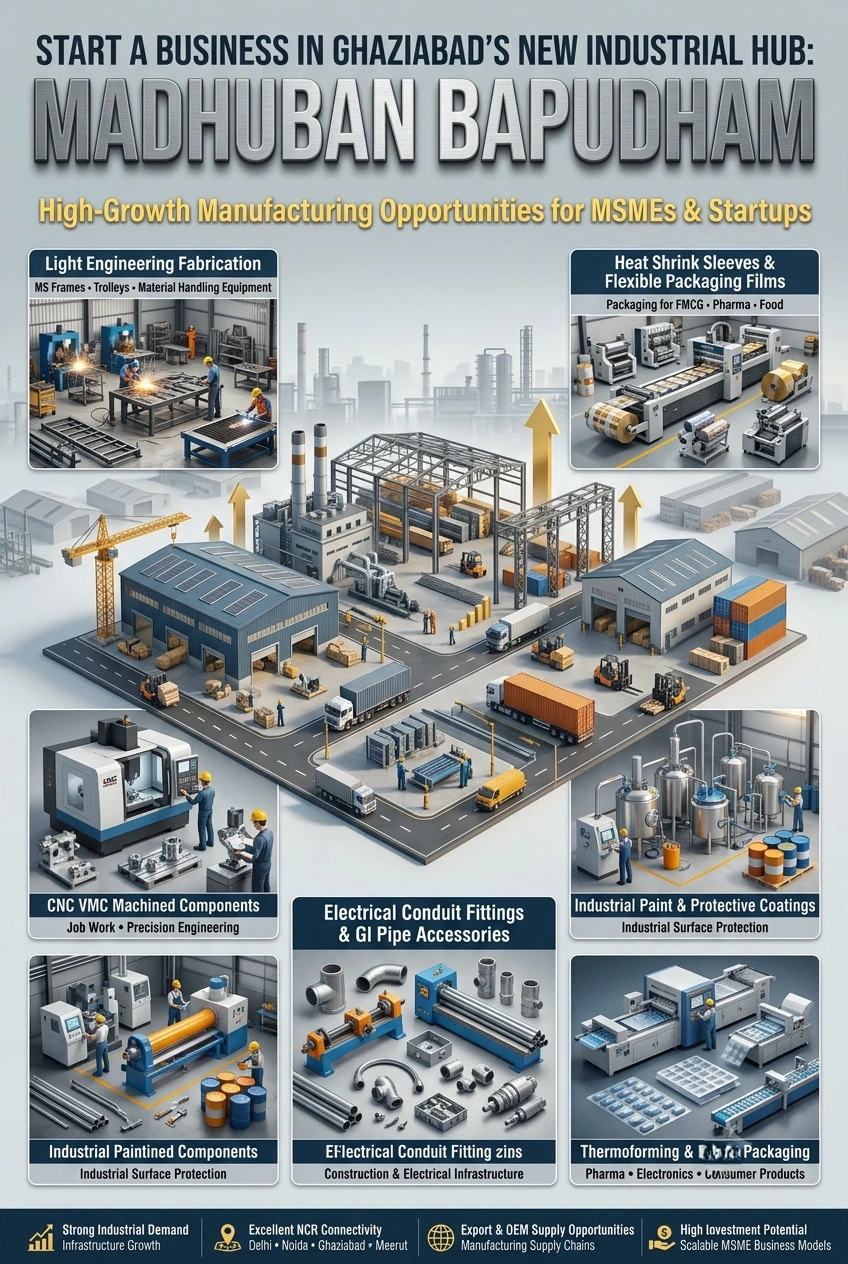
4: Industrial Paint and Protective Coatings Manufacturing
The products made: industrial epoxy coatings, alkyd primers, anti-corrosion paints, and floor marking paints for use in the factory construction, equipment painting, and floor marking. This is not “heavy chemistry,” it’s simply a blending and filling operation. Cost of Path to first revenue: ₹20-35 lakh for a mixing vessel set up for pigment dispersal work with a filling line. All the factories in the zone will have their floors, aisles and machinery painted during set-up and will reorder every year. Initial invoice will be sent 4-8 weeks after setup. Distribute within zone to factory contractors and maintenance crews. No distribution chain required at starting point.
5: Electrical Conduit Fittings and GI Pipe Accessories Manufacturing
The materials you’ll be working with: MS conduit pipe bends, GI conduit pipe bends, junction boxes, conduit trunking accessories, cable clips, conduit couplings — all the mundane, but necessary, electrical work in every factory. Why this is the underrated: 1000s of units per factory during construction and stocked permanently for use in maintenance. Path to first revenue: a basic press shop and threading unit (₹30-50 lakh) makes standardized products that are sold by electrical material suppliers and directly to factory purchase departments. Working in the zone means: No Freight cost to the biggest customer base you’ll ever serve. First invoice: 6-10 weeks. ISI marking registration adds to institutional eligibility for procurement.
Explore This Book: Handbook on Steel Bars, Wires, Tubes, Pipes, S.S. Sheets Production with Ferrous Metal Casting & Processing
6: Thermoforming and Blister Packaging Manufacturing
Products manufactured: thermoformed plastic trays, blister packs, clamshell packaging, and custom-formed plastic inserts (packaging hardware, electrical parts, auto parts and consumer goods). Thermoforming is the most approachable type of plastic manufacturing: one thermoforming machine (₹25-45 lakh) and mould tooling can yield a vast range of products. Path to first revenue: aim to anchor auto-ancillary and hardware factories in the zone. Provide component packaging trays in custom shape. A client mould is a client-funded mould, which means that you will not have to invest in the capital risk. First invoice: 6-8 weeks after machine commissioning. Thermoformed packaging for electronics, auto parts are actively sought from Indian manufacturers by buyers from ASEAN countries for export.
Export from Day One: Why New MSME Units Should Not Wait
One of the dominant pitfalls of new industrial estates is for the developers to view exports as a “phase 2” goal. In real terms, the best time to establish export connections is when you have low production volumes, flexible pricing and time to engage in international buyer communications, before you are fully sold out on domestic sales.
Immediately get IEC (Import Export Code) from the portal of DGFT after the Udyam Registration. The fee for the application is Rs. 500 and the Application process is fully online. This one-time registration unlocks all the export benefits under FTC – duty drawback, MEIS benefits etc.
- The Engineering and metal components segment show active buyer demand in all of its sectors, including the Gulf, Japan, and Germany.
- Plastic packaging products: ASEAN buyers seek to reduce their reliance on China
- Consumer goods and FMCG: Indian diaspora demand in 40+ Countries provides immediate market access.
- The lighting market in Africa and Southeast Asia is active.The electrical fittings and lighting market in Africa and Southeast Asia is active.
Founder Archetypes Who Win in Industrial Zones
The infrastructure-First Founder
Before factories operate, this founder is able to pinpoint the particular service that the zone will always require, and establishes a business based on recurring contracts. They can easily predict revenue and there’s not much competition, as most business owners will go with the easy plays.
The Aggregator Founder
This founder does not really target one factory, instead, he develops light touch relationships with 20-30 factory units and gathers order for packaging, safety gear or consumables. Thinner margins but volume makes up for it. The archetype for this is the customer base, which exists at scale, within walking distance, such as in 200+ factories in Madhuban Bapudham reported by Navbharat Times.
The Export-First Founder
This founder is thinking from the outset, about building for an international buyer. This helps to create stable baseline income from a domestic cluster and get the margin income from export orders. This can be implemented more easily in the Ghaziabad ICDs than in most industrial areas located in the interior of the country.
Discover business ideas that actually make money
NPCS – Niir Project Consultancy Services: Build Right from the Start
Every play described in this article becomes significantly stronger with a credible project report behind it. NPCS (Niir Project Consultancy Services) has prepared feasibility reports for entrepreneurs across every industrial sector — from precision engineering to food processing to safety equipment distribution. Their reports are structured for both internal decision-making and external presentation to banks and government agencies.
- Sector-specific market demand validation and competitor analysis
- Detailed cost of setup, machinery, raw materials, and working capital
- Revenue projections with realistic timeline to breakeven
- Regulatory and licensing requirements mapped for your specific sector
- Bank-submission ready DPR format accepted by all major lenders
Founder’s Quick-Reference Table: Business Plays at a Glance
| Business Play | Estimated Setup Cost | Time to First Revenue |
| Light Engineering Fabrication | ₹15-25 lakh | 6-10 weeks |
| Blown Film / Flexible Packaging Mfg | ₹45-75 lakh | 8-12 weeks |
| CNC VMC Job Work Unit | ₹60-90 lakh | 8-12 weeks |
| Industrial Paint & Coatings Mfg | ₹20-35 lakh | 4-8 weeks |
| Conduit Fittings & GI Accessories Mfg | ₹30-50 lakh | 6-10 weeks |
| Thermoforming & Blister Packaging Mfg | ₹25-45 lakh | 6-8 weeks |
| Sheet Metal Fabrication Unit | ₹40-80 lakh | 8-12 weeks |
| Rubber Moulded Components Mfg | ₹35-65 lakh | 8-12 weeks |
| Key Government Benefit | CGTMSE — up to ₹2 crore collateral-free loan |
| Capital Subsidy | PMEGP — 25-35% of project cost |
| First Registration to Complete | Udyam Registration (free, 30 minutes) |
Founder FAQ: The Questions That Actually Matter
Q1. I have ₹20-30 lakh. Which manufacturing unit is the best fit for me?
At ₹5 lakh, the three best-fit options are: (1) B2B packaging supply — low setup cost, predictable reorder demand; (2) HR and staffing — almost entirely relationship capital rather than financial capital; (3) export facilitation services — IEC registration costs ₹500, the rest is skills and network. All three can be launched lean and scaled with revenue.
Q2. What if factories take longer than expected to open?
This is a real risk. The mitigation is: don’t build expensive fixed infrastructure before confirmed client volumes. Start with a lean setup — rented kitchen, leased trucks, shared office — and convert to owned assets as contracts build. The businesses that fail in new industrial zones usually fail because of fixed cost overruns during the ramp-up period, not because the market did not materialize.
Q3. How do I find factory owners to pitch before their operations are running?
GDA’s auction and allotment lists (available on gdaghaziabad.in) identify who has taken plots. DIC (District Industries Centre) Ghaziabad maintains new unit registrations. Industry associations like CII and FICCI have chapter-level member directories. A physical presence near the zone, combined with these sources, typically generates first meetings within 2-3 weeks of active outreach.
Q4. Can a woman entrepreneur access additional government benefit here?
Yes — significantly. Under UP’s MSME policy, women entrepreneurs receive 100% stamp duty exemption (versus 50% for others) anywhere in the state. Increased subsidy for women candidates under PMEGP Special concession loan rate for MSMEs led by women-led firms available in some of the banks under RBI Guidelines Women-led unit also eligible under CGTMSE coverage.
Q5. What sectors should I avoid, given the anti-repetition principle for new zones?
Generic EV parts resellers, solar panel distributors, and AI-branded software services often target zones like Madhuban Bapudham, but they do not address the specific day-to-day needs of a manufacturing cluster. The best opportunities are in physical, on-site services that factories cannot easily source remotely: food, safety compliance, maintenance, workforce, and logistics.
Q6. How do I use Navbharat Times reporting as a business development tool?
Take an article with your presentation to your meetings with factory owners, banks, or government agencies. Use a story from Madhuban Bapudham on Navbharat Times to show your audience that independent news sources have vetted the opportunity. Hand them a printed copy of the article before or at the beginning of your pitch.
Conclusion: The Roadmap Is Clear — Execution Is the Only Variable
Navbharat Times has identified Madhuban Bapudham as NCR’s next industrial hub. GDA has the authority, the infrastructure, and the government mandate to make it happen. The RRTS and expressway connectivity are already real. The 200+ factories and 5,000 jobs are the planned next chapter.
What this article has tried to do is answer the founder’s natural follow-up question: “Great — now what do I actually do?” The answer is: choose one of the six plays described above, complete your Udyam Registration today, contact an NPCS consultant for a sector-specific project report, and begin your first client conversations within the zone within the next 30 days.(Madhuban Bapudham Industrial Hub)
Entrepreneurs who act early on the Navbharat Times signal will build the businesses that define Madhuban Bapudham’s commercial ecosystem. Register, plan your exports throu, and start building. The zone is forming. The window is open.