India’s food processing industry is in a transition phase and among food processing industry segments, tomato processing is one of the most promising segments for entrepreneurs and investors. The decision to invest in a new ketchup production line, in a tomato paste/puree plant or in a multi-product plant that also produces tomato powder and canned tomato products will not generally be made easy. Hence, the role of tomato processing and value-added product industry consultants in India has turned out to be of great value to the entrepreneurs, MSME operators, and agri-business investors of the first generation. Whether it is validating market demand, preparing the Detailed Project Reports (DPRs), choosing the suitable process technology or dealing with the FSSAI licensing and pollution control norms, the proper consultant can make or break your project from the very beginning.
This article creates a detailed picture of the role of the top tomato processing and value-added products industry consultants in India, how to assess and select the best among them and implications of the changing investment scenario in India for the entrants in this field.
Why Tomato Processing Is One of India’s Most Investable Agri-Processing Segments
Tomatoes are grown in almost every state in India. The country ranks second in the world in tomato production. India’s large raw material base gives local processors a structural cost advantage. Many other countries cannot match this advantage. India’s processed tomato production has more than doubled in recent years. However, the tomato processing rate still remains below global standards. This is a huge opportunity for newcomers.
Consumption of tomato-based products is growing at a fast pace. There are many reasons that are driving the ketchup market—these include rising disposable incomes of consumers, expansion of organised food retailing, fast food chains, and modifications in cooking preferences among urban and semi-urban households. The export side is just as interesting, though. Processed tomato products have been actively encouraged in export markets by the Agricultural and Processed Food Products Export Development Authority (APEDA) and processed fruits and vegetables have been one of the fastest-growing export categories of India.
This opportunity has been greatly increased by government policy. Operation Greens was launched by the Ministry of Food Processing Industries (MoFPI) with a focus on tomato, onion and potato value chains with the aim of minimising post-harvest losses and encouraging investment in processing. The Food Processing Induced Production Linked Incentive (PLI) Scheme, which has an outlay of Rs. Further rewards for manufacturers for scaling up their processing capacity, building Indian brands in global markets will be 10,900 crores. The abundance of natural resources, domestic demand growth and policy tailwind make this a very interesting project thesis for investors. But it’s not quite that easy to get from a thesis to a viable, actionable business plan without the help of a specialist consulting expert.
Get Detailed Insights from This Book: The Complete Book on Tomato & Tomato Products Manufacturing (Cultivation & Processing)
What Tomato Processing and Value-Added Products Plant Consultants Actually Do
For many first-time entrepreneurs, a consultant’s role is restricted to the creation of a project report. In reality, the role of a tomato processing plant consultant is quite extensive and much more significant in the success or failure of a project. This is a good way to help founders select the right firm and optimize the engagement.
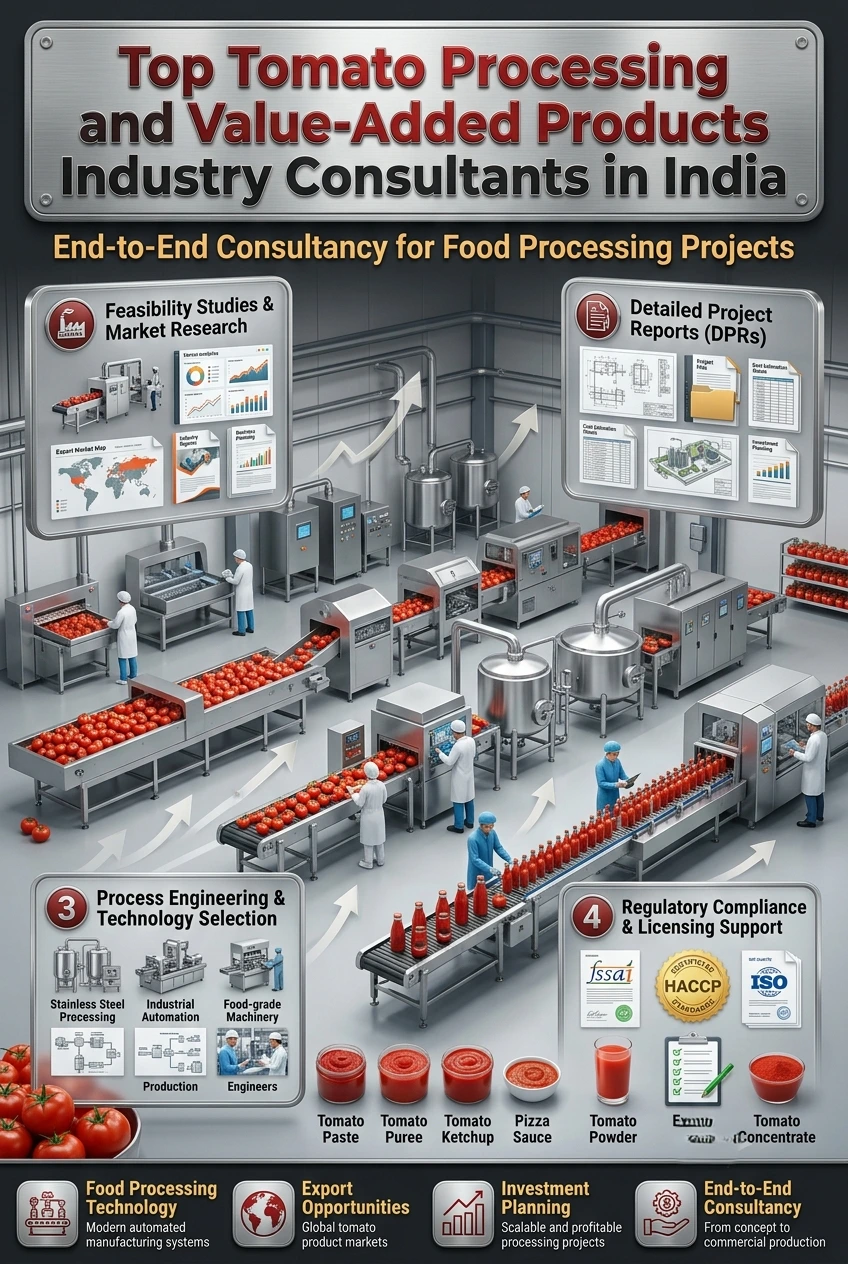
Feasibility Studies and Market Research
A serious feasibility study for a tomato processing plant is more than just a market overview. It examines product-specific demand by geography, identifies key buyers such as food service chains, retail distributors, institutional buyers and exporters and tests the revenue assumptions through inbuilt stress-testing for seasonal risks of raw materials price changes. Tomatoes are sensitive crops that spoil quickly and are price volatile – if a project does not take into account procurement risk, it does not work! A good consultant should develop realistic procurement models such as procurement contracts with farmer producer organisations (FPOs) or aggregators, to guarantee raw material security throughout the processing season.
Detailed Project Reports (DPRs)
The DPR is the backbone of any tomato processing and value-added products project. A well prepared DPR provides detailed information on the manufacturing process from raw tomato intake to washing, sorting, pulping, evaporation and final packaging in pouches, cans, glass bottles etc, including process flow diagrams. It outlines the machinery and equipment necessary such as pulpers, evaporators, pasteurisers, filling and sealing machines, and utility requirements like steam, electrical and chilled water. It also contains a detailed financial model that includes project cost, working capital, projected profit and loss, IRR, payback period and break-even analysis. The DPR is considered as the key document in project finance, as Banks and NBFCs demand a credible DPR before sanctioning project finance.
Process Engineering and Technology Selection
Food Technology expertise is especially relevant in tomato processing since tomato product quality is closely related to the process used. For example, the choice of hot-break versus cold-break processing influences retention of lycopene, the product viscosity, final product colour and shelf life which are key to market positioning and pricing. Likewise, deciding on the evaporation technology (single effect versus multi-effect evaporators), the aseptic filling system, and the packaging formats there are capital, operating cost and quality considerations that a knowledgeable process consultant can guide the client through in a clear manner.
Regulatory Compliance and Licensing Support
Layered regulatory framework is required to be followed by the tomato processing units in India. The Food Safety and Standards Authority of India (FSSAI) has laid down mandatory specifications for tomatoes products such as tomato puree, paste, ketchup, sauce, and juice in terms of Brix, additives, labelling, and hygiene. Each processing unit must have a Central or State FSSAI licence as per scale and turnover. In addition to FSSAI, processors have to get consent to operate from the State Pollution Control Board, register under the Factories Act, and also comply with the GST and MSME Udyam registration requirements. A compliance roadmap is mapped by experienced consultants, the documentation is created and clients are not experiencing costly post-commissioning surprises.
Get Detailed Project Report (DPR): Complete Guide to Tomato Processing and Value-Added Products
Why India Has Become a Hub for Food Technology and Tomato Processing Consulting
The consulting industry for India’s food processing has reached a lot of milestones. This has led to this growth, due to several reasons. The mushrooming of MSME scale food processing projects under various schemes such as PM Kisan SAMPADA Yojana, PM FME and PLI Scheme has resulted in huge demand for cost-effective, specialized advisory services. Most of these entrepreneurs are not willing to invest in global management consulting firms and require boutique management consulting firms in India who possess a strong domain knowledge, regulatory understanding, and manufacturing experience.
Secondly, there is a generation of food scientists and technologists that have come out of the food science and technology academic institutions, India, such as NIFTEM or CSIR-CFTRI, who are now employed by consulting firms with a credible technical background and can participate in client engagements with great technical expertise. Thirdly, food quality has been elevated by the emergence of domestic food brands and private equity funding of food. Newly, project consultants are required to present project demands meticulously, provide benchmarking and financial modelling.
For investors exploring the sector, IBEF’s food processing industry reports and Invest India’s sector pages offer a solid starting point for understanding market dynamics before commissioning a consultant.
How to Evaluate and Shortlist the Best Tomato Processing Industry Consultants in India
Seeking out a consultant is probably the most important initial decision a project promoter makes. If it’s not a good choice, it could result in a weak DPR that won’t pass bank scrutiny, efficiency designs that fall short of the mark, or compliance issues that delay commissioning by months. Let’s take a look at how savvy investors and entrepreneurs make this assessment.
Domain Depth in Food Technology and Tomato Processing
A general-purpose consulting firm which from time to time prepares food industry DPRs is very different to a firm whose main business is food technology, and in particular fruit and vegetable processing. Therefore, Consider having a consultant provide a portfolio of past tomato processing or allied projects completed. Look for the presence of food technologists, process engineers, and market research personnel on the company’s team. The top tomato processing industry consultants in India will not hesitate to talk about the pros and cons of hot break or cold break process, the product standards set by FSSAI for ketchup and puree and the options of the machinery vendors.(Tomato Processing Industry)
DPR and Feasibility Track Record
The best indicator of a consultant’s quality is his or her DPR track record. Specifically inquire how many tomato processing DPRs has the company prepared, what was the capacity range of the projects and whether these DPRs were able to secure bank loans or government scheme approvals. Firms with good track record will have references received from their clients who have availed PMKSY or PLI approval or availed term loans from SIDBI/NABARD or commercial banks based on their report.
Choose the right startup backed by real market demand
Engineering and EPC Capability
Process engineering consultants and EPC consultants are not the same but complementary. Process Engineering Consultant designs the plant, defines the process flow, specifies the machinery, creates the plant layout and determines the plant’s utility requirement. An EPC consultant brings this design to fruition, from procurement through construction and commissioning. In medium-scale facilities, a client may require a consultant to prepare the techno-economic study, assist with the DPR, and oversee the project until the plant is commissioned. Determine if the firm provides this built-in functionality.
Regulatory Know-How Across FSSAI, PCB, and MSME Norms
Tomato processing units have a multi-layered regulatory framework. The main requirement for food safety is FSSAI licensing. A consent from the State Pollution Control Board (PCB) is required because tomato processing produces organic effluent and solid waste, including seeds and skins. The processing unit must also prepare an effective effluent treatment plan. The compliance stack is completed by factory licences under the Factories Act, fire NOC and municipal trade licences. The best consultants view regulatory mapping as a part of the DPR, plan the plant to meet regulatory requirements in the first place, and work with clients to create NOC documentation efficiently.
Our Experience in Tomato Processing
Mr. Prosenjit Das from Kolkata, West Bengal, approached us in 2021 for a project report on tomato ketchup and mayonnaise. The report covered plant setup, machinery requirements, production planning, financial projections, and bank funding. In 2020, we also worked with Mr. Mitta Prabhakar Reddy from Hosar in Tamil Nadu. His project addressed a wider range of products, including tomato ketchup, sauce, and soup. We prepared a detailed feasibility study covering manufacturing infrastructure, production technology, and financial viability for that assignment.
Tomato powder and dehydrated vegetable products formed the focus of two further projects. In 2019, Mr. Kamalakar Rao Yenduri from Chittor, Andhra Pradesh, engaged us to prepare a DPR. The project was a pre-investment study on fruits and vegetables powder, covering tomato, onion, mango, pomegranate, and papaya powder. In addition, the study addressed plant requirements, capital expenditure, working capital, and financial projections.
Alongside this, M/s. Nakshatra Infrastuctures from Nagpur, Maharashtra, approached us in 2018. Their requirement was a techno-economic feasibility report on a powder plant producing banana, onion, orange, and tomato powder. We addressed the project scope, production planning, machinery requirements, financial projections, and bank funding for that plant.
Similarly, M/s. Dhawan Pandey & Associates from Lucknow, Uttar Pradesh, brought a project centred on tomato puree and fruit concentrate manufacturing. In 2017, we conducted a techno-economic project study for this client. The study evaluated the manufacturing process, including the hot break method for tomato puree production. It covered production capacity, plant facilities, machinery requirements, and financial projections.
An earlier engagement involved M/s. Sarah Foods Pvt. Ltd. from Bangalore, Karnataka. In 2013, we prepared a project investment report on tomato paste manufacturing. The report covered plant infrastructure, equipment selection, production planning, capital expenditure, working capital, and bank funding requirements.
If you are planning a tomato processing project, our team can help you evaluate it effectively. We prepare project reports, feasibility studies, and DPRs covering plant setup, manufacturing technology, financial planning, and bank funding. You are welcome to contact us to discuss your specific product area and project scale.
Role of NPCS in Tomato Processing and Value-Added Products Project Consultancy
Niir Project Consultancy Services (NPCS) is one of the leading and established industrial consultancy firms in India in tomato processing & value-added products sector. NPCS was established in 1994 and has, in more than two and a half decades, created one of the most comprehensive databases of food processing and allied manufacturing project profiles, feasibility studies and DPRs in India based in Delhi.
NPCS provides techno-economic feasibility studies and DPR for the entire tomato product range – from tomato juice to tomato puree, tomato paste, tomato ketchup, tomato sauce, tomato powder, tomato chutney, instant tomato soup and ready to eat tomato-based products for entrepreneurs who wishes to venture into tomato processing industry. For every DPR of NPCS, the complete manufacturing process is given with flow diagram, specification of machinery and equipment, raw material requirement, sourcing of raw materials, market research and demand analysis, product mix and capacity planning, and detailed project financials which include capital cost, working capital, profitability analysis, and break-even analysis.
NPCS has successfully completed projects in over 150 countries and has over 30 years of experience in the consulting industry, offering a wide range of sectoral experience that is not found in many boutique Indian consultancies. The NPCS tomato processing project profiles catalogue is a practical guide for entrepreneurs wanting to explore the full range of tomato processing project ideas before deciding on a product or size to work on, and is also useful for benchmarking investment.
Related Article: 20 Profitable Tomato Products Manufacturing Business Ideas
A key advantage of NPCS is its implementation-focused approach, making the reports relevant for MSME entrepreneurs. The DPRs provide data on actual inputs involved in the field, machinery alternatives available in the Indian market and financial assumptions based on the actual operating conditions in the field. This orientation ensures that the reports are directly usable for applications for bank loans, submission of government schemes and presentations to investors.
The India Consultancy Landscape: Delhi and Beyond
As entrepreneurs look for the top tomato processing sector consultants in Delhi, they connect with a city that is home to the most concentrated expertise in industrial consulting in India. There are many process plant consultants, feasibility report experts and project consultancy companies in Delhi and NCR region catering to North India with the major tomato growing and processing belt comprising of Punjab, Haryana, Uttar Pradesh, Himachal Pradesh and Rajasthan.(Tomato Processing Industry)
However, India’s consultancy landscape has become increasingly decentralised. Andhra Pradesh and Karnataka, which produce large volumes of processing-grade tomatoes, have developed a regional consulting community serving local entrepreneurs. Similarly, Maharashtra’s Nashik region has agri-processing consultants with deep produce-chain knowledge. Furthermore, with the rise of digital communication, many top consultants now serve clients nationally from their base cities, so geography should not be the primary shortlisting criterion.
The All India Food Processors’ Association (AIFPA) and associations affiliated with MoFPI serve as useful networking nodes for entrepreneurs seeking peer referrals to trusted consultants. Additionally, the APEDA network connects export-oriented tomato processing investors with consultants who have specific export compliance expertise.
Comparison of Consulting Service Types for Tomato Processing Projects
| Service Type | Core Focus | Key Deliverables | Best-Fit Client |
| Feasibility & DPR Consultant | Market validation, financial modelling, bankable DPR | Feasibility study, DPR, process flow diagrams, project financials | First-time entrepreneurs; bank/NBFC loan applicants; PMKSY/PLI applicants |
| Process Engineering Consultant | Plant design, process optimisation, technology selection for ketchup, puree, paste, powder units | Process flow sheet, equipment specs, utility design, plant layout | Greenfield plant investors; technology-upgrading MSME units |
| EPC Consultant / Project Manager | End-to-end execution: procurement, civil construction, installation, commissioning | Turnkey plant delivery, vendor management, commissioning report | Investors wanting single-point accountability from design to startup |
| Regulatory & Compliance Advisor | FSSAI licensing, PCB consent, Factories Act, MSME/GST registration, export certifications | Licence applications, NOC preparation, compliance documentation | New units with complex multi-product or export orientation |
| Market Research Consultant | Demand forecasting, competitive landscape, buyer identification, pricing strategy | Market research report, go-to-market strategy, export market mapping | Investors validating demand before capital commitment |
| Boutique Management Consulting Firm | Integrated advisory: strategy, operations, finance, and regulatory in a single engagement | Business plan, investor-ready presentation, operational roadmap | Growth-stage food processors seeking PE investment or scale-up funding |
Frequently Asked Questions: Tomato Processing Industry Consulting in India
How much does a DPR for a tomato processing plant cost in India?
The cost of a Detailed Project Report for a tomato processing plant in India typically ranges from Rs. 25,000 to Rs. 1.5 lakh for standard product-specific DPRs from established consultancy firms. Custom DPRs prepared for specific project parameters, including particular capacity, location, product mix, and financial structure, may cost between Rs. 1 lakh and Rs. 5 lakh or more, depending on the scope of market research and engineering detail included. Projects targeting government scheme approvals or bank financing above Rs. 1 crore generally benefit from commissioning a custom DPR rather than using a standard template report.
What is the difference between a process consultant and an EPC consultant?
A process engineering consultant designs the plant by selecting the required equipment, defining the manufacturing process flow, determining utility requirements, and planning the plant layout. Their deliverable is a set of engineering documents and specifications. An EPC consultant takes the design and executes it, procuring machinery and materials, managing civil construction, overseeing installation, and handing over a commissioned, running plant. For tomato processing projects above Rs. 2 to 3 crores in capital cost, engaging an EPC consultant after the process design is complete provides better cost control and faster commissioning than managing multiple vendors independently.
How do I choose the best tomato processing plant consultant in India?
The three most important criteria are domain specialisation, DPR track record, and regulatory knowledge. A consultant with genuine food technology expertise in fruit and vegetable processing is fundamentally more valuable than a generalist. Ask for references from completed tomato or allied projects. Verify that the firm’s DPRs have been accepted by banks, NABARD, SIDBI, or government scheme portals. Also check whether the firm understands FSSAI product standards for your specific product, as ketchup, puree, paste, and powder each have distinct regulatory requirements. Finally, evaluate the team, not just the brand name: in boutique consulting firms, the quality of the project lead determines the quality of the output.
What FSSAI licences does a tomato processing unit require?
A tomato processing unit requires an FSSAI licence under the Food Safety and Standards Act, 2006. The specific category, whether Basic Registration, State Licence, or Central Licence, depends on annual turnover. Units with turnover above Rs. 20 crores, or those involved in exports or multi-state distribution, require a Central FSSAI licence. Most MSME-scale tomato processors with turnover between Rs. 12 lakh and Rs. 20 crores require a State Licence. All units must comply with applicable product standards under FSS (Food Products Standards and Food Additives) Regulations, which specify Brix, pH, and additive limits for ketchup, puree, paste, and juice. Experienced consultants prepare the complete licence application package as part of their service offering.
What government schemes support tomato processing plant investment in India?
Several MoFPI schemes support tomato processing investment. Pradhan Mantri Kisan SAMPADA Yojana (PMKSY) provides capital subsidies for food processing units, cold chain infrastructure, and agri-processing clusters, all highly relevant to tomato processing. Operation Greens under PMKSY specifically targets tomato, onion, and potato value chains. The PM Formalisation of Micro Food Processing Enterprises (PM FME) Scheme supports micro-scale tomato processing units with credit-linked subsidies of up to 35 per cent of project cost. The PLI Scheme rewards larger processors with incentives tied to incremental sales. State government schemes from Andhra Pradesh, Karnataka, Maharashtra, and Punjab also offer capital subsidies and power tariff concessions for food processing units. A good consultant helps clients identify and stack applicable schemes for maximum financial benefit.
What is the typical capacity and investment range for an MSME tomato processing plant?
MSME-scale tomato processing plants in India typically range from 2 MT/day to 50 MT/day of raw tomato input capacity. A small-scale ketchup or puree unit at 2 to 5 MT/day capacity can be set up with a total project cost of Rs. 50 lakhs to Rs. 1.5 crore, depending on automation level and product range. A mid-scale multi-product facility producing ketchup, puree, paste, and soup concentrates at 20 to 50 MT/day typically requires Rs. 3 crores to Rs. 10 crores in capital investment. Seasonal operation during the 4-to-6-month peak harvest season, combined with aseptic intermediate storage for year-round production, is a common strategy that improves plant economics and reduces raw material cost risk.
Conclusion: Practical Next Steps for Tomato Processing Entrepreneurs
India’s tomato processing and value-added products sector offers a genuinely attractive investment opportunity, grounded in agricultural abundance, driven by domestic consumption growth, and reinforced by government policy support. However, converting this opportunity into a profitable, compliant, and financeable project requires specialist guidance from day one.
The first practical step is project identification. First, Decide which tomato-based product best suits your business. You may choose ketchup, puree, paste, powder, juice, or a combination of these products. Consider raw material availability, market proximity, and your available capital. The NPCS tomato processing project profiles catalogue provides a structured way to compare different project options. It covers investment requirements, product economics, and market characteristics.
The second step is commissioning a credible feasibility study and DPR from a consultant with proven food technology expertise and a track record of bankable project reports in the sector. Simultaneously, map out the applicable government schemes, including PMKSY, PLI, and PM FME, so the project structure optimises for available incentives from the outset.(Tomato Processing Industry)
Finally, treat compliance as a parallel workstream. This includes FSSAI licensing, PCB consent, and Factory Act registration. Do not leave these requirements until after plant commissioning. The best tomato processing and value-added products industry consultants in India guide clients through all three stages. They ensure a coordinated and time-efficient process. Choosing the right consulting partner early can deliver significant long-term value. It is one of the most important decisions a food processing entrepreneur can make.
For more industry data and sector intelligence, refer to IBEF’s food processing portal, MoFPI’s official scheme portal, and APEDA’s agri-export platform.