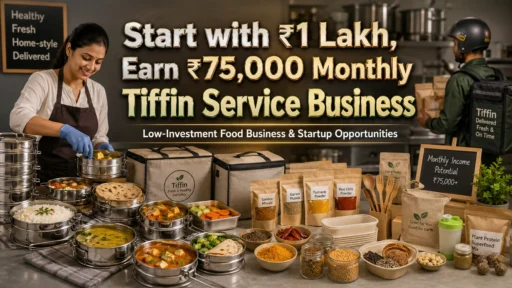


A ₹1 Lakh Startup That Can Earn ₹75,000 Every Month
There is an unnoticed but strong change taking place in India’s food economy. With rapid urbanisation and increasing nuclearisation in tier-1, tier-2 and tier-3 cities, one of the basic needs of millions of students, working professionals and migrant workers is yet to be met: affordable, hygienic, home-cooked food, needed every single day. Tiffin service business is one of the most promising MSME opportunities today, according to a recent report by one of India’s most popular Hindi-language news provider, Jagran. The report states that an entrepreneur can start this business with just an investment of ₹1 lakh and earn up to ₹75,000 on a monthly basis.
This is not just the case of the famous dabbawala system of Mumbai. It’s a country-wide change which is changing the way food is delivered to Indian homes and offices. The tiffin service sector might be worth considering for entrepreneurs, MSMEs and investors who are seeking low-risk, high-reward startups that can generate cash flow right away — and the figures that Jagran has provided indicate it should be done.
What Recent Reporting from Jagran Means for Entrepreneurs
In MSME coverage, Jagran has highlighted the tiffin service model as an opportunity that is clearly defined and has the potential for predictable returns. The key conclusion of the report is extraordinary — a start-up investment of around ₹1 lakh (including kitchen equipment, containers, marketing, packaging and initial marketing) is enough to start operations. When the regular customers are 40-60 subscribers, the monthly income can be as high as ₹75,000 and the profit margin in the range of 30%-45%.
The development is important in a number of important ways:
- In the urban areas of India, working class people are looking for home style food, which is also hygienic rather than food from a restaurant or fast food.
- The shift to nuclear families and single occupancy PG dwellings has generated consistent and regular demand.
- Local operators have seen the cost of acquiring a customer plummet to almost zero via digital platforms such as WhatsApp, Instagram, and food delivery aggregators.
- The business can be conducted from the business person’s kitchen, thus saving the one major cost of any food business, which is rent.
The Jagran study confirms what on-ground operators have long grounds to believe i.e. the tiffin industry is scalable, capital efficient and has a strong cultural connect with Indian daily life for entrepreneurs, MSMEs, manufacturers and startup founders.
Why the Tiffin Service Industry Is Growing Rapidly
In 2025, the foodservice market in India is estimated to be worth of around ₹7.5 lakh crore, and will continue to grow to ₹12.3 lakh crore by 2030. As part of this overall market, the home-based tiffin and meal subscription sub-segment is one of the fastest growing sub-segments, growing at a CAGR of 15-25% based on industry estimates.
There are a number of factors contributing to this growth:
Urbanisation and the Nuclear Family Shift
India is gaining millions of urbanites annually. Most of these new city dwellers are young professionals, students, and blue-collar workers without access to the reliable home cooking that is the privilege of those in rural areas. They perform a natural need for the tiffin service and their numbers are more and more rising.
Health Consciousness Over Fast Food
Since the pandemic, Indians have distinctly preferred fresh, healthy, cooked food over packaged food and food deliveries from restaurants. The fast-changing consumer behavior is the perfect fit for Tiffin service whose daily menu includes dal-roti-sabzi combinations made fresh daily.
Digital Customer Acquisition
What does the tiffin provider of today have to do with acquiring 50 new customers through a single WhatsApp broadcast or Instagram reel? Word-of-mouth referrals in apartment complexes and office parks offer an extremely cost-effective way to gain customers. This makes profitability much easier.
Subscription Revenue Model
A tiffin service makes a monthly subscription as compared to a restaurant, which makes an income per visit. This recurring revenue structure is predictable, which in turn provides a steady cash flow, which is a great plus for any MSME.
Government Policies and Incentives Supporting This Sector
The Indian government has provided good enablers for food MSMEs and tiffin entrepreneurs. There are several programmes that can directly contribute to this business model:
1. PM FME Scheme — Ministry of Food Processing Industries
Offers credit linked subsidy of up to 35% on eligible Plant and Machinery for Micro Food Enterprises (MFE) which include home based food business. This makes it possible to upgrade kitchen equipment with government support.
2. MSME Udyam Registration: Udyam Registration Portal — Ministry of MSME
Provides opportunity for tiffin operators to register as MSME to avail benefits of priority sector lending, benefits of government schemes and formal business identity.
3. Food Business Registration (FSSAI)
All food businesses mandatorily need to register with FSSAI — Food Safety and Standards Authority of India. The cost of basic FSSAI registration for an individual home-based tiffin service with a turnover less than ₹12 lakh per year is as low as ₹100 per year.
4. MUDRA Loan Scheme
MUDRA Yojana — Pradhan Mantri MUDRA Yojana offers collateral-free loans up to ₹10 lakh under the Shishu, Kishore, and Tarun categories, making it ideal for tiffin service startups seeking working capital.
5. National SC-ST Hub
The Ministry of MSME has launched a dedicated support system for SC/ST entrepreneurs to enable women entrepreneurs to venture into the MSME food sector, under the name of National SC-ST Hub.
6. Startup India
Startup India – DPIIT also has tax incentives, mentorship and regulatory support for Food tech and food delivery startups including tiffin service model-based platforms.
7. APEDA (Agricultural and Processed Food Products Export Development Authority)
APEDA — Export Assistance for Processed Food Products is for MSMEs who wish to export Indian processed food products, Spice Mixes, Ready to Cook Kits, Traditional Condiments associated with the tiffin industry.
8. Ministry of Food Processing Industries
MoFPI — Government of India runs multiple cluster development, incubation, and PLI (Production Linked Incentive) schemes for food processing MSMEs.
9. CGTMSE (Credit Guarantee Fund Trust for Micro and Small Enterprises)
CGTMSE — Collateral-Free Credit for MSMEs guarantees collateral-free loans for micro and small enterprises, removing a critical barrier for first-generation tiffin entrepreneurs seeking bank finance.
Manufacturing Business Opportunities Linked to the Tiffin Economy
The tiffin service boom is not merely a story in the service sector. It establishes a strong demand chain across the manufacturing value chain, ranging from containers and packing to kitchen gadgets and masalas. The tiffin industry is a high potential manufacturing business for the Indian entrepreneurs as noted by Jagran in its MSME coverage.
1. Stainless Steel and BPA-Free Tiffin Container Manufacturing
There is an ever-increasing demand for containers in every tiffin service. India is already exporting lunch boxes from stainless steel to UK, USA, Canada and Australia. The cost of the semi-automated stamping and polishing machine required to establish a tiffin container manufacturing unit is about ₹10–25 lakh. The domestic market alone accounts for sales of more than 50 million products each year, and the trend of phasing out plastic packaging worldwide is adding even more demand for exports.
Related Article: Stainless Steel Manufacturing Business Opportunities
2. Insulated Food-Grade Packaging and Pouches
As the demand for tiffin service grows, it needs to have insulated thermal pouches, leak-proof outer packaging, and environmentally friendly outer packaging. The production of multi-layer insulated food delivery bags—using aluminium food-grade foil for the lining and cloth for the covers—offers an opportunity for MSMEs with an investment of ₹15–30 lakh. The current market has many unorganised players, so good manufacturers have ample scope for growth.
Get Detailed Insights from This Book: Food Packaging Technology Handbook
3. Ready-to-Cook Masala and Spice Blend Manufacturing
When running a tiffin service with 50-100 customers a day, it is essential to maintain the uniformity of the tiffin items in terms of flavour. Standardised, ready-mixed spice mix is now in demand, because the tiffin industry is maturing, and is seeing an exponential demand for chana masala, dal tadka mix, sabzi masala etc. A small-scale spice blending and packaging unit requires an investment of ₹5–15 lakh and can serve tiffin operators, cloud kitchens, and HoReCa (hotel, restaurant, and catering) buyers.
Get Detailed Project Report (DPR): Spices and condiments, Indian Kitchen Spices, Masala Powder
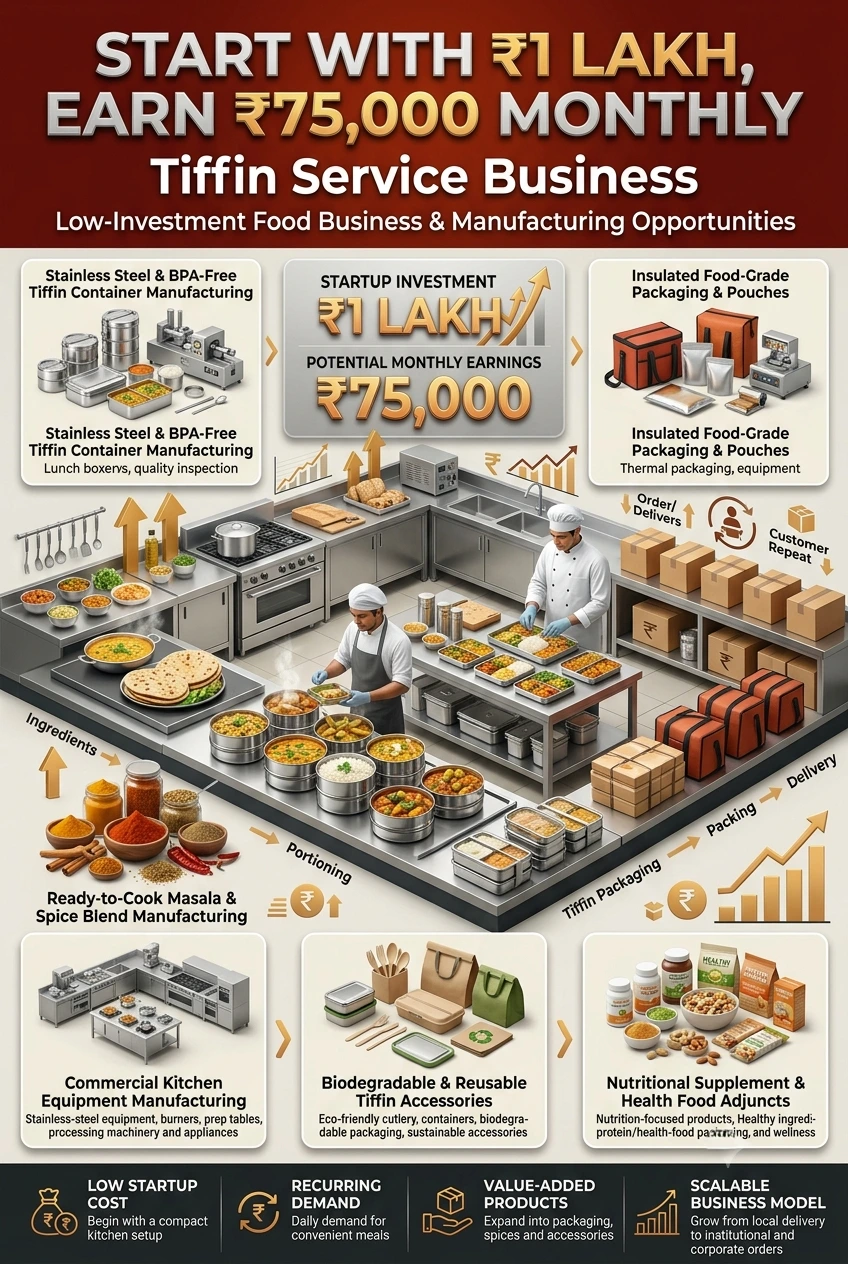
4. Commercial Kitchen Equipment Manufacturing
Pressure cookers, large-capacity cooking vessels, industrial induction cooktops, and food warmers are required for tiffin services operating from home and serving 100+ people. There is an unmet demand in the Indian market for manufacturing durable food grade stainless steel cookware catering to the micro commercial segment (range from 5-20 litres). The investment demands for a small-batch fabrication and polishing unit is in the range of Rs.20 lakh to Rs.50 lakh.
5. Biodegradable and Reusable Tiffin Accessories
There is a change in the way that tiffin services are introducing food in consumers’ eyes with sustainable packaging. Creating biodegradable paper bags, cotton tiffin carry bags, bamboo utensil sets and jute outer covers for tiffin delivery service is a niche business growing in the industry. The low investment requirement (₹3 lakh to ₹10 lakh) allows businesses to sell the product line in the domestic tiffin market as well as export it to environment-conscious markets in Europe and North America.
Explore This Book: Bioplastics & Biodegradable Products Manufacturing Handbook
6. Nutritional Supplement and Health Food Adjuncts
High-quality tiffin services are now providing menus for health-conscious people – those looking to manage their diabetes, weight or fitness. This means low GI ingredient mixes, protein powder supplements, fortified rice and atta mixes, and sugar-free condiments are in demand. A small-scale nutraceutical mixing and packing unit for the premium tiffin segment requires an investment of ₹10–20 lakh. It can also offer margins of 40–60%.
View Full Project Details: Value-Added Food Processing Guide
Import–Export Opportunity Analysis
The estimated Indian diaspora worldwide exceeds 32 million people. It spans the USA, UK, Canada, Australia, and the Middle East. This represents a significant and under-served export market for tiffin-related products.
Export Markets
- In the UK and USA, stainless steel tiffin boxes and lunch carriers are selling for a premium as ‘Indian tiffin’ is a lifestyle product.
- Indian ready-to-cook meal deliveries, spice mixes and curry bases are always in demand in the countries where a large number of Indians live as expatriates.
- The markets of Scandinavian countries and Germany are ready to accept bamboo and jute tiffin accessories as a substitute of conventional kitchenware.
- Freeze dried Indian meal parts (Dry sabzis and Dal blends) is an emerging export segment for Indian food processing MSMEs.
Import Substitution Opportunities
Today, the country imports vast quantities of food-grade silicone gaskets, food-safe plastic items, and vacuum-seal lids. These components are used in premium lunch box manufacturing. Precision moulding has boosted domestic production. It has also reduced imports and supported the Make in India initiative.
International Demand Drivers
The global meal kit and meal subscription market is expected to expand considerably until 2030. Indian tiffin follows a subscription model with small, culturally authentic meal servings. It is also well suited for export markets. Several Indian food startups already offer tiffin-inspired meal subscriptions in the UK and North America. This trend is creating demand for Indian-made containers and packaging.
Discover scalable startups tailored to your goals
Indian MSME Success Stories in the Tiffin and Food Service Sector
1. iD Fresh Food (Bengaluru)
Initially, iD Fresh Food was small unit supplying fresh idli-dosa batter to the local homes and restaurants in Bengaluru. Today it’s a ₹500+ crore business serving chilled, ready to cook (RTC) food in India and overseas. Home to national brand journey of its kind is the story of the scaling potential in the organised home-food segment that Jagran’s report identifies as ripe for new players.
2. Daawat Tiffin Services (Delhi NCR)
3. Homepreneur Tiffin Networks (Pan-India)
NPCS offers a complete solution for entrepreneurs interested in setting up a tiffin container manufacturing unit, spice blending facility, insulated packaging business or any other type of food business MSME. Please contact the Niir Consul for catalogues of the project report and enquiries for consultancy services at www.niir.org.
Tiffin Service Business: Key Data Snapshot
| Parameter | Details |
| Industry | Food Service / MSME / Home-Based Business |
| Market Driver | Urbanisation, nuclear families, health consciousness, digital ordering |
| Investment Range | ₹50,000 – ₹1,00,000 (service); ₹5–50 lakh (manufacturing) |
| MSME Opportunity | Tiffin service operations, container manufacturing, packaging, spice blends |
| Export Potential | Stainless steel containers, ready-to-cook kits, tiffin accessories — UK, USA, Gulf |
| Government Support | PM FME Scheme, MUDRA Loan, FSSAI, Udyam Registration, CGTMSE |
| Risk Level | Low to Medium (subscription model provides recurring revenue) |
| Growth Outlook | 15–25% CAGR; Indian foodservice market to reach ₹12.3 lakh crore by 2030 |
Conclusion: Why Entrepreneurs Must Act on This Opportunity Now
LiThe tiffin service business is not a new idea, but it has never been more accessible or scalable. It also aligns well with mainstream consumer demand today. As Jagran’s MSME reporting makes clear, the entry barrier is extraordinarily low. ₹1 lakh is all it takes to start a business with the potential to generate ₹75,000 in monthly earnings.
Beyond the service itself, the tiffin economy creates a rich ecosystem of manufacturing opportunities — in containers, packaging, spice blends, kitchen equipment, and accessories — that are equally compelling for production-oriented entrepreneurs. Government support through PM FME, MUDRA, CGTMSE, and FSSAI frameworks has never been stronger or more accessible.
India’s food service market is on a trajectory to reach ₹12.3 lakh crore by 2030. The tiffin segment — positioned at the intersection of cultural authenticity, health consciousness, and digital convenience — will capture an outsized share of that growth. Entrepreneurs who establish operations today will benefit from first-mover advantages in customer relationships, brand recall, and supplier networks.
The opportunity is real, the market is proven, and the government support is in place. The question is not whether the tiffin business works — Jagran’s coverage and thousands of successful operators across India confirm that it does. The question is: when will you start?
Source: Jagran — Tiffin Service Business: Start with ₹1 Lakh, Earn ₹75K Monthly | Jagran.com — India’s Leading Hindi News Platform