

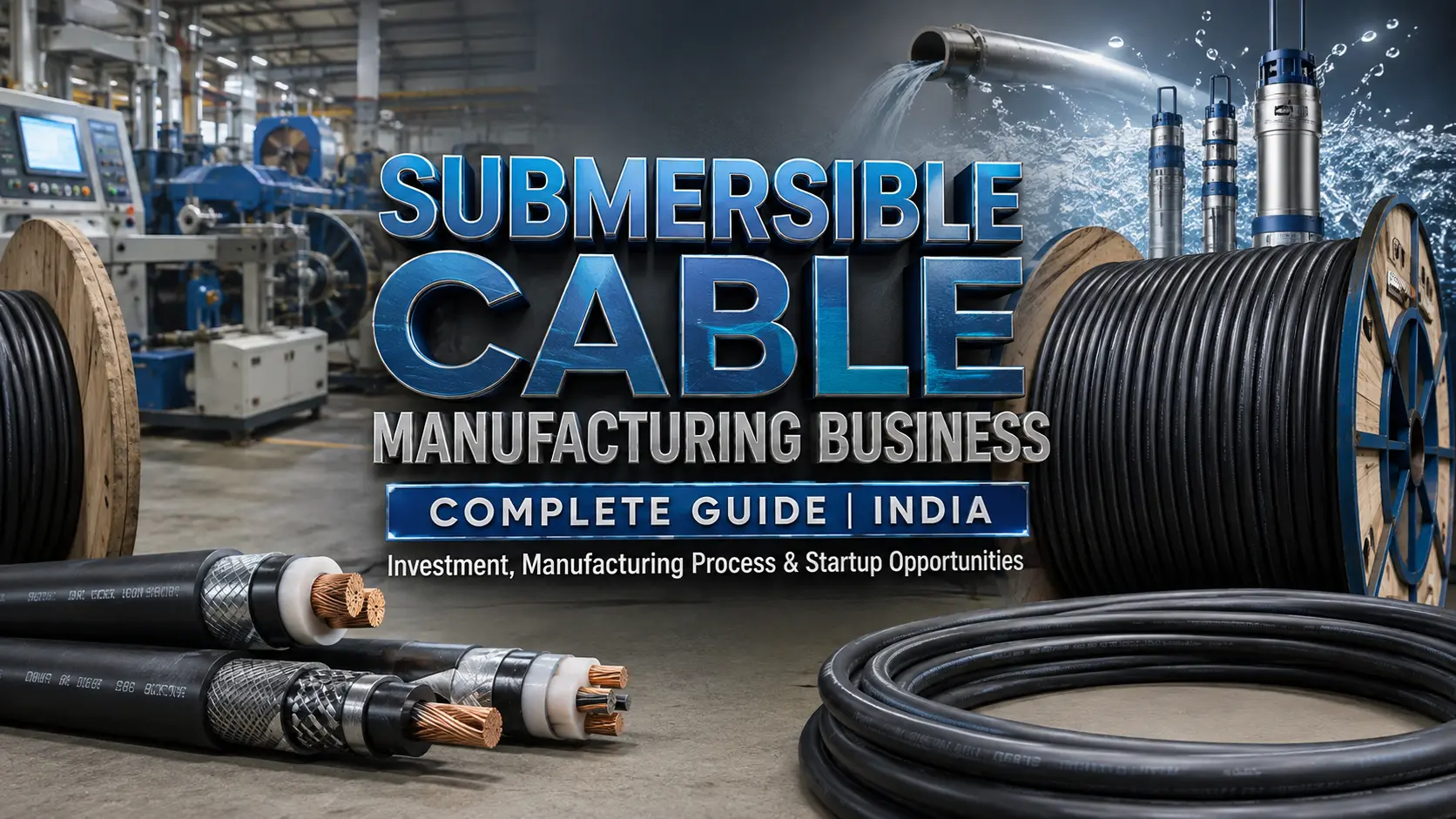

Submersible Cable Manufacturing Business
The Indian case of dependency on groundwater is opening up an opportunity that is not blatant or loud, but present. And at the core of that opportunity is the making of submersible cable. This is a good area to explore if you’re looking for business opportunities and are in the electrical and cable business. Millions of borewell pumps, agricultural tube wells and municipal water schemes are powered by submersible motors and each one requires a submersible cable to deliver a safe supply of power underwater. The fact that it is a demand-driven industry, and not a speculative one, is the only thing that makes it this way.
I have been a consultant helping dozens of first-generation entrepreneurs with their project reports in the field of wires & cables and I can assure you this: Understanding the technical process as well as the business logic behind it is essential to make it a success at submersible cable manufacturing. It’s no bed of roses. But it’s a consistent one, and consistent businesses develop wealth with time.
Why the Submersible Cable Industry Is Growing Fast
A substantial part of Indian agriculture continues to be powered by groundwater irrigation. The installation of each borewell, replacement of each pump and every new water infrastructure project generate new cable requirements. This demand is not fashion or seasonal dependent like consumer electronics. It relies upon water and water is not a passing fad.
A Replacement-Driven Market
Underwater cables are subject to harsh corrosive and aggressive conditions. Insulation degrades. Conductors corrode. This means that demand for replacement parts is consistent and reliable, and manufacturers have a steady stream of revenue from which they can make a profit.
Rural and Semi-Urban Demand Pull
Pump usage is moving into areas where there were no pumps 10 years ago, with the advent of rural electrification, farm mechanisation and piped water supply schemes. As a result, demand for cable is not being limited to a few industrial belts; it is spreading around the globe. This is supported by the steady growth in electrical equipment manufacturing base in India as seen in the sector data by the India Brand Equity Foundation. That spread opens up space for regional manufacturers, not only the large national companies.
Export Potential in Neighbouring Markets
Agriculture and groundwater extraction are already similar across a number of countries in Africa, Middle East and South Asia, and India’s cable exports are already to these countries. Thus a well-managed submersible cable unit is not restricted to the domestic market only and may develop a relatively early export book.
Get Detailed Project Report (DPR): Wire & Cable Projects
Government Policies and Incentives Supporting New Cable Manufacturers
Making an investment in manufacturing is easier now than it was 10 years ago, largely because the Government has targeted its support. There are a number of schemes applicable to a submersible cable project.
Production Linked Incentive (PLI) Scheme for Wires and Cables
The Ministry of Heavy Industries and the Ministry of Electronics have announced PLI incentives for parts of the wires and cables value chain, especially for new units building new, modern, and up-to-date extrusion and testing facilities. Though eligibility is dependent on scale and investment amount, even smaller investments can be indirectly considered as beneficial with the ecosystem created due to this policy, such as improved availability of raw material and increased demand of BIS compliant products.
MSME Credit and Subsidy Schemes
The Ministry of MSME has introduced a number of credits linked schemes such as Credit Guarantee Fund Trust for Micro and Small Enterprises (CGTMSE) which offers loans without collateral up to a fixed limit. Besides, the Prime Minister’s Employment Generation Programme (PMEGP) provides capital subsidy to the new manufacturing unit directly affecting the equity position of the promoter for the first time.
Make in India and Import Substitution Push
Make in India initiative has taken positive steps to foster local production of cable and wire products to reduce the import of electrical components. Hence the preference of government procurement bodies and public sector utilities to buy cables that are manufactured in India and certified by BIS as opposed to those imported from different countries.
State Industrial Policies
Most States provide further incentives in addition to the Central schemes such as stamp duty exemption, subsidy on power charges and subsidy for capital investment for units located in the designated industrial areas. Incentive measures at the state-level are kept an eye on and updated regularly by industry bodies like the Confederation of Indian Industry. These state level benefits, therefore, can make the effective project cost ten to twenty percent less.
Multiple Business Ideas Within Submersible Cable Manufacturing
The value chain of the submersible cable is wider than most of the newer boys think. Below are some concrete and actionable business ideas that you can consider.
Flat Submersible Cable Manufacturing for Domestic Borewell Pumps
Flat submersible cables are the most popular choice for residential and agricultural borewells because their narrow profile fits well inside narrow borewell casings. A small to medium-size unit manufacturing 2.5 sq mm to 6 sq mm flat cables can directly approach local hardware distributors, pump distributors and agricultural equipment manufacturers. Compared to round submersible cables, the entry capital is low in this segment and there is an immense demand as the number of irrigation borewells in the country are almost unlimited. A founder coming in here should be concerned with consistency of copper purity and insulation quality, as the price buyer is indifferent, he/she still expects the cable to be able to stand the test of time for years without failing under sea.
Round Submersible Cable Manufacturing for Industrial and Municipal Pumps
Round submersible cables are for some of the larger horsepower pumps such as those in municipal water supply, mining dewatering, and for process water in industrial applications. This is a more lucrative and more margin-rich market as the customers are typically water boards, governments or industrial plants who are not price sensitive but rather see the value in reliability. The flat cable segment is more demanding in terms of technical capability, such as good testing facilities for insulation resistance and voltage withstand but offers the advantage of more predictable long-term contracts and higher realisation per metre than the flat cable segment.

PVC and Rubber Insulation Compounding Unit as a Backward Integration Play
An entrepreneur can establish a small-scale PVC or the special type of rubber insulation unit to make the insulation material to avoid outsourcing the insulation compound. The idea of backward integration works well when a cable manufacturer reaches a certain production volume level as it ensures a fixed raw material cost and a fixed quality control. It also provides a secondary moneymaking opportunity, as companies can sell the extra compound to other businesses in the region that lack compounding facilities.
Copper Conductor Drawing and Stranding Unit
Another upstream opportunity is conductor drawing, which involves pulling copper rod down to form very thin wire and then twisting the copper into conductors. Several cable manufacturers can share one drawing and stranding unit that supplies the conductor, instead of each manufacturer investing in its own equipment. This model suits entrepreneurs who want to focus on B2B supply operations rather than finished-product businesses. It typically involves lower marketing costs because the buyers are technical customers who place repeat orders.
Cable Testing and Quality Certification Support Services
There are wires and cables smaller manufacturers that cannot afford a full in-house testing laboratory, but still require certification test reports. There are smaller wires and cables manufacturers that cannot afford to have a full in-house testing laboratory, but still require a certified test report. A special test service, providing insulation resistance, voltage withstand, and conductor resistance checks can be used for an entire manufacturing area. As opposed to the actual production of cables, this is a business idea with relatively low investment. At the same time, the strong quality control in the industry will also benefit the business.
Submersible Cable Jointing Kits and Accessories
Whether for repair or extension, every submersible cable installation will require the use of a jointing kit, heat-shrink cable sleeves, and the right accessory for connectors during its life. This is an almost forgotten part of the business, but it generates repeat sales because field technicians and pump repair contractors regularly purchase these products. A small business that only sells accessories may invest small and expand in line with the main cable business.
Explore proven business ideas with high success potential
Import-Export Opportunity Analysis for Submersible Cables
India is already exporting electrical cables to several other countries in the African and Middle Eastern region where groundwater irrigation is similar to the situation in India. In Kenya, Nigeria, and some areas in the Gulf region, the manufacture of submersible pumps and cables is limited, so these are imported.
There is still some specialised insulation compound and precision extrusion machine imported into India from countries like Germany, Italy and China. Therefore, a new competitor has two options: increase export capacity of finished cables when the quality of finished cables reaches the domestic level; and import substitution: concentrate on the localisation of machinery and compound production. Both support India’s current Make in India initiative and can help lower the country’s electrical components trade deficit over the long term.
For export documentation and export incentives, the Directorate General of Foreign Trade is responsible and for new exporters, it is advisable to register as early as possible for relevant duty drawback and RoDTEP benefit.
Indian MSME Success Stories in the Cable Industry
KEI Industries
Decades ago, KEI Industries was a small business making stranded wire, and grew it eventually into a large cable manufacturing company. The company’s early investment of the profits into its extrusion capacity enabled it to become a national listed company from a local supplier. The lesson for new entrepreneurs is simple: capacity expansion funded by retained earnings provides a better long-term foundation than capacity expansion funded by debt.
Polycab India
Initially, Polycab was a small wire and cable trading firm, but its promoters took up the production of wire and cables. They focused on the brand-building efforts at the distributor and electrician level, ahead of major industrial buyers. This bottom-up brand strategy relied on the trust of small dealers and installers and later evolved into a large industrial and export enterprise. In this category, trust is an important factor that new cable entrepreneurs are likely to take for granted and Polycab’s cable growth story is all about building trust with their distributors.
Finolex Cables
Finolex Cables earned an early reputation for quality and timely deliveries to electrical contractors and government departments. Instead of attempting to be in the whole range of product categories, the company concentrated on securing a limited range of products before expanding. In the case of a new submersible cable manufacturer, this translates to a viable approach –focus your new product development efforts on a few cable sizes and applications and get them right before diversifying.
Related Article: Manufacturing of ABC (Aerial Bundled Cable) Conductors
About NPCS: Turning This Business Idea into a Bankable Project
It’s possible to read about a business concept and then actualize it with your money. As an entrepreneurship setup, entrepreneurs can use our Services for preparation of Market Survey cum Detailed Techno-Economic Feasibility Reports (DPRs) for their new Industry including the submersible cable manufacturing unit.
Our reports include the entire manufacturing process, market research and demand analysis, process flow diagram, product mix and capacity planning, machinery and raw material specifications, and complete project financials with profitability analysis. That is—before putting money into the project, we want you to be able to see the numbers clearly, we want you to evaluate the feasibility, the profitability and the long-term size of your project, so your bank, your investors and YOU can see the numbers and make an informed decision.
Submersible Cable Market Snapshot
| Parameter | Typical Range / Detail |
| Common Conductor Sizes (Flat Cable) | 1.5 sq mm to 10 sq mm |
| Common Conductor Sizes (Round Cable) | 16 sq mm to 300 sq mm |
| Primary Raw Materials | Electrolytic copper, PVC/rubber compound, insulation tape |
| Key Applicable Standard | IS 694 and related BIS specifications for insulated cables |
| Core End-Use Segments | Agricultural borewells, municipal water supply, industrial dewatering, mining |
| Small Unit Indicative Capacity | Roughly 200 to 500 km of flat cable per annum, scalable with extrusion line capacity |
| Key Export Markets | African nations, Middle East, South Asia |
These figures are indicative starting benchmarks. Actual capacity, machinery selection, and cost structure depend on the specific product mix, location, and target market the promoter chooses. The promoter should always validate these factors through a proper feasibility study before finalising the project.
Frequently Asked Questions on Starting a Submersible Cable Business
Q1. What is the cost of a small submersible cable unit?
The amount of capital needed will depend on the capacity and the range of products produced but a small flat cable unit will require less investment than a round cable or compounding unit. The biggest cost factors are machinery, working capital for the procurement of copper, and setup of the factory.
Q2. Are submersible cables required to be BIS certified?
Of course, if the cable is not compliant with the relevant BIS specification, then it will not gain market credibility and many institutional buyers will not purchase uncertified cable. Planning from scratch to build this into your project plan will help prevent rework at a later stage.
Q3. What is the highest cost driver of raw materials?
Cafes, fast food outlets and airline caterers are making a concerted effort to adopt compostable cutleries and utensils, partly because the law now mandates their use.
Q4. Is there a possibility of starting this business small and then scaling up?
Absolutely. A large number of successful cable manufacturers started with one extrusion line with a narrow range of flat cable sizes and over the years invested the profits in getting round cable facilities in place and then built up more product lines.
Q5. What scheme of the government is most helpful to start with?
It is a common practice among new entrepreneurs to avail MSME credit guarantee support along with state industrial subsidies. An in-depth feasibility study is useful to pinpoint the precise schemes that would apply in your own place and size.
Q6. What makes a successful cable company different from a ‘what’s not working’ cable company?
Within our consulting experience, it is not as important to have the lowest price as it is to have consistent quality control and good distributor relationships. A loyal buyer is a purchaser who is confident in the brand’s reliability and will not hesitate to continue buying from it despite its slightly higher cost.
The Bottom Line
Submersible cable manufacturing is not a trending business idea; it is a foundational one, tied directly to India’s groundwater economy. That makes it less exciting on social media, but far more durable as a long-term venture. Entrepreneurs who combine sound technical process control with genuine distributor relationships, and who back their plans with a properly structured feasibility report, stand a strong chance of building a lasting business in this space.


