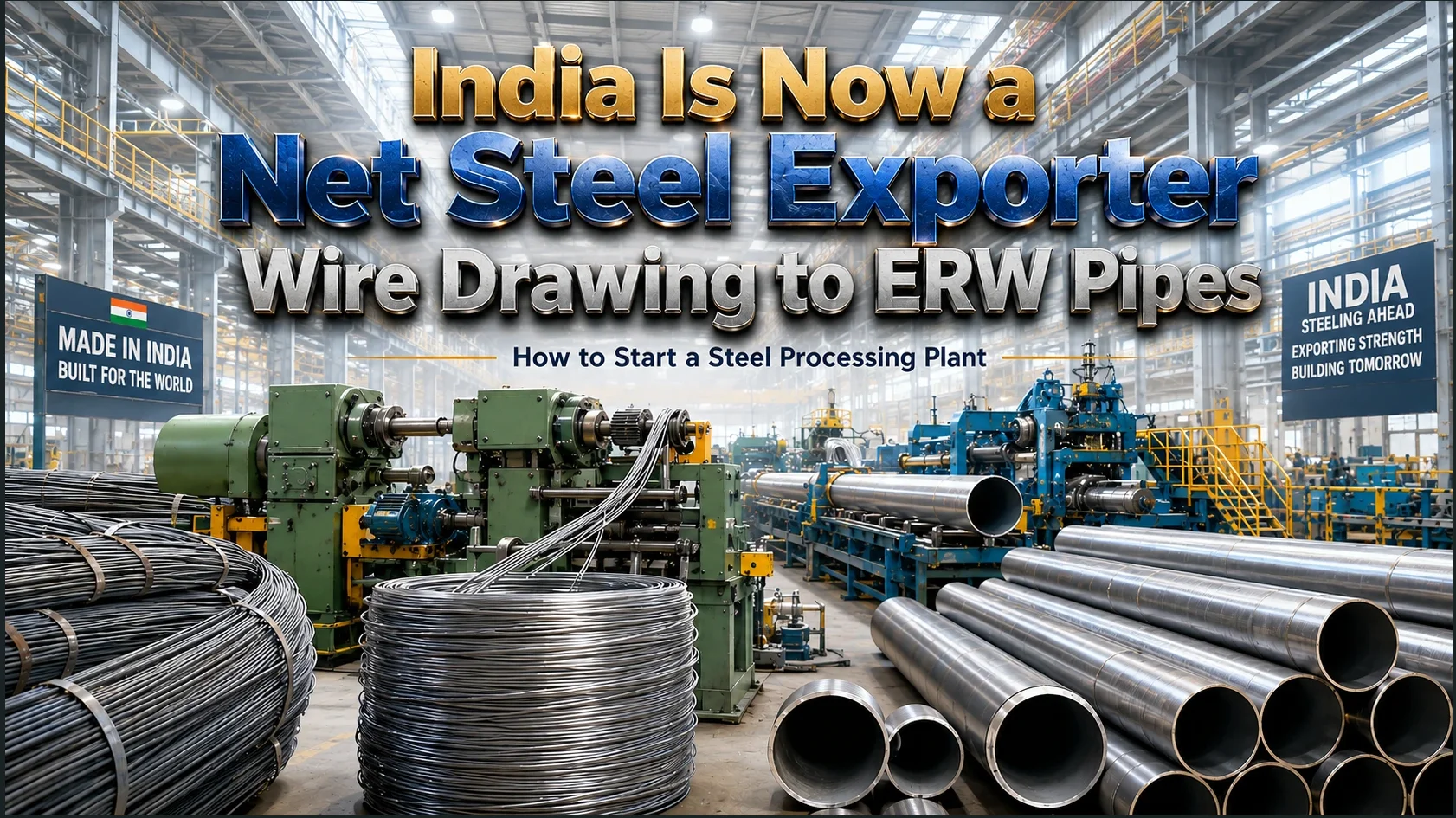

Steel Processing Business in India
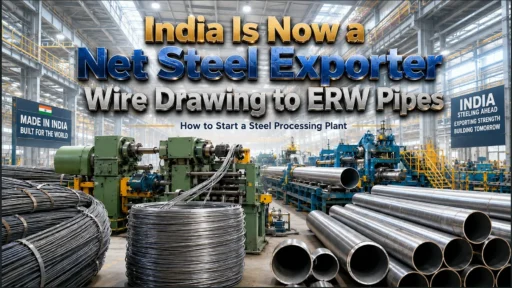
In the last fiscal year (April–February) India became a net steel exporter with its surplus at 0.40 million tonnes compared with a net import in the previous year. This is a change, not a trend. India is installing steel capacity at one of the highest rates in the world and the consumption of steel is also at a record high. Bihar’s ₹28,626-crore steel MoU cluster, JSW’s ₹1 lakh-crore steel plant in Gadchiroli, and SAIL’s current upgrades of capacities all indicate a decade long supply expansion.
But primary steel isn’t the big news. The juicy money for a first-generation entrepreneur is in secondary steel processing which involves the transformation of primary steel into value added products utilized by the construction, auto and infrastructure sectors which are growing by the leaps and bounds in India. There has to be somebody who pulls the string. Weld the pipes. Roll the bars. Galvanise the sheets. That some do not require a billion-dollar blast furnace.
Why India’s Steel Expansion Creates MSME Opportunity at Every Stage
Between the billion-dollar capacity and the daily construction demand lies secondary steel processors.
As per the Indian Steel Industry Report by IBEF, the secondary steel plants and MSMEs have 47% of the capacity of crude steel production in India. The iron ore reserves in India can generate 700 MT of iron ore per year, making it the second largest in the world. However, the secondary processing — cold-rolled sheets, galvanised coils, precision tubes, wire rod coils — is still far behind its demand in India – because of the infrastructure boom it is witnessing.
Livemint’s coverage of India’s steel export growth confirms that India’s steel exports grew by nearly one-third in April–December of the recent fiscal year, while domestic consumption also increased — a dual-engine demand scenario that is historically rare and creates sustained pricing support for secondary processors.
The Ministry of Steel’s PLI scheme for specialty steel provides 4–12% incentive on incremental production of high-value steel products — directly targeting MSME entry into higher-margin processing categories like electrical steel, coated steel, alloy steel, and specialty wire.
Get Detailed Insights from This Book: Complete Technology Book on Steel and Steel Products
| State | Steel Cluster | Primary Processing Gap | Emerging MSME Opportunity |
| Jharkhand | Jamshedpur, Bokaro, Dhanbad | Secondary processing | Wire rod coil-to-wire drawing |
| Odisha | Kalinganagar, Angul, Paradip | Value-added products | GP/GC sheets, structural sections |
| Chhattisgarh | Raipur, Bhilai | Steel furniture, ERW pipes | Construction component fabrication |
| Bihar | Rohtas, Aurangabad (new steel) | All ancillaries | Refractories, packaging, logistics |
| Maharashtra | Gadchiroli (new JSW plant) | All ancillaries | Limestone, coke chemicals, packaging |
| West Bengal | Durgapur, Howrah, Burnpur | Secondary processing | Wire drawing, bright bars, galvanised pipes |
About 65% of domestic steel is consumed by the construction industry, which is driven by ₹13 lakh crore government capital expenditure and housing programme PM Awas Yojana. Demand for TMT bars, MS angles and structural steel sections will stay high for the next 5-7 years. It’s the secondary processor that’s in place and on scale when this demand wave reaches its peak, rather than waiting to see what it becomes, who gets the margin.
Why Now Is the Specific Entry Window
Capacity additions mean pricing windows; secondary processors who enter in now are getting low-cost primary steel and still enjoying the growth in demand.
The new primary steel plants are being commissioned in Bihar, Maharashtra and Odisha which will help to push down the rate of raw material (wire rod, HRC, billets) by 4–8% in the coming 2–3 years as it crosses import parity level. The expansion of margins when raw material costs decline is straightforward profit uplift for a secondary processor who enters into the market at this price, establishing the customer relationship at a pre-existing price.
The JSW Steel and POSCO signed Heads of Agreement for a 6 MTPA integrated plant; JSW Steel-JFE Steel inked a joint investment of ₹5,845 crore for CRGO electrical steel that’s a specialty product on which India is 90% dependent. As per the data from IBEF on steel sector, during the period (April 2000 to December 2025), the total FDI inflows into the metallurgical industries in the country had been of worth ₹1,19,407 crore (USD 19.14 billion). This sector is in an upward trajectory, not stagnation.
Setting Up a Wire Drawing Unit — The Most Accessible Entry Point
Wire drawing is the most standardised, buyer-diversified and capital-efficient secondary steel processing business available for first generation entrepreneur.
Process: Drawing the wire rod (diameter 5.5-12 mm) into the specified gauge in the construction industry (binding wire), agriculture (barbed wire, fencing) and general engineering (fasteners, springs).
Investment: ₹35–45 lakh total. Machinery is standardised, readily available domestically and financeable.
Key Machinery: ₹7.5 lakh (bulk block wire drawing machine of 8-die, 250 kg/hr); Spooling and coiling machine: ₹3 lakh; Annealing furnace (batch of 500 kg): ₹5.5 lakh; Wire rod straightener: ₹2 lakh.
Wire rod supply: From authorised SAIL, Tata Steel, JSW or Jindal Steel distributors. Credits terms by the authorised distributors are normal 30-45 days. Price: ₹55,000–65,000 per tonne.
Licences: Udyam Registration, Factory Licence, GST, Pollution NOC, BIS mark for specific wire products (Binding wire and Prestressed wire) under the Quality Control Orders.
Timeline: 5–8 months from registration to first production.
Get Detailed Project Report (DPR): Steel Manufacturing & Processing
| Item | Specification | Cost (INR) |
| Bull Block Wire Drawing Machine | 8-die, 250 kg/hr | ₹7,50,000 |
| Spooling and Coiling Machine | Semi-automatic | ₹3,00,000 |
| Annealing Furnace | 500 kg batch | ₹5,50,000 |
| Industrial Shed (4,000 sq ft lease) | Secondary steel zone | ₹60,000/year |
| Wire Rod Stock (1 month, 30 MT) | ₹18,00,000 | |
| Working Capital | 2 months opex | ₹4,00,000 |
| BIS Certification + Licences | All fees | ₹90,000 |
| Utilities (power, water, industrial) | Heavy load connection | ₹2,50,000 |
| Contingency (10%) | ₹4,20,000 | |
| Total Project Cost | ₹46,20,000 |
The Margin Structure in Secondary Steel Processing
Wire drawing unit processing 25 tonnes/month:
Capital Expenditure: ₹40–50 lakh Monthly Operating Cost: ₹8–12 lakh (wire rod: 80%, power: 10%, labour: 7%, misc: 3%) Revenue at 60% Capacity (15 tonnes): ₹10.5–13.5 lakh/month Revenue at 100% Capacity (25 tonnes): ₹17.5–22.5 lakh/month Gross Margin: 14–20% Net Margin: 6–12% Payback Period: 24–36 months at 70% utilisation
Steel processing is a business of “volume”. Fixed cost does not increase by more than 40% when output is doubled from 25 to 50 tonnes. The standard growth path: Capital is ₹45 lakh and in 3 years, with the addition of a second drawing machine and annealing capacity, it becomes ₹80 lakh.
| Scheme | Ministry | Eligibility | Max Benefit | Apply At |
| PMEGP | MoMSME / KVIC | New MSME manufacturing | ₹25 lakh + 25–35% margin subsidy | pmegp.kvic.org.in |
| PLI Specialty Steel | Ministry of Steel | Specialty steel manufacturing | 4–12% production-linked incentive | steel.gov.in |
| CGTMSE | MoMSME / SIDBI | MSME loans up to ₹5 crore | 75–85% credit guarantee | cgtmse.in |
| Steel Cluster Development | MoMSME | Steel MSME clusters | Shared infrastructure grant | msme.gov.in |
| MUDRA Tarun | Finance Ministry | Existing enterprises | ₹5 lakh–₹10 lakh | mudra.org.in |
| Stand-Up India | DPIIT | SC/ST, women entrepreneurs | ₹10 lakh–₹1 crore greenfield | standupmitra.in |
Sudarshan Agarwal, an entrepreneur from Raipur, Chhattisgarh, began her wire drawing business in Urla Industrial Area with the capital of ₹22 lakh (Owned Rs 8 lakh and borrowed Rs 14 lakh from the bank). The first-year yield would be ₹85 lakh per month based on 30 tonnes drawn wire per month. Customers: Local mesh manufacturers, construction hardware stores, fence manufacturer. He has since added a nail-making machine and has annual earnings of ₹1.4 crore with 9 members of his team. His lesson: “It’s not the raw material that’s the money: It’s the people that use the product downstream who are the money. The MSME Development Forum, FICCI published this data.
Five Steel Ancillary Businesses Worth Entering Now
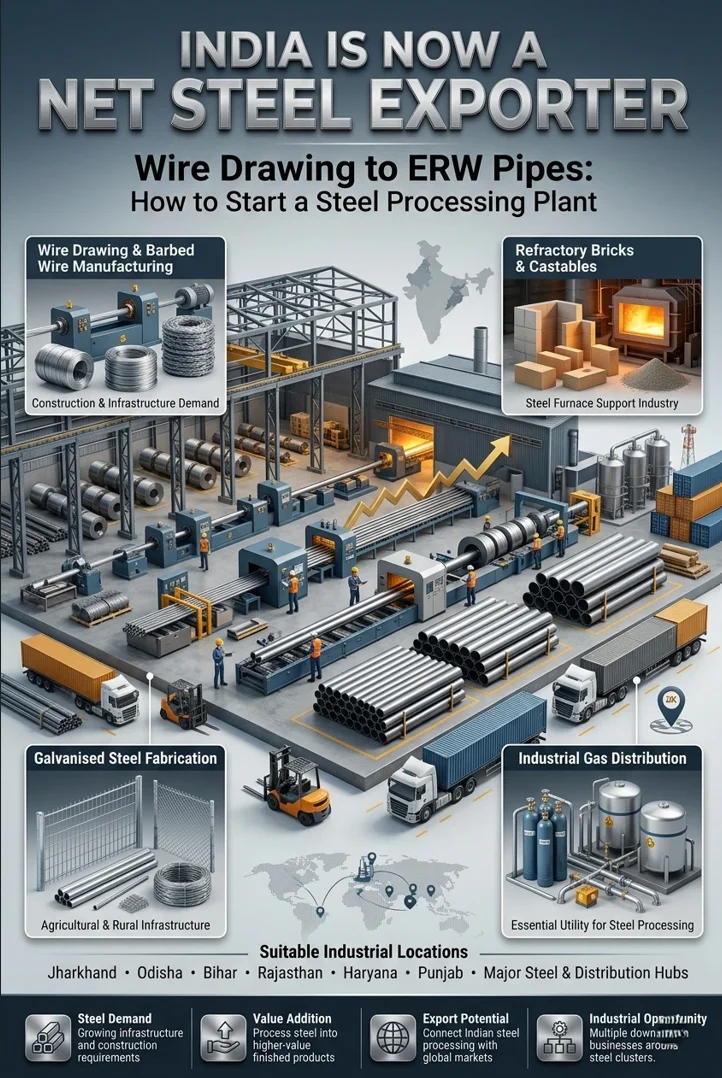
Wire Drawing and Barbed Wire Manufacturing for Construction (Any Steel Zone)
India’s most active small-scale steel processing business. Wire rod at ₹55,000–65,000 per tonne is drawn into galvanised binding wire, barbed wire, and MS wire at ₹70,000–85,000 per tonne realisation. Margin: 15–25% on material cost. A 2-machine unit processing 25–40 tonnes per month can generate ₹1.6–3 crore in annual revenue with a 7-person team. Bihar’s new industrial investments and Odisha’s construction expansion create immediate demand for binding wire and barbed wire at project sites.
View Full Project Details: Wire Drawing with Galvanizing Plant
Refractory Bricks and Castables for Steel Furnaces (Jharkhand/Odisha/Bihar)
Steel plants consume 10–12 kg of refractory material per tonne of steel produced. India imports approximately 30% of specialty refractories. A refractory brick unit near Jharkhand’s or Bihar’s steel clusters — with access to fireclay and silica deposits — supplies local plants at 8–12% freight advantage over distant competitors.
MS Pipes and ERW Tubes for Infrastructure (Near Steel Distribution Hubs)
Electric Resistance Welded (ERW) pipes are the most widely used steel product in construction — scaffolding, water supply, gas lines, structural framing. An ERW pipe unit (high-frequency welder, forming rollers, cut-off saw) and can produce 15–25 tonnes per day.
Galvanised Steel Fabrication for Agricultural Fencing (Rajasthan/Haryana/Punjab)
Galvanised steel fencing — chain-link, welded mesh, barbed wire, agricultural field fencing — is in sustained demand from infrastructure projects and industrial site security.
Related Article: How to Start a Steel Fabrication Business in India: Plant Setup, Investment & Profit Guide
Industrial Gas Distribution for Steel Plants
Steel plant operations require oxygen, acetylene, argon, and nitrogen in large volumes. Becoming an authorised distributor for Linde India, Air Liquide, or INOX Air Products.
Choose the right startup backed by real market demand
NPCS: Project Reports for Every Steel Ancillary Category
Niir Project Consultancy Services (NPCS) publishes detailed project reports for the full range of steel ancillary businesses — wire drawing, ERW pipes, refractory bricks, MS fabrication, and galvanised products — available at niir.org and entrepreneurindia.co. Each report includes machinery specifications, Indian vendor lists, state-wise raw material sourcing, financial projections, and government scheme eligibility — structured for PSU bank loan applications and DIC submissions.
India’s Steel Run Has Years to Go. Position Yourself Now.
New primary steel capacity in Bihar, Maharashtra, and Odisha will generate secondary demand that distant suppliers cannot efficiently serve. The entrepreneur who enters proximate to a new steel plant — with wire processing, refractory supply, packaging, or industrial gases — is not chasing a trend. They are positioning ahead of a decade-long demand wave.