This is one fact that every entrepreneur who is looking for any of the real manufacturing business ideas comes across: India imports a significant amount of its medical gloves. A new surgical latex/latex and nitrile gloves company can fill the gap between hospital needs and local manufacturing.
This article guides through the reality of the sector, the downside of its government schemes, and a few project ideas to evaluate. It’s not a promotional tone here but rather a practical tone, and founders should rely on the accurate numbers before investing in plant and machinery.
Why This Industry Is Growing Fast
Gloves are used regularly in hospitals, diagnostic laboratories, and dental offices, and are usually needed for each new procedure. Such consumption is consistent and is far less volatile than that of other manufacturing groups.
The disposable nitrile gloves market in India is estimated to be worth billions of dollars and continues to grow at a healthy rate, supported by the increasing number of hospitals, the growing volume of diagnostic testing, and stricter infection control guidelines. Thus, the market to be addressed continues to grow each quarter, rather than decline.
But local production has not met up to this demand. India also exports finished surgical gloves and imports an equivalent quantity, suggesting a lack of a consolidated market and an underdeveloped domestic manufacturing base.
View Full Project Details: Disposable Nitrile Gloves (Nitrile Examination Hand Gloves)
Import Dependency Creates the Opportunity
During the pandemic years, India realised that it was vulnerable when Malaysia stopped supplying the majority of its medical gloves. India found out how vulnerable it was when it was importing most of its medical gloves from Malaysia. In this vulnerability, policy makers have focussed on capacity for domestic dipping-lines, and the issue is still on the management agenda of hospital procurement teams now.
This is great news for an inexperienced company. As a result, a well-managed unit which sells latex or nitrile gloves to government hospitals, private chain and export markets has a demand cushion built-in and, therefore, does not have to develop the market from the bottom.
The Raw Material Angle
There is also considerable natural rubber cultivation in India, primarily in Kerala and Tamil Nadu, but the data published by Rubber Board reveals that the demand for natural rubber is still far greater than the supply in the country. Thus, latex-based gloves suppliers will need to carefully monitor their sourcing and working capital because prices can fluctuate with the international rubber market.
Nitrile requires, by contrast, synthetic rubber feedstock, which is heavily imported. Thus, the decision to use latex versus nitrile is not only a marketing pitch, but also a choice between two different raw material risks that the entire plant layout must consider.
Who Actually Buys These GlovesThe government hospitals and primary health centres purchase in bulk from the tenders, which are based on quality and timely delivery, not flashy labelling. Product feel, however, matters more in the private hospital chain, where patients often pay a premium for comfort and tactile sensitivity.
Another demand stream that many new entrants miss is industrial customers such as automotive workshops, electronics assembly companies, and chemical processing facilities. This means that a company’s founder, who considers the client base of both medical and industrial customers, creates a more robust order book from the start.
Government Policies and Incentives Supporting New Businesses
A first-time founder does not need to invest in the entire business with his own funds. There are a number of central and state schemes dedicated to reducing the initial cost of starting medical device or PPE production.
PLI Scheme for Medical Devices
The Production Linked Incentive Scheme for Medical Devices, administered by the Department of Pharmaceuticals, offers a 5 percent incentive on incremental sales for approved medical device categories. Although gloves sit at the accessible end of this ecosystem, the scheme signals a clear government intent to reduce medical device imports, and it indirectly supports ancillary investment such as testing labs and common infrastructure.
Explore This Book: Handbook on Medical & Surgical Disposable Products
PLI Scheme for Medical Textiles and PPE
The Ministry of Textiles also runs a PLI Scheme for Medical Textiles, which focuses on boosting the production of gloves, masks, and other protective textiles, following the import shock revealed earlier. Under this scheme, the government rewards entrepreneurs who invest in dipping technology, automation, and international quality certification.
MSME Credit Support: CGTMSE and PMEGP
There are seldom any properties that can be pledged by new units, which is where the Credit Guarantee Fund Trust for Micro and Small Enterprises comes into the picture. CGTMSE is a joint scheme of the Ministry of MSME and SIDBI which ensures a huge portion of a bank loan without any collateral thus making it much easier for the first-generation entrepreneurs to avail plant and machinery financing.
In addition to CGTMSE, the Prime Minister’s Employment Generation Programme provides capital subsidy for small manufacturing units and Udyam registration by the Ministry of MSME provides facilities of Priority Sector Lending, subsidised interest rates etc. and protection against delayed payment from customers.
Make in India and DPIIT Support
Medical devices are also a sunrise sector and are urged to promote import substitution in the industry within the Make in India initiative. On the other hand, if the founding team fulfils a set of criteria, DPIIT-recognised startups can enjoy tax holidays, accelerated patent processing and easier compliance in the initial years of operation.
State-Level Incentives Worth Checking
State industrial policy is as important as central policies – since majority of the established glove units are located in clusters around Kerala and Tamil Nadu. The K-SWIFT single window system, an initiative of the state government’s Department of Industries and Commerce (DoI&C), operates under the close monitoring of Invest Kerala, which oversees every aspect of factory licensing, pollution clearance and utility connections via a single online platform. Guidance Tamil Nadu also has a similar single window portal and provides capital subsidy and stamp duty concession to MSMEs establishing under the existing Industrial Policy of the state.
The success of these two states in implementing single window and MSME subsidy schemes should not deter entrepreneurs in other states, as most states in India now have similar schemes in place. The crucial factor is, on the other hand, the availability of natural rubber and experienced workers for the dipping line, and these conditions are still more favourable in the southern rubber belt.
Multiple Business Ideas for Startups in Glove Manufacturing
A single project for making gloves is not a business model. There are different ways to enter the market, with varying amounts of capital and profile of buyers for each one, depending on the risk appetite, location, and capitalization of the founders.
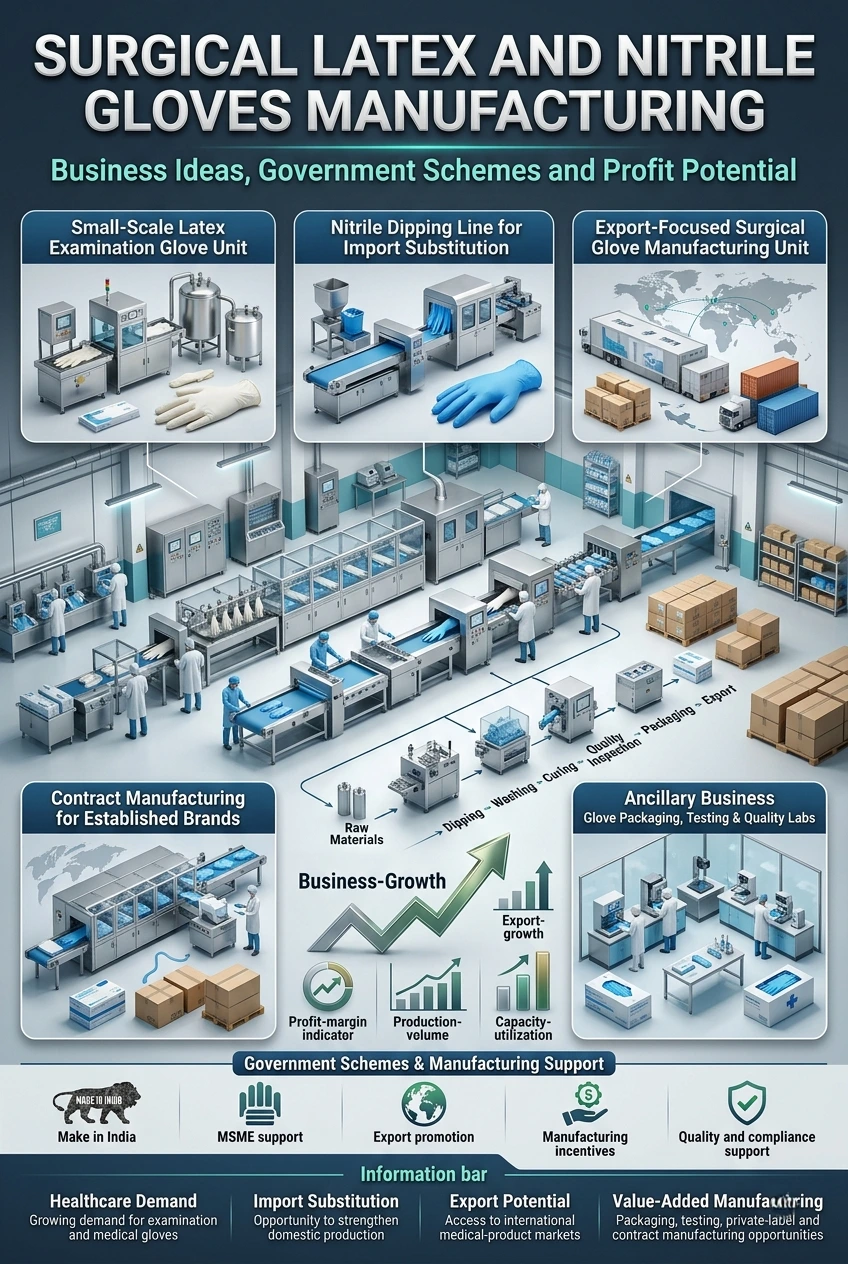
1. Small-Scale Latex Examination Glove Unit
A small dip line using a single or dual automated former can be used to manufacture examination gloves for local hospitals, nursing homes and pharmacy chains. This model is suitable for a foundry having a limited budget as the machine footprint is small and the product only requires a basic IS:4544 certification for domestic market. But this is because of the tender cycles for examination gloves—as they’re sold in bulk to institutional customers, cash flow matters more than headline margins, which makes working capital planning significant. Many successful small units begin here and demonstrate quality consistency, and then use profits from the first line to invest in a second line instead of obtaining external capital up front.
Related Article: Startup Business Opportunities in Nitrile Gloves Manufacturing
2. Nitrile Dipping Line for Import Substitution
Nitrile gloves still account for almost all imports in India. Hence, setting up a dedicated nitrile dipping line promises a less competitive market than latex, as domestic manufacturers currently produce nitrile gloves in negligible quantities. Upfront investment is higher due to a requirement for greater process control of the nitrile compounding and curing process, and consistent barrier performance from the buyers, particularly hospital chains and export clients. But the price is also upward and a founder who obtains the position just right without the accelerator and hypoallergenic can stand on the same ground as imported Malaysian brands when it comes to price and skin safety claims.
3. Export-Focused Surgical Glove Manufacturing Unit
A unit designed from the ground up for CE marking, FDA registration and export papers can enter lucrative markets that still pay a premium for surgical-grade quality. This concept requires a higher commitment of compliance effort and a longer approval process, but also shields the company from local price competition. But those who make this decision should plan to allocate funds for third-party audits and for freight logistics for export, as export buyers will not accept late deliveries or variable batch results.
4. Contract Manufacturing for Established Brands
A new player can enter the market by providing contract dipping and packing to existing glove manufacturers who have excess production. This model reduces the risk of marketing to a great extent as the anchor buyer already has the demand relationship. On the other hand, margins remain lower, and the business does not take off until utilization reaches a high level. Therefore, the plant must operate efficiently to make the business profitable.
5. Ancillary Business: Glove Packaging, Testing, and Quality Labs
Not all of these opportunities are in the business of owning a dipping line. They are surrounded by independent testing laboratories that meet IS:15972 and related standards, along with specialised medical-grade packaging units. The concept suits someone with a quality control or materials science background who wants a services business with lower capital investment needs while still targeting the same underlying demand as glove manufacturers themselves.
Import-Export Opportunity Analysis
The trade of gloves in India is at present a two way-flow of significant magnitude, exporting a roughly similar quantity as is imported as finished surgical gloves. The pattern typically indicates a less than well-ripened industry market, not a well-matured, self-supporting one — and fragmentation, for a disciplined new player, is the exact market in which they can gather their share.
The main weakness is on the import side with the nitrile gloves, as well as some high-quality latex products, as domestic production has not grown sufficiently to meet the demand from hospitals. A founder who imports even a small percentage of this volume immediately has a quantifiable market, rather than an untested idea.
Indian manufacturers with ISO and CE certification are already exporting to the USA, the European Union, parts of Africa and Southeast Asia. As a result, a new unit setting up early on the documentation and quality systems can make use of these buyer contacts faster than it would otherwise, not only through trade organisations such as the All-India Rubber Industries Association, but also export promotion councils like CAPEXIL.
But, from the side of the suppliers, premium nitrile supply to India is still dominated by the global giants including Ansell, Top Glove, Hartalega, Supermax, etc., leaving scope of getting a strong local brand. It is no contest that a founder who prices sensibly and is able to match the standards of barrier protection in other countries does not have to rely entirely on price when institutional buyers are considering to switch to another source.
Indian MSME Success Stories in the Glove Industry
In fact, anyone entering this space today can learn valuable lessons from how existing Indian companies have consolidated their foothold.
Kanam Latex Industries, Kottayam
Kanam Latex started its journey as a single automated glove manufacturing unit in Kerala and expanded to become the biggest surgical and examination glove exporter in the country with installed capacity reaching hundreds of million pairs a year. The company’s promoters, belonging to a rubber plantation family called Apostil Group, expanded the business with a steady investment in the new dip lines without looking for quick expansion through debt. The clear message for the new-founder is that being close to raw material and adding capacity in phases is better than an over-sized first plant built in a rush.
Sara Healthcare and Regional Institutional Suppliers
Many medium sized glove manufacturers and medical consumable manufacturers in India have secured early market share from institutional and government hospitals before venturing into export markets. Many of the medium sized companies in India in the glove sectors and medical consumable sectors won their initial market share in institutional and government hospitals and then expanded to export markets. It’s an approach that is repeatable — domestic institutional trust, then exports — and one that a fledgling company cannot match the name recognition of international brands such as Ansell or Top Glove.
The Broader Rubber Industries Cluster
In addition to individual companies, there is a clear trend among the cluster of manufacturers that the All-India Rubber Industries Association (AIRAM) recognizes each year for export excellence and best internal practices in rubber goods manufacturing: companies that specialize narrowly (surgical-grade latex or nitrile alone) out-compete generalist rubber goods manufacturers that view gloves as a side product.
Getting Expert Feasibility Support Before You Invest
All of the above are good business ideas, but to turn them into fundable projects, each idea needs supporting numbers, including machinery costs, a raw material sourcing plan, a manpower budget, and realistic sales projections.
At Niir Project Consultancy Services (NPCS), we prepare Market Survey cum Detailed Techno-Economic Feasibility Reports, or DPRs, for entrepreneurs planning to enter sectors exactly like this one. Our reports cover the full manufacturing process, market and demand analysis, process flow diagrams, product mix and capacity planning, machinery and raw material specifications, and complete project financials with profitability analysis.
In other words, before you commit capital or approach a bank for a CGTMSE-backed loan, a properly prepared DPR helps you and your lender evaluate feasibility, profitability, and long-term scalability with real numbers instead of assumptions.
Discover scalable startups tailored to your goals
Investment and Business Model Snapshot
The table below gives a quick, comparative view of the five business ideas discussed above. Treat these figures as planning ranges, since actual costs vary with location, automation level, and building versus leasing decisions.
| Business Model | Approx. Investment Range | Primary Buyers | Key Certification Needed |
| Small latex examination glove unit | ₹40 lakh – ₹1.5 crore | Local hospitals, pharmacies | BIS IS:4544 |
| Nitrile dipping line | ₹2 crore – ₹6 crore | Hospital chains, industrial buyers | BIS IS:15972 |
| Export-focused surgical unit | ₹3 crore – ₹8 crore | Overseas distributors, hospitals | CE marking, FDA registration |
| Contract manufacturing capacity | ₹1.5 crore – ₹4 crore | Established glove brands | Buyer-specific quality audit |
| Testing lab / packaging ancillary | ₹25 lakh – ₹80 lakh | Glove manufacturing clusters | NABL accreditation (for labs) |
Conclusion
Surgical latex and nitrile gloves manufacturing sits at a rare intersection: steady institutional demand, meaningful import substitution potential, and active government support through PLI, CGTMSE, and state-level single window schemes. For a founder willing to start small and scale in phases, the sector rewards patience and process discipline more than large upfront capital.
The business ideas outlined here, from a compact examination glove line to export-focused surgical manufacturing, give founders multiple entry points depending on budget and risk appetite. As a result, the right starting point depends less on the sector’s overall size and more on matching your capital, location, and buyer network honestly before you break ground.
Government and Institutional References
Ministry of MSME, Government of India: https://msme.gov.in
Make in India, Department for Promotion of Industry and Internal Trade: https://www.makeinindia.com/schemes-manufacturing-medical-devices
Press Information Bureau, PLI Scheme for Medical Devices: https://www.pib.gov.in/PressReleasePage.aspx?PRID=2085344
Credit Guarantee Fund Trust for Micro and Small Enterprises: https://cgtmse.in
Rubber Board of India, Ministry of Commerce and Industry: https://rubberboard.gov.in
Guidance Tamil Nadu, Industries, Investment Promotion and Commerce Department: https://www.investingintamilnadu.com/