
spice manufacturing business in Bihar
India is the largest producer of spices in the world and produces almost 75% of the world’s spices, and exports approximately 50% of the world’s spices. The organised spice manufacturing sector, however, is still segmented with regional players who do not feature any brands and a handful of big FMCG companies. This balance is changing.
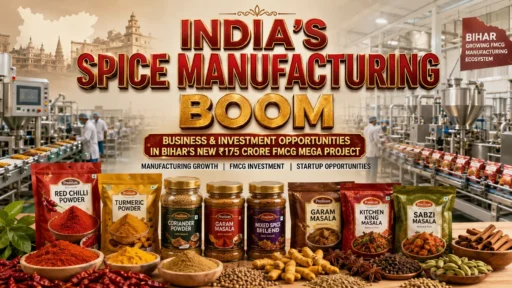
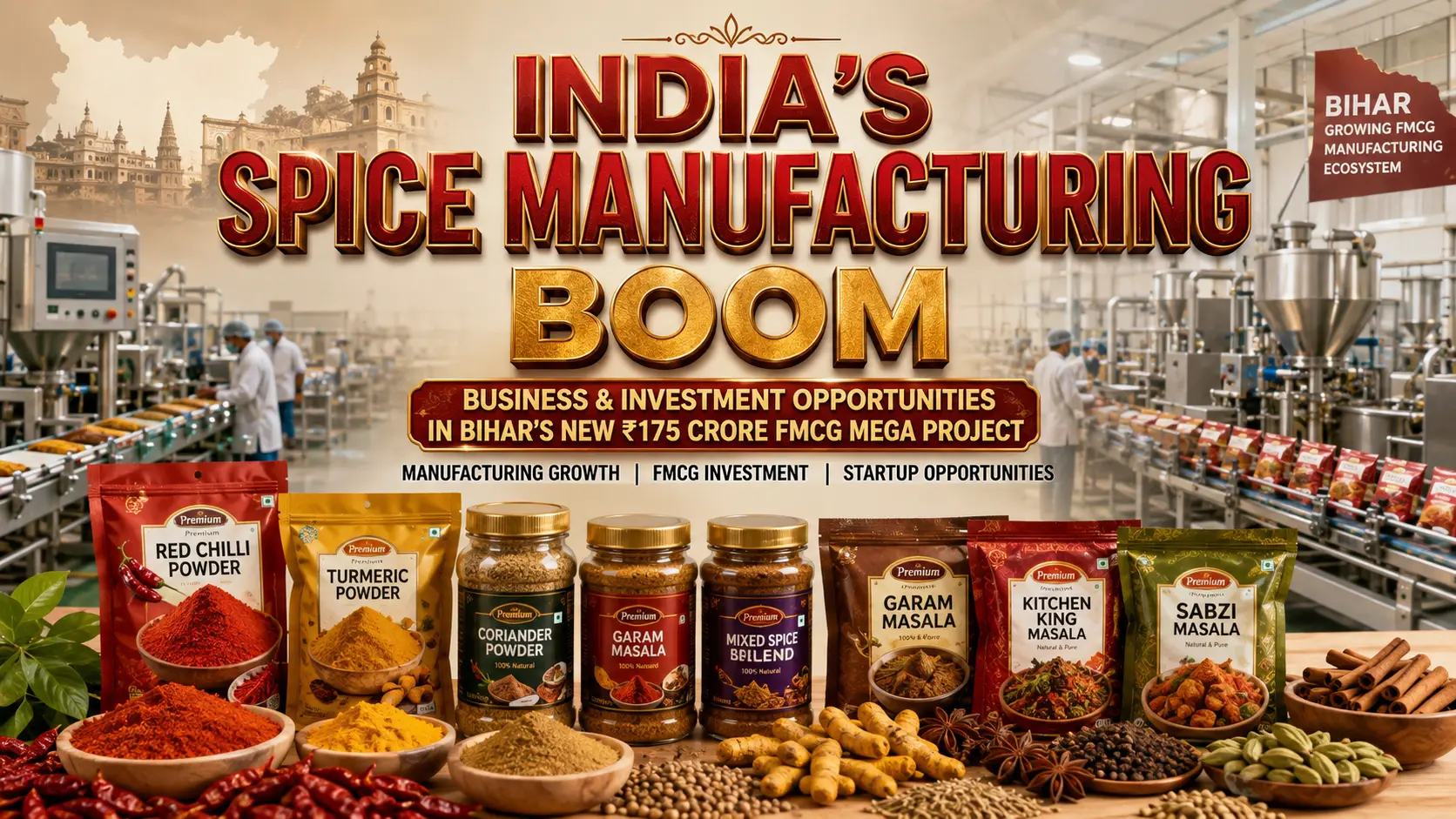
Food India, one of the fastest growing FMCG companies, has announced a mega investment of ₹175 crore to set up the largest spice manufacturing industry in the country in Bihar, according to Udaipur Times report dated August 6, 2026. The project is planned to be executed in three strategic areas like Muzaffarpur, Bhagalpur and Sasaram.
It’s not a typical industrial growth. The Bihar state government has reserved land at an imaginary rate of ₹1 to push this project forward and Chief Minister Samrat Choudhary has confirmed the date of its inauguration as October 2026. This is a landmark for the Indian food processing and spice manufacturing ecosystem with state-of-the-art imported machinery, international grade quality control, and direct linkage to farmers.
This news is good news for entrepreneurs, MSMEs, investors and startup founders as the entire spice manufacturing value chain from raw material procurement to grinding, packaging, export and branded consumer goods is in the midst of the high growth phase. The country’s domestic and export market is growing rapidly, and infrastructure and policy tailwinds will support those who come in now.
Get Detailed Insights from This Book: Handbook on Spices
What This Recent Reporting Means for Business
The Udaipur Times report is a compilation of several crucial things happening at the same time. Furthermore, In the highest form of endorsement, Food India’s CMD Sawan Pandey and Director Akhilesh Kumar met the Chief Minister Samrat Choudhary in person. Additionally, There is a high-level roadmap meeting on the horizon with technical experts from Bihar, Hyderabad and Maharashtra. It is a cross-state partnership, which is an indicator of advanced use of technology.
The project involves expenditure of ₹175 crore in three industrial hubs – Muzaffarpur (North Bihar), Bhagalpur (East Bihar) and Sasaram (South Bihar). This geographic dispersion is an indication of a supply chain approach, rather than only a manufacturing investment.
What’s most important to entrepreneurs and MSMEs is the indirect impact of this project. This size of a mega spice plant generates a requirement for its upstream raw material, packaging raw material, transportation, quality control testing, cold storage, and branded retail distribution. Each entity in this supply chain is a business opportunity by itself.
- For the entrepreneurs a positive market signal has been provided that Spice manufacturing and processing is now a viable industry at large in Bihar/Eastern India.
- MSMEs can serve as supplementary suppliers including packaging, spice blend, contract grinding and raw materials aggregation.
- Now manufacturers in adjacent industries (glass jars, PP bags, labels, secondary packaging etc.) have a secure anchor client.
- This geography might appeal to investors seeking rural-industrial plays in the area with government assistance and agricultural connection.
- Foreign exporters can avail the opportunity of value added agri-exports from Muzaffarpur (litchi corridor) and Bhagalpur (silk and vegetable belt) of Bihar.
- The startup founders can develop their tech-based platforms for spice quality testing, farm to factory traceability, or direct farmer procurement network.
Founders must move swiftly – before this mega project becomes operational. Those who get in first in ancillary supply, contract manufacturing, branded retail and regional distribution will have the first-mover advantage in the next 12-18 months.
Why India’s Spice Industry Is on a High-Growth Trajectory
India is a leading producer of spices, with an annual production exceeding 10 million tonnes. Moreover, Domestic spices market is worth more than ₹ 80,000 crore and the export market contributes foreign exchange earnings of ₹ 32,000 crore. However, over 70% of the domestic market remains unorganised, a huge white space for the organised, branded, FMCG format spice manufacturers.
This trend is being fueled by some structural factors. In addition, Indian consumers are shifting from buying unbranded and loose spices to hygienically packaged, quality certified branded spices. Furthermore, With a new trend in the health-conscious movement gaining ground after the pandemic, pure, traceable and pesticide free spice products have seen a surge in demand. Therefore, The times of the QR code-linked traceability and the production process that is FSSAI compliant are here.
Spices are experiencing a surge in demand in the country and in the world. Moreover, Volumes of Indian imports are increasing due to the Indian diaspora, worldwide restaurant chains and health-food stores in the US, UK, Middle East and South East Asia. In FY 2024-25, APEDA facilitated exports worth of over ₹32,000 crore.
The selection of Bihar as a State for the Food India not only because of the incentive but also as a wise choice in supply chain as Bihar is in direct contact with the belts of the production of chilli, turmeric, coriander, mustard, and garlic, was a calculated decision, as reported by Udaipur Times.
Bihar is witnessing a phenomenal industrial transformation. In the last few years, the MSME and food processing industry has been treated to an investment of more than ₹12,000 crore in the state. Moreover, Eastern India is a land of vast potential in food processing industry, which is made more viable by several factors such as availability of land, low labour cost, upgradation of infrastructure and forward-looking government policy.
Get Detailed Project Report (DPR): Spices, Condiments & Masala Powder Manufacturing
Government Policies & Incentives Driving This Sector
There are several government initiatives which directly benefit in the field of manufacturing of spices and processing of food products in MSME businesses:
Central Government Schemes
PLI Scheme for Food Processing (MoFPI): 10% Production linked incentives for food processing manufacturers with minimum sales. This scheme includes spice blending, branded FMCG and export grade processing.
PMFME – PM Formalisation of Micro Food Enterprises: Credit Linked Subsidy Scheme for Micro Food Enterprises to improve technology, branding and packaging facilities: 35% credit linked subsidy.
APEDA’s Spice Export Promotion – Financial assistance for certification and participation in food Trade Fairs.
Spices Board of India – Quality Upgradation & Development Scheme: Provides quality certification, GMP upgradation, laboratory facilities to spice growers & processors.
Bihar State Government Incentives
Single window investment facilitation (Bihar Udyog Mitra). Food India’s land-at-₹1 commitment is a blueprint for other similar incentive deals by food investors.
BIADA – Bihar Industrial Area Development Authority: Established plug and play industrial parks at Muzaffarpur, Bhagalpur, Hajipur and Sasaram cities.
Capital subsidy (25% for general and 35% for priority sector), electricity tariff subsidy, and 100% stamp duty exemption for first time investment in food processing are offered under Bihar’s Industrial Investment Promotion Policy.
Manufacturing Business Opportunities in the Spice Sector
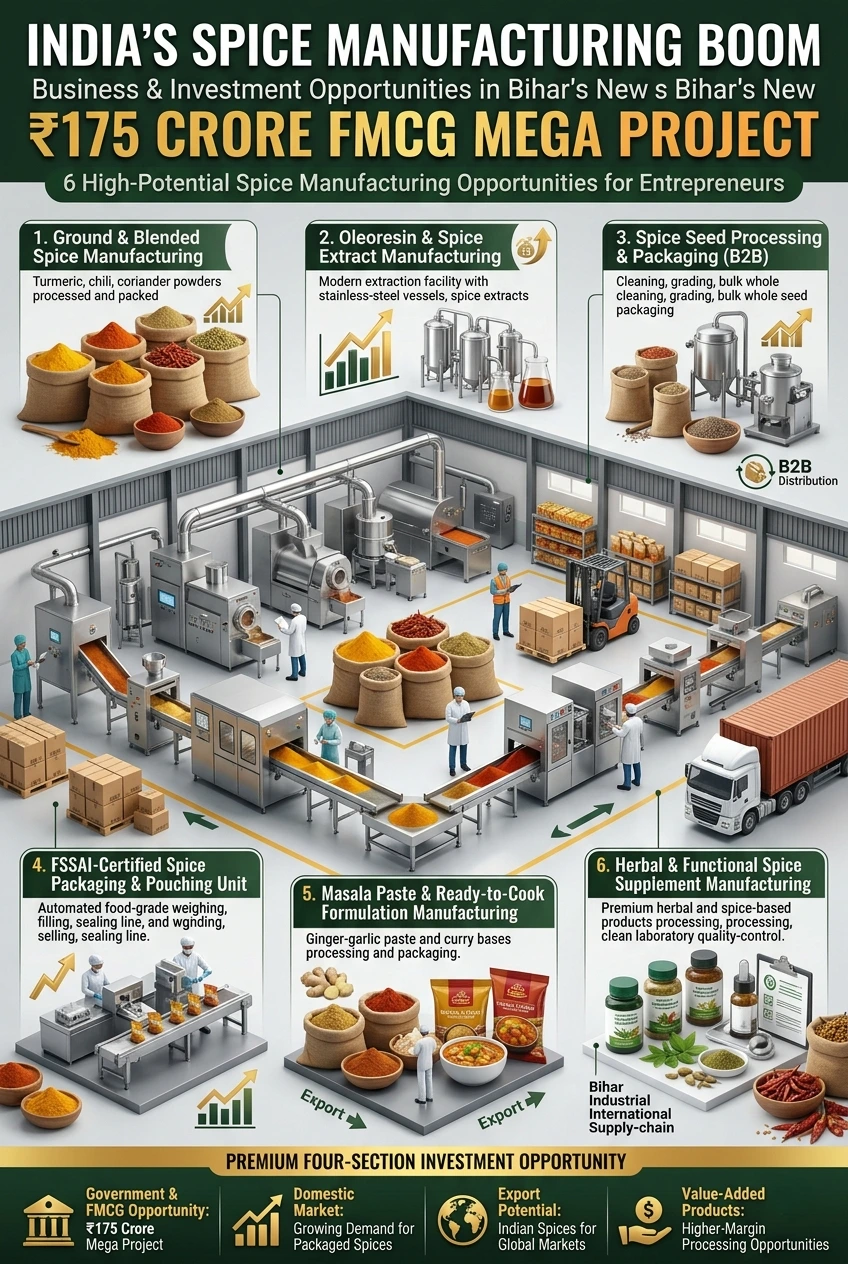
As per the Food India mega project reported in Udaipur Times, it creates the demand in an entire ecosystem. There are six promising manufacturing opportunities directly arising from this development:
1. Ground & Blended Spice Manufacturing
The most straightforward chance. Establishment of a FSSAI Licensed, GMP compliant spice grinding and blending unit catering to the need of the market of ‘HORECA’ (hotels, restaurants, catering), modern retail and export. Bihar’s proximity to raw material market of turmeric, red chilli and coriander makes economical procurement of raw material.
Total Investment: ₹50 lakh to ₹5 crore. Margin: 20-35% for branded SKUs. Must Have: FSSAI Licence, BIS for certain categories and ISO 22000 for exports.
2. Oleoresin & Spice Extract Manufacturing
The world is paying premium price for the use of Spice oleoresins (turmeric, paprika, capsicum, ginger) in food, pharmaceutical and nutraceuticals industry. India exports more than $600 million worth of the spice oleoresins each year. A higher capex (₹2-10 crore) but gross margin of 40-60% for this segment and the segment targets food ingredient buyers across the world.
The new anchor player in Bihar with the oleoresin aggregation infrastructure should make the region a cost-competitive oleoresin cluster in Eastern India.
3. Spice Seed Processing & Packaging (B2B)
The processing of whole spice seeds for cleaning, grading, moisture treatment, and bulk packing is a capital-light process requiring ₹20–80 lakh. Industrial buyers, export houses, and spice brands can use these services. Units can work as contract processors for larger brands, such as the upcoming Food India unit. This model offers an immediate B2B revenue opportunity.
4. FSSAI-Certified Spice Packaging & Pouching Unit
The form-fill-seal (FFS) packaging for spice packs, stand-up pouches, and retail packs is a growing ancillary market. Food India will import the machinery for international standard production and there will be a demand from the region for packaging suppliers who have facilities that are compliant to food grade. Setup cost: ₹40 lakh – ₹2.5 crore. Operating margin: 18–28%.
5. Masala Paste & Ready-to-Cook Formulation Manufacturing
One of the fastest growing food categories in India are wet spice pastes (ginger-garlic paste, green chilli paste, sambar masala pastes, and biryani base), retort-packaged curry base and cook-in-sauce category. Moreover, The digital platforms of retail and Quick Commerce have seized the battle of ready to cook formats with a fierce assault. Furthermore, The digital platforms of retail and Quick Commerce have swung into the ready-to-cook game with a vengeance. In addition, The availability of vegetables and spices in Bihar makes the region suitable for making wet paste for North Indian as well as export market.
6. Herbal & Functional Spice Supplement Manufacturing
The marriage of spices and nutraceuticals is fast catching on. Turmeric capsules, black pepper extract (piperine), Ashwagandha and Turmeric mixtures and ginger immunity products are available in the market via pharmacy chains, health portals, and direct to consumer channels. Gross margins of 50-70% can be gathered from a unit that makes standardised herbal-spice extracts. Investment: ₹1–4 crore.
Import–Export Opportunity Analysis
Export Markets
Indian spices are exported to more than 180 countries. Top markets include the USA, China, Vietnam, Bangladesh, UAE, UK, Germany and Australia. A spice manufacturing cluster in Bihar (if it is revived) becomes the gateway for exporting spices to Eastern India, which is now less in use than Gujarat, Maharashtra and Andhra Pradesh.
Major export markets for high-value spice products include turmeric powder (USA, Germany, Japan), chilli powder (Mexico, Malaysia, UAE), cumin (Pakistan, Iran, Europe), black pepper (USA, Vietnam, Germany), and spice blends (UK, Canada, Australia).
Exporters from Bihar can go for APEDA’s GI tagged and organic certification programmes and avail of premium pricing in international market of Rs 30-50 per kg.
Import Substitution
Dehydrated vegetables, specialty spice extracts and some food grade flavours are currently imported into India. The following areas of import substitution may be targeted through a well-equipped cluster for producing spice processing in Bihar: 1) food grade essential oil distillations (currently imported from Southeast Asian countries and Europe); 2) natural food colourants (oleoresin) for the processed food industry (currently imported from Spain, Mexico); 3) industrial oleoresin standards for the processed food industry (currently imported from Southeast Asian countries and Europe).
Related Article: Spice Processing Business Ideas in India: How the SPICED Scheme Helps You Start
International Demand Trends
There are a number of food manufacturers in the world that actively seek to use natural spice extracts and oleoresins in place of synthetic flavours. The world spice and herb market is estimated to rise from 5.6% CAGR till 2030, with India becoming the biggest supplier of the market. Traceable origin and organic certification are now compulsory for high paying retailers in EU and US.
Indian MSME Success Stories in Spice Manufacturing
1. Everest Food Products – Mumbai
2. Aachi Group – Chennai, Tamil Nadu
Started as a small spice-blending business in 1995, Aachi Masala is now a ₹2,000 crore brand with export offices in 50 countries. Aachi’s success shows how regional spice brands can compete with national FMCG giants. They can focus on authentic regional flavours and strong local distribution networks.
3. Ramdev Food Products – Gujarat
Choose the right startup backed by real market demand
About NPCS – Niir Project Consultancy Services
Since 1984 Niir Project Consultancy Services (NPCS) has been one of the premier industrial consultancy and project report suppliers to entrepreneurs, MSME, investors and financial institutions in India.
NPCS offers consultancy services for all spice manufacturing ventures from scratch such as:
- Preparation of Detailed Project Report (DPR) for bank financing, MUDRA loans and Government subsidy applications.
- Techno-Economic Feasibility Studies conducted for spice grinding unit, oleoresin unit, blending unit and export unit
- Market Research and Demand Analysis for domestic and international spice markets
- Plant layout, machine selection and sourcing of raw material advice
- Technology Consultancy for FSSAI compliance and ISO 22000 and HACCP certification
- APEDA export documentation and APEDA registration support
Industry at a Glance: Data Table
| Parameter | Details |
| Industry | Spice Manufacturing, FMCG Food Processing, Agro-Industrial |
| News Trigger | Food India ₹175 Crore Mega Project – Muzaffarpur, Bhagalpur, Sasaram (Bihar) |
| Market Driver | Organised spice demand, FMCG expansion, export growth, import substitution |
| Investment Range | ₹20 Lakh (B2B Processing) to ₹10 Crore (Branded Export Unit) |
| MSME Opportunity | Grinding, blending, packaging, oleoresin, paste, herbal-spice supplements |
| Export Potential | USA, UAE, UK, Germany, Bangladesh — over 180 export destinations for Indian spices |
| Government Support | PLI (MoFPI), PMFME subsidy, Spices Board, APEDA, Bihar Industrial Policy |
| Risk Level | Low to Medium (agri-commodity price volatility; mitigated by value addition) |
| Growth Outlook | 5.6% CAGR globally; India target: ₹1 trillion spice industry by 2030 |
Conclusion: The Spice Opportunity Is Now
Furthermore, The agricultural richness, low land and labour costs, and government support create a promising first-mover opportunity in Bihar. For instance, Land is available at ₹1, along with capital subsidies and improving industrial infrastructure. The Food India anchor project will also create supply chain vendors and raw material networks. It will set quality standards that other manufacturers must follow.
For MSME founders, the right product categories — branded ground spices, oleoresins, spice blends, herbal supplements — offer 30–60% gross margins in a market with proven domestic growth and export upside. Central government schemes (PLI, PMFME, APEDA support) reduce entry risk substantially. The Spices Board and BIADA offer direct institutional support for new entrants.
The global spice market is growing. India’s share of that growth is accelerating. And Bihar is positioning itself as the next major spice manufacturing cluster — with state policy, private capital, and agricultural infrastructure all aligned. Entrepreneurs who begin feasibility planning, secure land, and initiate licensing today will be operational when the demand wave peaks.