Small Scale Manufacturing Business Ideas
When you speak with seasoned consultants about how to get into Indian manufacturing, it is always the price range of ₹15–25 lakh in plant and machinery. In this investment zone, there is a surprising variety of business options, ranging from food processing and chemical intermediates, to light engineering and agro based manufacturing. In recent years it is not only the policy support that has changed. This has resulted in a trinity of India’s consumption pattern, export competitiveness and localisation of supply chains, which have combined to provide a truly positive environment for well-planned small-scale enterprises.
According to the Ministry of MSME, the MSME sector has more than 30% contribution to GDP and has nearly 45% share in total exports in the country. In this ecosystem, MSMEs with asset investments of less than ₹1 crore make up the largest group of manufacturers, and it is not surprising as a result. The economics at the ₹25 lakh investment level of machinery enable the entrepreneurs to run with low-capacity utilisation, work capital cycle efficiently, and scale up without compromising on equity. This article presents seven business ideas that have a proven history of market demand, produce repeatable outputs, have favorable input costs, and the government strongly supports these ideas.
Why the Small-Scale Manufacturing Segment Deserves Serious Attention
India is on a turning point in its industrial trajectory. Domestic manufacturing is strategically crucial because of the government’s production-linked incentives, the “China-plus-one” sourcing strategy of global buyers and the fact that the domestic consumption base has 1.4 billion people on an expanding income. At the micro level, benefits continue with reduced regulatory hassles, priority sector lending, and a well-established vendor and distributor network.
The difference between manufacturing and trading/service businesses is the margin. A small-scale well-managed plant with a 60–70% capacity utilization rate can provide a net margin of 15–25%, subject to the product and sourcing of input. This is a sector that trading can’t beat – for entrepreneurs who have limited capital but strong local market knowledge.(Small Scale Manufacturing Business Ideas)
Also, the investment limit of ₹25 lakh is ideally suited for the loans availed through CGTMSE, where micro and small enterprises can avail of collateral-free loans of up to ₹2 crore. This is opening up the financial gate easier than most first generation entrepreneurs realize.
Government Policies and the Incentive Landscape
The policy landscape for small-scale manufacturing has become more well-developed. The government has introduced a range of schemes directly geared towards the entrepreneurs in this investment band directly operated by the Ministry of MSME. Key programmes include:
- The CGTMSE scheme is a collateral-free micro and small enterprise working capital and term loan scheme for up to ₹2 crore.
- PM FME Scheme — 35% credit linked capital subsidy for food manufacturing units by the Ministry of Food Processing Industries.
- PLI Scheme — Small-scale component and input manufacturers were encouraged through the DPIIT by administering it across 14 champion sectors, which resulted in the creation of indirect demand for such manufacturers.
- NSIC — Assist small manufacturers with raw materials, credit and marketing.
- KVIC — Provides funding and tie-ups with markets for agro-based, food & village industry projects.
Entrepreneurs are also recommended to check out refinancing options through the SIDBI MSME portal and industry benchmarking through CII MSME resources. Moreover, state governments can offer incentives such as power tariff subsidies, allotment of land in industrial estates, and SGST subsidy reimbursement, which can reduce the payback period of plant investments by 18–24 months. (Small Scale Manufacturing Business Ideas
Manufacturing Business Ideas for Startups: Sector-by-Sector Analysis
1. Spice Processing and Blending Unit
India is the biggest producer, consumer and exporter of spices in the world! However, a substantial part of the domestic demand is met by unorganized vendors having very little value addition. You can set up a spice processing and blending plant comprising a grinder, pulveriser, blending drum, a packaging line, and cleaning equipment with an investment in plant and machinery of less than ₹20 lakh.
The real opportunity is not only grinding commodity spice powder but also creating proprietary blends of spices such as biryani powder, sambar powder, curry paste etc. which fetch 3-4 times the spread as commodity spices. FSSAI registration is relatively easy and e-commerce is now providing direct brand-to-consumer channels. Further, there are export opportunities for Southeast Asian and Middle Eastern countries with consistent quality certification from the Indian export market for spice mixes.(Small Scale Manufacturing Business Ideas)
Read the Complete Book Here: Handbook on Spices, Seasonings and Condiments Processing, Extraction with Kitchen Spices Manufacturing
2. Agarbatti (Incense Sticks) Manufacturing
Domestic as well as export market of Agarbatti products is structurally strong due to religious, aromatherapy and wellness market segment. A simple manufacturing line which consist of a mixing unit, automatic rolling machine, drying room and packaging station can be placed in a ₹15-18 lakh investment.
The key factor that differentiates the fragrance formulation. Manufacturers with the investment in proprietary scent profile and longer burn-time compositions are able to achieve much higher realisations as compared to commodity manufacturers. The bamboo sticks, the charcoal powder, the jigat powder, the fragrance oils used in this process are locally available raw materials, so as to limit the variations in input costs. Besides, KVIC has supported agarbatti clusters since time immemorial, and some State Governments have identified this sector as an area eligible for reservation and credit subsidies. (Small Scale Manufacturing Business Ideas)
3. Paper Plate and Disposable Packaging Manufacturing
Governments and businesses have managed the shift toward reducing single-use plastics effectively, which has led to continuous demand for paper-based disposable tableware. The commissioning of a paper plate, cup and bowl manufacturing unit with a hydraulic forming press, die-cutting machine and embossing machine can cost ₹20 – 22 lakh for machinery.
You can find it in the market and much beyond consumer retail. Institutional buyers (such as QSR chains, catering services, hospitals, and airline caterers) buy in large quantities and margins are predictable. Businessmen who are able to sell B2B can set up supply contracts with the regional distributors in mere months after commissioning. Units that obtain their mill raw material supplies directly at volume discounts enjoy a big competitive edge over other units sourcing it through intermediaries.
Related Article: Biodegradable Packaging Manufacturing: India’s ₹10,000 Crore Sunrise Opportunity Post-Plastic Ban
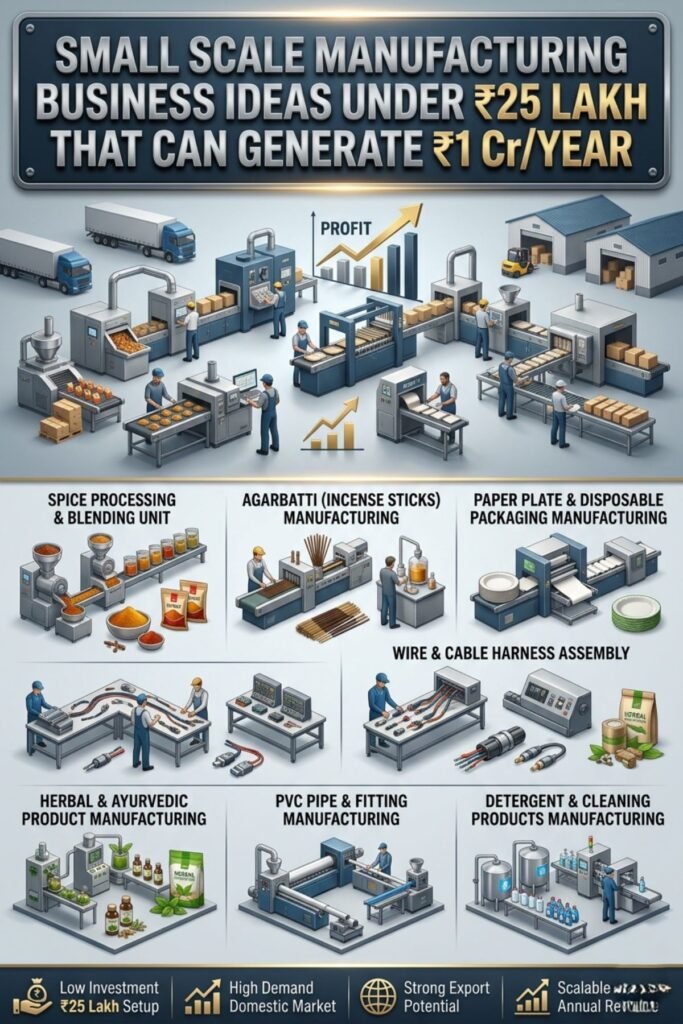
4. Wire and Cable Harness Assembly
Due to the rapid growth of automotive industry, construction activity and high penetration of consumer electronics in India, there is a shortage of mid-volume wire harness and cable assembly manufacturers. The cost of a small-scale assembly unit with crimping machines, wire cutting and stripping machines and testing equipment in range of ₹ 20-25 lakh.
Useful for Tier-2 or Tier-3 suppliers for electrical panel manufacturers, auto ancillary units and HVAC manufacturers. It is a knowledge-based enterprise where precision and control of rejection rates matter far more than scale. In other words, entrepreneurs who invest early in strong quality systems create durable competitive barriers. The working capital cycle remains relatively short, and once the company assures quality, it typically builds long-term vendor relationships with buyers.
5. Herbal and Ayurvedic Product Manufacturing
This transition towards natural products in the health and wellness sector, which has been accelerated by the pandemic, has resulted in a redefined demand landscape for herbal formulations, ayurvedic supplements and plant-based personal care products. Blending equipment, filling lines and labelling machines are the basic equipment to be placed in a manufacturing unit to produce herbal juices, churnas, immunity boosters or herbal hair oils — and they can be set up within ₹20 lakh.(Small Scale Manufacturing Business Ideas)
The regulatory pathway is much lighter in the case of micro scale units as compared to pharmaceutical manufacturing and AYUSH licensing is feasible. More importantly, this is a category where the branding is a key determinant. When you execute packaging design and product storytelling well and early, you can charge a higher price for a product even at low production volumes. The market has also been further democratized with direct-to-consumer digital channels for new brands.
Detailed Project Report (DPR): Handbook of Herbs, Ayurvedic Medicines and Herbal Products
6. PVC Pipe and Fitting Manufacturing
Local/regional demand for PVC pipes, conduits and fittings is steady from infrastructure spending, such as urban housing, Jal Jeevan Mission, agricultural irrigation etc. An extrusion line of simple PVC pipe consists of an extruder, die, cooling tank, haul-off unit, cutting machine can be obtained in the range of ₹22-25 lakh.
Generally, The business model normally entails selling to hardware distributors or plumbing contractors, or government project subcontractors who have a history of purchasing and predictable payment schedules. Additionally, Resin cost management is the key operational metric. PVC pricing tracks crude oil derivatives. During commodity cycles, companies that time raw material purchases at the lowest price can improve gross margins by 3–5 percentage points.
7. Detergent and Cleaning Products Manufacturing
Household and industrial cleaning is still one of the most profitable and cost-effective lines for FMCG manufacturing. A small-scale detergent powder/liquid detergent manufacturing plant consisting of mixing reactors, filling machines, pouch/sachet packaging line comes within ₹18-22 lakh investment in plant.
The formulation chemistry is well established and the raw material base including LAB, sodium sulphate, soda ash and builders are readily available from chemical distributors. This commercial opportunity is especially good in Tier-2 and Tier-3 markets where local brands such as budget detergents are price competitive and locally relevant against national brands. The differences between institutional product lines of cleaning products for hospitals, hotels, and food processing units yield better margins on a per-unit basis and longer contract terms than do consumer retail.(Small Scale Manufacturing Business Ideas)
Import–Export Opportunity Analysis
First-generation entrepreneurs have a systematic underestimation of the trade aspect of small-scale manufacturing. But, in some product categories mentioned in this article, export markets can provide better realisations and more stable volume.
Consider the following export opportunities:
- Spice blends, masala products — steady demands in the UAE, UK and North American markets.
- Herbal and ayurvedic formulas — sell at a premium price in European health and beauty stores.
- Multi-hundred crore export opportunity to Southeast Asia and Africa in Agarbatti, which is still largely dominated by small players in India.
In terms of imports, India still imports a large amount of paper packaging intermediates, wire harness components, and specialty cleaning chemicals from China and Southeast Asia. Small scale manufacturers, who can meet technical standards and supply with reliable delivery and competitive pricing are well placed to meet this domestic replacement demand. Tools such as buyer-seller meets, market intelligence reports and export promotion subsidies are provided by the FIEO (Federation of Indian Export Organisations) that new manufacturers ought to make use of for export facilitation.
Indian MSME Success Stories: Lessons from the Ground Up
Parag Milk Foods — Devendra Shah
Parag Milk Foods started out as a small-scale dairy processing company in Pune and eventually became one of India’s top branded milk companies. Moreover, The central idea of Shah’s was to shift from commodity milk procurement and develop processing capacity – which includes cheese, ghee and whey protein – that would generate brand value. The small-scale manufacturer has the lesson: margins are much better preserved by processing depth and product differentiation than by competing on raw commodity volumes. Consequently, The investment in the early stage of cold chain infrastructure and quality systems laid the foundation for national scale.(Small Scale Manufacturing Business Ideas)
Haldiram’s — Shivchand Agrawal Family
Firstly, Haldiram’s started as a small-scale namkeen manufacturing unit in Bikaner, and expanded into an industry with relentless attention to product consistency, aggressive building of retail channels and smart geographical expansion. Moreover, The turning point towards national distribution was the investment in packaging and shelf-life extension technology, as opposed to a traditional artisanal approach. Consequently, Haldiram’s success, achieved by utilising the organised wholesale channel to first establish market presence and later build consumer advertising, can serve as a blueprint for all new food manufacturing entrepreneurs.
Jyothy Laboratories — M.P. Ramachandran
Firstly, With a small machine in Kerala and a small amount of capital, M.P. Ramachandran started Jyothy Laboratories with a single cleaning product, Ujala fabric whitener. Moreover, His strategy mainly focused on deep rural distribution, which national brands were neglecting, as well as addressing the issue of very high pricing that was beyond household affordability. Therefore, The lessons for new entrepreneurs come from Ramachandran’s distribution system. Additionally, He directly managed the salesmen instead of relying on distributors, and this approach gave him a strong understanding of consumption patterns, unlike his competitors.(Small Scale Manufacturing Business Ideas)
Project Feasibility Evaluation: Getting the Numbers Right Before You Invest
Moreover, Investing funds into any production venture could be the distinction between a profitable launch and a costly failure, and frequently it boils down to the standard of pre-investment analysis. The manufacturing entrepreneurs that we work with go through exactly this screening phase at Niir Project Consultancy Services (NPCS), where we provide them with a realistic picture of the requirements of their business and what it can produce using a detailed Market Survey cum Techno-Economic Feasibility Reports (DPRs).
Our DPRs include:
- Granular manufacturing process documentation and process flow diagrams.
- Demand and market sizing analysis with competitive landscape assessment.
- Machinery selection and raw material sourcing details.
- Full project financials including profitability projections, payback period analysis, and sensitivity modelling.
In a segment where undercapitalization and poor market sizing are the two leading causes of early failure, a credible DPR is not an optional document — it is the foundational investment protection tool.
Find high-return business ideas based on your budget & ROI
Indicative Project Economics: Small-Scale Manufacturing at ₹25 Lakh Machinery Investment
| Business Segment | Machinery Cost (₹ Lakh) | Annual Revenue Est. (₹ Lakh) | Gross Margin (%) | Approx. Payback (Years) |
| Spice Processing & Blending | 12–18 | 60–90 | 28–35% | 2.0–3.0 |
| Agarbatti Manufacturing | 15–18 | 55–80 | 22–30% | 2.5–3.5 |
| Paper Plate & Packaging | 18–22 | 80–120 | 20–28% | 2.0–3.0 |
| Wire & Cable Harness | 20–25 | 90–140 | 18–25% | 2.5–4.0 |
| Herbal & Ayurvedic Products | 14–20 | 70–110 | 30–40% | 1.5–2.5 |
| PVC Pipe & Fittings | 22–25 | 100–160 | 15–22% | 3.0–4.5 |
| Detergent & Cleaning Products | 16–22 | 65–100 | 22–32% | 2.0–3.0 |
Note: Revenue and margin estimates are indicative, based on 60–70% capacity utilisation. Actual figures depend on product mix, local market conditions, and operational efficiency.
Frequently Asked Questions
Q1. Is it possible for an investment of 25 lakh in plant & machinery to commence a profitable manufacturing business?
Yes- the types of businesses discussed in this article find the machinery investment of 25 lakh to be a useful investment inflection point. The challenge here lies in choosing product areas in which the machinery to turnover leverages is most favourable and where working capital is readily available with the distribution channels are attainable without high marketing expenditures. The product segments like spice processing, herbal products and cleaning products will be profitable in 12 to 18 months’ period at this investment level.
Q2. What licenses and registrations do a small manufacturing unit require?
The core registrations are the MSME’s Udyam Registration; GST Registration; and product-specific licenses – FSSAI for food products; the AYUSH license for herbal/ayurvedic products; and product-specific certification likeBIS for some products such asPVC pipes. Depending on the product being manufactured, consent will be needed from the respective State Pollution Control Board if there are process emissions or effluents to deal with. For the majority of the categories covered, registration procedures are relatively straightforward and can be done within 30 to 60 days’ period.
Q3. How should a first-generation entrepreneur approach distribution for a new manufacturing brand?
One common mistake that first-generation entrepreneurs make is trying to set up consumer retail presence before having a stable B2B revenue stream. An entrepreneur entering this business should try to focus on institutional and dealer sales in the first 18 to 24 months as this channels provide volume, cash flow and product feedback that will aid in development, without the same brand marketing expenses. Once a new product gets well established with steady manufacturing and acceptable levels of quality, transition to branded retail is possible with the base of stable operations.
Q4. Are bank loans available for establishing a small manufacturing unit, and if so, what collateral will I need?
Under the Credit Guarantee Fund for Micro and Small Enterprises (CGTMSE), collateral-free loans of up to 2 crores are available to micro and small enterprises from all the scheduled commercial banks and non-banking financial companies. This scheme provides a credit guarantee cover to the bank that takes the lending burden, thereby eliminating the need for a borrower to provide collateral like personal or third-party property. Moreover, loans on attractive interest rates for specific industries are available from various state credit guarantee schemes and the direct lending products of the Small Industries Development Bank of India (SIDBI). A bankable DPR is likely to raise the chances of your loan approval significantly.
Q5. What is the role of a feasibility report before investing in a manufacturing plant?
The purpose of the Techno-Economic Feasibility Report (DPR) is to establish the viability of the proposed business and to outline the gap between entrepreneurial intent and operating reality. It includes the manufacturing process detail and the choice of machinery, procurement of raw materials, market analysis and demand estimation, competitor analysis, required licenses and certifications, the initial project capital cost estimate, and projections of return on investment, net present value and payback period of the investment. This report can be crucial to the first-generation entrepreneur both as a tool for investment and also as an aid when applying for loans and government grants.
Q6. Between all the business types shown, which ones can deliver quickest return on investment?
Based on generally accepted average curves for plant utilization and margin profiles across the manufacturing business types discussed, herbal and Ayurvedic product manufacturing is likely to deliver the fastest return on investment. This is mainly due to a good margin range (30-40%) in the branded wellness industry and a high margin ratio compared to capital costs. Spice processing and detergent manufacturing would come next in terms of quick returns (2–3-year payback period under normal circumstances). However, the overall outcome depends on many more factors such as market conditions and the marketing and execution ability of the entrepreneur.
Final Thoughts: Turning a ₹25 Lakh Plant Investment into a ₹1 Crore Business
Small manufacturing business is not a trade-off; it’s a conscious entry point. What unites the 7 small manufacturing business ideas mentioned in this article is that each has a defensible market space, an accessible investment entry point, and a path from pilot stage production to scalable commercial production.
The entrepreneurs who thrive in this domain share 3 traits. They invest time in building market understanding before purchasing the first machine. Build a revenue base through B2B first before they chase the retail shelf space. They regard the quality system and process documentations as assets, not as liabilities. And therefore, the 25-lakh investment barrier is not a hindrance but an important filter that reward systematic, market-intelligent founders.(Small Scale Manufacturing Business Ideas)
The manufacturing opportunity for the MSME sector in India have never been larger nor well supported with policy frameworks. As a result, the only question is that the MSME manufacturing opportunity for entrepreneur in India exists- it very clearly does. The question for an entrepreneur is whether he or she can objectively evaluate an opportunity, plan it thoroughly, and execute it with operational discipline. This ability distinguishes businesses that thrive in the long term from those that are simply well-intentioned initiatives.