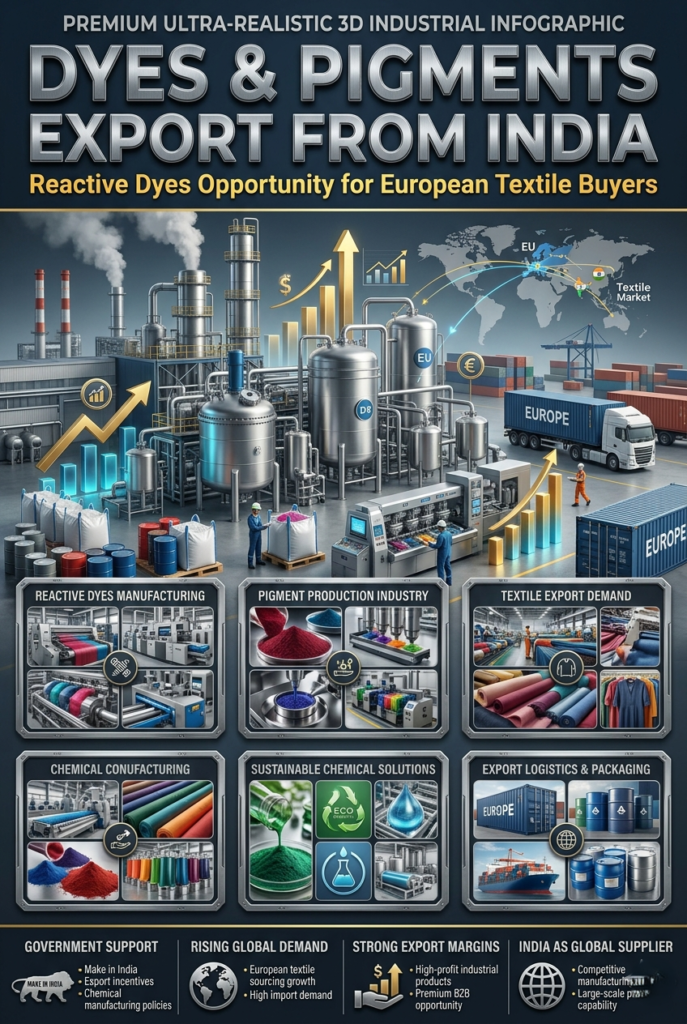
The chemical manufacturing industry in India is moving into a strong export growth trajectory and the reactive dyes are one of the most promising areas in the industry. European textile companies are actively looking for dependable sources other than the Chinese textile industry, whereas the Indian textile industry is working on increasing production capacity, enhancing quality systems, and boosting compliance. This synergy is opening a big opportunity for Indian MSMEs to venture into the export of reactive dye business.
As per the latest report released by Ministry of Chemicals and Fertilizers India is moving ahead in its position in the international market with production of dyes and pigment. Reactive dye segment continues to be the biggest in the market with excellent export demand and increasing capacity.
Get Detailed Insights from This Book: Modern Technology of Textile Dyes & Pigments (3rd Edition)
Why Europe Is Buying More Reactive Dyes from India
European textile factories are under growing pressure to operate. Procurement managers also want to de-Chinesify their supplier bases as energy costs stay elevated, environmental regulations are tightening and the push to create solar energy systems is accelerating. Manufacturers in India are emerging as the preferred choice due to their competitiveness in price, as well as their enhancement of compliance systems.
Gujarat has the biggest chemical ecosystem as a manufacturing edge. The cities such as Ahmedabad, Surat, Ankleshwar and Vapi have evolved into the major hubs of the reactive dyes industry owing to access to important dye intermediates and export facilities.
Indian suppliers offer a number of advantages to European buyers:
- With improved cost competitiveness in comparison to European production.
- Easier factory audits, transparency in the supply chain.
- Strong availability of dye intermediates like H-acid and vinyl sulphone
- Growing focus on REACH compliance and ESG standards
The change is creating fresh export opportunities for the mid-sized manufacturers of the Indian industry.
Reactive Dye Market Opportunity in India
Reactive dyes are used mainly on cotton and cellulosic fibres as they are capable of good wash fastness and strong colour fixation. European apparel brands and textile processors are still interested in the product, despite the fact that it is cost effective, as quality and consistency are now more important than low pricing.
Currently, India has high unutilised capacity in the dye segment, the reactive dyes, which can provide an opportunity to establish new manufacturing enterprises for exports.
India Reactive Dyes Industry Snapshot
| Segment | Installed Capacity | Production | CAGR |
| Reactive Dyes | 278,030 MT | 163,680 MT | 5.5% |
| Disperse Dyes | 90,380 MT | 68,770 MT | 7.3% |
| Acid/Direct Dyes | 46,000 MT | 22,510 MT | 2.7% |
The report is based on the Government of India Chemicals Sector Report.
Related Article: Spandex / Elastomeric Yarn Manufacturing in India: 32% CAGR Textile Opportunity
Best Business Opportunities in Reactive Dye Manufacturing
The best export prospects for the present are for bifunctional reactive dyes for processing cotton. The products have high durability and wash performance, which is preferred by European textile mills.
There is a potential to make decent profit in a mid-sized manufacturing plant after getting certifications and buyer’s acceptance for the manufacture of exportable Reactive dyes.
Fast-Growing Segments
1. Bifunctional Reactive Dyes
The color performance of these dyes is superior, so that cotton processing units in Europe and Turkey use them extensively.
2. Eco-Certified Reactive Dyes
Sustainable Textiles are gaining market importance in Europe. The organic apparel brands need GOTS compliant and eco-friendly dye chemistries.
3. Reactive dyes for wool and silk
The high-quality reactive dyes for wool and silk processing applications are still imported into Italy for luxury textile clusters.
Investment Required for a Reactive Dye Export Unit
Although the bottom line for making reactive dyes is good, it does take careful (financial) planning. There is a lot of underestimations of working capital requirement of export enterprises by many first-generation entrepreneurs.
Estimated Project Cost
- Plant & Machinery: INR 3–5 Crore
- Effluent Treatment Plant: INR 1 – 1.5 Crore
- REACH & Certification Costs: INR 50-80 Lakhs
- Debt to Equity ratio: 0.65:1
European buyers typically have a 60-to-90-day payment term, making it crucial to have cash on hand to keep your business alive.
Access Complete Business Plan: Technical Textiles in Agrotech, Buildtech & More
Biggest Challenges in Reactive Dye Exports
There are operational and regulatory risks in the industry, though there is good potential.
Major Risks Include:
- Political uncertainty and risk in the Middle East and other hotspots
- High compliance standards for REACH in Europe
- Delays in receiving payment from foreign customers
- Often high effluent treatment and environmental compliance costs.
When producers don’t take action to control these risks, they can find themselves in a difficult situation even with robust production capabilities.
Why REACH Compliance Is Essential
One of the foremost hurdles for Indian exporters wanting to go to Europe is REACH compliance. Buyers demand a lot of chemical safety documentation prior to approving suppliers.
The successful exporter should ensure that the following is maintained:
- Product traceability systems
- Environmental documentation
- Safety testing records
- ISO-certified quality systems
Compliance readiness is a prerequisite for even low-cost manufacturers to obtain repeat export orders.
Choose the right startup backed by real market demand
How NPCS Helps Entrepreneurs Start Reactive Dye Projects
Proper technical and financial planning is crucial before investing in a reactive dye manufacturing plant. This is where Niir Project Consultancy Services (NPCS) can make a significant contribution.
NPCS prepares detailed project reports (DPRs) for chemical and dye manufacturing companies and feasibility studies. Their reports enable entrepreneurs to know:
- Manufacturing process selection
- The planning of machinery and equipment.
- Raw material sourcing
- Financial projections
- Profitability analysis
- Market demand assessment
- Compliance and regulatory requirements
A professionally prepared DPR will help first generation MSME promoters to better plan their projects and make them more credible to banks and financial institutions.
Future of Reactive Dyes Export India
India’s dye export industry is very bullish on long-term prospects. Europe’s textile industry is craving for reliable, REACH compliant suppliers and India’s specialty chemicals industry is enhancing its capabilities.(Reactive Dyes Export India)
There are a number of structural trends that will aid growth:
- China+1 sourcing from Europe.
- Increase in the demand for textiles with sustainability focus
- An Indian government policy to support chemical manufacturing
- Industrial development in Gujarat
But it’s a business that’s built on patience and consistency, not on the fast pace of growth. Successful exporters are those that have been emphasizing on building long term buyer relationships, quality control systems from the outset and compliance systems.
Infrastructure is already in place in India. European demand is sure to grow. MSME entrepreneurs who are willing to invest strategically in the manufacture of Reactive dyes in 2026 will get one of the best opportunities in the chemical sector.
FAQ — Reactive Dyes Export India
What is the unit of the smallest investment of a reactive dye export unit?
The amount of money required for a small export unit is INR 6–9 crore, which includes the cost of machinery, certification, effluent treatment, and working capital.
What is driving the transition of European buyers towards the Indian dye manufacturers?
European companies want to source from more countries, at lower cost and have more visibility to their supply chains than if they stayed solely with China.
What are the best states for the production of Reactive dye in India?
Gujarat is the top state owing to its solid chemical industry ecosystem and export facilities.
Do products need to be REACH compliant for exporting to Europe?
Yes. In the absence of REACH compliance, it is very difficult to export reactive dyes to Europe.
So, is the business of Reactive Dye profitable for MSMEs?
Yes. In the case of export grade dyes, good operating margins can be achieved if the quality and compliance requirements are adhered to.
What are you struggling with the most in this business?
Meeting with regulatory standards and managing fluctuating costs of raw materials, particularly the long terms of payments on exports.