India Oman CEPA export Business Ideas
The Agreement That Changes the Math for Indian Exporters
Prior to the implementation of India–Oman CEPA on 1st June 2026, only 15.33% of Indian exports landed in Oman duty-free. All other were subjected to MFN tariffs. That number rose to 99.38% overnight. Not phased in for more than five years. Not subject to quotas. From the first day on.
Oman’s total import market amounts to almost USD 28 billion. India, despite its proximity and historical linkages of trade, is just a part of that. The CEPA is more than an open door, it’s a removed wall. This is not a policy declaration to read and forget for the right Indian startup or MSMEs. It’s a viable, market entry option which competitors from China, Italy, Thailand, and Turkey can’t beat. They continue to pay duties. You don’t.
The press release from the Ministry of Commerce & Industry press release (PIB, June 2026), the agreement will unfreeze 127 services sub-sectors and will include binding provisions for professional mobility for engineers, doctors, IT professionals, and educators. It’s not a two-way exchange. It is a launchpad.
Related Article: India-Oman CEPA: The Trade Gateway Every Indian Exporter Has Been Waiting For
The Gap Between India and Oman Is Bigger Than It Should Be
The bilateral trade in FY 2025-26 stood at USD 11.18 billion, an increase from USD 10.61 billion in 2024-25. Sounds good, but when you look at the numbers it’s not. Oman imports USD 1.07 billion worth of gems and jewellery annually. India alone contributes USD 25.78 million of this. The size of the pharmaceutical market in Oman was USD 302.84 million and was growing at an annual rate of 6.6% — now, with Indian pharma companies, this is no longer a matter of waiting for regulatory hurdles.
In the electronics sector, Oman imported USD 1.7 billion worth of goods only USD 146 million were supplied by India. In the products of marine, Oman imports USD 35.3 million, while India provides only USD 10 million. They are not problems concerning a particular sector. These are entry-level jobs.(India Oman CEPA export Business Ideas)
According to data provided by Agricultural and Processed Food Products Export Development Authority (APEDA), the agri exports to Oman from India have been increasing at 12.36% CAGR. But tariff disadvantage means that even products like honey, cashews, basmati rice and processed food will fail to realize their potential. That is now over.
Non-tariff barrier removal is not something to be taken lightly for Indian MSMEs. Oman will no longer require duplicative testing by the Export Inspection Council (EIC), in its ports, which had caused delays and cost. Organic certification is also accepted in India by NPOP. This cuts down time to market for food, pharma and agri-processed start-ups to a great extent.
Table 1: India–Oman Trade Gap by Sector (Current vs. Potential)
| Sector | Oman’s Total Import Market | India’s Current Export | Gap / Potential | CEPA Duty Change |
| Gems & Jewellery | USD 1.07 billion | USD 25.78 million | ~USD 124 million headroom | 5% → 0% (Day 1) |
| Electronics & Engineering | USD 1.7 billion | USD 146 million | ~USD 1.55 billion headroom | Up to 5% → 0% |
| Marine Products | USD 35.3 million | USD 10 million | USD 25+ million untapped | Up to 5% → 0% |
| Pharmaceuticals | USD 302.84 million | Low penetration | Growing at 6.6% CAGR | Zero duty + 90-day approval |
| Agri & Processed Food | India holds 17.8% share | USD 552.85 million | 12.36% CAGR growth | Duty eliminated on key items |
| IT & Professional Services | USD 12.52 billion (services) | 5.31% share only | USD 1.1 billion+ headroom | 127 sub-sectors opened |
| Textiles & Apparel | Part of USD 28 bn imports | Growing MSME cluster | Labour-intensive potential | Full tariff elimination |
| Halal Food Products | Gulf-wide USD 2+ billion | Under-penetrated | NPOP & halal cert accepted | Zero duty + cert recognition |
Source: PIB, Ministry of Commerce & Industry, June 2026
Eight Business Ideas That Make Sense Right Now
Here’s the list of eight export-centric startup ideas that can be made possible with CEPA. They are all aligned with a genuine demand shortfall, with a specific Indian productivity level, and with one scheme offered by the government that will lower your start-up costs.(India Oman CEPA export Business Ideas)
1. Silver & Gold Jewellery Manufacturing (Export Unit)
The jewellery imports market is USD 1.07 billion in Oman. The current share of India is USD 25.78 million. That is a 97% gap. Clusters already do produce for export in Jaipur (silver jewellery & gemstones) and Surat (diamonds) but mostly to the US and UAE. The Jaipur/MSKOLKATA-based jewellery MSME now has a structural price edge over its Italian and Turkish competitors thanks to the removal of the import duty imposed by CEPA on the import of the same from Oman. According to the gems and jewellery sector report of FICCI, India is one of the 29% of the global exporters of polished diamonds. This is the infrastructure, which is ready. It’s really just a matter of redirecting it.
Government Scheme: PMEGP (Prime Minister’s Employment Generation Programme) provides capital subsidy up to 35% in manufacturing in rural area. Qualifying are jewellery making units having an investment up to INR 50 lakh. Apply through the KVIC portal.
2. Processed Marine Products (Shrimp & Fish Exports)
India imports just 28% of the Oman’s marine market. There is no duty in place and Marine Products Export Development Authority (MPEDA) actively promoting the development of processing infrastructure, a shrimp processing unit in coastal Andhra Pradesh or Kerala is ready to focus on the seafood supply chain in Oman’s retail and hospitality sector. The tourism industry in Oman is growing, hotels and restaurants require frozen shrimp, processed fish fillets and value-added seafood. India’s APEDA and MPEDA certifications have been accepted at Omani ports in direct.(India Oman CEPA export Business Ideas)
Under Government Scheme, Pradhan Mantri Matsya Sampada Yojana (PMMSY) provides subsidy of up to 40% towards the cost of investment in cold chain and processing unit for SC/ST/women entrepreneurs and 20% for general category entrepreneurs. Units in coastal states are prioritised.
3. Generic Pharmaceuticals & Nutraceuticals
The breakthrough in regulation is the story here. Products that have been approved by the USFDA, EMA, UK MHRA, or TGA must be granted marketing authorisation within 90 days by CEPA. Presently, Hyderabad, Ahmedabad, and Baddi (Himachalus Pradesh) have many pharmaceutical SMEs who are already manufacturing WHO-GMP certified generics. Until recently, delays of 12–18 months prevented market entry. That obstacle has been removed. Indian pharma exports to the Gulf could see a 18% annual growth rate after CEPA, says P Pharmexcil (Pharmaceuticals Export Promotion Council of India).
Government Scheme: Production-Linked Incentive (PLI) Scheme for Pharma provides / incremental sales with 3–10% incentives. Specific product categories apply to small units, in bulk drugs and formulations.
Get Detailed Insights from This Book: Drugs & Pharmaceutical Technology Handbook
4. Halal Certified Processed Food & Beverages
Oman has accepted in principle the Indian nationalized organic certification and halal certification systems within CEPA. This is a significant commercial. India is now the sole exporter of bovine meat to Oman, accounting for more than 94% of the imports, while India’s share of fresh eggs imports is 98% of the total imports. The next frontier is ready-to-eat meals, biscuits, packaged spices, flavoured dairy substitutes, all branded and halal certified, on the retail shelf in the Gulf. The Uttar Pradesh, Maharashtra and Gujarat governments have formed food processing clusters that certify food as halal.(India Oman CEPA export Business Ideas)
Pradhan Mantri Kisan SAMPADA Yojana (PMKSY) is a government scheme that provides up to 35% grant assistance on project cost (up to INR 5 crore for cold chain and INR 10 crore for mega food parks) for food processing units. Apply via the Ministry of Food Processing Industries.
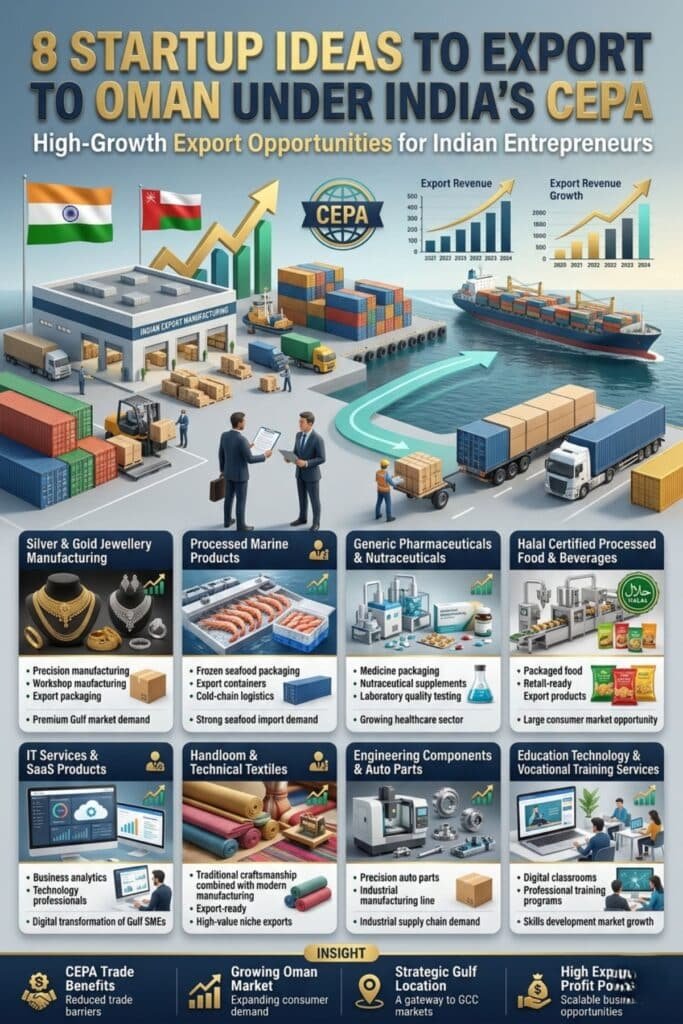
5. IT Services & SaaS Products for Gulf SMEs
Oman has a USD 12.52 billion services market and India contributes just 5.31% to the total market. CEPA will open 127 services sub-sectors for Oman with binding quotas for ICT workers increased from 20% to 50%. Oman’s SME base is an unexploited market for the Indian IT startups to develop SaaS solutions for accounting software, ERP for retail, logistics management, HR tools, etc. Along with a booming startup ecosystem, Oman Vision 2040 is rapidly promoting digitalization. Indian companies now already existing in UAE and Bahrain can now enter Oman with legal certainty with CEPA.(India Oman CEPA export Business Ideas)
The Government Scheme and the NASSCOM 10,000 Startups provides tech startups facilitation in terms of incubation, market access, and export. IT units can get 100% income tax exemption for the first 10 years through the Software Technology Parks of India (STPI).
6. Handloom & Technical Textiles
Oman’s import tariffs on textiles are now eliminated. Clusters that are already producing for the Gulf market in Bhiwandi, Ludhiana, Tirupur and Surat are labour-intensive. This price advantage is provided to these units over Bangladesh and Vietnam, which continue to impose MFN tariffs. In addition to clothing, technical textiles such as filtration fabrics, flame resistant work wear and construction geotextiles are being sought after as infrastructure investments are increasing in Oman. The Textile Export Promotion Council (TEXPROCIL) are actively promoting connections with the markets of the Gulf.
The government scheme is PLI Scheme for Textiles which covers man-made fibres and technical textiles. PM MITRA Mega Textile Parks are available to smaller investment as well with the state level sub schemes but minimum investment threshold has fixed at Rs 100 crore.(India Oman CEPA export Business Ideas)
7. Engineering Components & Auto Parts
In FY 2025-26, India’s engineering exports to Oman amounted to USD 875.83 million. CEPA estimates that will reach USD 1.3–1.6 billion. The gap is in the field of small and mid-sized precision engineering components such as castings, forgings, CNC-machined parts for oil & gas equipment and auto ancillaries. Natural clusters of sourcing are Rajkot (castings), Ludhiana (auto parts) and Pune (engineering components). Oman’s industrial zones (Duqm and Sohar) are expanding and require inputs for the machines.
Government Scheme: Engineering Export Promotion Council (EEPC India) offers export market development grants and facilitation of buyer-seller meet. The amount of loan sanctioned for upgrading of machinery under MUDRA (Kishor) and Tarun is INR 10 lakh and INR 10 lakh – 50 lakhs respectively.
8. Education Technology & Vocational Training Services
Oman has for the first time, in any bilateral FTA, committed to binding rules for the Indian professionals in the field of education, engineering, medicine, IT, and construction. If you are an Indian edtech company looking to create Arabic-English bilingual curriculum solutions, vocational certification solutions, or corporate training programs, you have a clear path to enter into Oman’s market. Startups in India can enter the Oman market legally with Arabic-English bilingual curriculum solutions, vocational certification solutions or corporate training solutions. The Omanisation policy of Oman Vision 2040 is where the Indian education service companies can focus their B2B (training government workers) and B2C (preparing exam) activities.
Choose the right startup backed by real market demand
Government Scheme: Startup India’s International Market Access is mentorship and market entry support for startups in the service sector. MEITY Funded EdTech Product Development through Digital India Mission incubators in Bangalore, Hyderabad, Pune.
Table 2: Setup Investment Guide for Each Business Idea
| Startup Idea | Min. Investment (INR) | Space Required | Key Licences | Time to First Revenue |
| Jewellery Export Unit | ₹20–₹60 lakh | 500–1,000 sq ft | BIS hallmark, GST, MSME Udyam, EIC | 4–6 months |
| Marine Processing Unit | ₹50 lakh–₹2 crore | 2,000–5,000 sq ft | FSSAI, EIC, MPEDA, Factory Licence | 6–9 months |
| Generic Pharma SME | ₹1–₹5 crore | 3,000–8,000 sq ft | CDSCO licence, GMP cert, WHO-GMP | 9–15 months |
| Halal Processed Food | ₹30 lakh–₹1.5 crore | 1,500–3,000 sq ft | FSSAI, Halal cert, APEDA, EIC | 5–8 months |
| IT / SaaS Startup | ₹5–₹25 lakh | Co-working / home office | GST, Startup India DPIIT, STPI | 2–4 months |
| Textiles / Technical Fabric | ₹25 lakh–₹2 crore | 2,000–10,000 sq ft | GST, Factory Licence, MSME Udyam | 4–7 months |
| Engineering Components | ₹50 lakh–₹3 crore | 2,000–6,000 sq ft | BIS (if applicable), GST, EEPC member | 5–9 months |
| EdTech / Vocational Training | ₹5–₹20 lakh | Office + digital infra | GST, DPIIT Startup, AICTE if training | 3–6 months |
Note: Investment ranges are indicative for small-scale startup units. Figures exclude land cost in cases where factory space is leased.
Access Complete Business Plan: Investment Opportunities & Business Ideas in Oman
How to Start: A First-Timers Checklist
Converting idea to first shipment under CEPA is not as complicated as many think. The basic sequence is:
- Register your business entity: Pvt Ltd or LLP is recommended for export units. File Udyam Registration for MSME status- The key to almost all govt. Schemes and priority banking.
- Obtain Import Export Code (IEC): Every exporter must have this one. Apply online on DGFT website:dgft.gov.in. It takes 2-3 days and costs rupees 500.
- Register with the relevant Export Promotion Council (EPC): MPEDA for marine products, FIEO for general merchandise, Pharmexcil for pharma, TEXPROCIL for textiles, EEPC for engineering. EPC membership gives access to subsidised trade fairs in Muscat.
- Obtain product-specific licences: FSSAI for food, CDSCO/GMP for pharma, BIS hallmark for jewellery, EIC certification were mandatory. The EIC certificate is now accepted directly at Omani ports under CEPA — this saves 5–7 days of re-inspection.
- Find your Omani buyer: Utilize the directory of the Oman Chamber of Commerce and Industry or participate in B2B sessions at the INDIA INTERNATIONAL TRADE FAIR (IITF) or communicate through the Indian Embassy in Muscat. As the provisions of CEPA also state that the joint venture provisions allow one can get into a partnership with an Omani distributor under a formalized agreement.
- Arrange export finance: ECGC- offers cover against buyer default. SIDBI and nationalised banks extend pre/post-shipment credit at concessional rates for MSME exporters.
Financial Snapshot: What to Expect at the Numbers Level
These projections are based on 60% and 100% usage of a mid-size startup. Choose the sector which is most attractive to you, and use these as planning guides, not guarantees.
Jewellery export unit (INR 40 lakh investment): Monthly revenue (on 60% capacity) — INR 18–22 lakh. At 100% — INR 30–36 lakh. Net margin: 14–20%. Payback: 24–30 months.
Marine Processing unit (INR 1 crore investment): Monthly revenue: INR 25-35 lakh (60% of investment) At 100% — INR 45–60 lakh. Net margin: 10–16%. Payback: 30–36 months.
Pharma generic unit (INR 3 crore investment): Revenue of INR 40-60 lakh per month at 60% profit. At 100% — INR 80–100 lakh. Net margin: 18–26%. Payback: 28–36 months.
Halal food processing (INR 75 lakh investment): Monthly income – INR 20 – 28 lakh (at 60% profit). At 100% — INR 35–50 lakh. Net margin: 12–18%. Payback: 24–30 months.
IT/SaaS Startup (Initial Investment: 15 lakh): MRR 60% on CAC (INR 4–8Lakh/month). At 100% — INR 10–18 lakh. Net margin: 35–55%. Payback: 12–18 months.
Table 3: Government Schemes for CEPA-Aligned Exporters
| Scheme | Administering Body | Benefit | Who Qualifies | Apply At |
| PMEGP | KVIC / MSME Ministry | Up to 35% capital subsidy | New MSME manufacturing units | kviconline.gov.in |
| PLI – Pharma | Dept. of Pharma | 3–10% incentive on sales | Bulk drug & formulation units | pharmaceuticals.gov.in |
| PLI – Textiles | Ministry of Textiles | 15% incentive (Year 1–2) | MMF & technical textile units | texmin.nic.in |
| PMMSY (Marine) | Dept. of Fisheries | 40% subsidy (SC/ST/Women) | Processing & cold chain units | pmmsy.dof.gov.in |
| PMKSY (Food) | MoFPI | 35% grant, max ₹5 cr | Food processing & cold chain | mofpi.gov.in |
| ECGC Export Insurance | ECGC Ltd. | Buyer default insurance 90% | All MSME & large exporters | ecgc.in |
| Market Dev. Assistance (MDA) | DGFT / EPCs | 75% airfare + stall subsidy | MSME exporters at intl. fairs | dgft.gov.in |
| MUDRA (Tarun) | SIDBI / Scheduled Banks | Loan up to ₹50 lakh | Existing small biz expansion | mudra.org.in |
Research, Feasibility Studies & Project Reports: A Resource for Serious Entrepreneurs
The decision to put money into any export-oriented manufacturing unit is a large one, so the in-depth project report (DPR) and techno-economic feasibility study can save a significant financial loss. In New Delhi, the NIIR Project Consultancy Services (NPCS) produces DPRs, plant layout plans, market feasibility studies, and entire projects in a consultative capacity for India’s MSME entrepreneurs and business investors. Over four decades, NPCS has conducted such analyses in a range of sectors-pharma, food processing, textiles, engineering, agro-processing-and it possesses on-the-ground financial modeling and machinery-cost details that are essential to bank-financed projects. Check niir.org for project reports and entrepreneurindia.co for detailed articles relating to particular manufacturing/export industries. Any investor in one of the eight above-named sectors will benefit greatly from a pre-investment feasibility study.(India Oman CEPA export Business Ideas)
Entrepreneur Spotlight
Rajiv Mehta | Jaipur, Rajasthan
Scale: Silver jewellery export unit — annual turnover INR 3.8 crore; exports to UAE and now exploring Oman
Started with INR 18 lakh under PMEGP subsidy, sourced silver from Jaipur’s wholesale market, and secured EIC certification in 4 months. His key lesson: ‘Don’t wait for the perfect product. Register, certify, find one buyer, and iterate. The Gulf buyer is practical — price and delivery reliability matter more than brand packaging at the start.’
The Window Is Open. The Question Is Whether You’ll Step Through.
The India-Oman CEPA comes into force from today itself. Not the next quarter. Not awaiting notification. First lots are already dispatched from Mumbai, Kolkata and Chennai with preferential tariffs, on June 1, 2006. The competitor of yours is likely already be calling customers in Muscat.
What is the ONE thing you absolutely MUST do this week: Register your Udyam, if you haven’t yet. And register with your specific export promotion council in your industry. The both of these steps are free, less than 48 hours in total time required and the two mandatory requirements for ANY government scheme mentioned in this article:(India Oman CEPA export Business Ideas)
Oman’s logistical centers at Sohar, Duqm and Salalah will also link to East Africa and the rest of the GCC. An export unit focusing on the Oman market therefore isn’t focused on a 5 million strong consumer market. It’s focused on a beachhead for an entire trade corridor of 100 million+. THAT’S the golden ticket. The tariff is only the entrance fee.
Frequently Asked Questions
Q1. What is the capital needed to set up an export-oriented unit under CEPA?
It completely depends on the sector. An IT or EdTech venture might require working capital of INR 5 to 15 lakh along with a laptop and leased office. For food processing or marine products unit, it can range from INR 50 lakh to INR 2 crore based on the unit’s scale. For jewellery export units, you might begin from INR 20-40 lakh. The PMEGP scheme offers capital subsidy up to 35% thereby bringing down your net investment quite drastically.
Q2. Which licenses are essential before exporting to Oman?
As a minimum you require Import Export Code from DGFT, GST registration and Udyam registration for MSME status beyond which all licenses are sector specific. This could include FSSAI license if exporting food, EIC certificate if producing regulated products and CDSCO/GMP for pharma products, and BIS hallmark for Jewellery. The good news is that the EIC certificate is directly accepted at Omani ports under the CEPA SPS/TBT chapter, so you don’t need duplicate certificates.
Q3. Where can I procure raw materials for export-oriented manufacturing?
Most Indian clusters are well-supplied for manufacturing exports. If you want marine products, you have Andhra Pradesh, Kerala, Tamil Nadu coastlines; for jewellery, gemstones and silver can be procured from Jaipur, diamonds from Surat, gold from Mumbai; for pharmaceuticals Hyderabad, Ahmedabad and Baddi; for food, basmati is sourced from UP, cashews from Maharashtra, spices from Gujarat. NPCS project reports on niir.org offer complete guidance on raw material sourcing for various products and sectors.
Q4. Is it genuinely profitable or a policy-driven story?
Profitability varies as per sector and scale. Margins are generally between 18-26% in engineering components and pharma generics while typically 10-16% in marine processing. IT and SaaS product development will deliver much higher margins of 35-55% once product is developed and sales are consistent, with payback periods ranging from 12-36 months across sectors. This information is based on benchmarks.(India Oman CEPA export Business Ideas)
Q5. Are there any specific Government incentives provided for CEPA targeted exports?
Apart from DGFT’s Market Development Assistance (MDA), where Government finances 75% airfare and stall exhibition cost, ECGCalso offers cover up to 90% for buyer-default. Besides these, PLI schemes can be availed for pharma and textiles industries, offering 3-15% incentives on increased sales while PMKSY and PMMSY give 35-40% capital subsidy for food processing and marine products industry.
Q6. How can NPCS guide me in planning this project?
NPCS offers full techno-economic feasibility studies and DPRs for all the 8 sectors mentioned here that deal with all the necessary aspects ranging from machinery to raw material costs to financial viability. This report is crucial if you seek capital subsidy under PMEGP, PLI and PMKSY schemes, as DICs require a DPR for assessing your application. NPCS’s market ready project reports are available at niir.org and you can further read sector specific articles at entrepreneurindia.co.
.