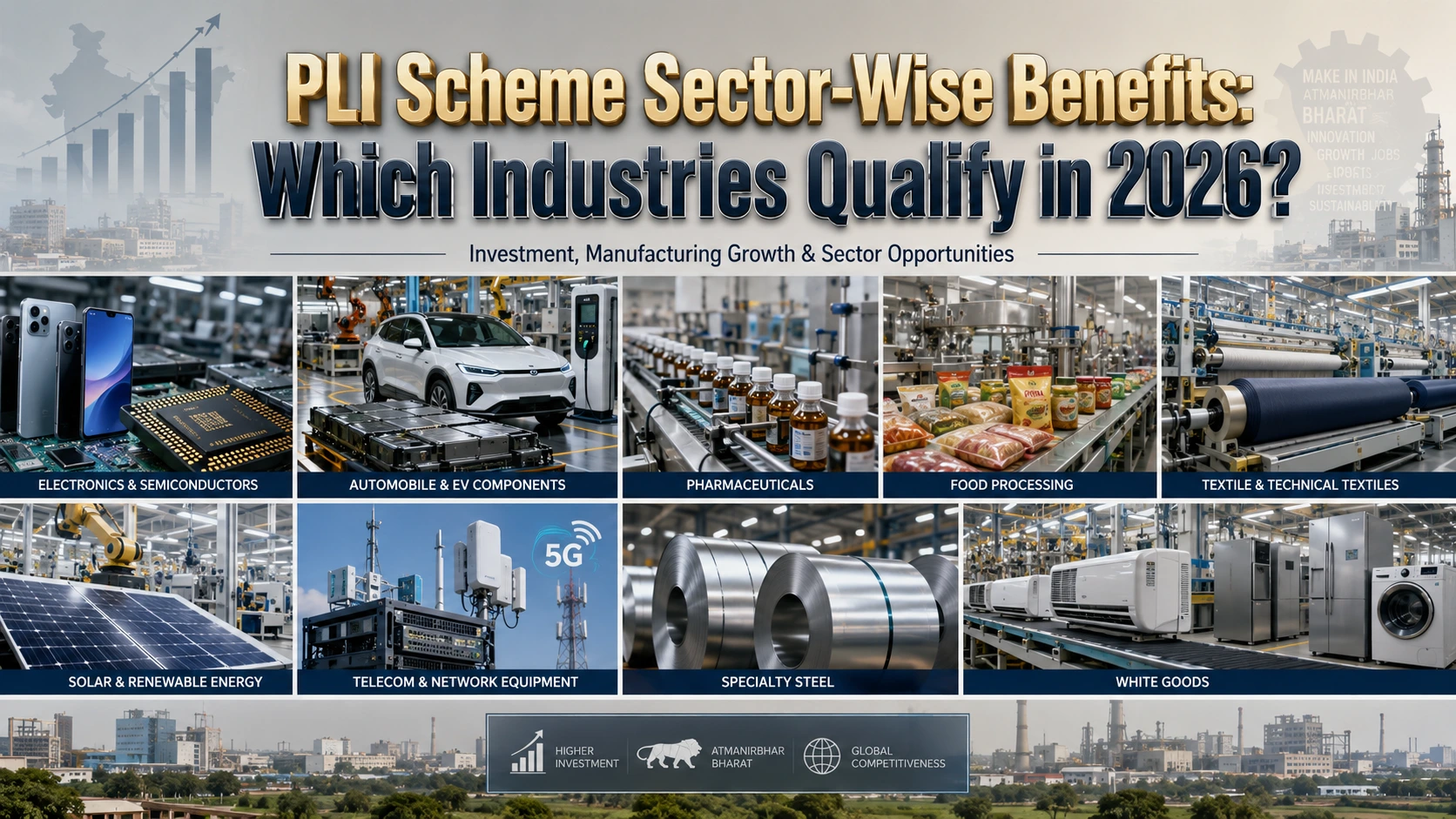

PLI Scheme Sector Wise Benefits in India
The Scheme Most Manufacturers Are Still Under-Using
Most first-generation entrepreneurs believe that PLI is a programme for large companies, like Tata, Samsung and Sun Pharma. That is costing them money. As of now, the authorities have approved 176 PLI beneficiaries, and all 176 are MSMEs. They work in bulk drugs, food processing, drones, medical devices, textiles and telecom. Many of them were able to start with a small investment and build up since, in effect, the government was paying them to make products.
PLI’s design is counter-intuitive. There is no money involved for government at the outset. It provides funds after you have already created and sold. This makes it challenging for cash-strapped business owners to get involved with. However, if they organize their operations properly and treat the PLI incentive as a planned revenue line instead of an afterthought, they can improve their overall financial outcomes.
This guide explains each of the qualifying sectors, percentages of incentives available and steps that an Indian manufacturer can take to avail the money that is lying idle.
The Manufacturing Gap PLI Was Built to Close
In certain essential sectors, India imports more than it produces. Import bill for electronics alone touches a figure of ₹5 lakh crore every year. 80% of medical devices are imported. Specialty chemicals, API (Active Pharmaceutical Ingredients) and telecom hardware are all very vulnerable to import. The PLI Scheme was created to fill this market need.
As per data from the Department for Promotion of Industry and Internal Trade (DPIIT), the total investment received under PLI applications is now more than ₹2.16 lakh crore. However, there are still significant differences in the levels of sectoral penetration. About 70% of all incentive payments are made to the electronics and pharmaceutical industries. Other sectors such as food processing, drones, and advanced chemistry cells still operate far below their potential because they receive lower levels of investment.
States such as Telangana, Gujarat, Tamil Nadu and Maharashtra have the highest manufacturing activities under PLI. However, manufacturers seeking PLI have largely ignored other states such as Rajasthan, Odisha, Uttar Pradesh, and Assam, where land is cheaper, labour is abundant, and industrial corridors already exist. This is a direct offer to the entrepreneurs who are ready to establish green field units in Tier-2 & Tier-3 industrial clusters.
The Ministry of Commerce & Industry has now confirmed that the production and sales of PLI participants have reached the massive figure of ₹16.5 lakh crores, which is still far from the target of ₹30 lakh crores. The catch-up means that there is a structural demand for production capacity that meets PLI standards.(PLI Scheme Sector Wise Benefits in India)
View Full Project Details: Pharmaceutical Drugs & Bulk Drug Intermediates Directory
TABLE 1: PLI Scheme — Sector-Wise Coverage, Incentive Rate & MSME Participation
| Sector | Nodal Ministry | Total Outlay (₹ Cr) | Incentive Rate | MSME Access? |
| Large-Scale Electronics / Mobile Mfg. | MeitY | 40,951 | 4%–6% of incremental sales | Limited (via contract mfg.) |
| Pharmaceuticals / Bulk Drugs | Dept. of Pharma | 15,000 | 10%–20% of sales | Yes — Category D MSMEs |
| Medical Devices | Dept. of Pharma | 3,420 | 5% of incremental sales | Yes |
| Automobiles & Auto Components | MHI | 25,938 | 13%–18% of sales (EVs) | Limited (Tier-1 vendors) |
| Advanced Chemistry Cell Batteries | MHI | 18,100 | Up to ₹1.5/Wh produced | No — large capex required |
| Telecom & Networking Products | DoT | 12,195 | 6%–7% of sales | Yes — MSMEs eligible |
| Textile Products (MMF & Tech Textiles) | MoT | 10,683 | 3%–15% of sales | Yes — lower inv. threshold |
| Food Processing | MoFPI | 10,900 | 10%–25% of incremental sales | Yes — 171 approved units |
| White Goods (ACs & LEDs) | DPIIT | 6,238 | 4%–6% of incremental sales | Yes — component mfg. |
| Specialty Steel | Ministry of Steel | 6,322 | 4%–12% of incremental sales | Limited (value-added steel) |
| Solar PV Modules | MNRE | 24,000 | 4%–5% of module output | No — large scale required |
| Drones & Drone Components | MoCA | 120 | 20% of value added | Yes — MSMEs encouraged |
| IT Hardware (Laptops, Servers) | MeitY | 7,325 | 2%–4% of incremental sales | Limited |
| Metals & Mining (Specialty) | Ministry of Steel | 6,322 | Linked to value addition | Selective |
Source: pib.gov.in | dpiit.gov.in | Ministry notifications (as publicly available)
Why the Window Is Still Open — And Narrowing
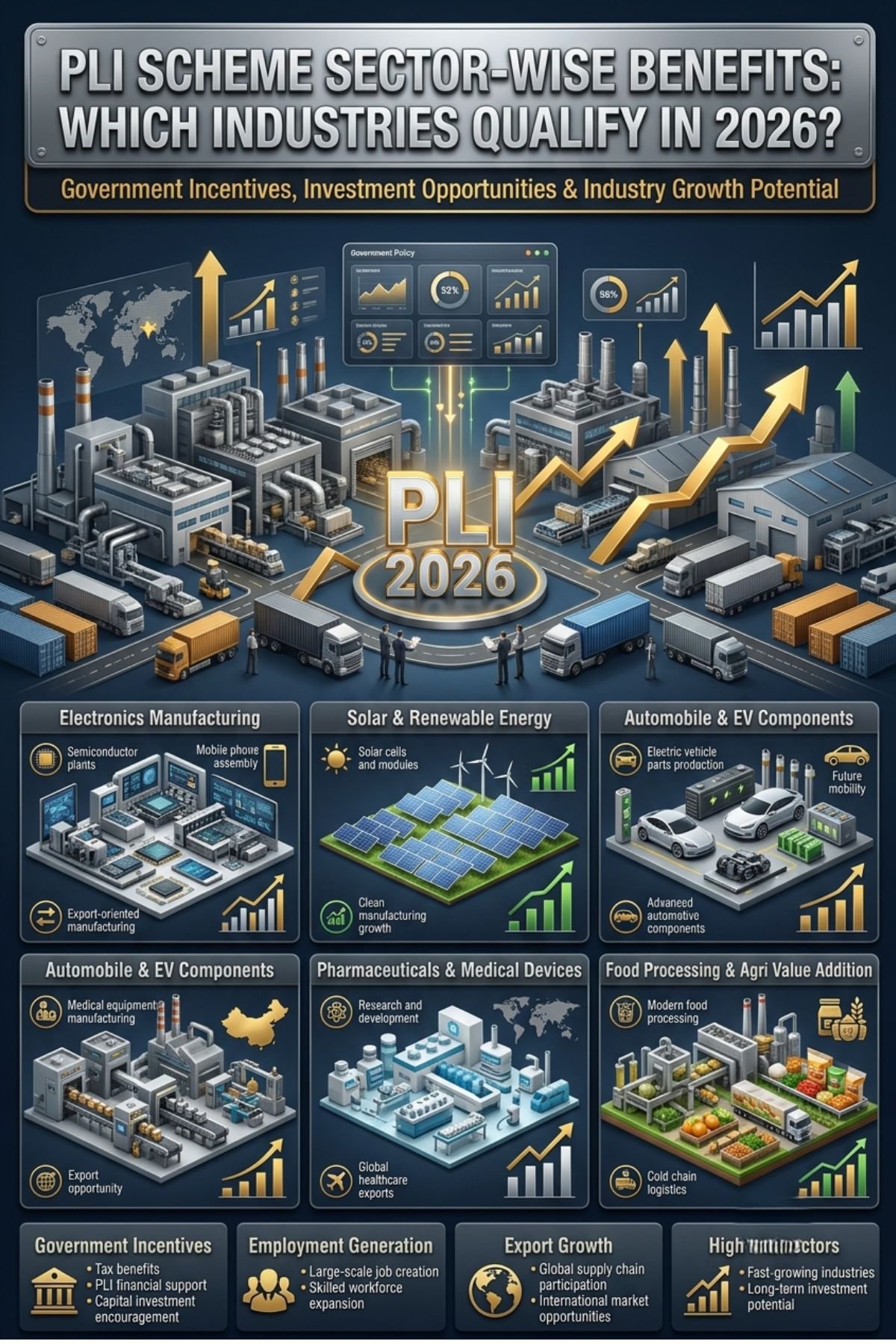
PLI is more valuable today than ever since its inception because of three key reasons: first, supply chain diversification by global buyers; second, India’s enhanced export competitiveness; and third, the government’s announced plans to expand PLI windows in priority areas such as semiconductors and components for green hydrogen.
Forty percent of electronics firms are looking to increase their supply chain footprint in India and Vietnam by 15–25%. The main ones being Apple’s iPhone manufacturing plants in Tamil Nadu and Karnataka and Samsung’s Noida manufacturing facility. However, the greater opportunity is in the component supply chain that supplies these plants. While the investment requirements for finished goods manufacturers are higher than for component makers, both can qualify for PLI if they manufacture display modules, battery cells, precision metal parts and packaging material.(PLI Scheme Sector Wise Benefits in India)
Food processing is still the easiest avenue of entry. For food processing, the minimum investment is ₹1 crore in small units through PLI. There is an incentive rate of up to 25% on sales against incremental sales of priority product categories which include: marine products, ready-to-eat meals, millet-based products. With India being the largest producer of milk, pulses and several horticulture crops, a food processing unit that has the right product focus can receive the PLI incentive within 18-24 months of the qualifying production.
Get Detailed Insights from This Book: Solar PV Power and Solar Products Handbook
The MSME Ministry (msme.gov.in) has ensured that the PLI manufacturer can avail loans from MUDRA, credit guarantee from CGTMSE, and PLI at the same time. The manufacturer who receives a CGTMSE-backed loan to cover the minimum investment requirement and then gets PLI incentives on production is using one government programme to finance another.
One particular area that deserves special mention is the drone. The drone scheme offers an incentive payment of 20% of the value added, which is the maximum limit. This structure makes the scheme suitable for smaller value-added technology companies. Authorities have set up drone testing corridors in Andhra Pradesh, Karnataka, and Maharashtra, giving PLI-registered drone manufacturers immediate access to infrastructure.
How to Register and Qualify: Step-by-Step
It’s more linear than it sounds. This is the way forward for a manufacturer making its first steps into PLI.
Step 1: Identify your qualifying sector and product category.
There is a target segment list for each PLI scheme. A dairy processing company should determine whether its products fall under the PLI scheme for food processing (MoFPI). Before taking any action, please download the notification of the same sector from pib.gov.in and match the HSN code of your product with the list of approved HSN codes in the notification.
Step 2: Check your investment threshold.
The amount of investment varies widely by sector. Drones: ₹2 crore. Food processing (Category A) – ₹10 crore. Electronics (large scale): ₹10 Lacs. Verify the exact number in the sector notification and not the secondary articles or aggregator sites. The official circular of the nodal ministry is the binding document.
Step 3: Register your entity and obtain baseline compliance documents.
Conditions Udyam Registration (MSME), GST registration, Factory License etc, in addition to appropriate approvals from sector specific government authorities (for Food – FSSAI, For Medical devices – CDSCO, for telecom equipment – WPC licence). Any food processing units needs a BIS or FSSAI Licence for applying to PLI. WHO-GMP is mandatory for pharma.
Step 4: Apply through the sector nodal ministry portal.
Applying is done online, via ministry websites. Invest India PLI portal offers consolidated links. Once submitted, a scrutiny committee will examine the financial forecasts, turnover (if applicable) and the proposed manufacturing plans. The scheme is open to greenfield manufacturers of drones and food processing, even if they have not previously turned over.
Step 5: Establish production and hit the incremental sales target.
PLI incentives are taken annually. Your sales in Year 1 of the scheme must be higher than your base year turnover in your sector by the amount of percentage specified for your sector. Maintain sales records, invoices and audited sales reports. The incentive payments are verified by the nodal ministry and paid within 90-120 days after claiming.(PLI Scheme Sector Wise Benefits in India)
Step 6: Maintain compliance across the incentive period (typically 5–6 years).
The manufacturing should be done in India. In some sectors, there are domestic value addition minimums. If a company imports all the sub-assemblies and only does final packaging in India, then it will be disqualified. The nodal ministry reviews the approval and may revoke it if the compliance conditions are not met.
Related Article: PLI Scheme: Is It Really for MSMEs or Only for Big Companies?
Typical Compliance and Licensing Requirements Across PLI Sectors
| Requirement | Food Processing | Pharma / Bulk Drugs | Electronics | Drones | Textiles (MMF) |
| Udyam Registration | ✔ Mandatory | ✔ Mandatory | ✔ Mandatory | ✔ Mandatory | ✔ Mandatory |
| GST Registration | ✔ | ✔ | ✔ | ✔ | ✔ |
| Factory Licence | ✔ | ✔ | ✔ | ✔ (if mfg unit) | ✔ |
| Sector Licence (FSSAI/WHO-GMP/WPC) | FSSAI mandatory | WHO-GMP / Schedule M | BIS (select products) | DGCA type cert. | Not required |
| Min. Investment (₹) | ₹1 Cr – ₹10 Cr | ₹50 Cr – ₹1,000 Cr | ₹100 Cr (handset) | ₹2 Cr | ₹100 Cr (MMF) |
| Domestic Value Addition Required | Yes (product-specific) | Yes (API origin) | Yes (30%+ DVA) | Yes (40%+ DVA) | Yes (fabric-to-garment) |
| Incentive Claim Frequency | Annual | Annual | Annual | Annual | Annual |
Source: Ministry of Food Processing Industries | Invest India PLI Portal (official scheme notifications)
Financial Snapshot: What a PLI-Registered Unit Actually Earns
The economic justification for PLI is strongest in areas with high incentive rates and where investment requirements can be met. A worked example for a food processing unit (ready to eat segment) is provided to illustrate one of the most accessible entry points for first generation entrepreneurs.
Take a unit that has a capex of ₹3 crore (of which ₹1.8 crore is for machinery, ₹70 lakh for civil work, and ₹50 lakh for working capital buffer). The annual revenue is around ₹4.2 crore when the capacity utilisation is 60%. When it is working at its capacity, its revenue is ₹7 crore at 100% capacity. With PLI at 10% on incremental sales (base year zero – greenfield unit), the direct cash flow to the company from the government comes to ₹42–70 lakh per annum. This alone cuts payback 18–24 months short.(PLI Scheme Sector Wise Benefits in India
The figures are more attractive for a pharma bulk drug unit that works in the category D segment (smaller investment bracket). PLI incentive rates are as high as 20% on selected Active Pharmaceutical Ingredients. A factory with an eligible sales of ₹40 crore per year and a cost of production of ₹60 crore per year will recover a whopping ₹8 crore per year in PLI before considering operating profits.
There is a huge variation in the margins of profitability of the PLI sectors. Electronics manufacturers are operating at a narrow margin (6-10%). Value added food processing provides net margins of 14-22%. Specialty chemicals and bulk drugs at scale have 18-28% net margins. The PLI incentive adds an additional 4–25 percentage points of revenue, significantly improving operating margins and strengthening unit economics.(PLI Scheme Sector Wise Benefits in India)
TABLE 3: Indicative Financial Profile — PLI-Registered Units Across Sectors
| Sector | Typical Capex (₹) | Rev @ 60% Cap. | Rev @ 100% Cap. | Net Margin (excl. PLI) | PLI Incentive Add-on | Payback (est.) |
| Food Processing (RTE) | ₹2 Cr – ₹5 Cr | ₹3.5 Cr – ₹4.5 Cr | ₹6 Cr – ₹8 Cr | 14%–20% | 10%–25% on incr. sales | 3–5 years |
| Pharma Bulk Drugs (Cat. D) | ₹50 Cr – ₹100 Cr | ₹25 Cr – ₹40 Cr | ₹50 Cr – ₹80 Cr | 18%–28% | 10%–20% on sales | 4–6 years |
| Textiles (MMF Segment) | ₹100 Cr – ₹300 Cr | ₹60 Cr – ₹100 Cr | ₹120 Cr – ₹200 Cr | 8%–14% | 3%–15% on incr. sales | 6–9 years |
| White Goods (Components) | ₹15 Cr – ₹40 Cr | ₹12 Cr – ₹20 Cr | ₹22 Cr – ₹35 Cr | 10%–16% | 4%–6% on incr. sales | 5–7 years |
| Drones & Components | ₹2 Cr – ₹10 Cr | ₹3 Cr – ₹5 Cr | ₹6 Cr – ₹12 Cr | 12%–22% | 20% of value added | 3–5 years |
| Medical Devices | ₹10 Cr – ₹50 Cr | ₹8 Cr – ₹15 Cr | ₹18 Cr – ₹30 Cr | 15%–25% | 5% on incr. sales | 4–6 years |
Note: All figures are central estimates. Actual performance depends on product mix, plant location, raw material sourcing, and sales volume. Consult a detailed project report before committing capital.
Identify high-growth industries before others do
ENTREPRENEUR SPOTLIGHT
Priya Ramachandran, Founder — AroFresh Foods, Coimbatore, Tamil Nadu
In the initial phase of the PLI food processing programme, Priya launched a ready-to-eat millet snack unit with ₹2.8 crore as its seed capital in Coimbatore. She was one of the applicants in the category B in Tamil Nadu who were the first. In the 2nd year of the scheme, her company made ₹5.2 crore of eligible PLI sales, which gave them ₹52 lakh in direct government incentive, which they leveraged into a second production line. Her primary takeaway: “If you don’t ship, you don’t get the money. If you ship early, every month, you get the money. Today, AroFresh has 47 employees and exports to UAE and Singapore.
Getting the Numbers Right Before You Commit Capital
The One Thing You Should Do This Week
Don’t consider PLI a programme for large companies. Download the Scheme Notification for your Sector from pib.gov.in today. Select the appropriate approved list of target segments for your product. If it is eligible, determine if you have enough money to invest the minimum amount in the next 12 months. If the number is attainable, incorporate the PLI application into your capital plan from the onset instead of an add-on after the plant is in operation.(PLI Scheme Sector Wise Benefits in India)
The PLI Scheme won’t wait forever. Scheme windows have closing dates; late scheme entrants are awarded a weaker base year. The longer they wait, the more incentive income they will lose each month. The opportunity of manufacturing in India is indeed there. The money is already set aside by the government. The only thing that remains to be done is to see if your company is listed.
Frequently Asked Questions
Q1: What is the minimum investment required to qualify for PLI?
Varies dramatically depending on the sector. Drone Scheme needs as little as 2 crores. Food processing sector requirements for the small-scale category starts from 1 crore depending on the sub segment for some food products. For electronics (large scale handset manufacturing) it will be over 100 crores. One must always check against the scheme notification provided by the respective nodal ministry as secondary sources may have outdated numbers.
Q2: Can an MSME apply directly for PLI, or is it only for large companies?
Yes, MSMEs can and do apply directly. Latest available data shows that the PLI scheme has approved 176 MSMEs, and these approved beneficiaries operate across sectors such as food processing, bulk drugs, medical devices, drones, telecom equipment, and white goods components, among others. While some schemes offer direct entry, others have category specific entry points with lower investment norms and proportionate incentives.
Q3: What raw material sourcing conditions apply under PLI?
Most of the PLI schemes have a condition of minimum Domestic Value Addition (DVA). For electronics sector (large scale handset manufacturing) this will be around 30%, For drones scheme around 40% or above. This basically implies that one cannot simply take imported components and do only packaging of those parts, there has to be minimum manufacturing involving Indian sourced components. Failure to adhere to DVA can lead to proportionate reduction or denial of PLI incentives.
Q4: How profitable is a PLI-registered unit in reality?
The PLI incentive should be considered as additional profitability, not a substitute for existing operational profitability. In food processing business, you can achieve 14-22% operational net margins from the business itself and around 10-25% additional income as the PLI incentive based on incremental sales. Bulk drugs or pharma companies have seen operational margins of 18-28% (at capacity utilisation) and have earned an additional 10-20% in incentives on top of this!
So, a PLI registered unit is profitable to the tune of both the operational profits of the firm coupled with PLI incentives.
It works best when the basic economics of the product is positive.
Q5: What government schemes can be combined with PLI?
You can stack the PLI scheme with several other government schemes such as CGTMSE for credit guarantees on loans, MUDRA loans for working capital to start your unit, and PMEGP for grants in food processing and small-scale manufacturing. State-specific industrial subsidies also continue to be applicable from respective state governments (e.g. Gujarat, Telangana, Tamil Nadu, Rajasthan). You need to check for applicable state schemes on the state’s department of industry website or with the relevant state industrial body.
Q6: How can NPCS help with a PLI application?
Niir Project Consultancy Services (NPCS) helps in preparing comprehensive Project Reports (DPRs), Techno-Economic Feasibility Reports which cover your Capital Investments, machinery specifications, regulatory, approvals and financial forecasts needed for PLI applications. You can use these reports as a business plan for your operations and directly submit them to the concerned nodal ministry. You may want to visit our website (niir.org and entrepreneurindia.co) for sector specific DPR’s.
Key Data Sources & References
- DPIIT — PLI Scheme Official Data
- Press Information Bureau — PLI Updates
- Ministry of Food Processing Industries
- MSME Ministry — Scheme Stacking Resources