A Quiet Deadline That Could Reshape Global Packaging Supply Chains
Starting from 12 August 2026, every pizza box, takeout container, microwave popcorn bag and fast-food wrapper sold in the European Union will not contain any PFAS (per- and polyfluoroalkyl substances), the class of synthetic chemicals used to provide water-repellant property in grease-resistant food packaging. The EU’s Packaging and Packaging Waste Regulation (PPWR) comes into force this week, and was applicable to all packaging on the market from February 2025, regardless of their date of manufacture. No sell through period. No grandfather clause. inventory No buffer inventory.
The consequence is clear, immediate and it gives India a once in a lifetime opportunity, one that is time-bound. Europe’s packaging importers are actively scouting for verified PFAS-free alternatives, such as molded sugarcane-bagasse trays, kraft-paper barriers and PLA-coated paperboard. With more than 22,000 packaging units, of which 85% are SMEs, and with the ability to export the containers and using JNPT and Mundra port, India is set to meet that demand. The question is if the Indian founders move fast enough to catch up.
Europe’s Packaging Crisis Is India’s Gap to Fill
Over the years, food-contact packaging manufacturers (in Europe and worldwide) have been finding a solution to grease resistance in the same way, and that is by using fluorinated coatings. PFAS were applied to paper bowls, pressed into bagasse clamshells, applied as a laminar to bakery papers. It was cheap and worked very well in the chemistry lab. The issue is they are not biodegradable. These build up in soil, in groundwater, and in human tissue and are thus referred to as “forever chemicals. The EU’s response to these exposures was driven by the growing body of evidence connecting PFAS to thyroid disruption, immune suppression and some forms of cancer.
The change in scale is great. The European Commission estimates that packaging waste would rise by 19% by the end of this decade if nothing were done to intervene in this sector, and could increase by up to 46% in the case of plastic packaging waste. The waste path and PFAS contamination led to a reckoning.
The difference is tangible for Indian manufacturers. The push for PFAS-free packaging is underway, with European customers of food packaging companies increasingly asking for PFAS-free packaging information from all suppliers, including those for supermarkets, foodservice distributors and private-label brands. There are currently many Asian suppliers that are not able to offer verified compliance. The export segment that needs to be made EU compliant is still underdeveloped and India’s packaging industry is already forecast to be worth ₹8.50 lakh crore (US$92 billion) by FY30 with an annual growth rate of 9%. The demand for certified PFAS-free molded fibre, bagasse tableware and aqueous barrier paperboard from Indian units is growing rapidly but there is limited capacity certified to EU standards. That is the gap.
Get Detailed Insights from This Book: Handbook on Biodegradable Plastics (Eco Friendly Plastics)
Table 1: State-wise Packaging Industry Concentration and Export Readiness — India
| State / Region | Key Districts / Clusters | Primary Packaging Demand Segments | Export Readiness |
| Maharashtra | Pune, Nashik, Navi Mumbai | F&B export, pharma, e-commerce | High — JNPT proximity |
| Gujarat | Ahmedabad, Surat, Ankleshwar | Chemicals, FMCG, textile packaging | High — Mundra, Hazira ports |
| Tamil Nadu | Coimbatore, Chennai, Hosur | Auto-ancillary, consumer goods, food | High — Chennai port |
| Uttar Pradesh | Noida, Lucknow, Gorakhpur | Agri-produce, spices, sugar-bagasse | Medium — inland hubs |
| Karnataka | Bengaluru, Dharwad, Tumkur | Electronics, pharma, food processing | High — KIADB clusters |
| Telangana | Hyderabad, Sangareddy | Pharma bulk, FMCG, F&B | Medium-High — dedicated pharma zone |
| West Bengal | Kolkata, Howrah, Siliguri | Tea, jute, food agri packaging | Medium — Kolkata port |
| Rajasthan | Jodhpur, Bhiwadi, Jaipur | Handicrafts, spice, textile packaging | Medium — border trade route |
Source: IBEF Paper & Packaging sector data, MoEF&CC EPR framework, author analysis
Three Tailwinds Converging at Once
It is good news that the EU PFAS packaging ban has come into effect. Two more are expanding the opportunity for the Indian manufacturers.
First, the India-EU Free Trade Agreement, which was signed in January 2026, after 19 years of negotiations, has guaranteed market access to over 99% of trade value of Indian exports to EU by trade value, as per FIEO Director General Ajay Sahai. To exporters of packages, the consequence is that this will ease tariff tensions at the exact time when there is increased demand for packaging from EU customers to find new compliant suppliers.
Second, India’s regulatory alignment is building a manufacturing base that is primed for compliance. As per MoEF&CC’s Extended Producer Responsibility (EPR) Rules 2024, the recycling targets for paper packaging producers, importers and brand owners will be phased from April 2026, as outlined in the IBEF paper and packaging sector overview. If manufacturers need EU compliance documentation for parallel compliance with EU regulations, they can comply with EU regulations internally much more easily.
Third, India’s raw material base is a true competitor. SuSugarcane production exceeds 400 million tonnes in the country, yielding bagasse as an agricultural by-product that currently sells for ₹1,200–₹1,800 per tonne at mill gates in Uttar Pradesh, Maharashtra and Karnataka. The most significant PFAS-free alternative to PFAS is bagasse moulded fibre, which matches the product categories that EU buyers need most.
Related Article: How to Start Pulp-Based Beverage Packaging Unit in India (Plastic Ban Opportunity)
This opportunity is directly supported by a number of Government schemes. PMEGP is a scheme that provides margin-money grants to new manufacturing MSMEs up to 15-35% of the project cost of up to ₹50 lakh. The PLI scheme for food processing, managed by DPIIT, has ₹4,415 crore allocated for it that provides incentives of 6-10% on incremental sales, including incremental sales in the packaging material manufacturing linked to the food processing industry. The greatest challenge faced by the first-gen founders is debarred by CGTMSE as it offers collateral-free credit guarantees up to ₹2 crore.
How to Set Up a PFAS-Free Packaging Unit in India: A Step-by-Step Guide
Step 1: Select your product niche and certify the process first
The EU ban is in relation to food contact packaging. The most popular PFAS-free formats are: (a) molded bagasse fibre tableware (plates, bowls, clamshells), (b) aqueous barrier coated kraft paper for wrapping and (c) PLA laminated paperboard that is used for cups and trays. Before purchasing machinery, choose which one you will make. They each have varying capitalization needs and certification requirements.
Step 2 – Registering the business
File for Udyam Registration at udyamregistration.gov.in (free, online). Register under GST. PMEGP loan application is done online at pmegp.kvic.org.in and the loan is disbursed within 45-90 days of application. Once registered as a Startup India via startupindia.gov.in, there are more tax benefits and expedient regulatory clearances.
Step 3 — Land and facility
The area requirement of micro bagasse tableware unit is 1200–1800 sq ft of covered space preferably in an MSME cluster or state industrial estate (and this will minimize the pollution NOC issues). For mid-scale units serving EU export volumes, you need 3,500–5,000 sq ft, with priority given to areas near sugarcane supply chains, such as MIDC estates in Maharashtra, GIDC in Gujarat, SIPCOT in Tamil Nadu, and UPSIDC clusters in Gorakhpur and Mau.
Step 4 — Key machinery. For a bagasse moulded-fibre unit
A pulping machine (wet process), a vacuum forming / moulding press, vacuum dry tunnel (or hot press) and edge trimmer. There are semi-automated lines available from Indian equipment manufacturers in Rajkot (Gujarat) and Ludhiana (Punjab), ranging from ₹5 to ₹7 lakh for micro-scale units and ₹25 to ₹38 lakh for mid-scale units. Budget: ₹75,000 to ₹2.5 lakh for QC capability is must for EU buyers and a total organic fluorine (TOF) testing setup is not a compromise.
Step 5 — Raw material sourcing
Sugarcane bagasse pulp: mills in Uttar Pradesh (Muzaffarnagar, Gorakhpur), Maharashtra (Kolhapur, Ahmednagar), and Karnataka (Mandya) sell at ₹1,200–₹1,800/tonne. Kraft paper: Tamil Nadu (Karur, Erode paper mills) and West Bengal (Ballarpur, Titagarh). PLA resin: currently 90% imported from China and Thailand; Assam Petro-Chemicals and some Gujarat units produce limited volumes. For PLA-based packaging, source from traders in Ahmedabad and Surat with import-export documentation.
Step 6 — Licenses and regulatory approvals
You will need: BIS certification if your product falls under Quality Control Orders (food-contact materials). FSSAI registration or license (mandatory for food-contact articles). State Pollution Control Board NOC (Green or Orange category depending on scale). Factory License (if employing 10+ workers with power). GST registration. For EU export, additionally obtain EN 13432 certification (compostability, required for biodegradable claims) through a NABL-accredited lab or via an EU-notified body. Total licensing timeline: 60–120 days.
Step 7 — Timeline
From Udyam registration to first production, a realistically planned micro unit takes 4–6 months: 30 days for registration and loan processing, 45 days for machinery delivery and installation, 30–45 days for trial production and QC testing, 15–30 days for buyer sample approval. First EU shipment typically follows 3–6 months after first domestic production, once documentation is in order.
Typical team
A micro unit runs on 8–12 people — 1 production supervisor, 5–7 machine operators, 2 QC/packing staff, 1 admin/accounts. Mid-scale units need 20–35 people.
Table 2: Investment Breakdown — PFAS-Free Packaging Manufacturing Unit
| Investment Head | Micro Unit (₹) | Mid-Scale Unit (₹) |
| Land / Shed (1,500 sq ft) | ₹3,00,000 (rental 2 yrs) | ₹12,00,000 (purchase/lease) |
| Core Machinery (pulp/bagasse moulding or paper converting) | ₹5,50,000–₹7,00,000 | ₹28,00,000–₹38,00,000 |
| Drying & Curing Equipment | ₹80,000–₹1,20,000 | ₹4,50,000–₹6,00,000 |
| Testing & QC (PFAS-free verification tools) | ₹75,000 | ₹2,50,000 |
| Raw Material Opening Stock (bagasse pulp/kraft paper/PLA) | ₹1,80,000 | ₹6,00,000 |
| Licensing & Regulatory (GST, Udyam, Pollution NOC, BIS, FSSAI) | ₹45,000 | ₹1,20,000 |
| Working Capital (3 months) | ₹1,20,000 | ₹5,00,000 |
| Contingency (10%) | ₹80,000 | ₹5,50,000 |
| Total Estimated Capex | ₹14,30,000–₹15,90,000 | ₹64,70,000–₹76,20,000 |
All figures in INR. Figures are central estimates; location, land tenure and machinery grade will cause variation.
What the Numbers Actually Look Like
The investment required for a micro bagasse table ware unit (Single hydraulic moulding press with capacity output – 500 kg/day) is in the range of ₹14.00 lakh to ₹16.00 lakh. The monthly running expenses of raw material, power, manpower, packing etc. are around ₹1.80- ₹2.20 lakh. The monthly revenue of domestic food-service and FMCG buyers at 60% capacity is ₹3.8–₹4.5 lakh. At full capacity, ₹6–₹7.5 lakh.
Gross margins for certified product for export to the EU are between 30-38%, much better than commodity packaging, which is 18-24%. Net margins at 80% capacity utilisation are 22 to 28%. Payback period of a micro unit is 18-24 months; on a mid-scale unit (₹65-76 lakh capex), it is 28-36 months, depending upon the ratio of export sales to domestic sales.
Certification premium is the main profit generating element. EU buyers are willing to pay 20-35% more for a PFAS-free, independently certified EN 13432 product than for the uncertified equivalent. Getting QC infrastructure right from day one is not an option as there is no point in paying the premium and then paying the third party to test it.
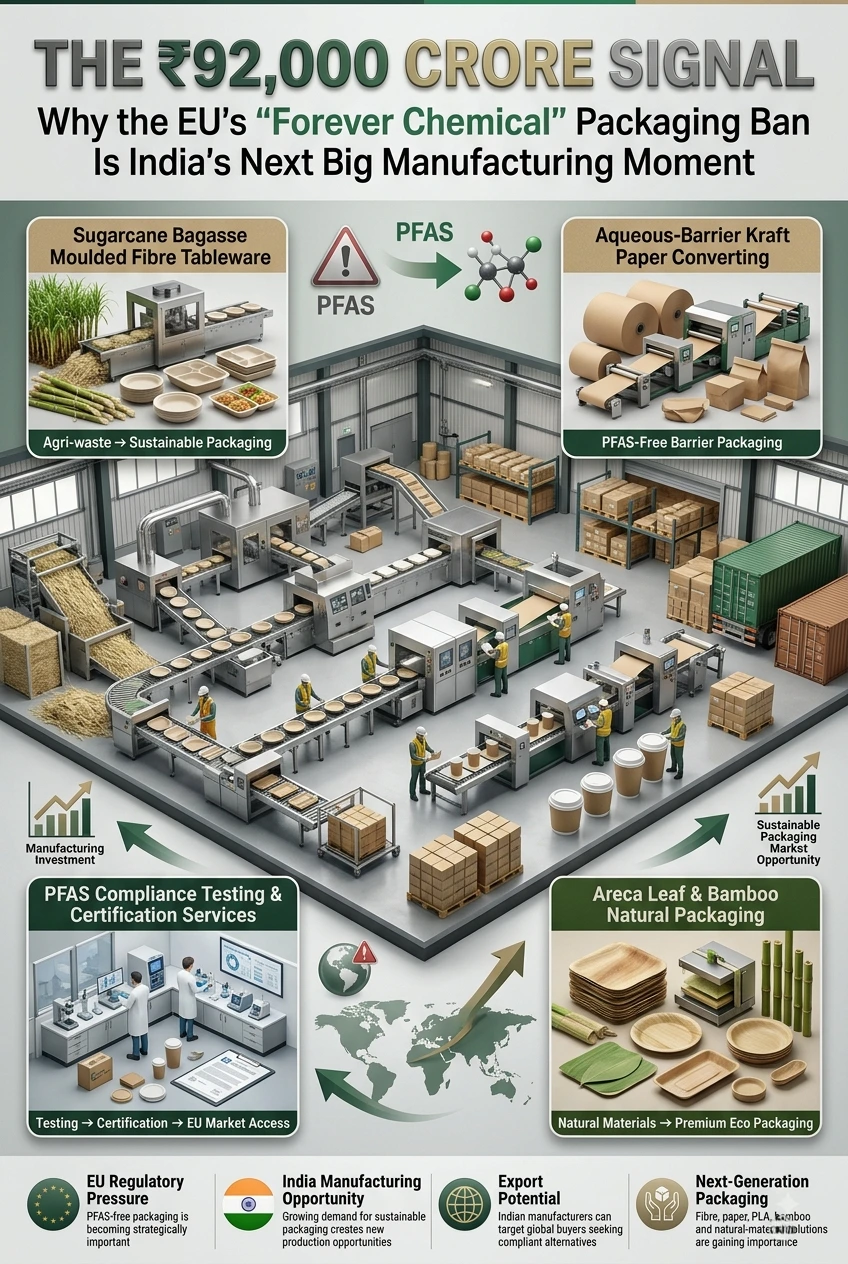
Five Manufacturing Business Ideas for the PFAS-Free Packaging Boom
Sugarcane Bagasse Moulded Fibre Tableware
India has three main sugarcane producing states (Uttar Pradesh, Maharashtra and Karnataka), which produce millions of tonnes of bagasse each year, mostly used for fuel and low-grade composites.
In addition, the moulded articles line produces PFAS-free food-contact articles from wet bagasse pulp using a hot-press system. The process requires no fluorinated coatings because the structural fibre itself resists grease from light oily foods. Furthermore, Domestic demand from cloud kitchens (C-Kitchens) connected to Zomato and Swiggy is expanding by 15-18% per year. Similarly, The domestic demand from Zomato and Swiggy connected cloud kitchens is growing at 15-18% per year.
Meanwhile, The EU demand post PPWR is creating a separate export order book. For example, Micro-unit — 1 hydraulic press, 1 dryer — it takes about ₹8–₹14 lakh of capital and can start selling in about four months. Finally, The first step is to approach one or two medium-sized food-service distributors in Mumbai or Bengaluru, and simultaneously get the EU documentation.
Aqueous-Barrier Kraft Paper Converting
The conventional approach to making a paper that resists grease was to use a wet-strength agent containing fluorine prior to the PFAS restrictions. Aqueous polymer dispersion barrier coating provides a PFAS-free alternative for kraft or natural brown paper on a roll-to-roll coating line. The resulting paper wraps burgers, rotis, parathas, and bakery goods for take-away use while meeting PFAS thresholds without using any fluorine-based chemistry. Kraft paper converting requires ₹25 – ₹45 lakh investment (mid-scale) for slitter-rewinder, coating applicator, and drying oven. Quick-service restaurants, bakery chains, institutional caterers and EU-export food brands are in the mix of buyers. The paper converting cluster towns of Tamil Nadu are in Karur and Erode, this is an ideal place with direct supply of kraft paper from the local paper mills.
View Full Project Details: Kraft Paper from Bagasse – Manufacturing Project Report
PLA-Coated Paperboard Cup and Lid Manufacturing
Single use plastic lids and polystyrene foam cups are being phased out all over India (MoEF&CC’s ban on SUPs includes several types of cups). It is a bio-based polymer material, which is heat and moisture resistant, and has replaced polyethylene with PLA (polylactic acid) coated paperboard that meets EU standards. Furthermore, EN 13432 composability certification, which is sought after by EU buyers, is also present on PLA-coated cups. Semi-automated Indian-made manufacturing line for PLA cups is available in the price range of ₹35 to ₹55 lakh per hour. The Pune-Nashik corridor is institutional buyer base (large QSR chains, airports, corporate campuses) and proximity to port in the Maharashtra state. For EU export buyers, FIEO offers a chance to reach them via its buyer-seller meets and the annual India Packaging Show in Mumbai.
Get Detailed Project Report (DPR): Paper Industry: Complete Business Guide
PFAS Compliance Testing and Certification Services
All packaging manufacturers that provide products to the EU market must have laboratory documentation such as total organic fluorine (TOF) test reports, EN 13432 certificates, and food-migration compliance records. Moreover, There are only a few NABL accredited laboratories in India and they are providing services for packaging analysis for PFAS. Therefore, setting up a dedicated PFAS compliance testing service for Indian packaging exporters requires an investment of ₹8 to ₹12 lakh for a micro unit with basic equipment, or ₹35 to ₹50 lakh for a complete NABL-accreditable laboratory.
The client base comprises all the bagasse, paper and bio-polymer packaging manufacturers in the country who are seeking to compete for orders from EU countries. However, It is not a conventional manufacturing unit, but a compliance service business and it is definitely part of the MSME manufacturing support ecosystem. In addition, The convenience in being located close to the potential customers is in the cities of Pune, Ahmedabad and Chennai near packaging clusters.
Areca Leaf and Bamboo Natural Packaging
The areca palm sheaths and bamboo plates, cups and small trays are naturally zero-fluorine. Does not need any coating or adhesive — product dries and presses, is compostable after use. The areca palm material is also available in plenty in Maharashtra, Goa, Karnataka and Assam and the source of bamboo is quite good in the Northeast India, Chhattisgarh and Odisha. The micro collection and pressing unit for areca leaf plates costs just ₹3–₹6 lakh in equipment, and is one of the most accessible options to enter the EU-compliant packaging market. Certified natural-fibre food-ware enjoys premium price in the European market, especially in Germany, the Netherlands and Scandinavia. A founder can build a supply chain with 15-20 areca sheath collectors and be able to export the products within six months in coastal Karnataka or Assam by leveraging the agri-packaging products buyer facilitation programme by APEDA.
Explore This Book: Bamboo Plantation and Utilization Handbook
Table 3: Government Schemes for PFAS-Free and Sustainable Packaging Manufacturers in India
| Scheme | Nodal Agency | Eligibility | Max Benefit | How to Apply |
| PMEGP | KVIC / MSME | New manufacturing MSMEs | ₹50 L (35% subsidy) | pmegp.kvic.org.in |
| CGTMSE | SIDBI / MSME | Micro & small enterprises | ₹2 Cr collateral-free loan | cgtmse.in via bank |
| PLI – Food Processing | DPIIT / MoFPI | Incremental investment, sales threshold | 6–10% incentive on sales | investindia.gov.in |
| MUDRA Tarun / Shishu | SIDBI / Banks | Manufacturing startups | Up to ₹10 L (Shishu ₹50K) | mudra.org.in |
| Make in India — Sustainable Packaging Priority | DPIIT | Eco-friendly packaging mfrs | FDI facilitation, no cap | dpiit.gov.in |
| CLCSS (Credit Linked Capital Subsidy) | MSME / SIDBI | Tech upgradation in MSMEs | 15% on machinery cost up to ₹1 Cr | msme.gov.in |
| EPR Compliance Support (MoEF&CC) | CPCB / MoEF&CC | Packaging producers, importers | Certification & market access | cpcb.nic.in |
ENTREPRENEUR SPOTLIGHT
Priya Subramaniam is the Founder of Greenleaf Packaging Solutions located in Chennai, Tamil Nadu.
That is why Priya Subramaniam began her bagasse tableware business in Ambattur Industrial Estate, Chennai with an investment of ₹12 lakh under the PMEGP scheme. In 18 months, she had two national QSR chains on the hook for supplying her and had sampled for a German food-service distributor. Turning over an annual business of more than ₹60 lakh and a net margin of 24% in year two. So, her first rule is: “Don’t even start talking with any EU buyer without your TOF report.
(Selected case is based on the success stories of MSMEs from the sustainable packaging sector that have been documented publicly.)
Identify high-growth industries before others do
Planning a PFAS-Free Packaging Unit? Start With the Right Project Report
Founders evaluating entry into this sector often underestimate the documentation load — from EU compliance filing to PMEGP loan applications and state pollution NOC submissions. Niir Project Consultancy Services (NPCS) provides detailed project reports, techno-economic feasibility studies, plant layout designs, and end-to-end project consultancy specifically for sustainable and eco-packaging manufacturing ventures. Their reports cover machinery selection, raw material costing, market linkage, and financial projections in formats acceptable to banks and government scheme disbursement offices. Entrepreneur India — the editorial platform affiliated with NPCS — regularly publishes sector-specific analyses on bio-packaging, EPR compliance, and MSME manufacturing opportunities in India.
The Window Is Open — But It Will Not Stay That Way
The EU’s PFAS packaging ban is not a future risk for Indian exporters — it activated on 12 August 2026. Therefore, European buyers are sourcing compliant alternatives right now. Moreover, India has the sugarcane, the paper mills, the MSME manufacturing base, and the government schemes to compete. However, What most Indian packaging founders lack is certification documentation and export buyer connections.
Therefore, The one specific action worth taking this month: run a PFAS-free compliance audit on your current or planned product using a NABL-accredited lab, and get a TOF test report in hand. In fact, That single document is what separates Indian packaging manufacturers who can enter EU export conversations from those who cannot. Furthermore, If you are starting from scratch, get a techno-economic feasibility report for your chosen product segment before committing capital — then apply for PMEGP or CGTMSE funding with your project report in hand.