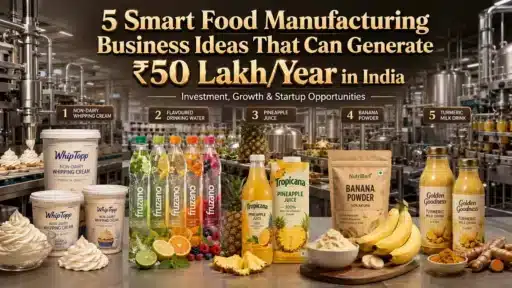


Food Manufacturing Business Ideas
The food and beverage industry is evolving rapidly in India. Ten years ago, most packaged food brands were under the wing of big legacy brands. Today, the first-generation entrepreneurs – of whom many have no experience in the industry – are starting commercial enterprises, developing networks of buyers and making regular profits in the food processing sector.
Moreover, This transition is no accident. Multiple dynamics are coming together; a growing middle class with new preferences, government policies actively encouraging MSME investment, rapidly improving cold chain infrastructure, and a world-wide trend toward savouring healthy meals, altering consumer expectations for packaged foods.
The five products that stand out as particularly interesting business ideas in this context are non-dairy whipping cream, flavoured drinking water, pineapple juice, banana powder and turmeric milk drink. Moreover, They have well-established manufacturing processes, available raw material supply chains, increasing institutional demand, and margins that are conducive to operational discipline. Furthermore, This article investigates the economics of manufacturing, market dynamics, and entrepreneur logic of all five.
Get Detailed Insights from This Book: The Complete Book on Fruits, Vegetables and Food Processing
1. Non-Dairy Whipping Cream: Riding India’s Bakery Boom
What the Product Does and Where It Sells
Non-dairy whipping cream is an emulsified product of vegetable fat. This duplicates — and in most commercial uses surpasses — the properties of traditional dairy cream. used in bakeries, confectioneries and HoReCa for cake frosting, pastry filling and desserts. It has a definite structural advantage in tropical markets such as India with greater heat stability, longer shelf life and better whipping consistency.
Cloud kitchens, dessert startups, and luxury mithai makers have embraced it and are producing Indian sweets in a Western-style manner. Manufacturers can flavor or sweeten it for specific applications, and it is available in liquid, powder, and spray-can formats. Demand is wide based and institutionally supported.(Food Manufacturing Business Ideas)
Manufacturing Process and Investment Range
In the manufacturing process the hydrogenated vegetable oils, which are palm kernel oil or coconut oil derivatives, are emulsified with sugar, caseinate and the stabilisers and flavouring agents. Furthermore, The production steps involve blending, homogenisation, pasteurization, UHT treatment and aseptic/ cold-chain packaging.
The main technical problem is the formation of the proper fat crystal structure on cooling. This directly influences on the whipping performance and the overrun ratio. Usually commercial products will get an overrun of 200-300% The cost of a semi-automated unit with a capacity of 500 to 1,000 litres per day is around ₹60 to ₹120 lakhs, depending on the level of automation and the integration of cold storage.
Market Size, Margins, and Government Support
Moreover, The bakery and confectionery market in India is estimated to be worth more than ₹1.25 lakh crore and is expanding at an estimated rate of 9 to 11 percent a year. Similarly, The organised non-dairy cream market has grown by 14-18% each year. As a result of the above, more than 5000 cloud kitchen operators are currently working across India, and home bakers have increased significantly as well — all contributing to steady demand.
The gross margin for branded products is between 28% and 38%. Direct institutional supply can drive margins even higher. The Ministry of Food Processing Industries actively promote this category under PLI scheme and PMFME fund, and it is a category for which credit and capex can be availed at subsidised rates.
Get Detailed Project Report (DPR): Food Confectionery and Bakery Products
| Cost Component | % of Total Cost |
| Raw Materials (fats, emulsifiers, stabilisers) | 58–65% |
| Packaging (aseptic cartons, PET bottles) | 10–13% |
| Processing & Energy | 7–10% |
| Labour | 6–8% |
| Overheads & Distribution | 8–12% |
2. Flavoured Drinking Water: Low Capital, High-Growth Market
Product Positioning and Buyer Profile
The flavoured drinking water market is a new space in the organised market, where they are both about hydration and wellness. Moreover, Manufacturers do not artificially carbonate it and market it as a low-calorie or sugar-free alternative to carbonated soft drinks. As a result, Active buyers include gym-goers, corporate users and parents who want healthier food options for kids.
Furthermore, The fastest-growing sub-segment are functional variants of products with added electrolytes, vitamins or botanical extracts, which are available at premium price points. Additionally, Distribution channels include modern trade, e-commerce, HoReCa, gyms, hospitals and airline catering.
Capital Requirements and Margin Profile
Firstly, Establishing a basic unit which can manufacture 5,000 to 8,000 bottles per day will require an investment of ₹35 to ₹55 lakhs. Furthermore, Scaled production to 30,000 or more bottles per day increases the required investment to ₹1.5–2.5 crore as economies of scale become more favorable. Moreover, The price of raw material is in the range of ₹4 to ₹8 per 500ml bottle and the MRP of branded bottles is in the range of ₹25 to ₹60. This spread suggests good margin opportunities for producers in the right position.(Food Manufacturing Business Ideas)
Labelled products must also meet the requirements of the Food Safety and Standards Authority of India (FSSAI) with regard to permissible limits of additives and labelling of flavoured water products, which is a regulatory challenge that well-prepared entrants can navigate with an ease.
| Segment | Est. Annual Growth | Key Buyers |
| Plain Packaged Water | 8–10% | Retail, HoReCa, Offices |
| Flavoured Water (Basic) | 18–22% | Modern Trade, E-commerce |
| Functional Water (Electrolyte/Vitamin) | 28–35% | Gyms, Hospitals, Airlines |
| Kids Flavoured Water | 25–30% | Schools, Retail, Online |
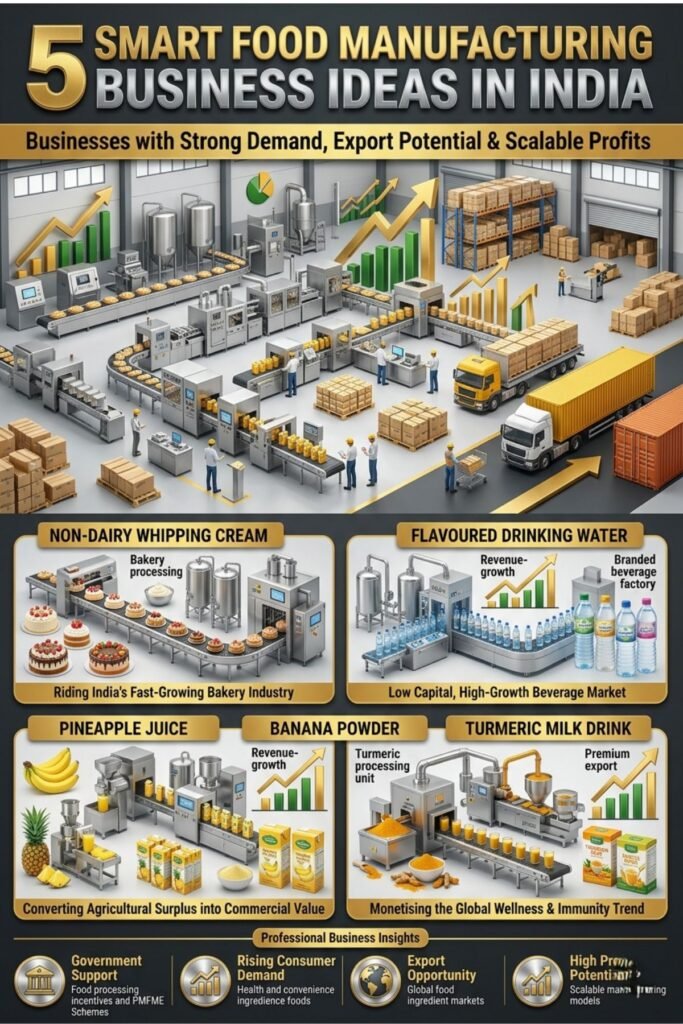
3. Pineapple Juice: Converting Agricultural Surplus into Commercial Value
The Processing Gap Opportunity
Firstly, India is one of the five leading producers of pineapple in the world. However, In spite of this, it is estimated that 20-30 percent of the annual crop is lost because of poor post-harvest processing. Therefore, This gap is one of the most tangible manufacturing opportunities in the fruit processing industry in India.
Retail stores and HoReCa outlets sell pineapple juice, while manufacturers use it in juice blends, fruit beers, and flavour formulations, and commercial processors purchase it in bulk. Furthermore, pineapple processing units may also produce bromelain, an enzyme used in the pharmaceutical and nutraceutical industries, thereby creating an opportunity for diversification at low incremental cost.
Investment Range and Margin Structure
Firstly, The cost of a small-to-mid scale unit (1 to 2 tonnes fresh fruit/day) is ₹45 to ₹90 lakhs. Moreover, The cost for units for concentrated juice or export market is to the extent of ₹1.5 crore to ₹3 crore. Additionally, Raw material cost makes up 45-55 per cent of production cost. Therefore, seasonal price volatility makes effective procurement planning and integration of cold storage a crucial margin protector.
The Indian fruit juice industry is valued at around ₹18,000 crore and will touch ₹30,000 crore by 2028. Regulatory environment is broadly supportive with export linkage incentives and infrastructure support provided by National Horticulture Mission and APEDA to pineapple processors.
| Product Variant | Target Market | Realisation/litre | Margin |
| Fresh Juice (NFC) | Retail, Cafés | ₹55–80 | 30–38% |
| Pasteurised Juice | Modern Trade, Export | ₹40–65 | 28–35% |
| Concentrated Juice (65 Brix) | Industrial, Export | ₹120–180 | 35–45% |
| Pineapple Pulp (IQF/Canned) | HoReCa, Export | ₹70–110 | 32–42% |
4. Banana Powder: Building a Shelf-Stable Ingredient from India’s Biggest Fruit Surplus
Why Banana Powder Deserves Serious Attention
Firstly, Banana powder is made from ripe or over ripe bananas either by spray drying or drum drying. Moreover, The outcome is a fine, easily flowable potassium, Vitamin B6, sugar and fibre rich powder. Furthermore, When well packaged, it has a shelf life of 12-24 months and is suitable for industries looking to harness fruit benefits without fresh produce logistics.
More than any other country, India accounts for above 30 million tonnes of banana production each year. But only 2% of this production is being processed into powder. This definitely indicates the potential for commercial scale processing.(Food Manufacturing Business Ideas)
Main application segments are:
- A key use of bananas is in baby food preparations, which includes banana as one of the first fruits fed to babies.
- Overnight cereals and health supplement blends
- The bakery products include banana bread mixes and muffin premixes.
- Smoothie powders and sports nutrition products.
- Pharmaceutical and nutraceutical formulations
- Animal feed formulations
Manufacturing and Export Economics
Furthermore, The cost of investment in a spray drying unit which will dry 300 to 500 kg/day of fresh bananas is ₹50 to ₹100 lakhs. Additionally, Those operators who establish direct procurement from farmer producer organisations (FPOs) always get better quality and lower raw material price as compared to their counterparts procuring from wholesale mandis.
The export realisations of ₹180-280 per kg of the banana powder is comparable to the domestic realisation of ₹90-130 per kg. Export operations thus represent an attractive business proposition for certified producers. The fruit powder sub-segment is expanding at a faster rate than the overall market, with India’s market expanding at 16-20% annually.
Related Article: Profitable Banana Powder Manufacturing Business
5. Turmeric Milk Drink: Monetising a Global Wellness Trend
From Kitchen Tradition to Premium Beverage Category
Firstly, After a millennium of usage in the kitchens of Indian households, turmeric has become a billion-dollar worldwide ingredient category. Turmeric milk, also called as haldi doodh, has been reworked for the packaged beverage market as a prepared-to-consume (RTD) product now commonly known as “golden milk.
This move opens up a much bigger addressable market. In addition to traditional Indian customers, it’s enjoyed by health-conscious urban millennials, high-end café shoppers, and export markets in Europe and North America. Commercial products are available in both dairy and non-dairy bases (almond, oat or coconut milk).
Firstly, Studies have continued to demonstrate turmeric’s anti-inflammatory and antioxidant activity, attributed to its active ingredient, curcumin, which continues to be a very potent commercial product. Moreover, the costs of consumer education are lower, in India, because of the high level of cultural familiarity. This combination renders the product really cost-efficient to market.
Production, Formulation Challenges, and Market Outlook
To produce a shelf-stable turmeric milk product, manufacturers mix a liquid base with a turmeric extract standardized for curcumin content, add black pepper extract (piperine increases turmeric bioavailability), and include other stabilizers and sweeteners. The blend is then UHT treated (and pasteurised for SKUs which are not refrigerated) and homogenized.
Firstly, For mid-scale RTD unit of 2000 to 5000 litres per day the total investment is in between ₹70 lakhs to ₹150 lakhs. However, The major formulation problem is colour stability, which is an inherent problem of curcumin, it is sensitive to light and pH. Fortunately, This is easily addressed by the manufacturers who invest in microencapsulated curcumin or light-protective packaging.
The present global golden milk market is valued over USD 300 million and is anticipated to grow at 7 to 9 per cent CAGR till 2030. The wellness segment of the RTD market is growing 22-28 percent a year in India. Both the AYUSH Ministry and APEDA have identified turmeric based functional foods as a strategic category of exports supported by the identified export clusters in the promotional and logistic aspects.(Food Manufacturing Business Ideas)
Strategic Lessons from Industry Leaders
Appy, Bailey water, B Fizz, and then finally Frooti – this is how Parle Agro mastered the art of category sequencing. Start with affordable pricing and create premium versions later. The institutional market and B2B can be easier markets to make first-time entry than retail.
Paper Boat proved that with a unique brand and story, traditional Indian flavours can offer premium packaged pricing. This is particularly true of turmeric milk and banana powder. Knowing the culture is a help, not a hindrance. Investing in design and brand story can result in disproportionate margins to their production volume.
The HoReCa channel’s main strength lay in the fact that it involved institutional customers who signed quarterly or annual supply contracts, which allowed for more visibility of revenue and helped the plant to better manage their working capital and plant utilisation. Moreover, If you manufacture non-dairy whipping cream or pineapple juice, your financial risk decreases significantly when you first sell to the institutional market and then enter the retail market.
Find high-return business ideas based on your budget & ROI
Comparative Overview: Five Business Ideas at a Glance
| Product | Entry Investment | Gross Margin | Market Growth (CAGR) | Primary Buyers |
| Non-Dairy Whipping Cream | ₹60–120 Lakhs | 28–38% | 14–18% | Bakeries, HoReCa, Retail |
| Flavoured Drinking Water | ₹35–250 Lakhs | 35–50% | 20–35% | Modern Trade, Gyms, Airlines |
| Pineapple Juice | ₹45–300 Lakhs | 28–45% | 14–16% | Retail, Export, Industrial |
| Banana Powder | ₹50–100 Lakhs | 30–42% | 16–25% | Baby Food, Nutraceuticals, Export |
| Turmeric Milk Drink | ₹70–150 Lakhs | 32–48% | 22–28% | Retail, Cafés, Export |
Frequently Asked Questions
Q1. Which product is easiest to start at a small scale?
Firstly, Lowest capital requirement is flavoured drinking water. Moreover, A simple setup could be initiated below 40 lakhs. Additionally, Banana powder using drum drying is also accessible. However, Non-dairy whipping cream and turmeric milk drink require more specialised equipment — including homogenisers and UHT lines — which raises entry investment considerably.(Food Manufacturing Business Ideas)
Q2. Do I need FSSAI licensing for all five product categories?
Yes, all five products are covered under FSSAI. Furthermore, You need an FSSAI Basic, State, or Central license depending on your annual turnover and the type of products you manufacture or sell. Health-claiming products like the turmeric drink with immunity-boosting qualities, have greater scrutiny under the FSSAI nutraceutical guidelines, and will not be able to make any disease specific claims on their packaging.
Q3. Is export a realistic target for a first-time manufacturer?
Export is achievable, but it requires additional compliance: APEDA registration, HACCP or ISO 22000 certification, export-grade packaging, and organic certification for several markets. Additionally, Most successful exporters begin with domestic commercial supply to build operational maturity before approaching export buyers. However, banana powder and pineapple concentrate attract active export enquiries even from small-scale certified producers.
Q4. How do I manage raw material seasonality?
Firstly, Cold storage for whole fruit, pulp, or concentrate is the primary hedge against seasonal price spikes. Moreover, Manufacturers who build direct procurement relationships with farmer producer organizations (FPOs) during peak harvest season, and invest in frozen pulp or concentrate storage, operate at a lower average raw material cost throughout the year.(Food Manufacturing Business Ideas)
Q5. What government schemes support food processing plant setup?
PM Formalisation of Micro Food Processing Enterprises (PMFME) scheme provides credit linked subsidy upto 10lakhs to micro food processing enterprises. Ready-to eat and beverages are covered under the PLI scheme. MUDRA loan under Kishore and Tarun category available for manufacturing unit. The various states industrial policy in fruit surplus state like Karnataka, Tripura, Maharashtra provide subsidy in land, power and working capital
Q6. Should I prioritise brand-building or B2B supply at the start?
Firstly, For most first-generation manufacturers, B2B institutional supply is the more reliable initial strategy. Additionally, It provides volume predictability, reduces marketing investment, and generates cash flow to build a production track record. Brand-building — particularly for retail-facing products — requires sustained investment rarely feasible in the first 12 to 18 months. Therefore, The recommended path: establish institutional supply in year one, stabilise product quality, then introduce a branded retail SKU in year two or three.
Conclusion: Building With Clarity in a Sector That Rewards Discipline
Food processing consistently ranks among the most recommended sectors for first-generation Indian manufacturers. Moreover, Raw materials exist domestically at scale. Additionally, Consumer demand is structurally growing. Furthermore, Government policy is explicitly supportive. And the product categories are diverse enough to accommodate a wide range of investment sizes and technical capabilities.(Food Manufacturing Business Ideas)
Firstly, The five business ideas examined here each offer a distinct and defensible entry thesis. Non-dairy whipping cream benefits from India’s rapidly expanding bakery ecosystem. Flavored water rides the wellness hydration wave with low initial capital. Additionally, Pineapple juice directly addresses a proven processing gap in a fruit-surplus country. Furthermore, Banana powder converts a highly perishable agricultural surplus into a globally tradeable shelf-stable ingredient. Finally, Turmeric milk drink monetizes one of India’s most globally resonant food traditions at a moment when international demand for functional wellness beverages is at its highest.
In fact, Success across all five categories ultimately comes down to the same fundamentals: disciplined procurement, consistent product quality, smart channel selection, and the patience to build institutional relationships before chasing retail scale. Moreover, Entrepreneurs who internalise these principles — and back them with realistic financial planning — will find that each of these five categories offers not just a product, but a commercially viable business.