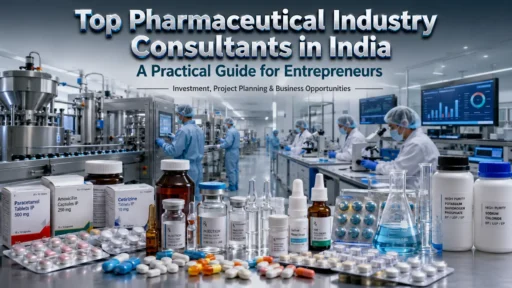


Pharmaceutical Industry Consultants
Why Pharmaceutical Industry Consultants Matter Right Now
India’s pharma industry has gone silent but been one of the world’s most watched manufacturing stories. It provides generic drugs to hospitals and pharmacies in the different continents and it does so in an extent that hardly any country can match. It’s the lure and the snare for an entrepreneur looking at this area. Well, it may seem like a big market on paper, but it’s a different matter constructing a compliant, bankable pharmaceutical unit.
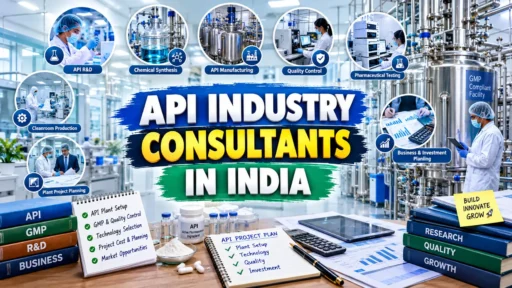
This is where the relevance of pharmaceutical industry consultants in India comes into the picture. Even a founder whose idea for a product is good, needs a partner who is familiar with the regulatory process, investment costs, plant design and market sizing to make that idea a viable fundable project. Even a good idea can get stuck at the bank loan table or meet compliance issues down the road without that support.
Government policy has also given impetus. The Production Linked Incentive schemes for bulk drugs and medical devices and a resurgent initiative of self-reliance for APIs have created opportunities for fresh players. But those same offers have technical requirements to meet, paperwork to follow, and deadlines to adhere to, and most first-time promoters find it hard enough to navigate, much less handle it on their own. That’s where the top pharmaceutical industry consultants in India come in.
Explore This Book: Drugs & Pharmaceutical Technology Handbook
What Pharmaceutical Plant and Process Consultants Actually Do
The word “consultant” can refer to a myriad of activities, and it’s important to understand what these consultants actually provide in a typical pharma project.
Feasibility Studies and Detailed Project Reports
In the case of any pharmaceutical unit, someone needs to ask the blunt question: Does this project make financial sense? before any pharmaceutical unit is set up. A feasibility study examines the demand in the market, the competition’s pricing, availability of raw materials and reasonable capacity utilisation. The Detailed Project Report (DPR) is slightly more detailed than this and will include an extensive financial model detailing project cost, means of finance, profitability projections and break-even analysis. A DPR is not usually a form of choice when financial institutions and banks are granting term loans for manufacturing projects in India.
Process Engineering and Plant Layout
There is no room for error when it comes to lay out in the pharmaceutical manufacturing. Before the first wall is built, cross contamination risk, air handling needs, and material flow must be planned. Process consultants produce process flow diagrams, machinery lists, and layout drawings, which are specific to the dosage form (tablets, capsules, oral liquids or active pharmaceutical ingredients (APIs)).
EPC Support
In larger projects, some consultants will also get involved with the engineering, procurement and construction (EPC) phase, which essentially means they will take charge of choosing vendors, coordinating civil construction and commissioning projects. This is weightier, action-oriented work that typically falls under the hands of another consultant from that who wrote the feasibility report.
Regulatory and Compliance Guidance
In India, no drug project takes off without first dealing with the regulatory setup that is managed by the
The Central Drugs Standard Control Organisation (CDSCO), India’s National Drug Regulatory Authority (NDRA), is in the ministry of Health & Family Welfare. This is where the expertise of consultants in this field can be applied with the assistance of license applications for manufacturing, providing Schedules M (GMP) compliance, documentation for new drug/ formulation approvals and State level Pollution Control Board and Factory Act clearances for manufacturing units in general.
View Full Project Details: Pharmaceutical Drugs, Bulk Drugs & Fine Chemicals Directory
Why India Has Become a Hotspot for Pharma Consulting
Several structural reasons account for pharmaceutical consulting becoming a specialised field within India and not remaining a part of industrial consulting.
First, the domestic industry itself has grown rapidly and organisations like the Indian Pharmaceutical Alliance (IPA) have been established to represent research-based national pharma companies which account for a large part of the country’s drug exports and pharma R&D investments from the private sector. That means continuous new formulation launches, capacity expansions and greenfield projects all requiring feasibility and compliance analysis.
Secondly, export potential continues to draw more people into the field. The Pharmaceuticals Export Promotion Council of India (Pharmexcil) can assist Indian exporters to connect with the global buyers and consultants can prove useful in bringing the manufacturing process closer to the desired standards expected by the export market from day one.
Third, the economics of entry have been altered by government schemes. Domestic API and formulation manufacturing is now much more appealing than 10 years ago, with PLI support for bulk drugs and import substitution priorities for bulk materials. This has led to a new wave of MSME entrepreneurs, not just the big pharma companies, to explore this field, and the majority of them are doing so for the first time.
The Department of Pharmaceuticals, Ministry of Chemicals & Fertilizers shares the scheme details and guidance for the sector, whereas Invest India and IBEF share details regarding market size, growth potential and investment opportunities across the sub-segments of the pharmaceuticals sector which are easier to skim than a government policy document.

How to Evaluate and Shortlist the Best Pharmaceutical Industry Consultants in India
Picking a consultant is harder than it sounds, mainly because the sector attracts a wide spread of capability under a fairly generic job title. A few criteria consistently separate strong consultants from the rest.
Domain expertise matters more in pharma than in most other manufacturing sectors, simply because dosage forms, API chemistry, and regulatory pathways vary so much from one product line to another. A consultant who has actually worked on tablet manufacturing feasibility will approach a problem differently from one whose experience sits mainly in general chemical processing, even if both call themselves industrial consultants.
A firm’s track record in DPR and feasibility work is the next filter. Ask directly how many pharmaceutical DPRs the firm has delivered and whether banks have successfully used those reports for financing. A DPR that looks polished but has never actually secured a loan approval tells you less than one with a modest track record of real financing outcomes.
Regulatory know-how deserves close scrutiny too. Given how central CDSCO licensing, GMP compliance, and state Pollution Control Board consents are to any pharmaceutical unit, a consultant unfamiliar with these processes will leave gaps that surface much later, often at the worst possible time — right before a plant inspection or license renewal.
Choose the right startup backed by real market demand
Engineering and EPC capability becomes relevant for entrepreneurs planning to build rather than outsource construction. Not every consultancy that prepares excellent DPRs also has in-house process engineering depth, so you should ask upfront whether the same team handles that capability or whether they subcontract it to another expert.
Finally, client base and sector diversity offer a useful signal. Consultants who have worked across formulation units, API plants, and allied segments such as nutraceuticals tend to bring broader pattern recognition to a new project than those who have only ever handled one narrow product category.
Role of NPCS in Pharmaceutical Project Consultancy
Among India’s established names in this space is Niir Project Consultancy Services (NPCS), a Delhi-based industrial consultancy set up in 1994. NPCS has built its practice around Detailed Project Reports and techno-economic feasibility studies for pharmaceutical and allied manufacturing projects, with reports that typically cover manufacturing process selection, machinery and raw material specifications, market research and demand analysis, process flow diagrams, product mix and capacity planning, and complete project financials with profitability analysis.
What distinguishes a firm with this kind of history is simply the volume of projects it has seen across sectors and geographies. NPCS has worked with clients across 85 countries and delivered over 150,000 project reports through more than 30 years in consulting — a scale that gives it exposure to a wide range of plant sizes, capacities, and regulatory contexts within pharmaceuticals and adjacent chemical-based industries.
For entrepreneurs who are still comparing project ideas rather than fixed on one product line, NPCS maintains a catalogue of pharmaceutical and pharma-intermediate project profiles that’s worth browsing before finalising a DPR brief — available at NPCS Pharmaceutical Project Profiles. This kind of resource is useful less as a promotional tool and more as a starting point for comparing capacity options, cost ranges, and product categories side by side.
Best Pharmaceutical Industry Consultants in Delhi and the Broader India Consultancy Landscape
Delhi holds a natural advantage as a base for pharmaceutical consulting, mainly because of its proximity to central regulatory offices, ministries, and the policy-making apparatus that shapes pharma schemes. Several established consultancies, including NPCS, operate out of the capital for this reason, and it makes coordination on regulatory and scheme-related queries somewhat easier for clients.
That said, the broader India consultancy landscape isn’t confined to any one city. Mumbai and Hyderabad also have strong pharma consulting ecosystems because they host headquarters of major pharmaceutical manufacturers and export bodies. Boutique management consulting firms in India increasingly specialise by sector rather than geography, and pharma has developed into a distinct niche where generalist industrial consultants often lack the expertise required for anything beyond basic feasibility work.
For an entrepreneur based outside these hubs, physical location matters less today than it once did. Consultants handle most DPR and feasibility engagements largely through documentation exchange and video calls, while they reserve site visits for later-stage plant layout or EPC work. What matters more than the city is whether the consultant’s technical depth matches the specific pharmaceutical sub-segment the company plans to pursue.
Related Article: Pharma Project Consultants in India: Why Expert Guidance Is Critical Before Starting a Pharmaceutical Manufacturing Unit
Comparing Consulting Service Types
| Consulting Service Type | Core Focus | Typical Deliverables | Best-Fit Client |
| Feasibility & DPR Consulting | Techno-economic viability, market and financial assessment | Detailed Project Report, cost sheet, ROI and break-even analysis | First-time entrepreneurs, bank loan applicants |
| Process & Plant Engineering Consulting | Manufacturing process design, plant layout, equipment selection | Process flow diagrams, layout drawings, machinery lists | Manufacturers setting up a new formulation or API unit |
| EPC Consulting | End-to-end engineering, procurement and construction execution | Detailed engineering packages, vendor management, commissioning | Mid-to-large investors building greenfield plants |
| Regulatory & Compliance Consulting | CDSCO licensing, drug approvals, GMP/Schedule M compliance | License applications, compliance audits, documentation support | Units preparing for manufacturing licenses or export clearance |
| Boutique Management Consulting | Strategy, fundraising support, market entry planning | Business plans, investor decks, growth strategy notes | Growth-stage companies planning expansion or diversification |
Frequently Asked Questions
How much does a DPR for a pharmaceutical plant cost in India?
Costs vary widely depending on plant capacity, product complexity, and the depth of financial modelling required. A basic feasibility report for a small formulation unit cost considerably less than a full DPR for a large API plant with multiple product lines, since the latter needs more detailed process engineering and market research.
What is the difference between a process consultant and an EPC consultant?
Process Design, Plant layout & Machinery selection is carried out on paper by a Process Consultant. An EPC consultant takes that design further into actual execution — procurement, construction coordination, and commissioning. Some firms offer both, but it’s worth confirming this explicitly rather than assuming.
How do I choose the best pharmaceutical plant consultant in India?
Your first line of attack should be domain knowledge about your specific dosage form and /or API segment; follow this up with reviewing their experience of successful CDSCO DPRs, that have resulted in obtaining bank finance and whether they have prior knowledge about the CDSCO licensing and CDSCO’s Schedule M compliance before you hire.
Do I need a separate regulatory consultant apart from my DPR consultant?
Not necessarily. While many legacy consulting companies include regulatory guidance in their DPR and feasibility proposals, projects involving injectables and biologics often require deeper regulatory expertise. In such cases, hiring an additional regulatory specialist alongside the DPR consultant is often worth the extra cost.
Can a first-time entrepreneur with no pharma background enter this sector?
Yes, provided the entrepreneur partners with consultants who can translate technical and regulatory complexity into a clear, actionable project plan. Most first-generation pharma entrepreneurs in India have entered the sector this way, leaning on external expertise for the parts they don’t yet understand.
What is the role of Pollution Control Board clearance in pharmaceutical projects?
Pharmaceutical manufacturing, like most chemical-linked processes, requires consent from the state Pollution Control Board before operations begin, in addition to Factory Act compliance. This runs alongside CDSCO licensing rather than replacing it, and a good consultant will sequence both processes so neither delays project timelines unnecessarily.
Conclusion: Practical Next Steps
Entering the pharmaceutical manufacturing sector in India rewards preparation far more than enthusiasm. The entrepreneurs who move fastest, once they actually start construction, are usually the ones who spent adequate time upfront on feasibility, DPR preparation, and regulatory mapping rather than treating those steps as paperwork to rush through.(Pharmaceutical Industry Consultants)
A sensible starting point is to shortlist two or three consultants with genuine pharmaceutical experience, ask each for references from completed DPRs that led to actual bank financing, and compare how they propose to handle CDSCO and Pollution Control Board compliance alongside the core project report. From there, the project takes shape considerably faster than most first-time founders expect.
Assumptions
Regulator identified for this article: CDSCO (Central Drugs Standard Control Organisation), Ministry of Health & Family Welfare. Technical keyword used: Pharmaceutical Technology. We verified all reference links (government, association, and data-bank) to ensure they were live before inclusion. As per the brief, we did not cite a specific year for any statistic.