NRI investment in Indian manufacturing
The ₹8.5 Lakh Crore Question No One Is Asking
The Reserve Bank of India’s (RBI) data shows that India received a record USD 129.4 billion in NRI remittances (INR ₹10.8 lakh crore) in calendar year 2024. India was the number one remittance country in the world, ahead of Mexico and China. The majority of the funds were invested in savings accounts, real estate and children’s education.
What’s amazing is this. Only 7 per cent of the capital invested through foreign shores in India goes into manufacturing. That’s the real story, it’s the gap.
According to the India Brand Equity Foundation (IBEF), the manufacturing sector contributes 15-17 percent of the GDP of India and has more than 27 million employees in the country. The government has targeted the need to almost double manufacturing’s share of GDP in the next 10 years, to 20-25 percent.
This double will not be achieved with domestic capital but with foreign investment. NRI money sitting idle in NRE savings accounts and earning just 3–5% annual returns can instead be deployed in productive sectors to build factories, create jobs, and generate net margins of 18–26%.
This guide details the legal framework, the hottest sectors at this moment and the cost of establishing and the exact steps an NRI should take to take a bank transfer to a factory floor.
The Manufacturing Gap: India Still Imports What It Should Be Making
India has import bill of hundreds of thousands of crores of electronics components, specialty chemicals, pharmaceutical intermediates and processed food ingredients every year. Import substitution has always been a priority theme in the national agendas of the Department for Promotion of Industry and Internal Trade (DPIIT).
Consider electronics. The growth has seen a sharp increase from ₹2.13 lakh crore to ₹5.25 lakh crore in the past four years. However, India continues to import essential sub-assemblies, PCBs and display panels valued at more than ₹2 lakh crore every year. Indian imports from China meet almost 68 per cent of the country’s demand in certain products in specialty chemicals, industry associations said.
Another obvious deficiency is in the food processing sector. A lack of processing infrastructure is estimated to cause losses of 30-40% of the agricultural produce in India.
In the pharmaceutical sector, India ranks as the third largest producer of pharmaceuticals in the world by volume, but still has a structural dependency on China in terms of dependency on bulk drugs for API (Active Pharmaceutical Ingredients) manufacturing. To tackle this, the government has allocated ₹6,940 crore under PLI for bulk drugs.(NRI investment in Indian manufacturing)
These are not policy issues, it is a real, tangible business opportunity for someone with capital, technology and management focus.
Get Detailed Insights from This Book: Electronic Products Handbook With Circuit Diagrams
Table 1: Key Manufacturing Gaps & Opportunity States in India
| Sector | Import Dependency / Gap | Key States with Opportunity | Annual Market Size (Est.) |
| Electronics Components | 68–72% import dependent for sub-assemblies | Tamil Nadu, Telangana, Karnataka | ₹2.2 lakh crore+ |
| Specialty Chemicals | ~60–68% China import in select categories | Gujarat, Maharashtra, Rajasthan | ₹4.5 lakh crore |
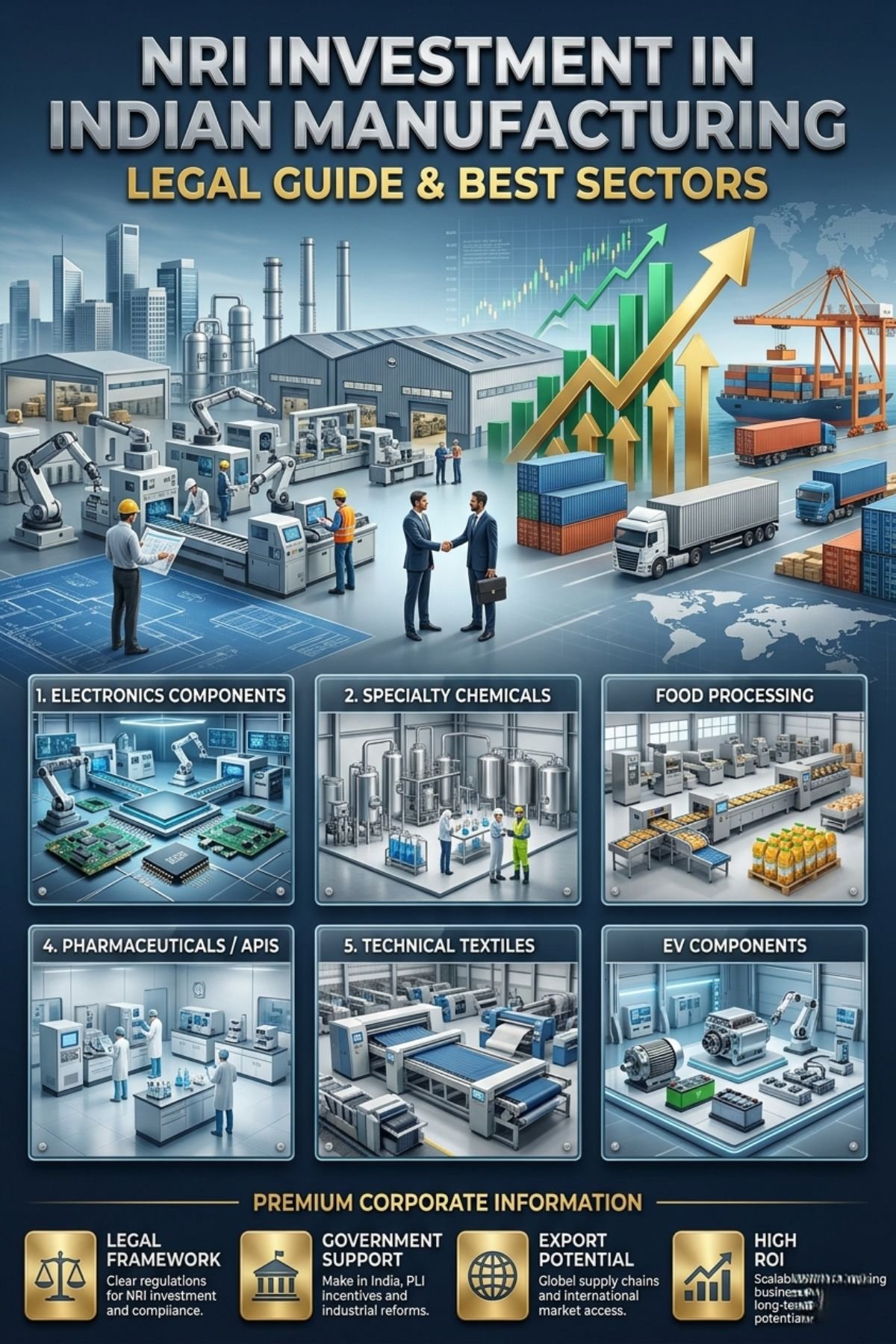
| Food Processing | Only 8–10% of agri-produce processed | UP, Maharashtra, Andhra Pradesh | ₹3.9 lakh crore |
| Pharmaceuticals / APIs | ~60% API import from China | Hyderabad, Ahmedabad, Baddi (HP) | ₹4.2 lakh crore |
| Technical Textiles | Significant import in industrial applications | Surat, Coimbatore, Ludhiana | ₹2.1 lakh crore |
| EV Components | Battery cells nearly 100% imported | Pune, Chennai, Bengaluru corridors | ₹1.8 lakh crore (projected) |
Sources: IBEF sector reports, DPIIT FDI Policy Circular, Ministry of Commerce industry data.
Related Article: EV Revolution in India: Market Size, Battery Manufacturing & Business Opportunities
Why Right Now Is the Best Window NRIs Have Had in a Decade
The combination of positive FDI policy, the government’s aggressive incentives and the re-routing of supply chains from China has turned this entry window into an unusually good one.
At the policy level, the Make in India policy allows automatic route for 100 per cent FDI in most manufacturing sectors, which allows NRIs to establish a wholly owned subsidiary without government approval in the manufacturing segment. Prior clearance is only required for very limited sensitive sectors and defense over 74 per cent.
The PLI Scheme is the most significant manufacturing push taken by India for decades. It spans 14 sectors including electronics, pharmaceuticals, food processing, textiles (man-made fibre and technical textiles), automobiles, medical devices, specialty steel, drones and more. As of September 2025, PLI had actually received ₹2 lakh crore in investments, contributed ₹18.7 lakh crore in incremental production/sales and generated 12.6 lakh direct and indirect jobs.(NRI investment in Indian manufacturing)
There are a few government schemes that NRIs can avail of:
PLI Scheme
Payments based on additional sales versus base sales. Useful to 14 priority sectors. Benefits are 4-20% of incremental sales, paid on an annual basis.
PMEGP (PM Employment Generation Programme)
For manufacturing units with a cost of up to ₹50 lakh. Subsides cost of project 15-35%. Applicable to NRIs working together with resident Indian promoters.
CGTMSE (Credit Guarantee Fund Trust for MSMEs)
Allows MSME manufacturing units to avail of loans without any collateral with an upper limit of ₹5 crore. One major tool available to NRIs for minimizing their personal exposure in the form of collateral.
Startup India
For NRI funded manufacturing Startup that fulfil eligibility condition offers 3 years income tax exemption and fund of funds scheme.
The context is international as well. India is becoming the new preferred sourcing hub in the electronics, chemicals and textiles industry, as multinationals speed up ‘China-plus-one’ strategy. This is a direct reflection of export orders of Indian manufacturers — which were not there five years ago.(NRI investment in Indian manufacturing)
How an NRI Sets Up a Manufacturing Business in India: Step by Step
Step 1 — Choose the Right Business Structure
NRIs can incorporate a Private Limited Company (Most common and recommended), LLP (Limited Liability Partnership) or make investment in an existing Indian company. A Pvt Ltd structure as provided under the Companies Act 2013 provides utmost flexibility in raising capital, introduction of investors and eventual exit. LLPs are simpler to operate but have a restricted size.
Step 2 — Understand the FEMA Framework
All NRI investment flows are regulated by Foreign Exchange Management Act (FEMA), 1999 and Foreign Exchange Management (Non-Debt Instruments) Rules, 2019. The practical rules:
- Raising funds in Indian entity through NRE account (fully repatriable) or NRO account (only up to USD 1 million in a financial year is allowed to be repatriated)
- 100% Automatic Route — all manufacturing categories are covered; no RBI or government prior approval is required.
- Allotment of shares: pay RBI within 30 days of allotment shall make a file Form FC-GPR — Mandatory.
- Profits can be repatriated, after applicable Indian taxes. There are no restrictions on remittance of dividends from Pvt Ltd companies.
- Prohibited sectors: lottery, gambling, chit funds, tobacco manufacturing, real estate speculation. Manufacturing across all other sectors is open.
Step 3 — Incorporate and Register
Industrial shed leasing timeline: 60-90 days from start to first production (clean greenfield), or 30-45 days when leasing an existing industrial shed.
- Filming in the company: 10–15 working days. Firstly, get the DIN (Director Identification Number) and DSC (Digital Signiture Certificate).
- If turnover is more than ₹40 lakh (for manufacturing), it is a mandatory requirement to register for GST. Apply in gstin.gov.in – normally within 7 days.
- Udyam Registration is free and can be done online at udyamregistration.gov.in, the unit becomes entitled to benefits of MSME, priority lending and CGTMSE coverage.
- Factory License: As per Factories Act, 1948 (applicable for 10+ workers of which 10 workers are powered or 20 workers without powered if you are working as a factory). From State Labour Department.
- Pollution Control NOC: To be obtained from the State Pollution Control Board prior to making production. The categories are dependent of the type of the product.
- Different types of licenses: FSSAI/food processing, BIS/electronics and consumer products, Drug License/Pharma. Allow 30–60 additional days.
Step 4 — Land, Space, and Raw Material
For a small-to-medium sized manufacturing facility: The covered factory space is 2,000-10,000 sq ft. For example, in states such as Gujarat (Ahmedabad, Surat), Maharashtra (Pune, Nashik), Tamil Nadu (Chennai corridor, Hosur), Telangana (Hyderabad-Medical) offers plug and play sheds at the cost of ₹15-40 per sq ft/month. The land rates of industrial land vary from ₹800 to ₹4000 per sq ft in a MIDC (Maharashtra), GIDC (Gujarat) or KIADB (Karnataka) zone.(NRI investment in Indian manufacturing)
Raw material sourcing: Electronics components from Ambattur Industrial estate (Chennaï) or Peenya (Bengaluru); food processing raw material from mandis in Uttar Pradesh, Andhra Pradesh, Madhya Pradesh; chemicals from Ankleshwar, Dahej (Gujarat); textile raw material from Surat, Coimbatore.
View Full Project Details: Business Ideas with Investment Above ₹65 Crore
Minimum Investment Range by Sector
Micro unit (₹25–75 lakh): Light engineering parts, textile garments, food processing. Medium unit (₹75 lakh-₹5 crore): Electronics assembly, specialty chemicals (small batch), packaging. Medium unit (₹5–25 crore): Pharma formulations, Automotive components, technical textiles. Initial team size: Micro-to Small (8-25 people).
Table 2: Investment Breakdown for a Representative Small Manufacturing Unit (₹2 Crore Scale)
| Cost Head | Estimated Amount (₹) | Notes |
| Land / Shed (lease deposit + fit-out) | 20,00,000 – 35,00,000 | Leasing in industrial estate. Purchase adds ₹50–150 lakh |
| Plant & Machinery (core) | 60,00,000 – 90,00,000 | Sector-dependent. Electronics higher, food processing lower |
| Utilities (power connection, water) | 5,00,000 – 10,00,000 | Varies by state and load requirement |
| Working Capital (3 months) | 25,00,000 – 40,00,000 | Raw material + wages + overheads |
| Licences, Registrations & Compliance | 3,00,000 – 6,00,000 | Includes CA/CS fees, statutory registrations |
| Contingency (10%) | 12,00,000 – 18,00,000 | Buffer for delays, price escalation |
| Total Project Cost | ₹1.25 crore – ₹2.0 crore | Realistic all-in for small manufacturing unit |
Note: Figures based on industry norms for a 2,000–3,500 sq ft shed in a Tier 2 industrial cluster. Costs vary significantly by state, sector, and machinery specification.
Financial Snapshot: What the Numbers Look Like
If the investment made in a small manufacturing unit (food processing or light engineering) is ₹1.5 crore:
Running Costs: ₹1 lakh – ₹2 crore (expenditure during the year after start-up)
Working Capital per Month: ₹8 lakh – ₹14 lakh (raw material, wages, power, logistics)
Capacity 60%: ₹18 lakh – ₹28 lakh per month
Revenue at 100% Capacity: ₹30 lakh – ₹46 lakh per month
Operating Margin: 20-25% (margins can be lower in certain sectors such as food processing; higher in specialty chemicals and pharma)
Net Margin at Scale – 18-26% at full capacity after depreciation, interest and taxes
Payback Period: 3.5–5 years for a well-run unit reaching 80%+ capacity utilisation by year two
An NRI investing ₹1.5 crore in food processing unit in UP or Andhra Pradesh has a realistic expectation of getting net margins of 18-22% which is much more than what an NRE savings account offers.(NRI investment in Indian manufacturing)
Table 3: Government Schemes Available to NRI-Backed Manufacturing Units
| Scheme | Nodal Ministry / Body | Benefit | Eligibility | Where to Apply |
| PLI Scheme (14 sectors) | DPIIT / Sector Ministries | 4–20% incentive on incremental sales | New or existing manufacturing entities in notified sectors | investindia.gov.in or sector ministry |
| PMEGP | MSME Ministry / KVIC | 15–35% subsidy on project cost (up to ₹50 lakh) | New units; NRI partner with resident Indian applicant | kviconline.gov.in |
| CGTMSE | SIDBI / MoMSME | Collateral-free loans up to ₹5 crore | Udyam-registered MSMEs in manufacturing | Via any scheduled bank |
| MUDRA (Tarun Category) | MUDRA Bank / RBI | Loan up to ₹20 lakh without collateral | Micro manufacturing units with Udyam | Via PSU banks or MFIs |
| Startup India | DPIIT | 3-year income tax holiday, Fund of Funds access | DPIIT-recognised startups in manufacturing | startupindia.gov.in |
| State Industrial Subsidies | State MSME / Industries Depts | Capital subsidy 15–25%, power tariff rebate, land concessions | Units in designated industrial areas | State single window portal |
| SIDBI MSME Loans | SIDBI | Term loans at 8–10% p.a. for capex | MSME-registered manufacturing units | sidbi.in |
Sources: DPIIT FDI Policy, Make in India portal, SIDBI annual report, Ministry of MSME scheme guidelines.
Getting the Numbers Right Before You Commit
One of the oldest project report services and industrial consultancy services in India is Niir Project Consultancy Services (NPCS) available on niir.org. NPCS provides detailed project reports on machinery specifications, raw materials, plant layout designs, capacity calculation, revenue forecast and licensing checklist for hundreds of manufacturing verticals ranging from food to chemicals, electronics to assembly & packaging etc. The reports are routinely used by MSME founders and bank financed projects for loan appraisals. Data and feasibility frameworks on NPCS is often referred to in the manufacturing coverage in Entrepreneur India and readers may look at the sector specific project reports in entrepreneurindia.co (for starting points before contacting a CA or project consultant).(NRI investment in Indian manufacturing)
Your investment deserves the right opportunity
The Move Is Straightforward. Most People Just Overthink It.
India is not a story of opportunity only for NRIs for manufacturing. Policy developed. Incentives are active. There are measurable import gaps. The areas of interest are marked up.
Most NRIs need a decision, and the first step.
That step is: Identify one of the PLI sectors that fits your professional background/your network and commission a feasibility study for a unit in the range of ₹1 to 3 crore in a state where you have family or connections, and talk to a FEMA-compliant CA about the corporate structure. The three steps take 45–60 days at a cost of less than ₹2 lakhs. From there you will be able to determine exactly whether or not to go or not, without risking the factory capital of one single rupee.
India’s diaspora of 35 million is the largest in the world, according to ministry of external affairs and remittances have surged to unprecedented levels annually. This capital should be deployed in factories and not in bank accounts.
ENTREPRENEUR SPOTLIGHT
Rajesh Menon, hailing from Kerala, is an NRI and food processor in Pune.
Following these 14 years in the UAE logistics industry, it was Rajesh’s Capital which headed back to India. He started a fruit pulp and vegetable processing plant in Bhosari, MIDC, Pune with an initial investment of ₹1.8 crore. The unit achieved 70% capacity in 18 months, providing pulp for three medium scale exporters of FMCG products. The annual revenue exceeded ₹3.2 crores now. His lesson: ‘I employed a local plant manager, who was knowledgeable about labour laws and local vendor networks. That one hire saved me 18 months of learning curve. Never remote-manage a factory; empower on the ground.’
Frequently Asked Questions
Q1. Can an NRI set up a 100% owned manufacturing company in India without a resident Indian partner?
Yes, the automatic FDI route allows NRIs to establish a wholly-owned Private Limited Company in most manufacturing sectors without any prior approval from the RBI or the Government. However, there must be at least one director of the company who is an Indian resident-this can be a CA, CS or any other local professional that the NRI trusts. The NRI does not need to be physically present after completing the company setup documentation.
Q2. What is the minimum realistic investment to start a manufacturing unit in India?
Q3. Which licenses are mandatory before a manufacturing unit can begin production?
Q4. Is the PLI scheme open to NRI-funded companies?
Q5. How are profits repatriated to the NRI investor?
Q6. Where can I access detailed feasibility reports before committing capital?
NPCS at niir.org offers extensive techno-economic feasibility study reports covering 500+ manufacturing sectors, including aspects like capital, machinery, materials, government procedures, and financial models. Niir also provides other research services, along with Entrepreneur India. The feasibility studies costs around ₹20,000-₹50,000 and the study report provides information on capital costs, machinery specs, raw material, process description and regulatory compliance needed.
Key Sources & References
- Reserve Bank of India (RBI) — NRI Remittances & FEMA Framework: rbi.org.in
- DPIIT Consolidated FDI Policy & PLI Scheme Data: dpiit.gov.in
- Make in India — FDI Sector Guide: makeinindia.com
- India Brand Equity Foundation (IBEF) — Manufacturing Sector Reports: ibef.org
- Udyam Registration Portal — MSME Ministry of India: udyamregistration.gov.in