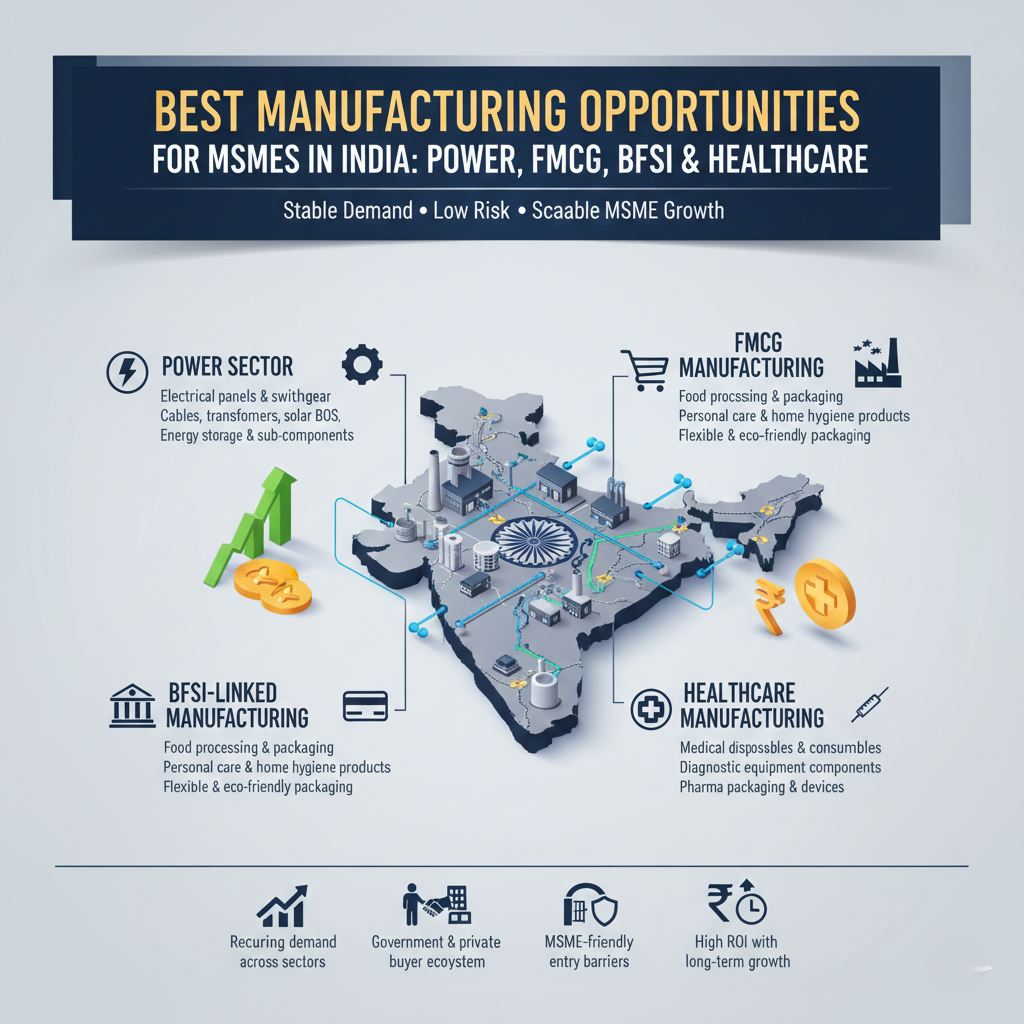
MSME manufacturing opportunities in India are growing like never before. The country’s manufacturing landscape is going through a paradigm shift, driven not by a single industry but by four key sectors — Power & Energy, FMCG, BFSI-linked manufacturing, and Healthcare. These industries offer unique, scalable opportunities for entrepreneurs with technical expertise and market insight.
What makes this phase distinct is not only the explosion in demand. Profitability is better, balance sheets are more robust than ever, government policy is actively aiding the growth of industry, and lines between services and manufacturing are more or less merging. For the first generation of entrepreneurs and startups, this convergence offers an uncommon opening to move into low-risk, high-visibility industrial projects, as long as they are making informed choices based on both technical feasibility and market demand.
This article looks at these four sectors and points to the most promising manufacturing opportunities, Why now is the ideal time to enter the space and Proven business models from India’s MSE leaders.
Read More: Medical Devices & Disposables Industry in India (Disposable Plastic Syringes, Disposable Mask & Gloves, Blood Bags, X-Ray, Ultrasound, ECG, Pacemakers, IV Fluid Sets and Other Devices) Market Analysis, Trends & Opportunities, Growth Drivers, SWOT Analys
Why Sector Comparison is Important
Entrepreneurs fail not because they lack effort or vision but because they enter saturated markets, invest in capital-heavy projects that have no certainty of demand or target industries that are not linked to policy support. The four sectors featured here, namely Power & Energy, FMCG, BFSI-linked manufacturing and Healthcare, are unique for a number of reasons:
- Consumption-driven demand: Each sector has regular predictable demand which minimizes business risk.
- Institutional backing: Projects can be funded by government or large private institutions, which helps to provide financial stability.
- For example: Domestic manufacturing opportunities exist because multiple products continue to be imported.
- Scalability: The various industry sectors support business development which extends from MSSME businesses to major corporations.
Entrepreneurs who understand the advantages of different sectors can use their knowledge to grow their businesses while reducing potential losses.
Power & Energy: Manufacturing More than Electricity
India’s power ecosystem has developed beyond its initial purpose of generating electricity. The system now includes transmission networks and distribution systems and renewable energy sources and energy storage technologies and infrastructure funding solutions. This makes it one of the most attractive sectors for manufacturers looking for long-term/institutional demand.
The market currently is driven by the rapid growth in renewable energy, modernization of transmission grid and growth in demand for energy storage solutions especially for electric vehicles. These trends have created a number of manufacturing opportunities:
- There is still a huge need for the Electrical Transmission and Distribution Equipment: HT/LT panels, switchgear assemblies, bus ducts, and insulators are still in high demand.” Domestic suppliers are favoured because of logistical convenience and compliance requirements.
- Renewable Energy Components: Solar mounting structures, cable trays, inverter enclosures and earthing materials are increasingly being domestically sourced. Many special parts are still imported which also offers a great import substitution potential.
- Energy Storage and EV Power Components: The growing electric vehicle network in India needs battery enclosures and thermal management casings and power electronics housings as its main components.
MSMEs for this sector usually go through regional utility contracts and grow nationally in two to three years. The key to success lies in matching the production capabilities to long-term utility and renewable energy projects.(MSME Manufacturing Opportunities India)
Read More: Business Ideas for Startup in Drugs & Pharmaceutical Industry with Project Profiles (3rd Edition)
FMCG: Manufacturing Where Consumption Never Sleeps
The FMCG sector is based on volume, repeat consumption and pervasive supply chains. The consumption patterns in rural and semi-urban areas are rising together with premium product demand which drives up needs for high-quality ingredients and packaging materials.
Some opportunities for entrepreneurs are:
- Food Processing and Value Added Ingredients: Products such as dehydrated fruits, spice blends and nutraceuticals are emerging with strong demand both domestically and for export. Manufacturers benefit from processed ingredients which provide standardized quality and extended storage capabilities.
- Packaging Materials: The food and beverage industry requires packaging materials which include flexible films and paper-based packaging materials and caps and closures and dispensing systems. FMCG brands are keen on suppliers who can guarantee quick delivery and the same quality.
- Home and Personal Care Intermediates: Surfactants, cosmetic bases and fragrance carriers are the backbone of the personal care manufacturing industry.
The initial product offerings of many successful MSMEs enabled one brand to grow their business into multiple product categories through time. Their competitive advantage stems from process consistency, quality control and timely delivery, and not marketing or brand visibility.
BFSI-Linked Manufacturing: The Hidden Industrial Engine
The BFSI sector operates mainly as a service industry, but it creates indirect manufacturing through its funding for infrastructure projects that support MSMEs, healthcare facilities and renewable energy initiatives. With the massive digitization and increasing flow of credit, entrepreneurs can take advantage of BFSI-driven demand in various ways:
- Secure Infrastructure and Fintech Hardware: Across the banking and fintech networks, secure lockers, ATM kiosks, secure cabinets, and payment terminal housings are needed.
- Manufacturing and Services: Finance and Insurance Services & Banking: 1.0 % 2.0 % 3.0 % 4.0 % 5.0 % 6.0 % 7.0 % 8.0 % 9.0 % 10.0 % 11.0 % Investment, deduction and loan amounts 668.19 668.20 668.16 668.09 668.20 668.07 668.19 66
- Equipment-as-a-Service Manufacturing: MSME-focused loan-backed machinery and modular industrial equipment lead to scalable opportunities.
Partnership with NBFCs or Banks for vendor financing helps in rapid growth, as there is less financial risk to the customer as well as helps in faster market penetration. Business models that require low assets and use modular systems find BFSI manufacturing operations to be the perfect match.
Read More: Handbook on Medical and Surgical Disposable Products (Blood Bags, Plastic Gloves, I.V. Cannula, Infusion Set, Gowns, Masks, Catheter, Cotton and Bandage, Surgical Wear, Syringes)
Healthcare: Recession Proof Manufacturing
Economic cycles have no impact on the healthcare industry, which maintains its constant demand. The combination of aging populations and lifestyle diseases and government public health spending creates a system that maintains stability.
Entrepreneurs can target:
- Medical Consumables: The domestic market requires constant supply of disposable syringes and IV sets and surgical gloves and diagnostic kits which also serve as export products.
- Hospital Furniture and Equipment Hospitals throughout India need various essential items which include patient beds and ICU furniture and trolleys and carts.
- Pharma and Diagnostic Ancillaries: Lab plasticware, cleanroom equipment and special packaging materials continue to be in short supply in the country.
Healthcare manufacturing is especially appealing because of long-term institutional contracts, steady demand and export possibilities. Entrepreneurs whose production lines match their procurement policies and who are able to compliance with regulatory standards are great contenders for steady growth.(MSME Manufacturing Opportunities India)
Read More: Top 25 Healthcare Business Ideas
Choosing the Right Sector
There is no one “best” sector. The choice of which to use depends upon the availability of capital, technical skills, access to markets and risk appetite.
- Power & Healthcare: Suitable for entrepreneurs looking for long term institutional demand and somewhat predictable revenue.
- FMCG: Best suited for those who strive for volume-driven growth, quick returns.
- BFSI-linked manufacturing: Ideal for asset-light/ modular businesses that focus on flexibility and scalability.
In every sector, manufacturing discipline, visibility of demand, and financial viability are important. Professional feasibility studies are useful to entrepreneurs in determining the scale of the project, mix of the products, regulatory compliance, etc.
Read More: Top 10 Profitable Pesticides and Insecticides to Manufacture
Support and Policy Ecosystem of Government
Government of India is giving active support to MSME and manufacturing sectors. Entrepreneurs should track:
- Ministry of Power: Policies on Renewable energy and grid modernization.
- Ministry of Food Processing Industries: Incentives for FMCG and food manufacturing.
- Ministry of Health & Family Welfare: Procurement Standards and Healthcare Support
- Department for Promotion of Industry and Internal Trade (DPIIT) – MSME development, tenders and policy advice
The government provides financial incentives and tender opportunities and strategic guidance through its initiatives to help projects decrease risk and enhance their project feasibility.
Conclusion
India’s manufacturing growth is being driven by a number of different sectors, each of which is offering profitable, scalable, and institutionally supported opportunities. Power & Energy and Healthcare for long-term institutional demand, FMCG for high-volume consumption, and BFSI linked manufacturing is perfect for asset-light and modular ventures.(MSME Manufacturing Opportunities India)
Entrepreneurs who have a combination of market insight and technical expertise, combined with disciplined manufacturing practices, can exploit these opportunities. The most important thing is to pick the right sector, align with existing market and policy trends and plan very carefully to scale successfully.
FAQs
Which sector is the quickest to produce returns?
FMCG generally offers faster return on investments because of high volume repeat consumption while Power and Healthcare have steady long-term returns.
Is initial capital a barrier?
BFSI-linked manufacturing is rather low capital. Power and Healthcare demand medium capital and FMCG also investment is different based on types of products and scale.
Can startups get into many different sectors at once?
Focusing on one sector is advisable for scalability and alignment with the markets.
What are the government policies for MSMEs?
Through incentives, subsidies, tenders and sector specific advice.
Why is now the ideal time to enter?
Increasing domestic demand, institutional financing, policy support, and opportunities for import substitution, this is a good time for entrepreneurs.