
A Seminar That Signals a Structural Shift
India has 63 million MSMEs contributing to 45% of India’s exports and almost 30% of India’s GDP. But most of these enterprises have never sold outside their district, much less their country. In that day, it is about to change – and it is changing quickly.
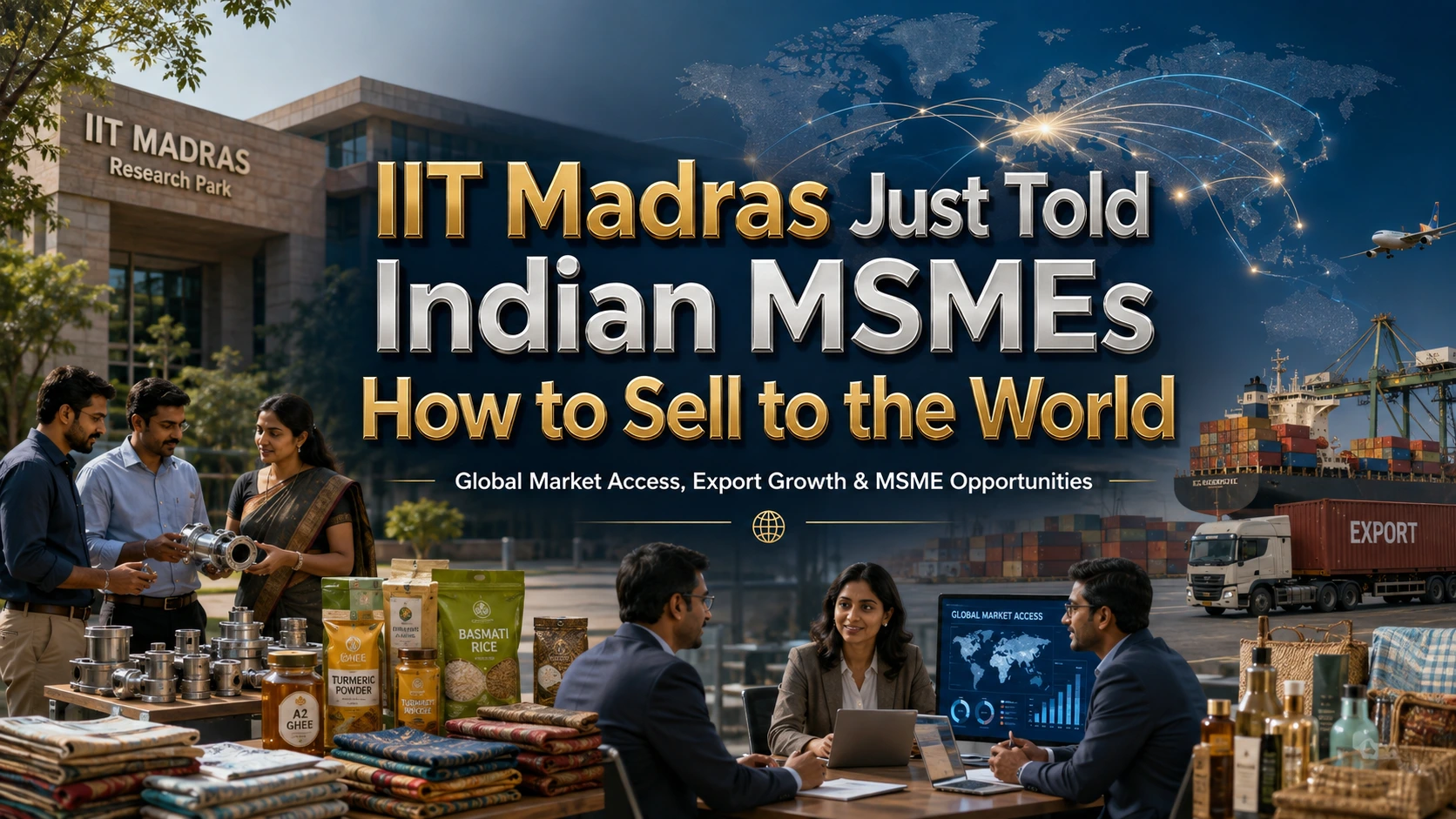
The Ministry of Micro, Small & Medium Enterprises (MSME) conducted a historic National Seminar on “From Local to Global: Enabling Export-ready MSMEs through Digital Commerce” at IIT Madras on 18 August 2026. The event has been attended by the policymakers, DGFT officials, EXIM Bank, ECGC, export consultants and more than 100 MSMEs, entrepreneurs and students from Chennai, reported DD News.
This is not a normal governmental function. Structured capacity-building, academic collaboration, and financial institution access are all key policy tools being deployed to steer MSMEs into global digital trade, and it is clear that it is the Centre’s policy. The opportunities for entrepreneurs and manufacturers to jump on this trend are vast — and will keep growing bigger.
What the DD News Report Means for Entrepreneurs
MSME Development & Facilitation Office (MSME DFO) Chennai in association with Entrepreneurship Cell, IIT Madras hosted the seminar, according to DD News. The theme: Digital commerce – national & international opportunities for MSMEs.
Speaking on digital commerce, Praveen Yadav, Additional Chief Secretary, MSME Department, Tamil Nadu, pointed out that it is overcoming geographical barriers and emphasized the need for greater convergence between the Centre and States to boost the competitiveness of the MSME sector in the global market.
Prof. Manu Santhanam, Dean, IC&SR, IIT Madras emphasized the importance of academia-industry partnership to assist MSMEs to create competitive products for export. Hansraj Verma, Director General of the Council of State Industrial Development & Investment Corporation of India, made a very simple yet profound statement: Quality is the pathway to global competitiveness; digital onboarding is the road.
Technical sessions focused on export procedures, trade finance, risk mitigation (ECGC), international payments, market identification, compliance and digital onboarding. It was hands-on training, not pohm-dang talk.
Why this matters for every founder:
- Through the MSME capacity building scheme ‘Procurement & Marketing Support (PMS)’ the Government provides expert guidance on exports to MSMEs at no cost.
- IIT Madras’s seal adds credibility and leads to innovation funding for programmes in digital commerce.
- DGFT’s, EXIM Bank’s and ECGC’s participation indicate the formal credit and risk-cover infrastructure is starting to shift its gears in favour of MSME exports.
- Students and potential entrepreneurs were clearly identified — the next generation of exporters are being prepared right now, and those who start early will create a snowball effect of gains.
Why India’s Digital Commerce Sector Is Entering a Golden Decade
India has an e-commerce market of $350 billion by 2030. The fastest growing segment is cross-border exports through digital platforms (MSME exports). This is a structural opportunity as a number of forces are coming together.
Policy Tailwind
Targeting $2 trillion in exports by 2030, the Foreign Trade Policy 2023–2028 has been introduced. The focus here lies with MSMEs and digital commerce as the scalable channel to achieve the ambition.
Infrastructure Readiness
UPI, GST, Aadhaar linked KYC and Open Network for Digital Commerce (ONDC) have reduced the hassle for MSMEs to practically nothing. Now, any micro enterprise with a smart phone can take the first step towards the road of exports.
China+1 Global Demand Surge
The buyer demand in India for alternatives to international products in engineering, textiles, food processing, pharmaceuticals and other sectors is unprecedented and unprecedented, due to the reconfiguration of the supply chains post-pandemic. There is an active sourcing coming into the US, EU, UAE and Southeast Asia from India.
Financial Ecosystem Alignment
For the smaller, first-time exporters, EXIM Bank, ECGC, and SIDBI have all launched MSME-specific products. The seminar connected these institutions with the people who have the greatest need for them – the entrepreneurs.
Government Policies & Incentives Every MSME Exporter Must Know
- Ministry of MSME – PMS Scheme: Provides financial support to national seminars, export fairs, and digital capacity building for MSMEs all over India.
- DGFT – Foreign Trade Policy 2023-28: Districts is declared as export hubs, MSME priority status and simplified IEC registration.
- EXIM Bank India: Pre- and post-shipment credit, Overseas Investment Finance and MSME trade-finance products.
- Export credit insurance and Export Credit Guarantee – Export Credit Guarantee Corporation (ECGC) – that will eliminate the risk of buyer default for small exporters.
- SIDBI – MSME Digital Finance: Loans for digital infrastructure upgradation, e-commerce onboarding, and working capital.
- Government e-Marketplace (GeM Portal): India’s e-commerce platform for government procurement; enhances credibility of the supply chain for international tenders.
- ONDC – Open Network for Digital Commerce: Decentralised e-commerce infrastructure by which MSMEs can serve the consumers on several apps with a single registration.
- Tamil Nadu MSME Department, directly co-organised the seminar at the IIT Madras, specifically in the areas of Subsidy, Cluster Development and export facilitation.
- Invest India – MSME Gateway: One-stop access for connecting with global buyers, facilitation of foreign investment and sector reports for MSMEs.
6 Manufacturing Business Ideas Unlocked by India’s Digital Commerce Push
Each of the below ideas are directly tied to focus areas discussed during the seminar: export readiness, digital onboarding, packaging compliance, cross-border e-commerce, and navigating trade finance.
1. Export-Ready Handicraft & Artisanal Product Manufacturing
The handloom, pottery, woodcraft and metalwork industry of India is in demand in the world but it is also the industry which is the least exported industry in the world due to absence of digital presence and compliance. The emphasis on digital onboarding and market identification provides a direct path for small manufacturers to connect with Amazon Global, Etsy and Faire. If a unit produces 500 to 1,000 pieces per month for export at an appropriate price, it can earn 4–6 times more than by selling them for domestic use only.
This is a venture that requires an investment of Rs 10-50 Lakhs and targets markets in USA, UK, EU, Japan, and Australia.
Related Article: Top 20 Wood Product Manufacturing Business Ideas
2. Agri-Processed Food Products (Export-Grade Processing Unit)
India is a leading exporter of spices, pickles, organic rice, lentils and superfoods to more than 100 countries. Supply is sufficient – it’s the export grade processing, labelling and compliance. Food Processing unit with GMP certification and listings on Amazon Global, Noon and Woolworths is a high margin business. The seminar on export compliance training is in sync with the framework of FSSAI, APEDA and DGFT.
This is a good time to invest in the UAE, USA, UK, Australia or Canada.
Get Detailed Insights from This Book: Handbook on Fruits, Vegetables & Food Processing with Canning & Preservation
3. Precision Engineering & Auto Component Manufacturing
The state of the seminar, named Tamil Nadu, is the base of the “capital” of the auto-component industry in India. As China+1 moves, precision-machined parts, castings and tooling are in high demand from German, US, and Japanese OEMs. Units can participate in overseas RFQs on digital B2B platforms such as Thomasnet, Alibaba B2B and IndiaMart which do not require them to be present in the country. A minimum requirement is ISO certification and digital cataloguing.
The project involves investing Rs 50 Lakh to Rs 2 Crore in the project, with a target market of Germany, USA, Japan, and South Korea.

4. Textile & Apparel Manufacturing (Direct-to-Consumer Export)
Even though India’s textile industry is the second largest industry in the manufacturing sector, it is not receiving adequate support to sell through digital marketing channels. The vertically integrated apparel segment can directly tap into the UK, US, and Australia consumer markets by integrating the Shopify storefront, Instagram commerce, and ONDC export B2C logistics. Most textile MSMEs lack three key pillars—duty drawback, compliance guidance, and trade finance—which the IIT Madras seminar discussed.
The investment range is from Rs 20-75 lakh and the target markets are UK, USA, EU and UAE.
Get Detailed Project Report (DPR): Textile Processing and Manufacturing Projects
5. Herbal, Ayurvedic & Nutraceutical Product Manufacturing
Herbal and Ayurvedic product exports of India have increased by more than 40% in the past five years. Immunity supplements, botanicals and Ayurvedic products from the USA, Germany, Japan and Australia are in high demand globally. Manufacturers of MSME can create high-margin international businesses by leveraging digital commerce distribution through iHerb, Amazon US and Vitacost in addition to a GMP compliant manufacturing process. With the right support of a consultant AYUSH certification and FDA/CE compliance can be achieved.
The investment range of the project is Rs 30 Lakh – Rs 1.5 Crore and the target markets are USA, Germany, Japan, Australia.
Explore This Book: Herbal Cosmetics & Ayurvedic Medicines (EOU)
6. Export-Readiness Consultancy & Digital Onboarding Services
The seminar itself exposes the huge services gap that exists for thousands of MSMEs: expert guidance on digital onboarding, IEC registration, ECGC cover application, DGFT compliance, setup of international payment systems, and selection of the cross-border platforms. The Ministry of MSME is creating demand, which a specialised export-readiness consultancy or a SaaS platform can directly monetise by providing these services at scale. Low CAPEX, high scalability.
Ramping up the sales and marketing of their products and services, the company is seeking to increase its market share.The company wants to expand its market share by accelerating the sales and marketing of its products and services.
Import–Export Opportunity Analysis
Top Export Markets for Indian MSMEs
- Indian handicrafts, nutraceuticals, food products and precision engineering components are all in demand in USA & Canada.
- UAE & GCC: Textiles, Food Processing, Automotive Components. India-UAE CEPA is working towards bringing down trade barriers.
- UK & EU: Post-Brexit, Indian MSMEs with digital presence and compliance documentation are clinching new contracts.
- Southeast Asia: Asian Association of Southeast Asian Nations (ASEAN) trade corridors are growing, and Indian industrial goods are being imported by buyers in Thailand, Vietnam and Indonesia.
Import Substitution Opportunities
- Domestic development of Digital commerce SaaS platforms, with assistance from funds under Digital India can be developed by local firms which are licensed from US/EU based companies.
- Manufacturing of export grade packaging – present import dependent – can be done at MSME scale, using specialised cushioning and climate-controlled packaging.
Trade Infrastructure Opportunity
For MSMEs, there is a gap in logistics aggregation services, customs clearance technology, and platforms for trade finance facilitation. As the seminar clearly pointed out, startups that digitalize these services have a huge and ever-expanding addressable market.
Indian MSME Success Stories in Digital Commerce & Export
1. Tara Crafts, Jaipur (Handicraft Exports)
An artisan business started at the home market, moved to the fair market and now to Amazon Handmade USA. The business now exports to 12 countries, thanks to their investment in professional product photography, GST documentation for exports and IEC registration, and 70% of revenue comes from digital commerce. In four years turnover increased from Rs 15 lakh to 1.8 crore without any physical presence in overseas.
2. Vasundhara Organic Foods, Nashik (Agri-Export MSME)
Food Processing MSME used APEDA’s agri-export scheme, digital listing in international platforms to export Organic Turmeric and spices to Germany and UK. The founders were able to offer buyers abroad longer payment terms without worrying about their default because ECGC export credit insurance eliminates the buyer default risk.
3. Kovai Components, Coimbatore (Precision Engineering)
Start with clarity—choose the best business idea
About NPCS – Niir Project Consultancy Services
Since 1990, Niir Project Consultancy Services (NPCS) has been serving entrepreneurs, start-ups and MSMEs, investors and exporters in India with bankable intelligence.
NPCS delivers:
- Detailed Project Reports (DPR): These are bankable project reports which are accepted by SIDBI, NABARD, and commercial banks for loan sanctioning.
- Market Research: Demand analysis, pricing, competition mapping, distribution intelligence based on the sector.
- Feasibility Studies: Technical, financial and commercial feasibility of new manufacturing ventures.
- Technology Consultancy: Plant layout, Selection of machinery, selection of raw materials, Manufacturing process design.
- IEC & RCMC Registration Assistance, Digital Commerce Onboarding Support, export pricing, etc. support from Export Business Setup with APEDA/ECGC Registration.
Business Opportunity at a Glance
| Parameter | Details |
| Industry | Digital Commerce / E-Commerce for MSMEs |
| Market Driver | Government PMS Scheme + IIT Madras Academia–Industry Collaboration |
| Investment Range | Rs 5 Lakh – Rs 2 Crore (depending on vertical) |
| MSME Opportunity | Export onboarding, cross-border e-commerce, B2B digital marketplace services |
| Export Potential | High — US, UAE, UK, Southeast Asia, Europe |
| Government Support | PMS Scheme, DGFT, EXIM Bank, ECGC, SIDBI, GeM, ONDC |
| Risk Level | Low to Medium — strong policy backing, growing digital infrastructure |
| Growth Outlook | Strong — India e-commerce exports projected to cross $300 billion by 2030 |
Conclusions: The Seminar opened a Door — Founders Must walk through it.
In the case of the national seminar at IIT Madras, as reported by DD News, this is more than just a news story. It is a policy pronouncement. The Government of India is deliberately removing barriers that have prevented MSMEs from entering international markets. These barriers include compliance confusion, limited access to trade finance, low awareness of digital platforms, and export risks.
This combination of policy objectives, institutional support and digital infrastructure is an unusual and synergistic business opportunity for entrepreneurs. MSME exports could hit $300 Billion a year in India by 2030. The companies that get a head start by creating export-ready, digitally enabled businesses will reap the lion’s share of that growth.
These are the sectors: export grade food processing; artisanal manufacturing; precision engineering; herbal products; textile. Support from the institutions is on the live mode: EXIM Bank, ECGC, DGFT, SIDBI, PMS Scheme. The platforms are ready, and they are Amazon Global Selling, ONDC, Alibaba B2B and Shopify.
Now, there’s a decision that needs to be made.
Technology support, market investigation and a bankable project report are what you need to build an export-ready MSME business – contact NPCS today! This is a once-in-a-lifetime opportunity, supported by government, academia and financial institutions.