Manufacturing opportunities in India sector undergoes complete transformation from its established operational methods. The industry is shifting from low-margin products which depend on commodity resources towards advanced manufacturing of specialty chemicals and pharmaceutical intermediates and bio-based extracts and renewable fuels. The current transformation of the industry receives backing from regulatory frameworks and the increasing healthcare sector and sustainability objectives and the rising demand for exports.
The manufacturing sectors which provide entrepreneurs and MSMEs and investors with this transition create business prospects because these sectors deliver two benefits through their ability to set prices and grow their operations and maintain steady demand for their products. The article examines three business opportunities which create intersections between agriculture and chemistry and energy while presenting distinct risk-return profiles.
Read More: Potato Powder -Manufacturing Plant, Detailed Project Report, Profile, Business Plan, Industry Trends, Market Research, Survey, Manufacturing Process, Machinery, Raw Materials, Feasibility Study, Investment Opportunities, Cost and Revenue, Plant Economics
Pharmaceutical APIs and Botanical Extract Manufacturing
The manufacturing of pharmaceutical APIs and botanical extracts is among the most attractive value-added segments in India today. The market includes products which include Thiocolchicoside and Ginger Oleoresin and Curcumin and Coleus Extract which serve both regulated pharmaceutical markets and the quickly developing nutraceutical and wellness industries.
Key products in this segment include:
- Thiocolchicoside, a muscle relaxant widely used in orthopedic and neurological medicines
- Ginger oleoresin, used in food flavoring, beverages, pharmaceuticals, and cosmetics
- Curcumin, extracted from turmeric, with applications in pharmaceuticals and dietary supplements
- Coleus extract, commonly used in weight management and cardiovascular formulations
The demand for this segment generates commercial value because it exists in two separate market channels. Pharmaceutical APIs provide both regulated demands which maintain stable demand patterns and botanical extracts which grow through current lifestyle patterns and preventive healthcare tracking and international export potential.(Manufacturing opportunities in India)
The manufacturing process of production requires five separate procedures which include solvent extraction and concentration and purification and standardization and drying. The production of Thiocolchicoside needs to follow strict GMP regulations while plant extracts rely on the quality of their raw materials and their production methods. Successful companies operate extraction facilities which handle multiple products because they can switch their operations to process ginger and turmeric and coleus according to what is available during different seasons and how much the market charges for those products. The ability to adjust operations between different ranges of production capacity helps organizations to operate more efficiently while protecting themselves from potential losses.
Raw material sourcing is a critical cost factor. To manage price volatility and quality consistency, manufacturers increasingly adopt contract farming or backward integration. Operational costs are strongly influenced by:
- Energy consumption
- Solvent recovery efficiency
- Effluent treatment and environmental compliance
The rising demand for these products arises from three factors which include the growth of generic pharmaceuticals and the worldwide increase in nutraceutical use and the rising demand for plant-based ingredients in cosmetics and wellness products. India exports large quantities of curcumin and oleoresins to the United States and Europe and Southeast Asia because those regions pay higher prices for standardized products.
The Indian market for botanical extracts and selected APIs shows an annual growth rate between 9 and 11 percent. Export-grade standardized extracts enable well-managed units to achieve EBITDA margins between 18 and 25 percent.
Read More: Power Project For Glass Industry – Manufacturing Plant, Detailed Project Report, Profile, Business Plan, Industry Trends, Market Research, Survey, Manufacturing Process, Machinery, Raw Materials, Feasibility Study, Investment Opportunities, Cost & Revenue
Concentrated Citric Acid Solution for Bicarbonate Dialysis
Dialysis The production of dialysis-grade chemical concentrates depends on concentrated citric acid solutions because these products establish a stable manufacturing system which can be easily defended. The products are essential components which hospitals use to operate bicarbonate dialysis systems for patients who suffer from chronic kidney disease and they must achieve the purity and sterility requirements of pharmaceutical products.(Manufacturing opportunities in India)
India is experiencing daily growth in kidney diseases because diabetes and hypertension rates continue to rise. The increasing number of dialysis centers has emerged as a solution to this problem, which both private healthcare providers and government programs support in urban and semi-urban areas.
The manufacturing process requires strict adherence to regulations because it lacks technical difficulties. The process requires multiple stages which include the controlled dilution of pharmaceutical-grade citric acid together with micro-filtration and microbial control measures and final sterile packaging.
Critical compliance requirements include:
- Purified water systems
- Cleanroom environments
- Batch traceability
- Shelf-life and stability validation
The primary raw materials include pharmaceutical-grade citric acid, purified water, and HDPE containers. The key customers for this product are hospitals, dialysis chains, and medical equipment suppliers.
From an investment perspective, this segment is attractive because:
- Businesses require minimal capital expenditures.
- The market shows constant and predictable demand patterns.
- Approved products maintain their price stability. The market for dialysis
consumables in India grows at an annual rate exceeding 12 percent, which makes this business opportunity ideal for first-generation entrepreneurs and conservative investors who want to achieve consistent financial growth.
Read More: Tata Chemicals Sodium Bicarbonate Success: Manufacturing Process
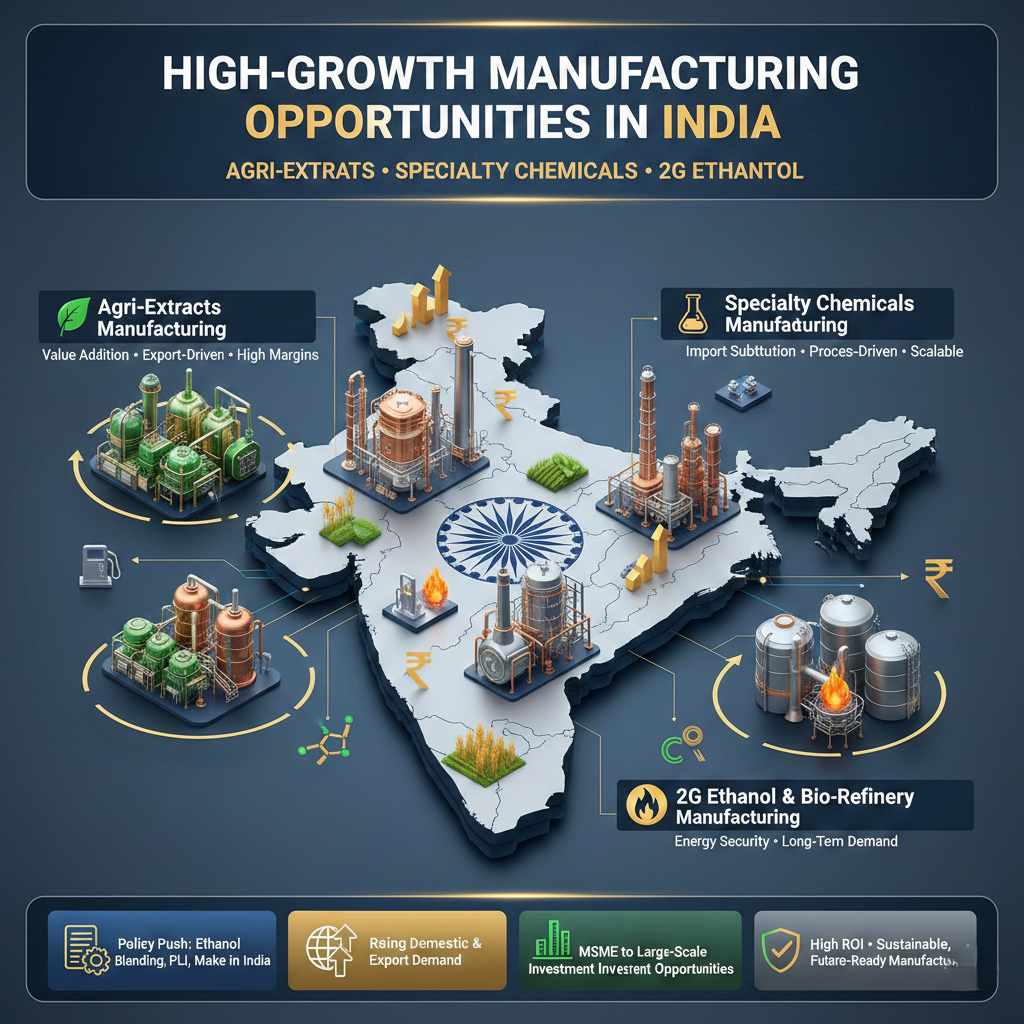
Second-Generation (2G) Ethanol Manufacturing
Second-generation ethanol manufacturing aligns closely with India’s renewable energy and sustainability objectives.2G ethanol production uses agricultural residues which include rice straw and wheat straw and bagasse to produce fuel that does not compete with food crops.
The Ethanol Blending Program in India uses 2G ethanol as its primary fuel for gasoline because it targets a 20 percent ethanol blend with gasoline. Oil marketing companies maintain their long-term offtake agreements to support this market segment which arises from policy requirements.(Manufacturing opportunities in India)
A 2G ethanol plant integrates multiple process stages, including:
- Biomass collection and handling
- Pre-treatment and enzymatic hydrolysis
- Fermentation and distillation
- Effluent treatment and waste management
Most projects depend on established technology providers because of the difficulties which advanced technology creates. The economic viability of a project depends on feedstock availability within a 50-70 kilometer distance while seasonal storage planning determines the project’s operational stability. Many plants integrate co-generation systems to improve energy efficiency.
2G ethanol production offers revenue stability and long-term market relevance which makes it a strategic investment for businesses that want to invest over extended periods.
Read More: Modern Technology of Agro Processing & Agricultural Waste Products
Lessons from Indian Industrial Leaders
Indian industrial leaders have shown that companies achieve long-term success through specialized operational processes and controlled business development. For example, Aarti Industries established market presence through its expertise in niche chemical intermediates which it later used to expand into adjacent markets. Similarly, Praj Industries established its leadership position in biofuels through technological partnerships and strategic alignment with national energy initiatives.(Manufacturing opportunities in India)
MSMEs should implement process-based business models which enable them to achieve operational excellence through focused activity while maintaining safe company growth.
Read More: Start a Specialty Chemicals Business in India: High-Growth MSME Opportunity
Role of Niir Project Consultancy Services (NPCS)
Niir Project Consultancy Services supports entrepreneurs by developing Market Survey reports and Detailed Techno-Economic Feasibility Reports. The reports evaluate demand and pricing together with competition and manufacturing techniques and raw material needs and plant design and financial estimates. Together, The combination of technical analysis and commercial assessment enables investors to evaluate project feasibility through NPCS services before they make investment decisions.
Final Thoughts
Overall, These three manufacturing opportunities reflect India’s shift toward value-added, policy-aligned industrial growth. Moreover, The business model of botanical extracts and APIs enables higher profit margins through operational difficulties, while dialysis chemicals provide businesses with stable and defendable market presence, and 2G ethanol delivers strategic advantages during extended periods.
For entrepreneurs and investors, success lies in understanding process economics, securing raw material supply chains, and aligning capacity with real demand rather than speculative trends.
Frequently Asked Questions (FAQs)
Is botanical extract manufacturing suitable for small entrepreneurs?
Yes. Many manufacturers start with a single extract and scale gradually as market access improves.
How long does it take to obtain approvals for dialysis-grade chemical manufacturing?
The process typically requires six to twelve months because both regulatory compliance and documentation must be fulfilled.
Are 2G ethanol plants viable without government policy support?
The financial viability of 2G ethanol plants depends on both long-term offtake agreements and policy incentives which create necessary support for their operations.
Which segment offers the fastest break-even period?
Dialysis-grade chemical concentrates show faster break-even results because they need less capital investment to start.
Is export orientation necessary for long-term profitability?
The export of products remains optional, it improves profit margins for botanical extracts and active pharmaceutical ingredients.