

Waste Tyre Rubber Granules Manufacturing Business
A Business Idea Born from India’s Waste Crisis
Millions of end-of-life tyres are produced in India annually. The majority of these tyres go to landfills, open dumps or illegal burning areas which pose significant public health and environmental concerns. However, there’s a great business ideas opportunity in the waste buried deep. Rubber granules recycling from waste tyres is one of the most rapidly growing green manufacturing activities that are emerging in India. Those who get on board early will gain from the robust demand for industrial products; government assistance; and virtually free or cheap raw material flow.
The Rubber Granules industry is at the crossroads of waste management, principles of the circular economy and industrial raw material supplies. This is an exciting space for startup founders and MSME investors interested in the scalable, socially responsible manufacturing.
Why the Rubber Granules Industry Is Growing Fast
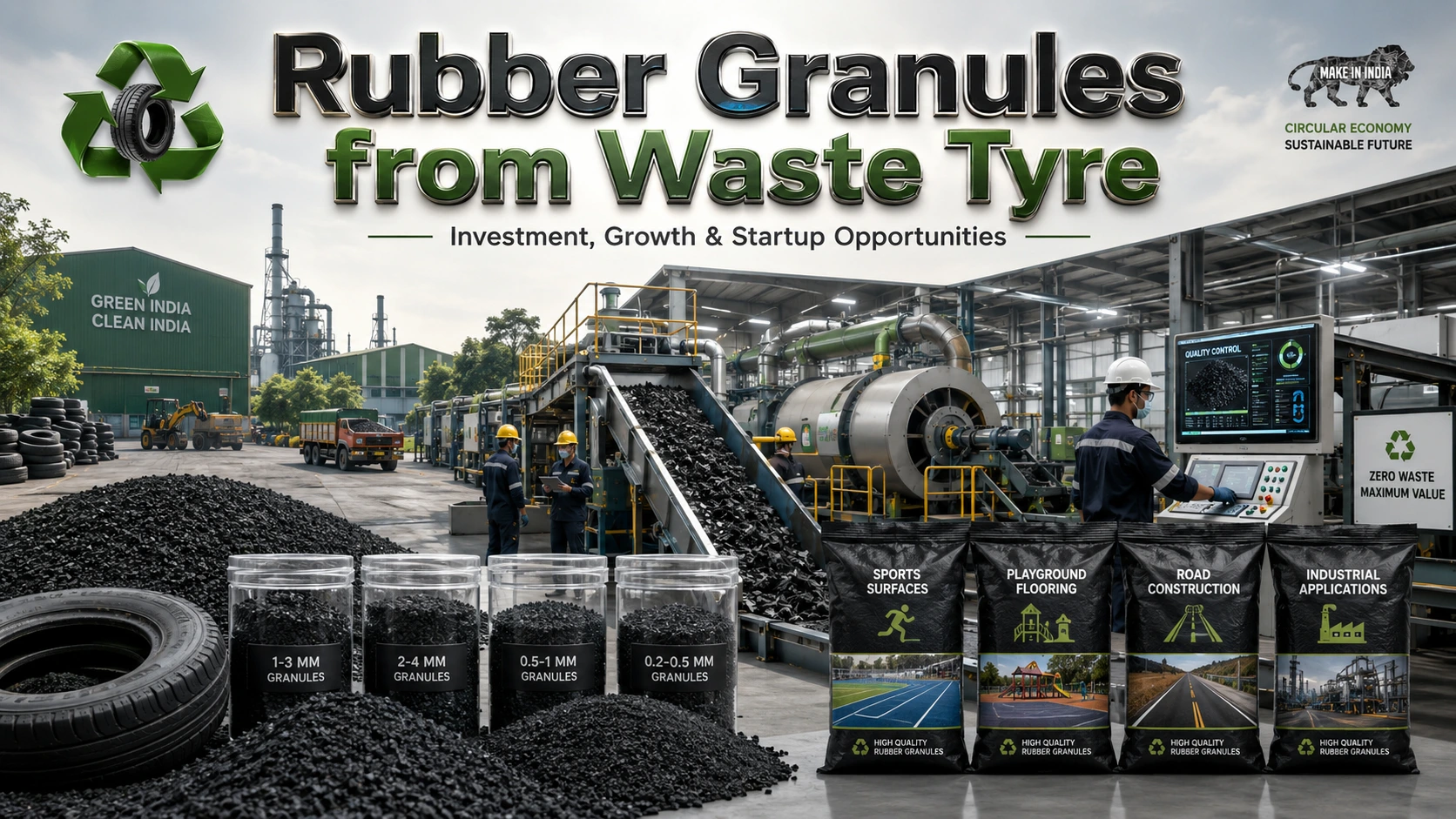
Recycled rubber granules have become in great demand in several industries. Rubber granules are applied in construction in flooring compounds, waterproofing membranes and thermal insulation materials. They are used in sports infrastructure as infill for artificial turf and cushioning in running tracks. They are used in the automotive industry in new tyre compounds and vibration-dampening parts. In addition, crumb rubber-modified bitumen (CRMB) is also being incorporated in asphalt mixes by road construction agencies to extend the life of the road and to quiet the road, which is a trend that has been mandated by state road departments.
The raw material advantage makes this business very appealing. Waste tyres are near-free from tyre dealers, auto repair workshops, municipal collection centres and Extended Producer Responsibility (EPR) networks. The Ministry of Environment, Forest and Climate Change (MoEFCC) has made stricter rules regarding tyre disposal and now the tyre waste has a clear and expanding supply chain for registered recyclers.
Also, the Bureau of Indian Standards (BIS) has laid down quality standards for crumb rubber, thus gaining credibility for the product even among large institutions. Consequently, premium rubber granules prices have been stable with good margins for manufacturers.
Get Detailed Project Report (DPR): Comprehensive Guide to Rubber and Rubber Products
Government Policies and Incentives Supporting This Business
Government of India has developed a comprehensive policy framework for the waste tyre recycling companies. There are several schemes which directly benefit the entrepreneurs entering into this field.(Waste Tyre Rubber Granules)
The Prime Minister’s Employment Generation Programme (PMEGP) provides project funding ranging from a minimum of ₹15 lakh up to ₹50 lakh for the manufacturing units and 15 to 35 percent subsidy by the government on the project cost. In the case of a rubber granules plant, it means significant capital assistance in the early phase.
The Credit Guarantee Fund Trust for Micro and Small Enterprises (CGTMSE) enables credit facilities to be accessed without any collateral to eligible MSMEs thus lowering the financial barriers for the first-generation entrepreneurs. Furthermore, the MoEFCC has notified the EPR framework, under which tyre producers, importers, and brand owners must collect and transfer end-of-life (EOL) tyres to authorised recyclers, thereby directly supplying your plant with a steady institutional stream of raw materials.
The Make in India programme of the Department of Promotion of Industry and Internal Trade (DPIIT) also includes recycling and green manufacturing under priority industrial segments, enabling entrepreneurs to avail the benefits of incentives by DPIIT at state level, including access to land at concessional rates, power tariff subsidy, and priority credit access. In many states such as Maharashtra, Gujarat, Rajasthan and Tamil Nadu, the government has set up separate green industrial parks for the tyre recycling units for special treatment.
The Startup India programme also provides tax exemptions for the first three years for the recognized startups in the recycling sector and also facilitates ease of regulatory compliance.
Business Ideas for Startups in the Rubber Granules Sector
1. Standard Crumb Rubber Manufacturing Unit
The most direct way is to establish a crumb rubber producing factory. This process includes mechanically shredding the waste tyres, extracting the steel wire from the tyres with the help of magnetic separators and granulating the rubber to obtain a standardised particle size (0.5 mm to 10 mm). We can sell the product to compound rubber processors, road construction companies, and manufacturers of sports flooring materials such as crumb rubber or rubber granules. The mid-sized unit (3-5 tonnes of waste tyre per day) can earn ₹90 lakh to ₹1.5 crore per year. The secret of a profit is to maintain the highest standard of product uniformity and size accuracy, and making a direct connection to the construction and infrastructure companies. From the beginning, we should target government road projects and sports authority contracts as anchor clients.(Waste Tyre Rubber Granules)
2. Rubber Powder Manufacturing for Automotive Applications
Some steps above the basic granules are fine rubber powders, generally smaller than 200 microns. This product is significantly more expensive and finds applications in the automotive, paints, coatings, and specialty rubber compounding industries. A further cryogenic grinding or ambient fine milling device produces high-quality rubber powder, effectively achieves fine grinding, and significantly reduces the cost of rubber powder milling. Individuals in this niche may feel more comfortable playing the role of a niche, or specialty material supplier, to larger well-known manufacturers instead of going head-to-head on volume. In this type of business model, small sized firms can generate bigger profit with not so much large processing unit.
3. Rubber-Modified Bitumen (CRMB) Compound Supply
One of the most emerging applications of reclaimed rubber granules in India is CRUMB RUBBER MODIFIED BITUMEN (CRMB). The use of CRMB is becoming more common in high traffic roads for both road construction agencies and state highway departments due to its durability and lower road noise profile. An entrepreneur can install a CRMB blending unit by sourcing crumb rubber from their granule plant or any other source. Directly to the offtake of National Highways Authority of India (NHAI) approved contractors and state PWDs gives stable big volume offtake. The CRMB is more expensive than plain bitumen and provides a significant revenue benefit per tonne to the supplier.
Get Detailed Insights from This Book: Modern Technology Of Rubber & Allied Industries

4. Recycled Rubber Products Manufacturing
Moreover, Some entrepreneurs see the added value in recycling rubber granules to make rubber products, instead of just selling the rubber granules as raw material. Additionally, They include rubber tiles for gym flooring, playground, rubber mats for industrial use, speed breakers, railway track pads, anti-vibration mounts and others. Furthermore, Finished goods margins are significantly greater than granule supply margins. This path, however, will involve the investment in moulds, compression moulding presses and quality testing equipment. The growth drivers of this model are building a brand in the B2B institutional sales category, such as supplying to gym chains, schools, housing developers, and factories.(Waste Tyre Rubber Granules)
5. Waste Tyre Collection and Aggregation Business
Moreover, A parallel business concept — which can be independent or in conjunction with a granule plant — is to establish tyre collection and aggregation center. Furthermore, Within the EPR framework, collection targets must be met and there is reliance on registered collectors for this. In addition, An aggregation business can receive a handling fee from the tyre manufacturers for each tonne collected and also provide a raw material advantage for the tyre manufacturers. Therefore, It is suitable for businessmen who have logistics facilities and connections with the transport system of Tier 2 and Tier 3 cities where tyre waste is in surplus and collection system is lacking.
Import–Export Opportunity Analysis
The export business of rubber granules is an underutilized but potential business idea for Indian entrepreneurs. Sustainability regulations are driving manufacturers in Germany, the Netherlands, and the United Kingdom to use recycled materials, which has created a high demand for recycled rubber granules in Europe. Middle Eastern and Southeast Asian markets also import crumb rubber for sports surface construction and other construction applications.
Indian producers have the cost advantage in terms of labour, raw material sourcing, overheads, etc. over European recyclers. This equates to a competitive export price, which can still provide good margins. The Federation of Indian Export Organisations (FIEO) actively helps the MSMEs in their identification of export opportunities and guidance on documentation. Furthermore, MSME Export Promotion Council is also providing market linkage assistance in the European market for product registration.
In addition, the export volume of fine rubber powder to the paints and coatings sector in Japan and South Korea has been on the increase, owing to the quality enhancement in the Indian manufactured fine rubber powder. Those entrepreneurs who invest in regular consistency control of particles and BIS or ISO certification will be able to reap export premiums of 15-25 percent over domestic prices.(Waste Tyre Rubber Granules)
Related Article: How to Start a Tyre Recycling Business: ₹40 Lakh Investment, ₹1.8 Crore Revenue
Indian MSME Success Stories in Rubber Recycling
Tinna Rubber and Infrastructure Ltd.
Tinna Rubber (now Tinna Trade Pvt. Ltd.) is one of the best-known companies in India that made great business of supplying crumb rubber to road construction projects. The promoters recognized the product CRMB was a government-driven product and positioned the company as a preferred supplier to NHAI projects early on. Companies that align with government policies and meet required specifications demonstrate strong success, showing that policy alignment can be a significant growth multiplier—this alignment also shields them from demand volatility.
Pioneer Crumb Rubber Manufacturers
It is located in Gujarat and began life as a small tyre shredder for local rubber compounders. The promoters found this to be a good opportunity to invest in fine powder milling for the paints industry as this greatly enhanced the margins. The lesson they learnt is the need to diversify their product line with the same raw base, shifting from low value granules to high value specialty powder.
South India Recycling MSMEs (Tamil Nadu Cluster)
Firstly, A number of small recycling plants have sprouted up around Chennai and Coimbatore in Tamil Nadu and are providing crumb rubber in the state for use by the growing tyre making and auto component industry. Moreover, The units have advantages in their close location to raw materials and industrial buyers. Furthermore, The cluster model has enabled single small units to have access to common testing facilities and shared logistics, thereby enhancing quality standards and cost benefits for the members. As a result, This partnership model is a great example for new entrepreneurs in other states.(Waste Tyre Rubber Granules)
How NPCS Can Help You Start This Business
As experts in the field of professional business consulting, Niir Project Consultancy Services (NPCS) offers a range of services for preparing Market Survey cum Detailed Techno-Economic Feasibility Reports (DPR) for the establishment of new industries and businesses. Our feasibility reports include detailed manufacturing processes, market research and demand analysis, process flow diagrams, product mix and capacity planning, machinery and raw material sourcing details and complete project financials including profitability analysis for a rubber granule from waste tyre project. The goal is to assist entrepreneurs in determining scalability, feasibility and profitability prior to investing any capital. You can rely on NPCS as your analytical partner, whether you are considering a 500 MT plant or a 2000 MT facility that will have value added products.
Discover business ideas that actually make money
Key Project Parameters at a Glance
The table below summarises the core parameters for a rubber granules manufacturing project in India:
| Parameter | Details |
| Industry Category | Waste Recycling / Green Manufacturing |
| Primary Raw Material | End-of-Life Tyres (ELTs) |
| Key Output Products | Rubber Granules, Steel Wire, Carbon Black, Textile Fibre |
| Typical Plant Capacity | 500 – 2,000 MT per annum (small unit) |
| Estimated Project Cost | ₹50 Lakh – ₹2.5 Crore (depending on capacity) |
| Key Machinery | Shredder, Granulator, Magnetic Separator, Screener |
| Revenue Per MT (Granules) | ₹18,000 – ₹28,000 |
| Payback Period | 3 – 5 years |
| Primary Demand Sectors | Construction, Sports Flooring, Automotive, Road Infrastructure |
| Export Potential | High – markets in Europe, Middle East, and Southeast Asia |
| Government Scheme Support | PMEGP, CGTMSE, FAME India, EPR under E-Waste/Tyre Rules |
Frequently Asked Questions (FAQ)
Q1. How much capital is needed to start a rubber granules unit?
A compact, small-size facility (capacity 1 to 2 tonnes a day) can be established at an investment of Rs 50 lakh to 80 lakhs, inclusive of machines, civil work, and working capital. For bigger set-ups handling more than 5 tonnes a day, you may need about Rs 1.5 crore to Rs 2.5 crore. Government initiatives such as PMEGP and CGTMSE provide a substantial amount of capital assistance.
Q2. Where can I source waste tyres as raw material?
You will also gain entry into bulk waste tyre streams and participate in the circularity efforts in waste tyre management under ERP initiatives of Tyre Manufacturers; you have to get ourselves as Authorized Re Cycler with the State pollution control board. These are the options available to you: Tyre retailers Waste tyre from auto service stations Municipal waste management systems Tyre fleet operators, Waste tyre through ERP collection mechanism
Q3. What are the main regulatory requirements for this business?
The documents required will be the Consent to Establish & Consent to operate from State Pollution control board, GST registration, MSME Udyam registration and must adhere to Hazardous & Other Wastes management rules & EPR framework under solid wastes management rules. In some states, separate local Municipal authorization might be required to set up the waste managing plant.
Q4. What is the profitability outlook for a rubber granules plant?
An efficiently operated plant could achieve an EBITDA of 20–30%, depending on raw material costs, the variety of products sold, and the sales achieved. Revenue from granules ranges between ₹18,000 and ₹28,000 per ton, whereas fine rubber powder sells for ₹35,000 to ₹55,000 per ton. Small and medium sized plant gives a payback period of 3 to5 years.
Q5. What markets should I target first as a new entrant?
New players should initially focus their efforts on building relationships with local construction contractors, rubber product manufacturers, and sports flooring companies. State government road construction tendered works involving CRMB could be another strong area to enter. After building expertise and a sound profile in terms of qualifications, approaching export opportunities via FIEO and participating in rubber expos can give yet another dimension to business.
Q6. Is this business environment-friendly and compliant with sustainability norms?
Yes. Rubber granules manufacturing from waste tyres is a certified circular economy activity. It reduces landfill waste, eliminates harmful tyre burning, and provides recycled alternatives to virgin rubber. Entrepreneurs in this space qualify for green financing, sustainability-linked credit, and ESG compliance certifications, all of which are becoming significant advantages in industrial supply chains.
Conclusion
Waste tyre recycling for production of rubber granules is no more a niche opportunity but is fast emerging as a mainstream industrial requirement in India. The end market demand is high, the government is promoting it, the raw material supply chain is readily available and export potential is increasing, making it one of the most promising green manufacturing business ideas for Indian entrepreneurs today. In addition, the several value-added product lines from the original granules to fine powder to the finished rubber products provide founders with flexibility of growth and diversification. A rubber granules plant, if properly planned, fitted with suitable machineries and complying with the regulations, can provide long-term benefits and yield sustainable profits.(Waste Tyre Rubber Granules)
The first step, before investing money into this area is to undertake a comprehensive techno-economic feasibility study. Your plant may be a success or a costly lesson to learn, depending on your knowledge of the actual cost of production, realistic market pricing and the regulatory process at your site.