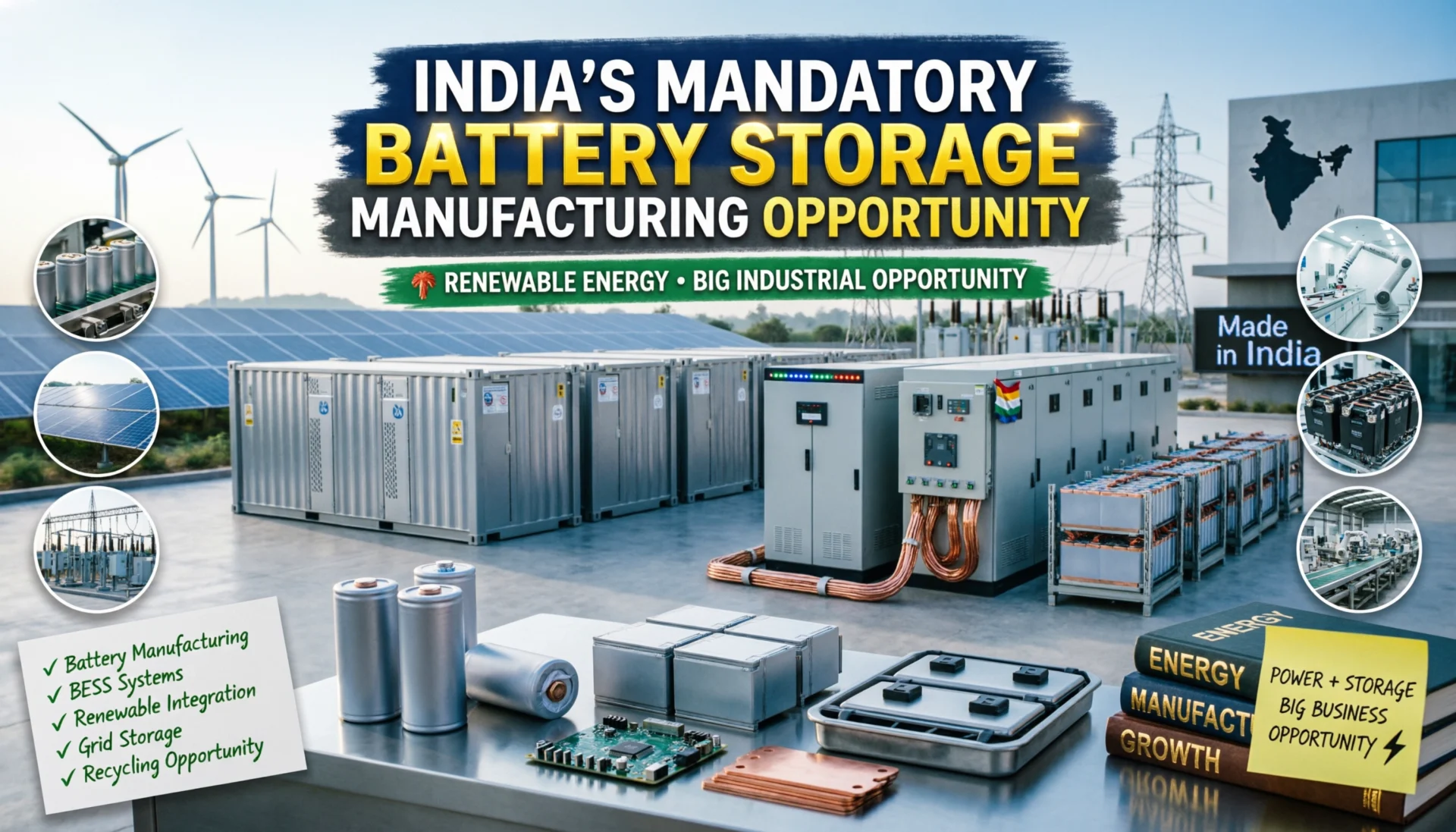

There is a structural change that is imminent in India’s power sector which might change the way renewable electricity is generated, stored and delivered for the next few decades. The Central Electricity Authority (CEA), the country’s top technical body for electricity planning under the Ministry of Power, has issued draft regulations requiring all new ground-mounted solar and onshore wind projects commissioned after July 1, 2027, to include energy storage systems. The draft amendment requires all new renewable energy projects to install co-located energy storage equal to at least 10% of their installed capacity, with a minimum storage duration of two hours. Starting in July, 2029, the requirement is even more stringent, increasing to 4 hours storage.
This proposal is not a routine technical adjustment and is now out for public consultation until October 4, 2026. It is a policy shift of huge commercial importance. Once finalized, this regulation will ensure every renewable energy project with a capacity of 100MW and above will require battery storage, presenting a huge opportunity for those ready to invest and build in this expanding market. Implementing this will ensure that all new renewable energy projects >100MW would need battery storage, giving entrepreneurs, MSMEs, investors and start-up founders a significant opportunity to jump into this growing market early.
What This Development Means for Indian Businesses
The proposed mandate is a game-changer for the economics of renewable energy development in India. Until recently, the possibility of battery storage was an optional extra – something that project developers could choose to include to provide a competitive edge and/or something that only appeared in certain hybrid tenders. If finalized, from July 2027, storage will no longer be voluntary. It will be a key part of all new solar and wind installations.
India has ambitious target of 500 GW of non-fossil fuel power capacity by 2030. The number of new solar and wind projects that will come online between 2027 and 2030 will be huge, with additions at around 40-50 GW per year. With a total storage capacity of only 10% per project, the total storage demand will reach tens of thousands of MW-hours in only a few years when the rule will go into effect.
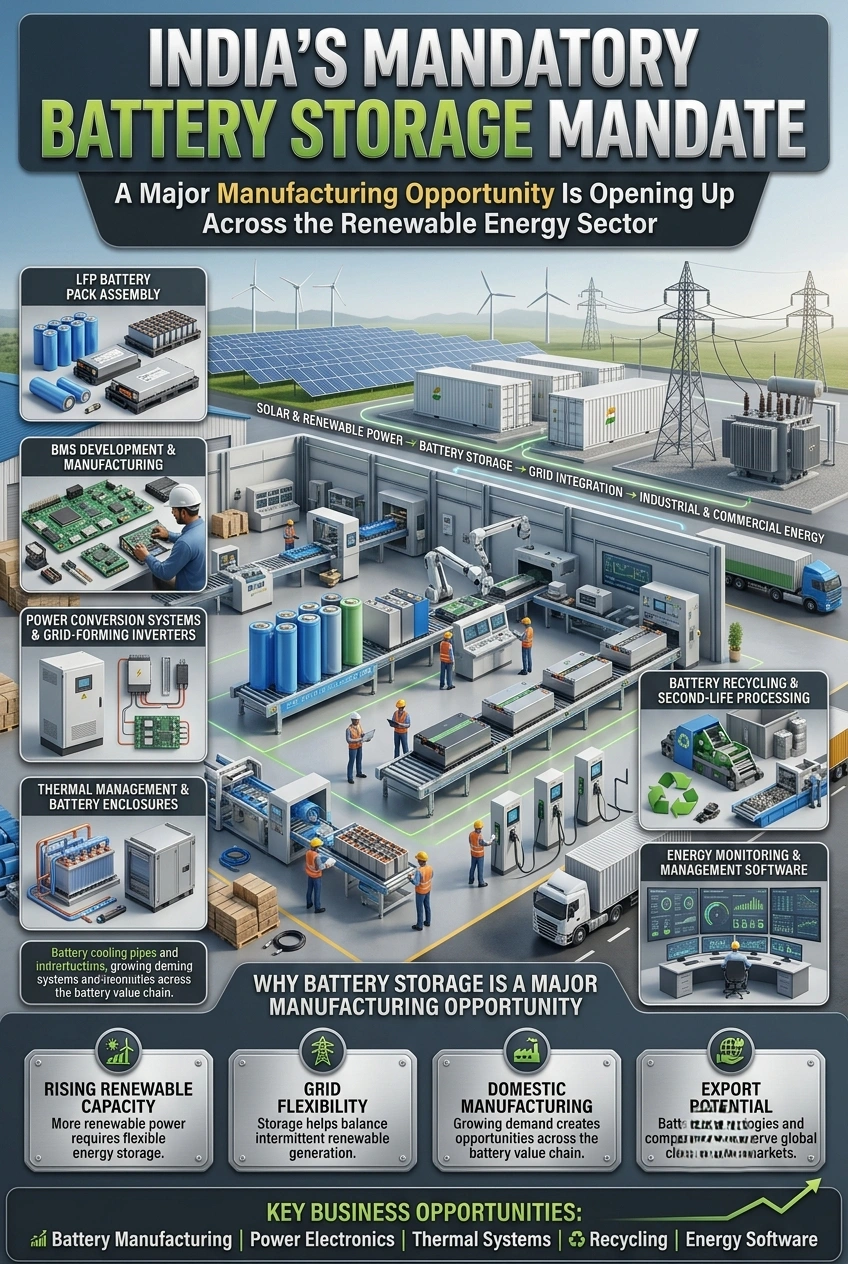
This results in a clear and policy-driven demand for a variety of products and services. All of the above battery cell manufacturers, battery management system developers, power conversion system manufacturers, thermal management solution providers, container fabricators, EPC contractors, and system integrators will benefit. MSMEs and startups can also benefit from the opportunity, not only in the batteries themselves but throughout the supply chain, from raw material processing to monitoring software to maintenance services.
The timing is important. India currently has to import almost all of its lithium-ion cells from China. The window of opportunity for domestic manufacturers to develop their capacity, quality and to get a head start against the high tide of mandated demand is now until July 2027. Early movers will benefit from a competitive edge over late movers.
Why This Industry Could See Stronger Growth
There are a number of structural justifications for the commercial rationale of the proposed battery storage mandate and these factors together suggest continued industry growth beyond the mandate’s initial policy mandate.
The grid is facing a known problem in India — the mismatch between electricity demand in the early evening, when the sun is setting and the demand for electricity when the sun is shining, a problem sometimes referred to as the ‘duck curve’. Battery storage is the most commercially viable option to balance this out. Thermal power plants, if not stored, have to be ramped up quickly in the evenings, thereby incurring additional costs and carbon emissions. Renewables become more robust and more dispatchable: Storage is required at the project level, providing greater grid stability and enabling greater clean energy penetrations.
The proposed regulations also establish grid-forming inverter requirements — with a minimum of 15% of inverters in each new renewable project needing to include grid-forming control. Furthermore, all of the power conversion systems in battery storage systems need to be grid-forming. This technical requirement on the other hand, generates a parallel demand for the advanced power electronic which is yet another big manufacturing opportunity for Indian industry.
Get Detailed Project Report (DPR): Explore This Battery Manufacturing & Recycling Guide
The signal is already being acted on by private investment. The government has allocated more than ₹9,100 crore for battery storage capacity under its Viability Gap Funding (VGF) initiative with 43.2 GWh, while the PLI scheme for Advanced Chemistry Cells has a budgetary allocation of ₹18,100 crore to support 50 GWh of domestic battery manufacturing. Customs duty exemption on importation of lithium and capital goods for manufacturing batteries also bring down the cost of entry for the local producers.
The draft regulations also reflect further restrictions: The CEA has specifically reserved the right to raise the amount of storage over time, indicating that 10% is more of a minimum than a maximum. The outlook for the industry is far beyond 2027, in other words.
Government Policies and Incentives
The regulatory landscape for battery energy storage production in India is becoming one of the friendliest in Asia, and several levels of financial and policy support are accessible to entrepreneurs and investors.
The Ministry of Heavy Industries is working on the implementation of the Rs. The 18,100-crore production linked incentive (PLI) scheme for advanced chemistry cell (ACC) battery storage is designed to be a major driver in establishing 50 GWh of domestic battery manufacturing. The scheme encourages value addition within a country, which is relevant to the manufacturers who can show that the product has significant Indian content.
The MNRE is pivotal in achieving the targets of renewables and the deployment of storage. The scope of battery storage procurement will be determined by the ministry’s policies that incorporate hybrid renewable schemes using solar or wind power and storage.
The Ministry of Power has approved mandatory integration of storage systems in all the new renewable projects and has also given policy support such as waiver of inter-state transmission system charge for the BESS project that is co-located with the new renewable project and has been commissioned up to 30th June 2028. Storage projects will benefit from greatly reduced operation costs with this waiver.
The Ministry of MSME has provided credit guarantee support, collateral free loans under CGTMSE, capital subsidy under Credit Linked Capital Subsidy Scheme (CLCSS), and technology upgradation support, which are relevant to small MSMEs in the manufacturing supply chain, especially those in battery components, enclosures, cables, etc.
Discover business ideas that actually make money
Startups entering battery technology, power electronics, and energy management software can explore support under Startup India (DPIIT), which offers income tax exemptions for three consecutive years within the first ten years of operation, simplified compliance, and access to Fund of Funds for equity support.
For manufacturers targeting exports, the Export Promotion Council for EOUs and SEZs (EPCES) provides guidance on special economic zone benefits, export obligations, and duty drawback mechanisms that can significantly enhance the viability of export-oriented battery manufacturing units.
State-level industrial development authorities in Telangana, Gujarat, Andhra Pradesh, and Rajasthan — key states for renewable energy and battery manufacturing — are offering land, power, and financial incentives. The Telangana State Industrial Infrastructure Corporation (TSIIC) is particularly relevant given Amara Raja’s major cell manufacturing investment in the state.
Entrepreneurs can also explore grant support and technology access through the National Institute of Solar Energy (NISE), which supports R&D and testing in solar and storage technologies, providing a resource base for manufacturers seeking technical validation and quality testing.
The Solar Energy Corporation of India (SECI) — the government’s nodal agency for large-scale renewable energy and storage tenders — is the primary procurement window for utility-scale battery storage projects. Manufacturers and system integrators that secure SECI empanelment gain access to the country’s largest and most reliable procurement pipeline.
Manufacturing Business Opportunities Emerging From This Development
1. Lithium Iron Phosphate (LFP) Battery Pack Assembly
Indian companies can easily enter battery pack assembly by incorporating imported lithium-ion cells into complete battery packs, including battery racks and modules for grid-scale deployment. Lithium iron phosphate (LFP) chemistry dominates India’s BESS projects because of its low cost, long cycle life, and thermal stability compared with NMC chemistries.
Pack Assembly Facilities can be started with investment scale that could be available to mid-sized pack manufacturers (₹20–100 crore as per the capacity) with the mandatory Co-Location rules creating captive domestic market and PLI incentive rewarding domestic value addition. The target customer base includes renewable energy project developers, EPC contractors and DISCOMS. The PLI framework provides a strong incentive to progressively localise, and exports to South Asia, Africa and South East Asia, offer a longer-term opportunity as Indian manufacturing costs improve.
Related Article: How to Start Lithium-Ion Battery Manufacturing Business in India: Market Demand, Setup Cost & Feasibility
2. Battery Management System (BMS) Development and Manufacturing
The battery management system (BMS) serves as the intelligence layer in any BESS. It monitors cell voltages, manages thermal performance, controls charge/discharge cycles, and communicates with grid management systems. Domestic companies have made limited progress in developing BMS technology. Most advanced systems are imported or developed through technology licensing agreements with China.
Under VGF, the procurement of local content is compulsory, that is, at least 20 percent of the value, which includes indigenous Energy Management System (EMS) software. This leads to a direct policy-based demand for the Indian BMS and EMS developers. The development of BMS software, the design of BMS hardware, and the communication between the BMS and the grid are key competency areas that are very valuable for technology start-ups and electronics manufacturers and have good potential for Intellectual Property rights. It is an MSME & Startup friendly investment as the investment amount of a BMS development and small batch manufacturing unit is comparatively low (₹5–25 crore).
3. Power Conversion Systems and Grid-Forming Inverters
In accordance with the draft regulations issued by the CEA, new renewable projects should equip at least 15% of their inverters with grid-forming inverter technology. In addition, BESS projects should equip 100% of their power conversion systems with this technology. Currently, developers mainly meet these technical requirements by using imported equipment.
Power conversion systems (PCS) and Grid Forming Inverters (GFI) market in India provides high precision and high value manufacturing opportunity for power electronics competency companies. The market demand will be significant: All new solar and wind installations from 2027 will need inverter and PCS equipment that meets the requirements. There are substantial export opportunities to other emerging markets with similar grid stability needs. Capital investment in PCS manufacturing ranges from ₹30–150 crore with good margins and potential for long-term orders for the right investor.
4. Thermal Management Systems and Battery Enclosures
Thermal management is a very critical element of grid-scale battery storage systems, as it is important to keep cell temperatures within safe operating limits, especially in India where temperatures can reach 45℃ or higher in the summer months in Rajasthan, Gujarat and Andhra Pradesh.
Most thermal management components are imported. These include heat exchangers, cooling plates, phase change material assemblies, and intelligent climate control systems. Indian sheet metal fabricators can develop thermal management products for local conditions. Precision engineering industries and refrigeration equipment manufacturers can also serve this market. These products can be designed for Indian climate conditions and BESS container formats. Battery enclosures, BESS housing, and container construction also offer adjacent opportunities. Precision sheet metal workshops and structural steel fabricators can benefit from this growing area. The investment requirement for MSMEs ranges from ₹5 crore in the entry points that involve fabrication.
5. Battery Recycling and Second-Life Battery Processing
At the end of the life of first-generation BESS systems, mandatory storage requirements will generate a large stream of end-of-life batteries within the next 5–8 years. Lithium-Ion Battery Recycling (LIBR) will therefore become an important industry in India. It involves recycling spent lithium-ion batteries to recover valuable materials such as lithium, cobalt, nickel, copper, and aluminium.
Those entrepreneurs who invest in recycling infrastructure, especially for hydrometallurgical processing facilities that can recover black mass, lithium carbonate, and cathode precursor materials will be in position as the number of spent batteries increases. The Ministry of Environment, Forest and Climate Change has issued Battery Waste Management Rules creating an extended producer responsibility (EPR) framework, which provides a regulatory supported offtake mechanism for recyclers. The pilot scale recycling unit can be set-up for a cost of ₹5–20 crore and is a very scalable process.
Read the Complete Book Here: Handbook on Lithium-Ion & Lead-Acid Battery Production and Recycling
6. Monitoring, Control, and Energy Management Software
Indian software firms and startups with the power systems engineering expertise are able to create cloud platforms for BESS fleet management, performance analytics, and grid services optimisation. Indigenous EMS software – direct policy mandate in VGF. They are also low on capital investment and high on technical expertise, which makes it perfect for startups with a technology focus and engineering companies.
Import-Export and International Market Opportunity
Export Opportunity
With government incentives under PLI and a growing domestic market, India can build competitive BESS manufacturing capabilities. These capabilities can also support exports. Renewable energy deployment is increasing across Southeast Asia, South Asia, Africa, and the Middle East. As a result, these regions are seeing a growing need for energy storage capacity.
Import Substitution Opportunity
The case of BESS in India is one such most interesting case of import substitution in the manufacturing sector. China imports virtually nothing of lithium-ion cells, the most valuable part of any battery system. The electronics and power conversion systems, thermal management components and grid forming inverter technology used in advanced BMS are also reliant on imports.
The Union Budget 2026–27 has waived basic customs duty on lithium imports. It has also removed the duty on capital goods used for lithium-ion cell manufacturing. These measures create a more favourable cost structure for domestic cell producers.
PLI-backed gigafactories from Amara Raja, Exide, and Waaree are scaling up cell production. As production increases, import dependence is expected to reduce progressively. This creates opportunities for component manufacturers and material processors. They can build domestic supply chains around these anchor facilities.
Indian MSMEs and Startups in Related Industries
Several Indian companies are already building relevant positions in the BESS value chain, demonstrating that the opportunity is not limited to large conglomerates.
Amara Raja Energy & Mobility Ltd
Amara Raja is widely recognised for its Amaron battery brand. The company is investing ₹9,500 crore to establish a 16 GWh lithium-ion cell gigafactory in Telangana. It is also developing a 10 GWh BESS manufacturing facility in the state. Amara Raja has already established battery pack assembly capacity. It has also partnered with Nuvation Energy to localise high-voltage battery management systems for Indian requirements.
For MSMEs and startups, this expansion creates opportunities to become domestic suppliers. The company will need thermal management components, enclosures, wiring harnesses, and software services as production scales.
Exide Energy Solutions Ltd
Waaree Energies
Waaree Energies, one of India’s largest solar module manufacturers, has announced a 16 GWh integrated lithium-ion battery gigafactory in Andhra Pradesh. The company plans to invest approximately ₹8,175 crore in the project. The facility will cover battery cells, packs, and large-scale BESS.
This investment signals Waaree’s plan to serve the mandatory storage market through vertical integration. The company aims to offer solar and storage solutions through a single domestic supply chain. For MSME suppliers, Waaree’s new battery manufacturing footprint opens procurement opportunities in fabrication, materials, logistics, and EPC services.
What Entrepreneurs Should Evaluate Before Investing
The battery storage manufacturing opportunity is genuine, large, and policy-backed — but it requires careful evaluation before committing capital.
- Policy Status: understand that the CEA draft regulations are currently in public consultation and are not yet final. While the direction of policy is unambiguous, entrepreneurs should track the finalisation process before making irreversible commitments.
- Market Entry Point: The most viable entry points for MSMEs are not cell manufacturing (which requires gigascale investment) but component manufacturing — BMS, thermal management, enclosures, wiring, software — where investment thresholds are lower and import substitution value is clear.
- Quality and Standards: Battery storage systems are subject to Bureau of Indian Standards (BIS) certification and CEA technical standards compliance. Entrepreneurs must factor in testing and certification timelines and costs.
- Raw Materials: Raw material supply — lithium, cobalt, nickel, aluminium, copper — remains globally traded and price-volatile. Manufacturing cost models should be stress-tested against commodity price scenarios.
- Tax Structure: GST on standalone BESS currently runs at 18%, which increases upfront capital costs. Budget proposals and policy evolution on GST classification should be monitored.
- <strong>Location: Selecting manufacturing locations in states with renewable energy industrial parks (Rajasthan, Gujarat, Andhra Pradesh, Telangana) gives proximity to BESS project sites and potential state incentive access.
- Manpower: Skilled manpower in power electronics, battery technology, thermal engineering, and SCADA software is currently scarce. Building in-house training programs or partnering with engineering colleges is important.
- Financial Planning: Battery storage is a capital-intensive and technically sophisticated industry. Explore PLI benefits, VGF support, MSME credit guarantee, and state capital subsidies to optimise capital structure.
- <strong>Feasibility First: Conducting a detailed feasibility study and DPR (Detailed Project Report) before committing investment helps avoid costly errors in technology selection, capacity sizing, and market positioning.
How NPCS Can Help Entrepreneurs Evaluate the Opportunity
NPCS – Niir Project Consultancy Services is one of India’s most established industrial project consultancy organisations, with experience spanning manufacturing, renewable energy, chemicals, agro-processing, and infrastructure sectors. For entrepreneurs evaluating entry into the battery storage supply chain, NPCS offers:
- Detailed Project Reports (DPRs) for battery pack assembly, BMS manufacturing, thermal management components, enclosures, and battery recycling plants — providing financials, machinery requirements, raw material sourcing, and market sizingMarket research and feasibility studies to evaluate demand drivers, competitive landscape, import substitution potential, and investment viability in the BESS sector
- Technology consultancy to identify appropriate manufacturing processes, equipment vendors, and quality standards for battery storage components.
- Plant and machinery assessment to benchmark capital costs and capacity planning against current market realities.
- Manufacturing project planning including location evaluation, utility requirements, regulatory approvals, and project implementation timelines.
- Investment evaluation support to help entrepreneurs assess financial returns, break-even analysis, and risk factors before committing to a project.
<p>For entrepreneurs, MSMEs, and investors who want to move from opportunity identification to bankable project planning, a structured feasibility study and DPR is the critical first step.
Business Opportunity Snapshot
<td>PLI for ACC (Rs 18,100 Cr), VGF scheme (Rs 9,100 Cr+), BCD exemption on lithium imports, ISTS charge waiver, MSME credit guarantee, Startup India exemptions
| Parameter | Details</td> |
| Industry | Battery Energy Storage Systems (BESS) | Renewable Energy | Power Electronics |
| Market Driver | Proposed mandatory co-located battery storage (minimum 10% capacity, 2-hour duration) for all new solar and wind projects from July 2027 |
| Key Development | CEA Draft Amendment Regulations 2026 — co-located energy storage and grid-forming inverter capability to become mandatory for new renewable projects |
| MSME Opportunity | Battery pack assembly, BMS manufacturing, thermal management components, structural enclosures, wiring and cable assemblies, EMS/SCADA software |
| Manufacturing Potential | Strong — across cell assembly, power conversion systems, battery containers, thermal cooling, BMS hardware and firmware development |
| Export Potential | Moderate to High — Southeast Asia, South Asia, Africa, Middle East as renewable energy deployments expand in those regions |
| Import Substitution | High — lithium-ion cells, BMS electronics, grid-forming inverters, thermal management systems, and EMS software are currently heavily import-dependent |
| Government Support | |
| Investment Consideration | Rs 5–25 Cr (BMS, software, components), Rs 20–100 Cr (pack assembly, enclosures), Rs 100 Cr+ (PCS, grid-forming inverters) |
| Risk Level | Moderate — policy finalisation risk, import price volatility, skilled manpower availability, GST structure on BESS |
| Growth Outlook | Strong — market projected to grow at 25–33% CAGR through 2031; mandatory co-location mandate will accelerate deployment significantly post-2027 |
Conclusion
India’s proposed mandatory battery storage regulations for new renewable projects mark a turning point for the country’s clean energy sector. They also open a manufacturing opportunity of rare scale and strong policy visibility. Once the CEA’s draft amendment is finalised, every new ground-mounted solar and onshore wind project in India will need co-located battery storage. India is targeting 500 GW of renewable capacity by 2030. As a result, the cumulative storage requirement could reach hundreds of gigawatt-hours over the next decade. This will create permanent, large-scale demand for battery systems and related technologies. The opportunity will extend to power electronics, thermal management, energy management software, and battery recycling services.
The opportunity is not restricted to battery giants. For MSMEs, the supply chain ecosystem — components, enclosures, BMS, thermal management, and monitoring software — offers entry points at achievable investment levels. Startups, technology-differentiated products in power electronics and energy management software represent high-margin, IP-rich opportunities. For established manufacturers in electrical engineering and precision engineering, diversifying into BESS components offers a natural extension of existing capabilities into a fast-growing market.
The window between now and July 2027 is a preparation window. Entrepreneurs who use this time to complete market research, conduct feasibility studies, prepare Detailed Project Reports, and build manufacturing and supply-chain capabilities can position themselves to capture the opportunity as it materialises. Those who wait for certainty may find the most accessible positions already taken.
Now is the time to conduct structured market research, commission a professional feasibility study, prepare a bankable Detailed Project Report, and develop a credible investment plan — before the mandated storage market moves from proposal to procurement reality.