
A realistic, consultative guide to manufacturing, government schemes and business ideas for new start-ups
Indian farmers are subtly altering how they nourish their soil and liquid fertilizer is at the heart of the change. Slowly, huge bags of urea and DAP are being replaced by smaller bottles which can be transported by a two-wheeler or sprayed using a drone. Entrepreneurs, who are having a bit of a window of opportunity for finding a good business idea in the agri-input sector, are not dreaming.
The three factors of low entry cost, growing demand by farmers and government support, come together in the manufacture of liquid fertilizers. This is unusual in manufacturing in India these days. The real money, the policy support, and practical business ideas for the serious investor are outlined in this article. It also discusses export potential; lessons learn from Indian entrepreneurs and the no’s a founder must have before writing a business plan.
Get Detailed Insights from This Book: Manufacture of Biofertilizer and Organic Farming
Why the Liquid Fertilizer Business Is Growing Fast
India is the second largest fertilizer producer and consumer in the world, so that is enough to understand that market is not going anywhere. But demand is undergoing rapid changes of composition. Different liquid formulations are becoming more popular with farmers because they are easily stored, transported, and applied.
Farmers Want Lighter, Faster Options
Usually, a single bottle of liquid fertilizer is equivalent to the nutrients of several bags of conventional fertilizer. This is very important for small and marginal farmers which form bulk of agriculture in India. Transporting and storing a bottle costs only a fraction of a bag, as a bottle weighs less than a bag. Moreover, liquid formulations are more rapidly absorbed through foliar spray or drip irrigation, thus enticing farmers to seek high production while reducing input wastage.
Spraying using drones is also gaining momentum in various states such as Punjab, Andhra Pradesh and Madhya Pradesh. The liquid fertilizer technology is much better suited for delivery than the solid granular form, so the technology transition in farming is unnoticed creating a parallel transition in fertilizer demand.
Government Demand Signals Are Real
This push isn’t just from the farmers. The use of Government-supported nano and liquid fertilizers has been steadily increasing with the Indian Farmers Fertiliser Cooperative (IFS) increasing the capacities of various plants for the production of nano liquid urea and nano DAP.
Meanwhile, India’s overall nanotechnology fertilizer market, which is the one with a higher dominance of liquid technology, is expanding at a decent rate, with the cause of sustainable agriculture taking the initiative. This is a reminder to a new entrepreneur of persistent demand, not a passing fad.
Government Policies Supporting New Businesses
The policy environment is undoubtedly one of the most supportive for this industry in Indian manufacturing and any founder looking at this industry should carefully study it. They range from raw material subsidy to collateral-free loans, offered by the central schemes.
Central Schemes Worth Knowing
With the efforts of the Department of Fertilizers, the indigenous manufacturing capacity of phosphatic and potassic fertilizers has been improved through the Nutrient Based Subsidy Scheme, which is now taking a step toward supporting the liquid and nano forms of fertilizers. In parallel, promoting balanced use of fertilizers and incentivizing states to decrease dependence on chemical fertilizers also indirectly increases the demand for liquid and biofertilizers.
Manufacturing setup, for the most part, is a set of support schemes provided by the government of India, Ministry of MSME, and not subsidies for fertilizers. The Prime Minister’s Employment Generation Programme provides subsidy for manufacturing projects of 15 to 35 per cent on project costs, based on the project location and the entrepreneur’s category. One of the biggest challenges first-generation entrepreneurs face is securing bank loans without collateral. The Credit Guarantee Fund Trust for Micro and Small Enterprises (CGTMSE), established by the Ministry of MSME and SIDBI, addresses this challenge by enabling eligible businesses to obtain collateral-free loans of up to ₹2 crore.
This is because it is almost impossible to find an entrepreneur who is not eligible for any of these schemes; the first administrative job on an entrepreneur’s checklist should be to login into the Udyam Registration portal.
The Zero Defect Zero Effect certification scheme also promotes Quality manufacturing by providing financial aid for certification and a preference for government procurement via the Government e-Marketplace. As a result, a Certified Unit stands out as a credible source of information for institutional buyers like State Agriculture Departments and Farmer Producer Organisations.
Get Detailed Project Report (DPR): Fertilizer Manufacturing Guide
State-Level Incentives
State industrial policies are also relevant, since the production of fertilizer and the allocation of land is also to a certain extent a state concern. The majority of the industrial states have a single window investment portal featuring capital subsidy, stamp duty exemption and power tariff concession for new manufacturing units.
- Gujarat: iNDEXTb single-window portal for industrial approvals and incentives
- Maharashtra: MAITRI (Maharashtra Industry, Trade and Investment Facilitation Cell)
- Uttar Pradesh: UP Invest portal for MSME and industrial incentives
- Punjab: Invest Punjab single-window clearance system
- Rajasthan: Rajasthan Single Window System for industrial licensing
Prior to the final decision on location, founders should take into account the percentage of capital subsidy, land costs and the availability of raw material such as phosphoric acid, seaweed processing units and/or microbial culture laboratories; freight cost on liquid products can be a silent margin killer.
Business Ideas for New Entrepreneurs in Liquid Fertilizer
Now it’s time to make theory come to life. Here are some of the real ideas that you can use for a business when it comes to making liquid fertilizers – these are tailored to different investment types and skill sets.
1. Micronutrient Liquid Fertilizer Unit
Micronutrient liquid fertilizer units are formulated to correct specific soil deficiencies with elements like zinc, boron and iron. The process is relatively simple, as it requires only mixing and quality testing and is not as complex as chemical synthesis, which keeps the machinery costs low for a first-time entrepreneur. Demand is from both horticultural and cash crop belts where growers are actively looking to improve yields and are willing to pay premiums for specific nutrition information. Formulations are crop specific – a founder can develop a loyal dealer base around two or three bestsellers rather than a price-driven product range. This segment has healthier margins as brand and pack is a significant factor with the end farmer when compared to bulk fertilizer.
2. Liquid Biofertilizer and Microbial Consortia Manufacturing
One of the more rapidly emerging segments in Indian agri-input retail is liquid biofertilizers, which contain living microbial cultures like Azotobacter, Rhizobium, phosphate-solubilising bacteria, etc. In contrast to chemical fertiliser, this business requires a significant, cold-chain-free formulation stability and culture quality to make this idea work and therefore a small microbiology lab and a culture quality control is more important than heavy machines. They have retail demand and are actively sourced by government procurement agencies and organic farming clusters; providing a reliable institutional buyer market. This concept has potential long-term visibility of demand as a number of states take a step towards organic and natural farming regimes.
View Full Project Details: Liquid Biofertilizer Manufacturing Industry
3. Seaweed and Humic Acid-Based Growth Promoters
Seaweed extract and liquid humic acid-based growth promoters fall in the middle between bio stimulants and fertilizers; this is an area that has rapidly developed because farmers are searching for alternatives to chemical growth regulators. A small manufacturing facility can buy seaweed concentrate from overseas or locally, mix it with amino acids and micronutrients and then bottle it for sale. As these products are marketed on a premium positioning, packaging design and marketing becomes as important as the formulation itself. Export buyers from Southeast Asia and West Asia also import seaweed-based inputs from India. Therefore, every potential entrepreneur should prepare the required export documents well in advance instead of focusing only on the domestic market. By targeting both domestic and international markets, entrepreneurs can create an additional source of income.
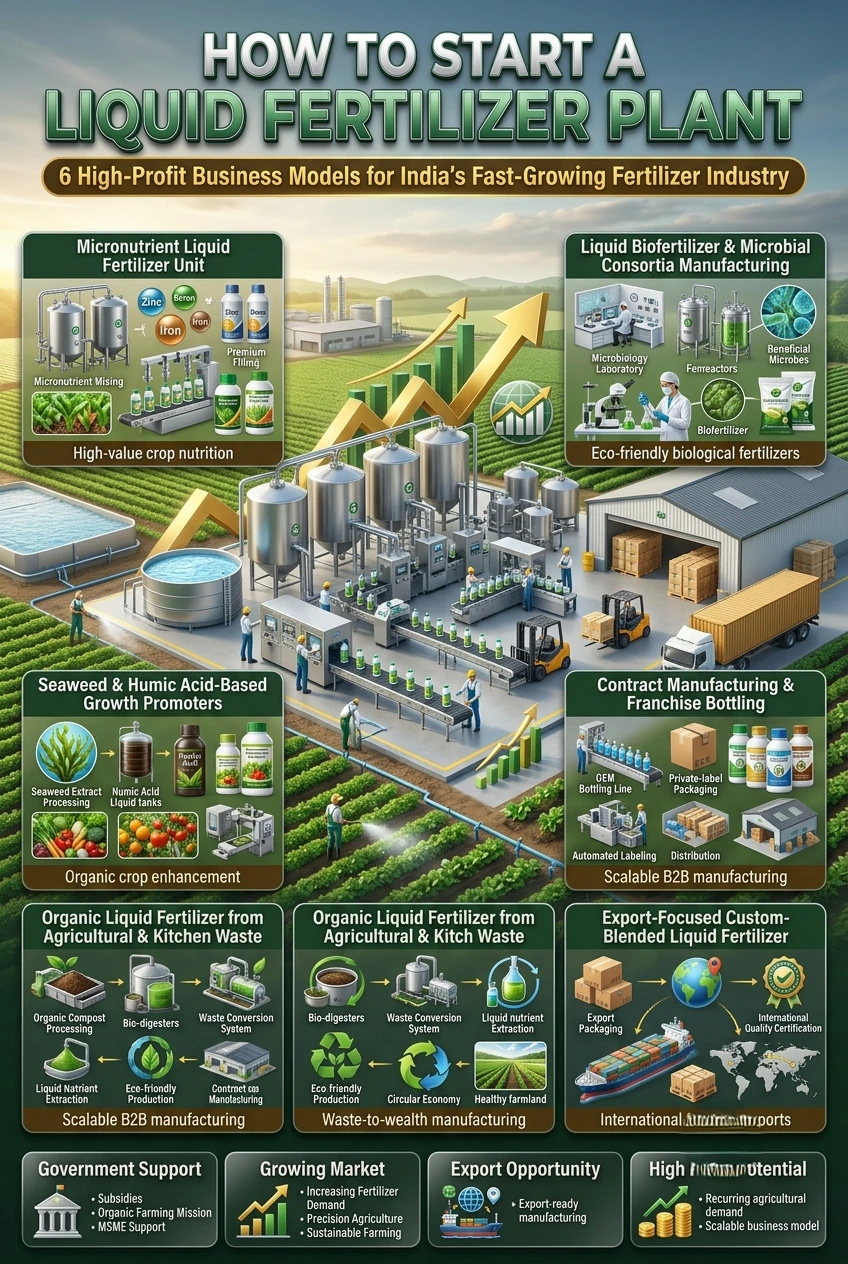
4. Contract Manufacturing and Franchise Bottling for Established Brands
Large fertilizer companies and cooperatives increasingly rely on smaller manufacturing partners, especially in the case of nano-fertilizers and liquid fertilizers, where local availability helps to lower logistics costs. Starting a bottling and packaging company to produce bottled products under license or franchise to an existing brand reduces the market development risk a lot for a new entrepreneur. This business model is ideal for entrepreneurs who want to generate revenue quickly because the main company has already established buyer relationships and demand forecasts. A contract manufacturer can accumulate sufficient technical credibility, development and reputation over the years to introduce a new and independent product line, which can be a low-risk situation.
5. Organic Liquid Fertilizer from Agricultural and Kitchen Waste
Vermiwash, compost tea and fermented organic liquid fertilizer, using agricultural residue and/or household waste, are a true low investment business, perfect for a peri-urban or rural entrepreneur. The business keeps raw material costs low by using waste materials and fermentation tanks instead of expensive chemical processing equipment. This model is complementary to the municipal waste management contracts and organic farming clusters, which are increasing as part of the state’s sustainability programmes. Given the low barrier to entry, competition can be fierce at the local level, and successful founders will likely only distinguish themselves on the back of on-going quality testing and direct farmer relationships, not price.
Related Article: How to Start a Gel-NPK Fertilizer Manufacturing Business in India
6. Export-Focused Custom-Blended Liquid Fertilizer
If you have a little working capital and you have a tendency to work for compliance, then custom-blended liquid fertilizer for contract farming or exports is the top business idea on this list in terms of profit potential. It entails product development to tighten the specifications of an overseas buyer or a large domestic agribusiness that is demanding more quality control and documentation in the manufacturing process than a retail-oriented product. This model gives revenue stability, as export buyers pay in hard currency and are normally entered into into multi-year offtake agreements. However, building an export brand takes longer because you must establish credibility and complete the registration process, both of which require more time than launching a local retail brand.
Import-Export Opportunity Analysis
The fertilizer trade picture in India is very special; the country imports significant quantities of finished phosphatic and potassic fertilizers and raw material like rock phosphate, but is developing export capacity for value-added liquid and bio-fertilizers. This provides two separate possibilities for a new manufacturer.
Entrepreneurs are also able to create businesses based on the substitution of raw materials, for example, domestically processed seaweed or microbial culture production, which will lessen the country’s reliance on imported bio stimulant concentrates. Government is actively promoting backward integration in the case of phosphatic raw material and so a founder who successfully overcomes a part of the import dependency problem is getting strong policy tailwind and possible assistance in the raw material segment from the National Small Industries Corporation.
Indian liquid biofertilizer and biostimulant manufacturers have already expanded into export markets such as Bangladesh, Nepal, Sri Lanka, and several countries across Africa and Southeast Asia. They compete successfully with European products by offering high-quality solutions at competitive prices. With the assistance of the Directorate General of Foreign Trade, along with the Federation of Indian Export Organisations, even a small manufacturer has a viable road to these markets. Therefore, entrepreneurs who want to establish an export-oriented liquid fertilizer business should not treat exports as a future option after stabilizing the domestic market. Instead, they should integrate an export strategy from the very beginning. The founders must prioritize product quality certification and maintain high manufacturing standards to build credibility in international markets and make a successful start in the business.
Indian MSME Success Stories in Fertilizer Manufacturing
The business case is brought to life with examples, and there are some instructive examples of Indian fertilizer manufacturing.
The Indian Farmers Fertiliser Cooperative, with its past Managing Director Dr. U.S. Awasthi, made a calculated bet in the field of developing Nano Urea as a liquid fertilizer in place of the conventional bagged urea. So, the logic was clear – lower logistics cost, better nutrient use efficiency and lower India’s dependence on urea feedstock. The cooperative invested in sustained research before commercialization, and that investment paid off when its plants in Gujarat, Uttar Pradesh, and other parts of the country began producing nano liquid fertilizer. The message for new entrepreneurs is clear: invest in formulation research even before making any money brings a defensible product moat.
The Chennai-based Coromandel International, led by its Managing Director S. Sankarasubramanian, who is running the company as part of Murugappa Group, converted itself from a bagged-fertilizer business to an integrated agri-solutions business in specialty nutrients, organic products and crop protection. Businesses that operate in a highly subsidised market should consider diversifying into specialty liquid nutrients instead of focusing only on production volume. Value-added liquid and specialty formulations offer one of the most effective ways to achieve higher profit margins in an otherwise commodity-driven industry.
Find the most profitable startup for your investment range
IPL Biologicals Limited, founded in the early 1990s and headquartered near Delhi with manufacturing in Haridwar, built its business from a small microbial research operation into a company serving more than five lakh farmers, with products tested and exported to over a dozen countries. Its growth model rested on continuous strain research and patient brand-building in the biological fertilizer category, rather than chasing rapid scale early on. For a first-generation entrepreneur, this remains perhaps the most relevant case study, because it shows that a technically sound, bootstrapped biological fertilizer business can scale into a nationally recognised brand over roughly three decades.
Why a Detailed Feasibility Report Matters Before You Invest
Every idea discussed above looks attractive on paper, but the difference between a profitable liquid fertilizer unit and a stalled project usually comes down to planning quality. Machinery selection, raw material sourcing cost, working capital cycle, and realistic demand estimation all need to be modelled before a single rupee goes into construction.
This is precisely the gap that Niir Project Consultancy Services (NPCS) helps entrepreneurs close. NPCS prepares Market Survey cum Detailed Techno-Economic Feasibility Reports for new industries, including detailed manufacturing processes, market research and demand analysis, process flow diagrams, product mix and capacity planning, machinery and raw material specifications, and complete project financials with profitability analysis. For a founder evaluating liquid fertilizer manufacturing, a well-prepared feasibility report becomes the backbone of both the bank loan application and the operational rollout plan, reducing the guesswork that derails many first-time manufacturing ventures.
Liquid Fertilizer Business at a Glance
The table below summarises indicative investment tiers for different liquid fertilizer manufacturing models, based on prevailing machinery and setup costs across small and micro enterprise categories.
| Business Model | Approx. Investment | Plant Capacity | Approx. Annual Revenue* | Ideal Scale |
| Micro unit (semi-automatic, 1-2 products) | ₹15 lakh – ₹25 lakh | 500–1,000 litres/day | ₹60 lakh – ₹1 crore | Micro (Udyam) |
| Small automatic unit (multi-product line) | ₹40 lakh – ₹80 lakh | 2,000–3,000 litres/day | ₹2 crore – ₹4 crore | Small enterprise |
| Biofertilizer / microbial liquid unit | ₹25 lakh – ₹50 lakh | 1,000–1,500 litres/day | ₹1.2 crore – ₹2 crore | Small enterprise |
| Nano/contract bottling & franchise unit | ₹60 lakh – ₹1.5 crore | 5,000+ litres/day | ₹5 crore and above | Small to medium enterprise |
*Revenue figures are indicative, based on prevailing market rates for branded liquid fertilizer, micronutrient, and biofertilizer products, and vary with formulation, brand positioning, and distribution reach.
Frequently Asked Questions
Q: How much investment does a small liquid fertilizer manufacturing unit need?
For a simple semi-automatic machine producing micronutrient or biofertilizer liquid, 15-25 lakh would typically cover the machinery, initial raw material and working capital. Automatic would increase in cost depending upon automation and range of products.
Q: Which license is mandatory for liquid fertilizer manufacturing in India?
Manufacturers should obtain registration with the Fertilizer Control Order, a Udyam Registration, a GST registration and permission from the state pollution control board. Biofertilizer units must conform to the BIS specification for their class of product.
Q: Can a first-time entrepreneur get a collateral-free loan for this business?
Yes. The Credit Guarantee Fund Trust for Micro and Small Enterprises facilitates hypothecation free loans up to Rs.2 crore with the guarantee from Credit Guarantee Fund Trust for Micro and Small Enterprises, if applicant shows Udyam Registration and a acceptable project report.
Q: Is liquid fertilizer manufacturing more profitable than solid fertilizer?
Yes, especially in the micronutrient, biofertilizer, and specialty fertilizer segments, where strong branding and value addition drive higher profitability. Unlike bulk commodity fertilizers, government subsidy regimes heavily regulate prices, making differentiation and premium pricing more challenging.
Q: Do I need a chemistry or microbiology background to start this business?
It’s useful, but not required! Many founders without a scientific background successfully partner with an expert formulator and/or microbiologist to develop their products while focusing on distribution, quality assurance (QA), and growing the business.
Q: What is the realistic timeline from planning to commercial production?
It generally takes between six to 12 months to bring small units into full production from the feasibility study and completion of the site. Time, of course, depends on how quickly statutory approvals are finalised and equipment installed.
Conclusion: Is This the Right Time to Start?
The liquid fertiliser manufacturing unit has a fantastic advantage at present time. Policy for preferring and encouraging the manufacture in India along with rationalisation of fertiliser prices is in good favour. This trend, combined with easier access to MSME financing than a few years ago and changing demand among farmers for lightweight and easy-to-use nutrients, has created significant business opportunities.
That said, success in this industry rewards founders who treat it as a serious manufacturing business rather than a quick opportunity. Formulation quality, consistent supply, and dealer trust take time to build. Entrepreneurs who combine a well-researched feasibility plan with patient brand-building, much like the companies profiled in this article, stand the best chance of building a durable, profitable business in India’s evolving liquid fertilizer industry.
References and Useful Government Links
- Ministry of MSME, Government of India — msme.gov.in
- Udyam Registration Portal — udyamregistration.gov.in
- Press Information Bureau, Government of India (fertilizer subsidy releases) — pib.gov.in
- Fertiliser Association of India — faidelhi.org
- National Small Industries Corporation — nsic.co.in
- Credit Guarantee Fund Trust for Micro and Small Enterprises — cgtmse.in
- DPIIT Startup India Portal — startupindia.gov.in