
Manufacturing, Business, and Business Ideas Inside India’s Fastest-Growing Metal Sector
Aluminium extrusion is emerging as one of the most viable business ideas for Indian businessmen these days in a silent manner. Aluminium billets are processed into profiles in the manufacturing process, which are applied in windows, solar frames, electric vehicles and electrical systems. Demand is rising steadily, and volumes are being driven up by construction and clean energy, and India still imports a significant proportion of what it consumes. It is just in that space that new business opportunities emerge. This article examines the market, government assistance and a number of project ideas to consider.
Why Aluminium Extrusion Is One of India’s Smartest Business Ideas Right Now
Over half of the world’s extrusion consumption is used in building and construction, ranging from window frames to curtain walls and scaffolding. Transportation ranks next to the largest user and is increasing at a rate higher than the rest of the market, as automakers continue to replace heavier metals with aluminium to reduce vehicle weight.
The thinning trend is a big deal for eVehicles. Battery enclosures, cooling systems and crash-management structures are increasingly using extruded aluminium, as every 100 kg of weight removed can increase a car’s driving range by about 10 to 15 per cent. The amount of metal required for each EV is forecast to continue increasing throughout this decade.
Access Complete Business Plan: Aluminium & Aluminium Downstream Projects
Global Demand Is Shifting Toward Asia — and India Sits Right in the Middle
Asia Pacific is the largest region for extrusion demand and China is the biggest producer in the world already. But India, Vietnam, South Korea and Japan are gaining a larger percentage of both capacity and consumption. Meanwhile, North America has put in place trade restrictions against cheap extrusion imports, encouraging global buyers to diversify their sources. That’s an opportunity, not a number, for an Indian manufacturer.
Solar energy provides a layer of growth too. Extruded aluminium sections are key to both panel frames and mounting structures, and renewable energy infrastructure continues to spread throughout the nation. Include electricity transmission, busbars and electronica heat sinks, and the demand base for extrusion is exceptionally varied, as compared to many metal-based industries.
Government Policies and Incentives Powering Aluminium Manufacturing Business Ideas
Entrepreneurs starting new ventures aren’t doing it alone. The Ministry of Mines has also published an Aluminium Vision Document for the nation outlining a strategy to increase the production of aluminium in the country by some 600% by mid-century and provide a significant boost to bauxite mining. This indicates a long-term policy plan to reinforce the whole value chain, not just primary smelting.
Production linked incentives are also being used to incentivize metal manufacturing downstream. The PLI Scheme introduced by the Ministry of Steel for specialty and alloy products has already seen thousands of crores of committed investment in various rounds and is a representation of the type of incentive regime that the Government is willing to establish for value-added metal manufacturing in general.
Support for MSMEs and First-Time Entrepreneurs
Udyam Registration with the Ministry of MSME is still the first step towards accessing collateral-free credit loans and other subsidy schemes and priority sector lending for smaller units. Registered units are also given preference on government procurement, which is important as construction and infrastructure agencies are big buyers of extruded profiles.
The national investment promotion agency Invest India keeps a vigilant eye and promotes opportunities in the metals and mining industry, such as recent big-batch capacity addition by domestic aluminium majors. The Make in India concept also emphasises the metals and mining industry as one of the key sectors and notes that the cost advantage in conversion economics is one of the factors that makes India one such country.
Industry advocacy propels policy further. The Aluminium Extrusion Manufacturers Association of India (ALEMAI) has been loud and clear in its demand to block loopholes in the free trade agreement that permit import of duty-free finished extrusion products for boosting new capacity creation by domestic MSMEs. If you’re thinking about investing for the long haul in this space, then it’s a space to keep an eye on for that kind of advocacy.
Multiple Aluminium Extrusion Business Ideas for Startups
In India, the capacity of the aluminium extrusion industry is still not fully utilised as compared to the installed capacity, thus the actual space for adding extra focused and well managed extrusion units is available. The following are a few specific directions that can be considered in detail.
1. Architectural and Fenestration Profile Manufacturing
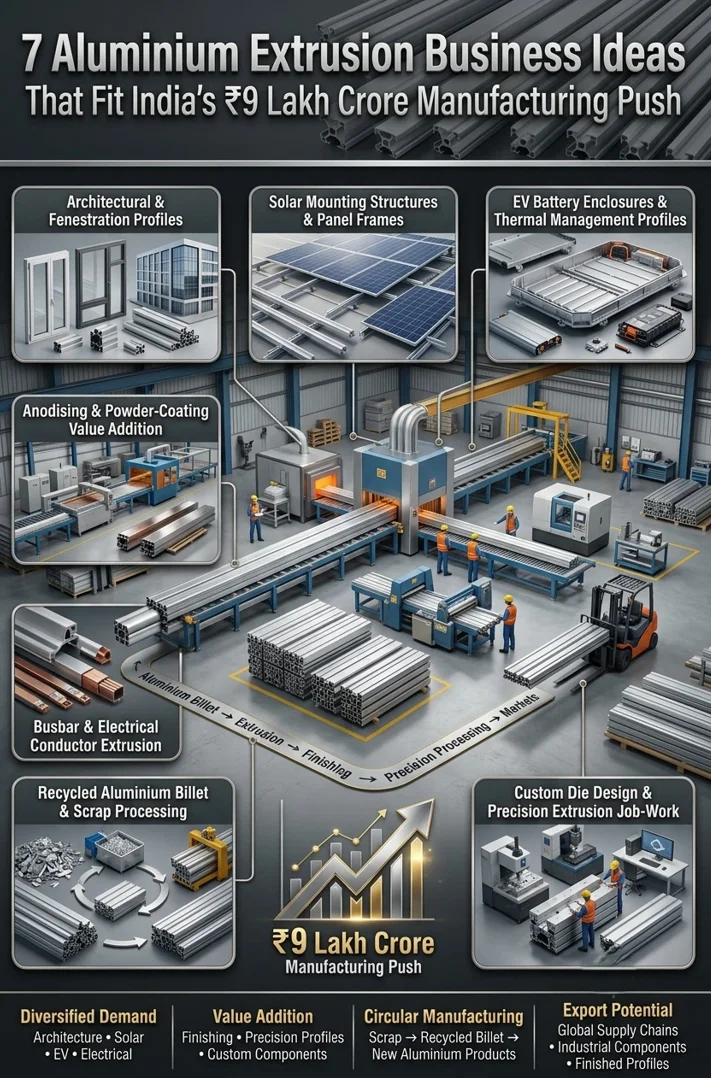
In the field of structural glazing, windows, doors, curtain walls and structural glazing are the biggest user of extruded aluminium globally and India’s construction growth is only driving up the demand for them. The unit examines architectural profiles for 6063 alloys and can be used by real estate developers, government infrastructure projects, and fabricators that create finished window and door systems. This part of the business pays for finish quality, meaning that those who have invested in anodising/powder-coating even as job-work partners have better margins than those who sell plain mill-finish profiles. The secret is to select a regional market where construction is going on and establish relationships with architects and fabricators who use specific finishes and tolerances.
2. Solar Mounting Structure and Panel Frame Extrusion
Though India has the theoretical capacity to produce solar panel frames, it still imports many pre-fabricated frames. Mounting structures and anodised panel frames offer a steady, high-volume opportunity for dedicated extrusion lines. Renewable energy capacity continues to grow, supporting this demand. Entrepreneurs can also build direct supplier relationships with solar EPC companies and module assemblers. This reduces dependence on the trading market and improves project demand stability.
Get Detailed Insights from This Book: Solar PV Power and Solar Products Handbook
3. EV Battery Enclosure and Thermal Management Profiles
The extruded aluminium market for electric vehicle applications is growing at a rapid pace. It is outstripping all but a handful of other end-use categories in growth rate. This growth is driven by requirements for battery trays, crash-protection structures, and cooling channels.
For a start-up product targeting this niche, there is a need for tighter tolerances and stronger alloys, usually 6061 or 6082. A close relationship with automotive design teams is also important to produce custom profiles. While it is a more technically challenging business venture than architectural extrusion, it can be more lucrative and sustainable. Automakers appreciate reliable, quality-certified suppliers instead of one-off suppliers.
View Full Project Details: Electric Vehicle & Battery Operated Vehicle Handbook
4. Anodising and Powder-Coating Value-Addition Units
This is not a business where one can just base their success on tonnage. Many successful entrepreneurs get into the business through surface finishing. Anodised, powder coated and thermal break profiles, on the other hand, are used in higher-value structural and architectural applications. They offer better realisations per kilogram, as this is a commodity business with thinner margins. The stand-alone finishing unit can also be used as a job-work partner for multiple extrusion companies. This can lower the initial capital intensity compared to starting a full extrusion press line.
5. Busbar and Electrical Conductor Extrusion
Aluminium busbars, conductors and heat sinks are embedded in electrical and electronic systems and demand has been growing, although it has happened surreptitiously as e-vehicles, data centres and renewable power infrastructure have come on the scene. It’s a smaller but rapidly expanding market segment within the larger extrusion market, and those who have experience in electrical engineering or power equipment manufacturing may have an easier time getting into the market than those of the more populated architectural market. Fostering partnerships with switchgear vendors, EV charging infrastructure providers, and data centre integrators can provide a consistent order pipeline.
6. Recycled Aluminium Billet and Scrap Processing
The pressure on sustainability is fundamentally changing billet supply around the world and post-consumer scrap processing is no longer a sideline, but a viable business opportunity. An extruder processing recycled aluminium into extrusion billets can both provide recycled aluminium to large extruders and to itself, while being attractive to a growing number of customers who are being demanded to provide carbon footprints on their supply chains. This concept is right for business owners that are adept at working within a trading circuit of scrap collectors and prefer a business model that’s less tied to the primary metal price.
Related Article: How to Start an Aluminium Billet Plant
7. Custom Die Design and Precision Extrusion Job-Work
A press line isn’t for every entrepreneur. For smaller fabricators and OEMs, the extrusion process is a specialized service that values technical expertise over capital scale, namely die design, die correction, and precision job-work extrusion. For complex profiles – especially battery enclosures and thermal-management components – extruders are increasingly turning to specialists for the engineering work. It’s a low-capital option for someone who has a good background in tooling and metallurgy, but isn’t able to secure large capital funding.
Import–Export Opportunity Analysis for Aluminium Extrusion Entrepreneurs
India’s aluminium extrusion trade scenario is not one-sided. Knowing both sides is essential when deciding on a business plan. Solar panel frames and some architectural parts, for instance, are being imported into the country in large numbers. Most come through free trade agreement routes, often with lower duties. Industry body ALEMAI has identified this as a structural issue. Domestic installed capacity remains below its potential, partly due to import competition.
However, India’s cost position in conversion economics is very competitive in international markets. It provides real export possibilities for value-added, finish-certified products and not just plain mill sections. As global buyers shift away from a few large suppliers, exporters that can deliver international-quality products may benefit the most. Increasingly, buyers also require carbon-intensity disclosures that comply with schemes such as the EU carbon border mechanism. Therefore, traceable, lower-carbon sourcing of billets should be a priority from the beginning. Every entrepreneur starting an export-oriented unit should plan this early instead of retrofitting it at later stages.
Indian MSME and Industry Success Stories
Established by Dr Sitaram Jindal, Bengaluru-based Jindal Aluminium is considered as one of the first aluminium extrusion companies in India. The company consistently adhered to the principle of developing profiles business, and gradually developed a wide-ranging domestic and export machine base, starting from a single press. The growth story is a good reminder to new entrants that: specialization in some product line with systematic investments in capacity over decades can beat diversification in a wider product line.
Then there is the case of Hindalco Industries of the Aditya Birla Group. It created an integrated value chain from bauxite mining to smelting and product rolling/extrusion. It then expanded internationally through the acquisition of Novelis. This integration gives Hindalco greater price and supply strength than smaller standalone extruders are likely to match. It also shows the industry’s direction: value-added and downstream operators are becoming more distinct from commodity producers.
In the era of public sector governance, what the National Aluminium Company (NALCO), headquartered in Bhubaneswar, has accomplished is reflected in its disciplined “mine-to-metal” approach. Its bauxite-alumina-aluminium-power operation continues to be one of the largest integrated bauxite operations in the country. Its production success provides a good indication for entrepreneurs considering backward integration in billet supply.
Find the most profitable startup for your investment range
About NPCS: Helping Entrepreneurs Evaluate This Opportunity
Each one of these business ideas can be made a bankable project with more than enthusiasm. At Niir Project Consultancy Services (NPCS), we draft comprehensive Market Survey cum Techno-Economic Feasibility Reports for the entrepreneurs who are assessing new manufacturing projects, such as Aluminium Extrusion and Downstream Metal Processing Units for the market. From manufacturing process flow, market and demand analysis, product mix and capacity planning, till complete project financials with a profitability analysis, our reports paint a realistic picture of the feasibility to the founder before making any investment. Such a formal assessment is one of the deciding factors for people considering their entry into this business, and can make the difference between a successful launch and a costly mistake.
Aluminium Extrusion Business Idea Snapshot: Market Size and Growth Trajectory
| Stage | Global Market Value | Growth Signal |
| Base period | Roughly USD 100–105 billion | Starting point for the current outlook cycle |
| Current phase | Roughly USD 110 billion | Steady expansion led by construction and EVs |
| Near-term | Roughly USD 118 billion | Transportation and solar segments accelerating |
| Mid-decade milestone | Roughly USD 150–160 billion | Broader industrial and infrastructure pull-through |
| Outlook horizon | Roughly USD 195–235 billion | Full realisation of EV, solar, and green-billet trends |
| Compound growth rate | 6 to 8 per cent annually | Value terms across the full outlook period |