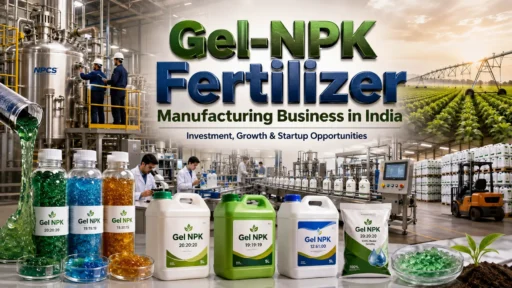
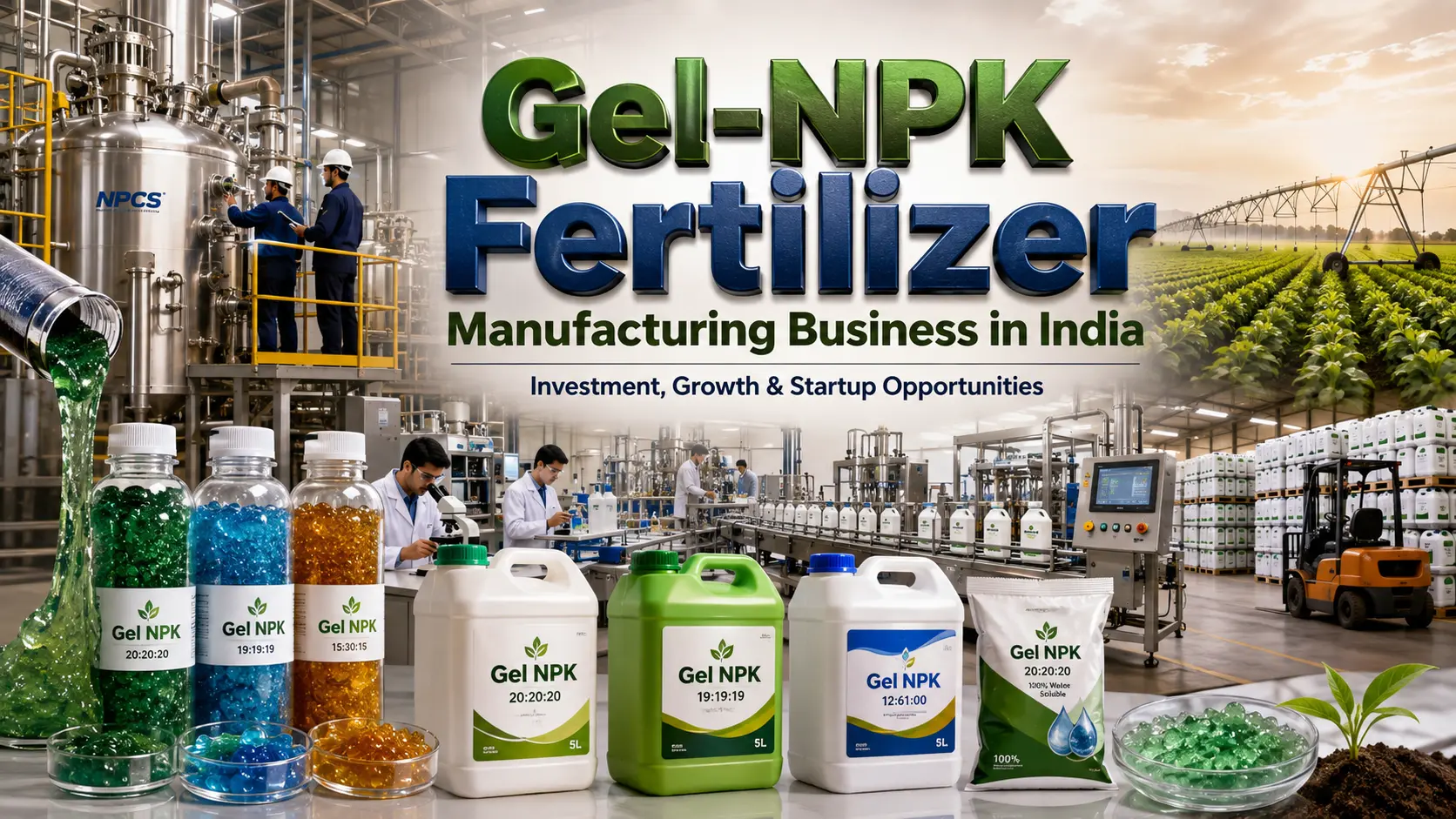

Gel NPK Fertilizer Manufacturing Business
Gel-NPK fertilizer is in a strange but lucrative middle-ground between chemistry and the principles of cultivation. It does not pack these nutrients into a hard granule, but suspends them within a semi-liquid gel base that eliminates problems that have long frustrated Indian farmers, such as slow release, irregular distribution and nutrient loss in monsoon runoff. This product is definitely worth considering for anyone looking to venture into a business that is more practical that falls under agri-inputs. The business model is not just abstract, either. The market for real MSME units has already started in Gujarat and is increasing quite rapidly across the cotton belt, sugarcane belt and horticulture belt.
Why This Sector Deserves Your Attention
The total NPK fertilizer market in India already fetches annual turnover of about USD 12 billion with an estimate of reaching to USD 15 billion in the next five to six years. This translates to modest single-digit increases on a annual basis – a welcome respite for a fledgling manufacturer. Fertilizer demand follows sown acreage and government purchases, and both are slow to develop and predictable. With that, a new player is given time to rectify the quality problems and has the opportunity to avoid the negative consequences of minor mistakes in the market.
Read the Complete Book Here: Fertilizers Manufacturing Handbook
Why the Gel Format Beats Traditional Granules
Granular NPK has been a good solution for Indian agriculture, but it has its baggage. It is commonly kept in poorly ventilated sheds by the farmers and as the humidity level rises during monsoon season, it cakes and releases nutrients unevenly when it is applied to the soil. Gel based NPK doesn’t have this issue as the NPK is in a semi solid state and diffuses out in a controlled manner. As a result, yield increases and farmers get a greater yield from less product. The demand is not abstract as the price of water-soluble and gel-based specialty fertilizers is already higher in Maharashtra and Gujarat compared to the standard granular grades, which are in use today.
Export Potential Adds a Second Revenue Stream
The Indian story of nano and gel format fertilizers has already piqued the interest of the world. IFFCO’s liquid nano products are now starting to gain access to export markets such as Kenya, Bangladesh, Brazil and Nepal, and this market is an inspiration for smaller gel-NPK manufacturers. Similar to India, storage and transport problems are faced by the markets in Southeast Asia and Africa, and so a compact spill-resistant gel product has better transportability than bulky bags of granular material. This means a manufacturing plant that is already producing export paperwork and FCO compliant labelling can benefit from the domestic subsidy market and from export sales without the need to retool the plant.
Government Policies and Incentives Supporting New Businesses
However, no fertilizer business plan is complete without the policy layer, as the timing of subsidies and licensing conditions have a direct impact on cash flow. Now, here are the facts about any gel-NPK start-up, jargon free.
Nutrient Based Subsidy (NBS) Scheme
It is a Nutrient Based Subsidy Scheme by the Department of Fertilizers which pays a fixed price per unit of nitrogen, phosphorus, potassium and sulphur content of registered P&K fertilizer grades to the manufacturers. Since the scheme is nutrient based and not product based, if the well formulated grade of the gel-NPK passes the FCO registration it is eligible to avail the same subsidy pool like DAP and MOP. The fiscal commitment in the support for NBS is reflected in the fact that government expenditure has gone beyond two lakh crore rupees during the last few budget cycles. Before deciding on product grades, entrepreneurs should check the nutrient subsidy rates published on the Department of Fertilizers website.
PMEGP, CGTMSE and MSME Lending Support
The Prime Minister’s Employment Generation Programme or PMEGP is a good beginning for a first-generation founder without huge capital. It provides subsidy of up to fifty lakhs on manufacturing projects and provides subsidy of 15 to 35 percent on margin money based on category and location. Since the balance amount is being funded by the banks, the Credit Guarantee Fund Trust for Micro and Small Enterprises takes away the collateral conundrum by guaranteeing the loans up to two crores. Combined, these two scheme allows a founder to begin a small gel-NPK unit using a small amount of personal equity. Entrepreneurs can submit applications through the Ministry of MSME’s PMEGP e-portal, and they must complete Udyam Registration before applying for either scheme.
Get Detailed Project Report (DPR): Fertilizer Production & NPK Projects
Startup India, DPIIT Recognition and the Make in India Push
In addition to direct subsidy, DPIIT-recognised startups receive tax exemption and speedy processing of patents and access to government tenders for MSMEs. The government has also announced that a Startup India registered manufacturer of GEL-NPK will also be enabled to be visible on agriculture departments’ procurement platforms. The underlying theme of the Make in India campaign of pushing domestic manufacture of fertilizers to reduce dependence on imports is further matched by specialty formats such as gel-NPK, as its raw material sourcing can be largely kept domestic. Founders should register early as some benefits are based on a defined timeframe.
Fertilizer Control Order Licensing and State-Level Support
Registration of all gel-NPK plants is mandatory under the Fertilizer (Control) Order, 1985, issued by the agriculture department of the respective State. The authorities do not base the registration process on the size of the units. Before approval is given to the process, the manufacturing layout, in-house testing lab capacity, and storage safety are checked. In addition to the central schemes, a number of states have their own industrial incentive package. Under the capital subsidy and stamp duty exemption programs for MSME manufacturing units, Gujarat’s industrial extension portal, iNDEXTb, expedites land and environmental clearance processes, while Maharashtra’s single-window system, MAITRI, streamlines land and environmental clearance procedures. Uttar Pradesh has a similar push with its Invest portal UP Invest which is especially beneficial owing to the large number of farmers in the state.
The PLI Gap Worth Knowing About
A good consultant also points out the areas where improvement is needed, but not every incentive story is positive. While the government promotes nano and gel fertilizers through awareness programmes and pilot projects, it currently does not offer a specific Production Linked Incentive (PLI) scheme for this product category. A founder should not make NBS and PMEGP and state incentives the true foundation, instead of planning around a PLI payout that isn’t yet available for this format.

Multiple Business Ideas for Startups in Gel-NPK Manufacturing
It’s not just a single ‘gel-NPK factory’ that goes in. The category includes several distinct business ideas, each requiring different levels of startup capital and targeting different customer groups. Founders should choose according to available capitals, availability of raw material, and the requirement to directly sell to farmers or supply large brands as contract manufacturing.
Standard Gel-NPK Compound Fertilizer Unit
The most direct path is through creating a compound unit for common “row crop” and horticultural “grades” of common gel-NPK fertilizer, like 19:19:19 or 12:32:16. This model requires a reaction vessel, a gel-stabilising mixer, filling lines and a small quality-control lab in order to meet the FCO testing requirements. Raw material sourcing is unlikely to limit production because suppliers maintain stable prices and provide consistent formulations for widely traded materials such as urea, DAP, MOP, and micronutrient chelates. The first market for a founder entering this segment should be the regional dealer networks, as water-retentive, slow-release formats already have good demand in cotton and sugarcane belts of Gujarat, Maharashtra and Punjab. The margins on commodity grades remain small and volume and dealer relationship are more important than premium branding in the early years.
Choose the right startup backed by real market demand
Specialty Micronutrient-Fortified Gel Fertilizer
Instead of going by the volume, some of the founders create a smaller unit that includes fortified gel-NPK with zinc, boron, or sulphur added to the product for certain crops, such as paddy, cotton or fruit orchards. This niche commands a real premium because customers view it as a solution rather than a commodity. Recent NBS policy revisions have also expanded coverage for micronutrient-fortified grades. The initial investment is lower than a full compound plant, but the farmer needs to put more effort in agronomic trials and farmer demonstrations to demonstrate this yield advantage. This model works well for farmers who already have contacts in agriculture extension services or cooperative societies – trust sells specialty inputs quicker than advertising ever will.
Contract Manufacturing for Established Fertilizer Brands
Smaller MSMEs increasingly produce specialty and gel-formulated fertilizers for large fertilizer companies instead of relying on capacity expansion by major manufacturers, creating a strong white-label business opportunity. A founder develops the manufacturing capacity to make products to FCO standards, gets ISO or GMP like certification and approaches mid-size brands who look for overflow or a new product line without investing in capital expenditure. This path minimises the marketing risk as the buyer already has distribution and dealer trust. But that requires greater process discipline as brand customers scrutinize batch consistency very carefully when they are considering entering into batch supply contracts. For founders who can thrive in a production partnership model (as opposed to consumer brand), this quickly becomes the route to predictable/repeatable revenue.
Export-Focused Gel-NPK Unit for Neighbouring Markets
A smaller number of founders develop a specifically export-focused product from the outset, with India’s existing fertilizer co-operatives having trade links with Bangladesh, Nepal and Sri Lanka, and East Africa. The gel format allows easier transportation than granular bags, resists moisture damage during sea freight, and enables manufacturers to package it in smaller quantities for the smallholder farms common in these markets. The model requires an export licence, the strict adherence to import regulations in the target country for fertilizers and time, as trust from the building is more difficult to earn abroad as it is domestically. But for those with trading or logistic experience, this is still one of the more lucrative business ideas in the category.
Import-Export Opportunity Analysis
Although the country has made significant progress toward achieving self-sufficiency in raw materials, it still imports considerable quantities of rock phosphate and muriate of potash. For the new gel-NPK producer, the dependency on imports is a two-way street. One way this is good: raw material costs remain vulnerable to international price fluctuations and currency exchange. However, each unit of gel-NPK sold in the domestic market replaces an imported product and hence government is providing strong support to the domestic manufacturing of the same through NBS and Make in India incentives. Early-bird founders who take advantage of raw material supply agreements help “hedge” against the price volatility that has recently occurred in phosphate pricing.
Opportunity is better on the export side than most founders think. Fertiliser trade in the neighbouring South Asian and parts of East African markets is going on in large quantities, while Indian co-operatives have already established trade corridors for nano and liquid fertiliser. A gel-NPK unit that is able to secure export registration can build on this trust instead of starting from scratch. Moreover, freight economics will prefer compact, moisture-resistant packages and the gel format provides this over the cumbersome granular packages. Another benefit of exporting is that it protects young manufacturing companies from subsidy payment delays, a risk they must consider when selling only to the domestic market supported by the NBS.
Indian MSME Success Stories in Fertilizer Manufacturing
The vision of IFFCO was not of one mind but the vision of cooperative farmer ownership, which is still a lesson for new entrepreneurs: distribution trust is as important as manufacturing capability. IFFCO’s entry into Nano and liquid fertilizer market is testament to a traditional fertilizer company making a successful transition to the new category of compact, efficient products like gel-NPK. The lesson for a smaller founder is simple. Dealers are important, and if they are established before farmers try new formats, they are more likely to be successful than the aggressive advertising.
Now under the Mehta family leadership, Deepak Fertilisers and Petrochemicals Corp. developed its brand Mahadhan into a top specialty and water-soluble fertilizer brand in India in about two and a half decades. Since no one is interested in pan-India volumes from the get-go, the company set its sights on horticulture-rich states such as Maharashtra, Karnataka and Gujarat. The regional-first approach allowed the business to fine-tune its formulations and create dealer loyalty before expanding its reach. This is an exact blueprint for a new gel-NPK founder: control 2-3 agriculturally strong districts – then make the yield claims – and then expand when there is repeat order.
Coromandel International, part of the Murugappa Group and currently chaired by M M Murugappan, grew from a single-state fertilizer producer into one of India’s largest phosphatic fertilizer manufacturers by continuously widening its product mix toward specialty and water-soluble grades. The company’s decision to keep investing in formulation research, rather than compete purely on granular commodity pricing, protected its margins through multiple subsidy policy changes over the years. For a founder starting small in gel-NPK, the takeaway is clear: build formulation know-how as a genuine asset, because commodity pricing pressure never really goes away, but a differentiated product earns pricing power that lasts.
Related Article: Organic Fertilizer & Bio-Stimulant Manufacturing Business in India: Cost, Profit & Market Opportunity
Feasibility Planning: Where Most New Entrepreneurs Go Wrong
All the business ideas listed in this article appear practical, however their actual feasibility on ground depends upon prices of local raw materials, machines and the correct estimation of market demand for a particular district a founder may wish to target. This is where new entrepreneurs find the service offered by Niir Project Consultancy Services or famously referred to as NPCS to be of great help. The market survey reports cum techno economic feasibility study prepared by NPCS clearly specify the manufacturing process of a product, detail its machinery and raw materials, provide for product mix and overall project financials with profitability estimation.
Rather than guessing at capital requirements from generic online estimates, a founder working from a properly researched feasibility report walks into bank discussions and PMEGP applications with numbers a loan officer can actually evaluate. For a category like gel-NPK, where formulation and process design genuinely affect output quality, that kind of grounded feasibility work often decides whether year one succeeds.
Gel-NPK Market and Investment Snapshot
The table below pulls together the numbers a founder actually needs before writing a business plan, from market size to the specific subsidy percentages available at each stage.
| Parameter | Current Estimate | Outlook / Notes |
| India NPK fertilizer market revenue | Approx. USD 12 billion annually | Projected to cross USD 15 billion within the next five to six years, growing near 4-6% a year |
| Combined N+P+K nutrient consumption | Roughly 24 million metric tonnes a year | Rising steadily with sown acreage and balanced-fertilization push |
| NBS subsidy outlay on P&K fertilizers | Over ₹2 lakh crore across recent budget cycles | Sustained government commitment; rates revised each season |
| Minimum investment for a small gel-NPK unit | ₹25 lakh to ₹75 lakh (machinery + working capital) | Scales up for contract-manufacturing or export-grade capacity |
| PMEGP margin money subsidy | 15% (urban, general) to 35% (rural, special category) | Requires Udyam Registration; routed through KVIC and partner banks |
| CGTMSE collateral-free guarantee | Up to ₹2 crore | Removes the biggest entry barrier for first-generation founders |
Key Challenges to Plan For
No feasibility article is complete with mentioning the threats. Price volatility for raw material, urea, phosphate and potash is the # 1 risk as these prices fluctuate according to the international markets and are beyond the control of a small producer. Consistency in quality is another, as both FCO agents and dealers may inspect the batches and can ruin a new brand’s reputation very quickly. Farmer education on the gel form, to gain its acceptance among farmers, is still being built up, hence initially sales will take time. Seasonal stress usually occurs because demand mainly depends on sowing seasons, while delays in receiving government subsidies can create cash-flow shortages. Arranging working capital with a mindset of potential crisis instead of optimism is a difference between successful and failing startup that comes into existence.
Frequently Asked Questions
Do I need a technical degree to start a gel-NPK fertilizer manufacturing unit?
No, there is no necessity of having such degree for you, because to make FCO registration is required in agriculture or biochemistry or chemistry degree on behalf of the promoter or another person. You will make registration of this degree by some professional person
How much capital does a small gel-NPK unit realistically need?
A simple compact unit capable of manufacturing normal grades should cost from 25 lakh to 75 lakh rupees which will include the machinery, gel-stabilizer, minimal testing laboratory and initial working capital – though contract-manufacturing for major buyers requires substantial capital outlay.
Can I get government subsidy on gel-NPK, or only on standard granular fertilizer?
Subsidy eligibility depends on nutrient content and FCO grade registration rather than physical form. A properly registered gel-NPK grade can qualify for Nutrient Based Subsidy just like granular equivalents, provided it matches an approved specification.
How long does FCO licensing usually take?
The time varies per state, but the founders should probably factor in two to four months for the site visits and document inspections. Once the FCO compliant storage, safety compliant manufacturing plant building is ready before you apply, the approval will happen quite smoothly.
Is export a realistic option for a first-year gel-NPK business?
It is possible but rarely advisable in year one. Most successful founders establish domestic quality consistency and dealer trust first, then pursue export registration once production stabilises and cash flow allows for the longer payment cycles export buyers often require.
What is the biggest mistake new entrepreneurs make in this sector?
Underestimating working capital needs tied to subsidy disbursement delays. NBS payments do not always arrive quickly, so founders who plan cash flow only around immediate dealer payments often face a liquidity crunch within the first two quarters.
Conclusion
Gel-NPK fertilizer manufacturing is not a speculative opportunity dressed up as a business idea; it offers a well-measured venture supported by real market growth, strong government subsidy infrastructure, and proven MSME models that entrepreneurs can study and follow. As the sector rewards those entrepreneurs who obey licensing; prepare for working capital transparently and go for a specific business proposal under the vertical rather than taking all positions in single time. All in all between NBS aid; PMEGP grants; CGTMSE guarantees to the specific State Industrial incentives – never has the entry for any pragmatic entrepreneur wanting to enter manufacturing space seemed less prohibitive than now.
The distinction between the working factory and non-working factory largely arises from post manufacturing phase preparation, prior to even placing the first machine order in the hands of any manufacturer – i.e.: robust economic and viability numbers; concrete region-wise and district-wise sales target and adequate working capital that would sustain between the completion of production and receipt of the subsidy. Get that groundwork right, and gel-NPK manufacturing offers one of the more grounded business opportunities in India’s agri-input economy today.
Sources and Further Reading
This article draws on public data and policy information from the Press Information Bureau, the Ministry of Micro, Small and Medium Enterprises, the Federation of Indian Chambers of Commerce and Industry (FICCI), the Confederation of Indian Industry (CII), the Fertiliser Association of India, and market research aggregated by India Brand Equity Foundation (IBEF). Readers should check official state and central portals for the latest subsidy rates and licensing fees before finalising a business plan, as authorities revise these figures periodically.