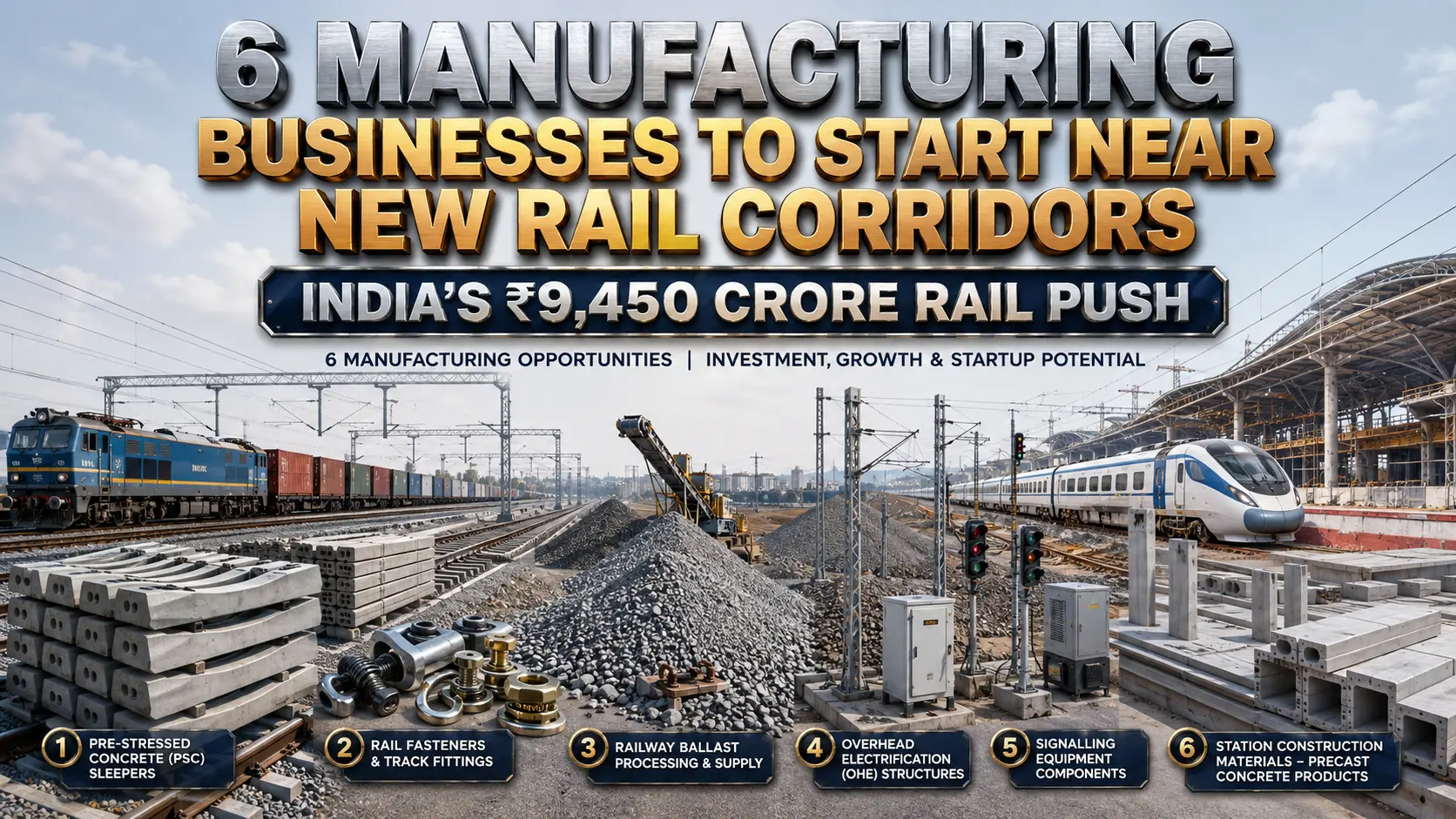

Four strategic multitracking railway projects in India’s four states with an estimated cost of ₹9,450 crore have been approved by the Cabinet Committee on Economic Affairs (CCEA). The historic move is expected to extend India’s rail network by hundreds of kilometres, freeing up space on some of the nation’s busiest freight tracks, according to a Times of India report.
This is not only a government infrastructure announcement, it is a market signal to entrepreneurs, manufacturers and MSME owners. For each kilometre of new track there are tonnes of steel, concrete sleepers, fasteners, ballast, signalling equipment, electrical components, and safety equipment. When each new station comes comes up, it’s construction materials, furniture, lighting systems and facility management. Each extra train movement generates further demand for locomotive spares and maintenance spares, brake systems, and other train running parts.
To put it simply, the government’s expenditure of ₹9,450 crore has a multiplier effect that is several times the value in terms of manufacturing, services, and supply chain opportunities. Approval comes in the wake of India’s overall PM Gati Shakti master plan, which aims to bring together the rail, road and logistic networks into a single national network, as reported by the Times of India. The challenge before all Indian MSME owners today is how to see how they can participate in the opportunity.
What Recent Reporting Means for Business Owners
The CCEA headed by Prime Minister Narendra Modi has approved four multitracking projects in four states, the Times of India reports. These are extensions of the third, fourth and further railway lines on heavily-used corridors where passenger services and freight are now either severely delayed or congested.
The parallel rail lines added to existing tracks are known as multitracking. This significantly boosts the capacity of a railway line—more trains can operate at once, the speed of freight trains can be reduced and the costs of these operations can be reduced for industries that rely on rail for transporting coal, steel, cement, fertilisers and agricultural produce.
This is why it is crucial for every type of business to pay attention:
- Entrepreneurs: Greenfields business districts are created along new rail corridors. New rail infrastructure generates station economy, cold-chain logistics parks, and last mile warehouses.
- MSMEs: Railway projects have huge expectations on procurement of track pieces, civil construction materials, and tools for maintenance – all areas where small manufacturers can compete.
- Companies that make components for steel, concrete products or precision engineering will benefit in the long-term from the supply contracts signed by the contractors working on these projects.
- Manufacturing in the infrastructure segment is characterised by government-backed demand with multi-year visibility, which is a rare combination of demand characteristics in the Indian MSME markets, and is attractive to investors.
- Exporters: Companies with rail export contracts in Indian Railways can use that reputation to secure rail export contracts in South Asia, Africa and Southeast Asian markets.
- Data-driven rail maintenance, track monitoring technology, and station-based logistics automation are new commercial opportunities that are gaining momentum in the start-up community.
Related Article: Railway Manufacturing Business Opportunities: How MSMEs Can Benefit from Indian Railways Capex
The impact of spending on railway infrastructure is well documented. Every ₹100 crore spent on rail capex creates about ₹250–300 crore in business across the rail industry’s upstream manufacturing and services businesses, industry analysts estimate. In this total, the total addressable opportunity for Indian manufacturers and MSMEs could be more than ₹25,000 crore throughout the project lifecycle in this ₹9,450 crore approval.
Why This Industry Is Growing
The Indian railway system is undergoing its biggest expansion in decades. However, the Ministry of Railways has been allocated a record budget of capital expenditure in recent years and the expenditure has increased significantly year-on-year. The multitracking approvals announced by The Times of India come as a part of a comprehensive strategy to remove the blockages on major freight corridors.
Three structural forces are fueling this growth:
1. Freight Capacity Crisis
India has the most productive rail lines with a capacity utilisation exceeding 100 per cent — that is, for every train movement another has to be delayed. Multitracking is a direct solution to this because it is able to double or triple the throughput of corridors without constructing new routes. This is an efficient delivery of infrastructure which demands vast amounts of manufactured inputs.
2. Logistics Cost Reduction Imperative
Logistics costs in India as a percentage of GDP are still quite high. The government has a clear objective to ease this burden. Rail freight is 5-7 times more energy efficient than road freight. Multitracking projects allow for the movement of increased freight volumes from road to rail, resulting in a growing need for rail compatible packaging, loading equipment and intermodal solutions.
3. PM Gati Shakti National Master Plan
The multitracking clearance is part of India’s overall PM Gati Shakti initiative, which brings together transport, civil infrastructure planning from various ministries on a common platform. Projects under Gati Shakti are given priority for speedy approvals, simultaneous land acquisition and multi modal connectivity. This avoids project delays, and provides manufacturers entering the supply chains at an earlier stage with a competitive edge.
Government Policies and Incentives
India’s railway infrastructure projects offer a number of overlapping policy frameworks that benefit Indian manufacturers:
- National Rail Plan 2030: India’s Ministry of Railways targets a 45 per cent share of freight traffic by rail by 2030, up from about 27 per cent today. This plan commits ₹50+ lakh crore in infrastructure investment. Visit: indianrailways.gov.in
- PM Gati Shakti Portal: The integrated multi-modal infrastructure portal enables coordinated project planning and contractor engagement.
- Make in India – Railway Sector: Indian Railways mandates local content requirements of 75–100 per cent for most categories of rolling stock components and track materials. MSME manufacturers with registration can bid directly for sub-supply contracts. Visit: makeinindia.com
- MSME Udyam Portal: Registered MSMEs receive preferential treatment in government procurement, access to the Government e-Marketplace (GeM), and priority credit under CGTMSE. Visit: udyamregistration.gov.in
- PLI Scheme for Steel: Rail-grade steel manufacturers can access production-linked incentives under the Ministry of Steel’s PLI framework, significantly reducing cost structures. Visit: steel.gov.in
- RDSO Vendor Approval: The Research Designs and Standards Organisation (RDSO) of Indian Railways approves vendors for track components, signalling equipment, and safety hardware. RDSO approval unlocks access to all Indian Railways tenders. Visit: rdso.indianrailways.gov.in
- National Infrastructure Pipeline (NIP): Rail projects under NIP qualify for viability gap funding and priority project status.
- GeM Portal (Government e-Marketplace): MSME manufacturers can list products and bid for railway sub-supply contracts directly. Visit: gem.gov.in
- IRFC (Indian Railway Finance Corporation): IRFC finances rolling stock and infrastructure acquisition, ensuring contractors and sub-suppliers receive timely payment.
Manufacturing Business Opportunities: 6 Sectors to Enter Now
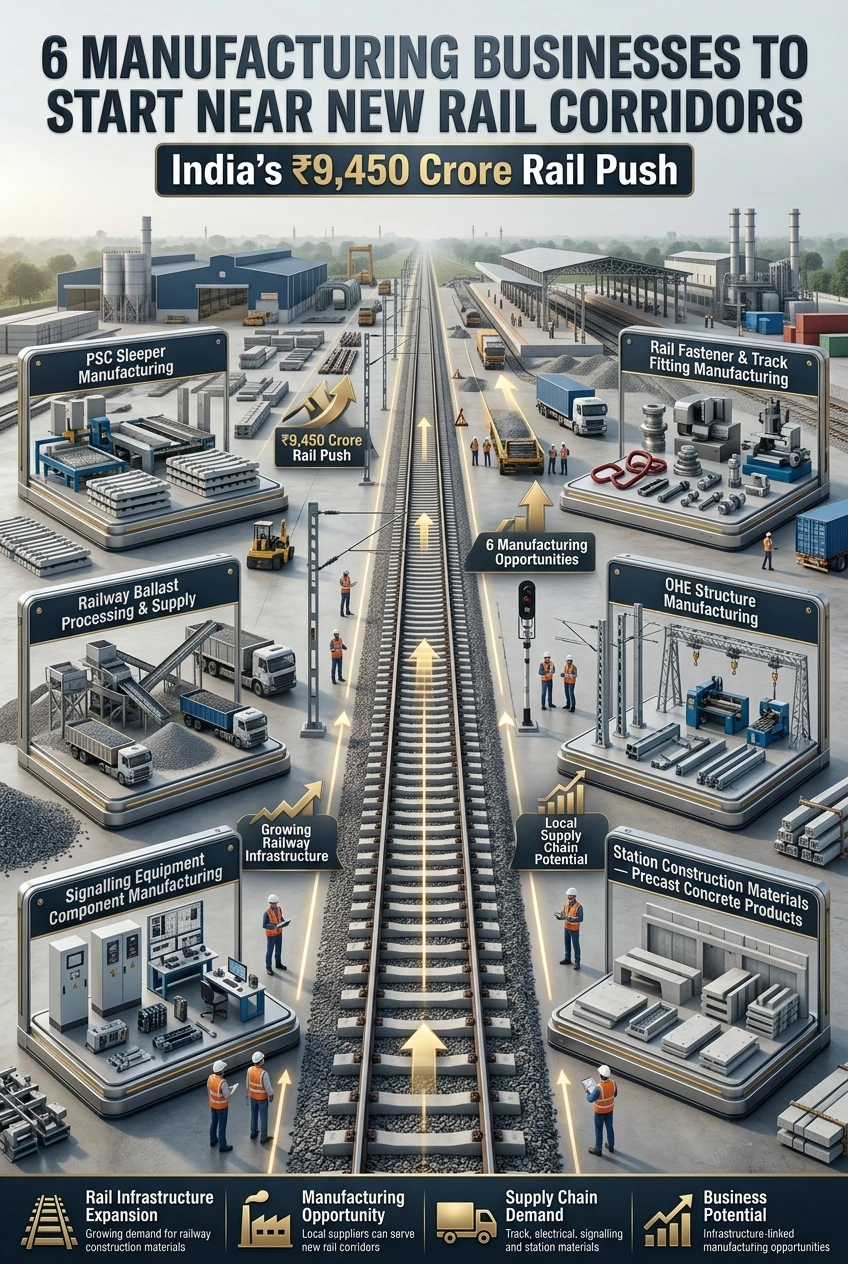
The following manufacturing opportunities emerge directly from the ₹9,450 crore multitracking approval reported by the Times of India. Each sector has verifiable demand, existing RDSO specifications, and clear entry pathways for new manufacturers.
1. Pre-Stressed Concrete (PSC) Sleeper Manufacturing
Every kilometre of new railway track requires approximately 1,660 concrete sleepers. Multitracking projects covering hundreds of kilometres translate to millions of sleepers needed over the project lifecycle. PSC sleeper manufacturing is capital-moderate (₹2–5 crore for a medium plant), has proven technology, and enjoys stable RDSO-approved specifications.
Why this opportunity emerges: The multitracking corridors reported by the Times of India pass through states that currently have supply gaps in sleeper manufacturing. New plant owners located near project corridors benefit from significantly reduced logistics costs on their heaviest product.
Investment Range: ₹2–5 crore | Capacity: 300–500 sleepers/day | Raw materials: Cement, steel wire, aggregate
View Full Project Details: Pre-Stressed Concrete Electric Poles
2. Rail Fastener and Track Fitting Manufacturing
Track fasteners — the elastic rail clips, baseplate screws, and fish bolts that hold rails to sleepers — are consumed in enormous quantities. A single kilometre of track requires thousands of fasteners. These are precision-engineered components with tight RDSO tolerances, which means quality manufacturers face less competition from commodity suppliers.
Why this opportunity emerges: India currently imports a significant portion of high-specification rail fasteners. The multitracking push creates the volume justification for domestic manufacturers to set up dedicated fastener lines and achieve RDSO approval.
Investment Range: ₹1.5–4 crore | Key processes: Cold forging, heat treatment, surface coating
3. Railway Ballast Processing and Supply
Railway ballast — the crushed stone aggregate that supports and drains track — is required in massive quantities for every multitracking project. A single kilometre of track requires approximately 1,500 cubic metres of graded ballast. Ballast quarry and processing operations near project corridors represent straightforward MSME opportunities with low technology barriers.
Why this opportunity emerges: Multitracking projects in new states require sourcing ballast from geologically appropriate quarries within reasonable distance. The four states covered by this approval each have potential quarry locations worth assessing.
Investment Range: ₹50 lakh–₹2 crore | Requirements: Mining lease, crushing plant, RDSO ballast specification compliance
4. Overhead Electrification (OHE) Structure Manufacturing
Railway electrification runs in parallel with track expansion. Every new multitracking corridor requires OHE masts, cantilever structures, registration arms, and associated steel fabrications. These are standard structural steel fabrications with specific dimensional tolerances.
Why this opportunity emerges: Indian Railways is simultaneously expanding its electrified network to near 100 per cent coverage. Multitracking projects add new kilometres of electrified corridor, requiring corresponding OHE hardware at scale.
Investment Range: ₹2–6 crore | Key capability: Structural steel fabrication, galvanising, RDSO drawing compliance
5. Signalling Equipment Component Manufacturing
Modern multitracking projects deploy advanced signalling — axle counters, track circuits, point machines, and signal housings. While complete signalling systems require significant technology, many component categories are open to MSME manufacturers: enclosures, cable trays, junction boxes, conduit fittings, and terminal blocks.
Why this opportunity emerges: As the Times of India reports, these projects target high-traffic corridors where advanced signalling is mandatory for safety. Component demand from signalling system integrators creates a large sub-supply market accessible to MSME metal and electrical manufacturers.
Investment Range: ₹1–3 crore | Key processes: Sheet metal fabrication, powder coating, electrical wiring assembly
6. Station Construction Materials — Precast Concrete Products
Every multitracking project includes construction of new stations and upgradation of existing ones. Precast concrete products — platform slabs, roof panels, wall elements, drain covers, and boundary wall sections — can help MSME units serve civil contractors.
Why this opportunity emerges: Precast concrete construction significantly shortens construction time — a critical factor for railway projects on tight delivery schedules. Contractors actively prefer precast suppliers who can deliver on schedule near project sites.
Investment Range: ₹1.5–4 crore | Products: Platform slabs, roof elements, manhole covers, retaining wall blocks
Explore This Book: The Complete Book on Construction Materials
Import–Export Opportunity Analysis
Export Markets
Indian railway component manufacturers who build a credible track record supplying to Indian Railways — the world’s fourth-largest rail network — gain powerful export credentials. Target markets include:
- Bangladesh, Sri Lanka, Nepal: Building out rail infrastructure with Indian technical assistance
- Sub-Saharan Africa: Multiple gauge conversion and network expansion projects under development
- Southeast Asia: Vietnam, Indonesia, and the Philippines actively expanding urban and intercity rail
- Middle East: GCC countries investing heavily in metro and high-speed rail
Indian concrete sleeper manufacturers have already won export orders in African markets. The volume scale created by domestic multitracking projects allows manufacturers to build competitive cost structures that open export doors.
Import Substitution
Several railway component categories remain import-dependent despite India’s manufacturing ambitions:
- High-specification rail fasteners (currently imported from Europe and Japan)
- Advanced signalling system sub-components
- Specialised track geometry measurement equipment
- Rail welding consumables and thermite compounds
The ₹9,450 crore multitracking push creates the demand volume that justifies import-substitution investments in these categories. Manufacturers who achieve RDSO approval in the next 12–18 months will be positioned to capture this demand as projects reach procurement phase.
Trade Opportunities
India’s National Export Policy for railway equipment targets $1 billion in annual exports by 2030. Government export promotion schemes through Engineering Export Promotion Council (EEPC India) and the Ministry of Commerce support railway component exporters with marketing assistance, participation in international trade fairs, and product certification support.
Indian MSME Success Stories
1. Patil Rail Infrastructure, Secunderabad
Patil Rail Infrastructure (founded 1933) evolved from a small civil contracting firm into India’s largest concrete sleeper manufacturer, supplying pre-stressed concrete sleepers across virtually every Indian Railways zone. The company achieved RDSO approval, invested in seven automated sleeper plants across India, and has won export contracts. It demonstrates the compounding advantage of early RDSO vendor registration for MSME manufacturers.
2. Energia Steels, Kolkata
Kolkata-based MSME manufacturer Energia Steels narrowly focused its business on railway track fittings – rail joints, railway sleepers and track machines. From 2008, Energia Steel has set itself apart in this industry by targeting export-quality railway fittings and securing business among EPC contractors who implement Indian Railways tenders and has developed its business by specialising for large, institutional customers.
3. KEC International (Rail Division)
KEC International’s rail division, while now a large enterprise, began as an MSME electrical contractor. The company-built capability in railway electrification — overhead equipment installation, traction substation work — and grew its order book alongside Indian Railways’ electrification programme. MSME manufacturers supplying OHE components to contractors like KEC represent a replicable entry point for new market entrants.
Find the most profitable startup for your investment range
About NPCS – Niir Project Consultancy Services
Niir Project Consultancy Services (NPCS) is India’s leading industrial consultancy and project report preparation firm, with over four decades of experience supporting entrepreneurs, manufacturers, investors, and government agencies across 7,500+ industrial sectors.
NPCS provides end-to-end support for businesses entering railway infrastructure supply chains:
- Detailed Project Reports (DPR): Bankable reports covering plant layout, machinery selection, raw material sourcing, financial projections, and ROI analysis — the essential document for loan approvals and investor conversations.
- Market Research Reports: Sector-specific demand analysis, competitor mapping, and procurement intelligence for railway component categories.
- Feasibility Studies: Technical and financial viability assessments for new manufacturing ventures, including site selection and utility requirement analysis.
- Technology Consultancy: Process selection, equipment specifications, quality control systems, and RDSO approval pathway guidance for railway component manufacturers.
- MSME Setup Support: End-to-end guidance from business registration to first production, covering statutory approvals, plant commissioning, and initial marketing support.
Whether you are setting up a concrete sleeper plant, a rail fastener forge, or a signalling component fabrication unit, NPCS provides the technical and commercial intelligence to build a sustainable business. Visit: www.npcs.in
Industry Snapshot: Railway Infrastructure Manufacturing
| Parameter | Details |
| Industry | Railway Infrastructure – Track Components, Civil Materials, Station Equipment |
| Market Driver | Cabinet-approved ₹9,450 crore multitracking expansion across 4 states (Times of India) |
| Investment Range | ₹50 lakh – ₹6 crore depending on product category |
| MSME Opportunity | Concrete sleepers, fasteners, ballast, OHE structures, precast station elements |
| Export Potential | Bangladesh, Africa, Southeast Asia, Middle East – rail hardware in high demand |
| Government Support | RDSO approval, Make in India, PLI (Steel), GeM, CGTMSE credit guarantee |
| Risk Level | Low–Medium (government-backed demand, long project tenures, stable procurement) |
| Growth Outlook | Strong through 2030–31 (National Rail Plan targets, Gati Shakti pipeline) |
Conclusion: The Track Is Laid — Will Your Business Board?
The Cabinet approval of four railway multitracking projects worth ₹9,450 crore, as reported by the Times of India, is not simply a government infrastructure announcement. It is a procurement signal — a government-backed commitment to buy millions of tonnes of steel, concrete, and precision components over the next five years across four Indian states.
India’s railway expansion programme is the most predictable large-scale procurement engine in the country today. Unlike private sector demand, which swings with economic cycles, railway capex is budgeted years in advance, protected by legislative approvals, and executed through contractors who need reliable domestic manufacturers.
The manufacturers who win are those who act now — before the project execution phase begins. Achieving RDSO vendor approval, establishing a plant near project corridors, and building relationships with tier-one contractors require 12–24 months of preparation. The businesses that begin today will be procurement-ready when the multitracking projects reach full execution speed.
Whether you manufacture concrete products, structural steel, electrical hardware, or precision fasteners — the railway sector offers a route to sustained, government-backed growth through 2030 and beyond.