Khadi Business Plan India is no longer a mere fabric of heritage linked with the freedom movement of India. It has become a structured, policy supported and export ready commercial sector. Under the direction of Khadi and Village Industries Commission (KVIC), the industry has shown steady growth in terms of production, turnover and employment generation.
For entrepreneurs looking for a scalable manufacturing option with relatively lower risk, Khadi is a rare combination of sustainability, brand value and organized market demand. When approached with feasibility driven planning rather than emotional positioning it can be a profitable long-term business.
Read More: TEXTILE BLEACHING, DYEING, SPINNING, WEAVING, PRINTING, FINISHING AND TEXTILE AUXILIARIES PROJECTS
Why Khadi Is Getting Start Up’s Attention
The appeal of Khadi is that it is a distributed production model. Unlike capital-intensive textile mills, Khadi manufacturing can start on a medium scale and grow slowly. Depending on their capital and expertise, entrepreneurs can compete in various stages of the value chain.
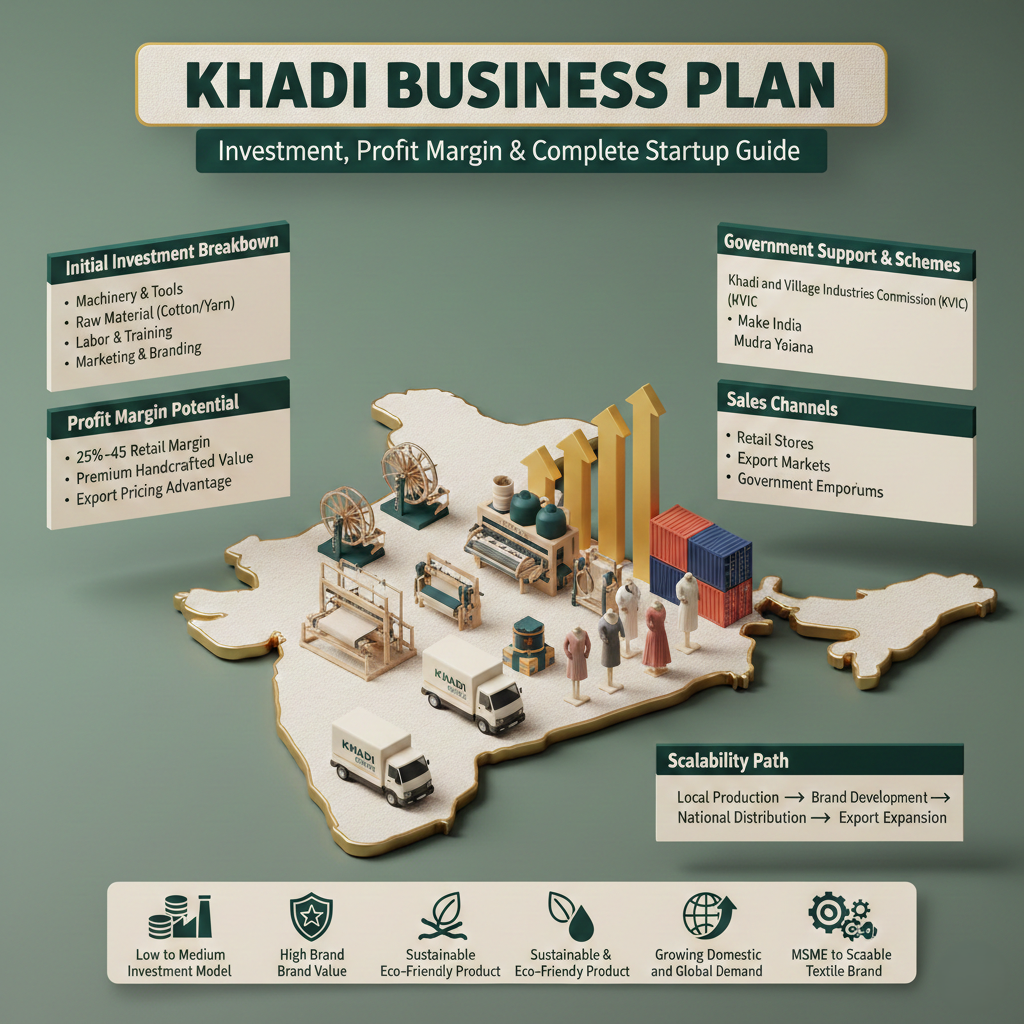
The sector’s commercial indicators indicate its strength:
- Production value of annual exceeding 1.16 Lakh crore
- Sales turnover breaking the mark of Rs. 1.45 lakhs crore
- Employment provision for more than 49 lakhs artisans
- Presence in over 100 export markets
These numbers are used to reduce uncertainty in market entry and validate actual consumer demand.
Understanding the Value Chain of Khadi
Khadi is not just one activity, it is an integrated ecosystem. The value chain comprises fiber preparation, spinning, weaving, dyeing, stitching, branding and retail distribution. Startups have options regarding where to enter based upon the strategy.
For example:
- Fabric Production Units are concerned with stable bulk supply
- Stitching and finishing units capture better margins
- Branding and D2C models for unlocking premium pricing
This flexibility can enable phased investment and structured growth.
Where Profitability Really Exist
One misconception that is widespread is the belief that Khadi works on thin margins. In actual life, margins are dependent on positioning.
Fabric only units tend to have moderate returns based on volume. However, businesses that integrate forward into apparel, home furnishing or lifestyle products are stronger in profitability. When the ownership of the design and the branding is added, the pricing power really takes a turn for the better.
Key drivers of profitability are:
- Brand-based distribution rather than pure trading
- Direct to consumer online sales
- Export-based premium positioning
- Efficient working capital management
Energy efficiency is also an important factor. As the process of Khadi production has lesser dependency on fossil fuel based heavy machinery, the volatility in the cost is less than other conventional way of textile manufacture.(Khadi Business Plan India)
Read More: TEXTILE WEAVING MILL – Manufacturing Plant, Detailed Project Report, Profile, Business Plan, Industry Trends, Market Research, Survey, Manufacturing Process, Machinery, Raw Materials, Feasibility Study, Investment Opportunities, Cost and Revenue
High-Growth Models of Khadi Startups
Some parts in Khadi have greater scope than others.
Integrated Khadi apparel units are some of the most promising ones. Modern designs with certified Khadi fabric may be aimed at urban consumers, institutional purchases and exports.
Home furnishing products like curtains, cushion covers, upholstery and table linen provide greater per-unit realization and more stable demand. Boutique hotels and higher-end residential buyers are increasingly seduced by sustainable textiles.
Natural dyeing and eco-processing units are an opportunity for supply chain Many producers have not yet established a standardized dyeing infrastructure and there is an opportunity for specialized service providers.
Khadi-based wellness and personal care products such as soaps and herbal cosmetics enjoy repeat purchase cycles and have high consumer trust. These products tend to have faster inventory turnover than apparel.(Khadi Business Plan India)
Read More: Cotton Cultivation & Cotton Yarn Manufacturing (E.O.U.) – Manufacturing Plant, Detailed Project Report, Profile, Business Plan, Industry Trends, Market Research, Survey, Manufacturing Process, Machinery, Raw Materials, Feasibility Study, Plant Layout
Export Potential: A Potential Massive Growth Lever
The global textile industry is taking a turn to be sustainable and ethical. International buyers are strongly moving away from reliance on synthetic, carbon-heavy fabrics. Khadi fits very well with these requirements.
Export advantages include:
- Premium positioning in sustainable fashion markets
- Less competition than mass textile exports
- Long-term buyer relationships that are based on ethical sourcing
This makes the exports of Khadi more value-driven than price driven, which enhances the stability of margin.
Risk Factors and Considerations
While the sector does have good fundamentals, founders need to plan carefully. Quality consistency across decentralized networks of production is fundamental for brand credibility. Working capital management is equally important, especially so when it is dealing with institutional or export clients.
Operational risks include:
- Maintaining uniform quality standards
- Managing payment cycles for bulk orders
- Modifying designs based on shifting consumer preferences
These risks are manageable if proper feasibility studies are made, realistic capacity planning are made and disciplined financial modelling is done.(Khadi Business Plan India)
Read More: Khadi Manufacturing Business in India: Investment, Profit & Export Opportunity Guide
Long-Term Growth Outlook
The growth of Khadi is not driven by momentary demands but by structural trends. Sustainability, slow fashion, ethical consumption and domestic manufacturing are going mainstream preferences.
The first sentence explains how digital commerce has increased Khadi’s need for distribution beyond conventional retail spaces. Through e-commerce platforms small manufacturers can establish their products as national brands. The first sentence explains how digital commerce has increased Khadi’s need for distribution. With the right branding and integration of the supplies chain, it is no longer just large corporations that can scale their products.
The sector’s structure of distributed manufacturing is also important for inclusive growth, especially with high women workforce participation. This enhances its socio-economic relevance but continues to ensure its commercial viability.
Read More: Top 3 Profitable Manufacturing Opportunities in 2026: Ferrosilicon, Vedic Paint & Bamboo Wood Pellets
Final Verdict
Khadi today represents more than tradition, it represents structured opportunity. The first sentence explains how digital commerce has increased Khadi’s need for distribution. The first sentence explains how digital commerce has increased Khadi’s need for distribution.
Through planning and proper strategic placement, a Khadi startup can transform its operations from small-scale production into a company that competes at both national and global markets.(Khadi Business Plan India)
Frequently Asked Questions (FAQs)
Is Khadi a profitable startup opportunity 2026?
Yes, especially when startups are combining manufacturing with branding and direct sales as opposed to just being a supplier of raw fabric.
What is the usual investment requirement?
Investment is dependent on scale and segment. Stitching and finishing units have moderate capital requirement and it can be expanded gradually.
Can Khadi startups scale internationally?
Yes. Khadi products are already being exported to more than 100 countries and the world is demanding more and more sustainable textiles.
Is there government support available?
Yes. The sector operates under the framework of the Khadi and Village Industries Commission (KVIC) which promotes development and expansion.
How long does it take to break-even?
With proper planning and good market linkage, operational breakeven can be reached in a reasonable period of time depending on scale and positioning.
Is Khadi Suitable for First Generation Entrepreneur?
Yes. Entry barriers are medium and the decentralized structure permits phased investments and expansion.