
Textile Manufacturing Business Ideas in India
The textile & apparel manufacturing industry in India presents some most interesting business opportunities. This sector is a huge market of opportunity, as over 45 million people are directly working in this sector and another 60 million people are working in ancillary trades. India is one of the top three producers of cotton in the world and second in the world for its exports, but its manufacturing potential is very low.
The European press release market is so tantalising at the moment because it is the meeting point of several strong megatrends. Domestic demand is increasing due to the expanding middle class. Global brands are actively seeking to diversify their supply chains from China and India is the most credible alternative. The Ministry of Textiles, Government of India, has estimated that the textile industry accounts for about 2.3% of the GDP of India, 13% of industrial production, and around 12% of the total export earnings of the country, making it one of the most policy-friendly manufacturing industries in India.
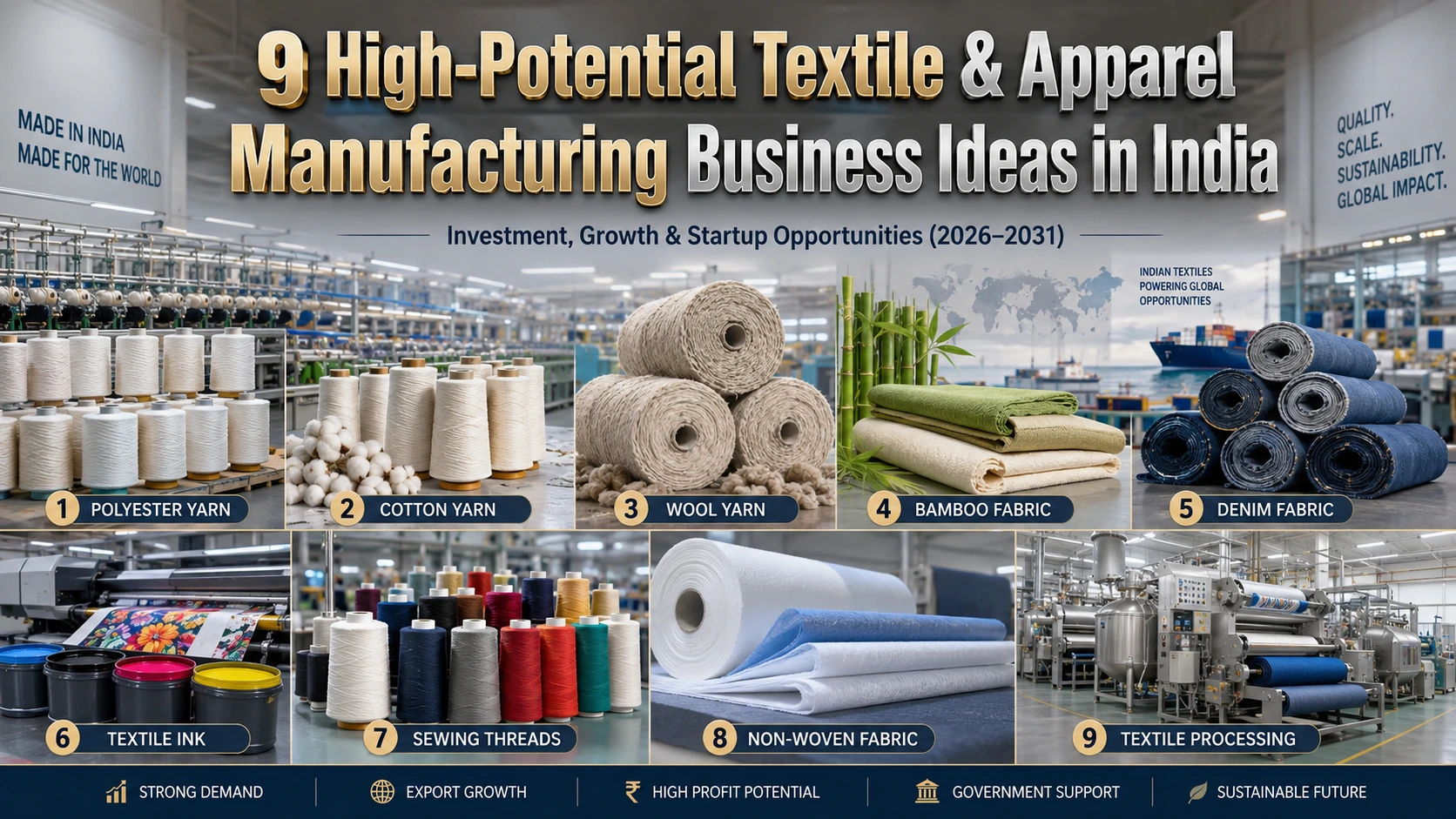
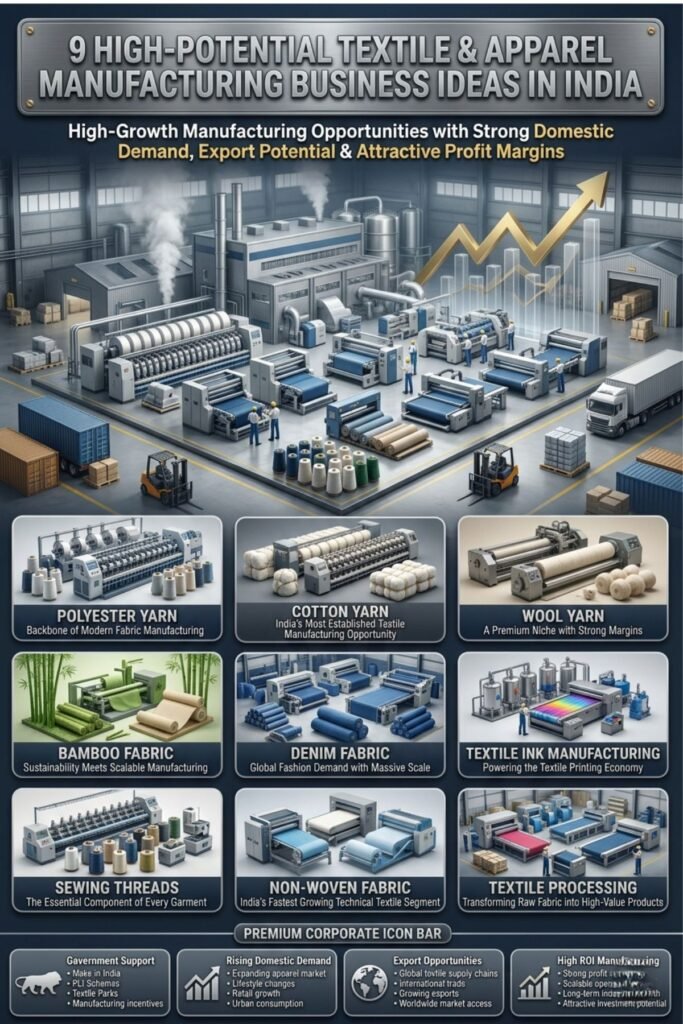
This article digs deeper into nine product-level segments in the textile and apparel area. Production characteristics, demand factors, market outlook and entrepreneur viability for each segment are examined.
1. Polyester Yarn: The Backbone of Modern Fabric Manufacturing
Product Overview and Applications
Polyester yarn is the most popular synthetic fibre used worldwide. It is made from polyethylene terephthalate (PET) and has properties that natural fibres cannot match, such as durability, moisture resistance, dimensional stability, and cost. These applications range from common everyday T-shirts to sportswear, industrial filtration materials to upholsteries and curtain fabric.(Textile Manufacturing Business Ideas in India)
The demand for polyester yarns has been gradually rising since the last ten years in India. Its ability to be blended with cotton, viscose and wool has established it as a popular product in the value-added market. There is strong demand for textured polyester yarn in the athleisure and activewear markets, especially.
Manufacturing Insights
The process of production is based on a well-established melt spinning process. PET chips are melted at a controlled temperature, extruded through spinnerets to make filaments, then drawn, textured and wound onto bobbins. The four main quality variables are intrinsic viscosity, draw ratio, texturing speed and the heat setting parameters. Multi-position texturing machines allow for huge economies of scale for producers looking to invest in such a machine.
Mid-scale plant of 3000–5000 tonnes per year requires Rs. Machinery and civil works expenditure of Rs 8–15 crore. The primary raw materials, PET chips and purified terephthalic acid (PTA) and nonethylene glycol (MEG), are fairly stable in domestic supplies.(Textile Manufacturing Business Ideas in India)
Market Size and Growth Outlook
We estimated the value of India’s polyester yarn market to be around Rs. 42,000 crore in 2023 and is projected to grow at a CAGR of around 7.5% through 2030. The big consumer centres are Surat (Gujarat), Ludhiana (Punjab) and Bhilwara (Rajasthan). In 2023, the global polyester production reached over 60 million tonnes and India is catching up as a premium market for polyester.
Get Detailed Insights from This Book: Modern Technology of Textile Dyes & Pigments (3rd Edition)
| Parameter | Detail |
| Market Value (India, 2023) | ~Rs. 42,000 crore |
| CAGR (2023–2030) | ~7.5% |
| Primary Raw Material | PET chips, PTA, MEG |
| Key Producing States | Gujarat, Rajasthan, Punjab |
| Typical Plant Investment | Rs. 8–15 crore (mid-scale) |
| Major End Uses | Apparel, home textiles, sportswear, industrial |
2. Cotton Yarn: India’s Oldest, Most Enduring Textile Opportunity
Product Overview and Applications
India’s textile journey really starts with Cotton yarn. India’s cotton farming area is the largest in the world and its production is second largest in the world, giving it a natural edge over other cotton spinning hubs where cotton cannot be grown at the same scale and cost. Cotton yarn ranges across an amazing quality spectrum: from coarse counts that are used in hosieries and towels to fine combed yarn for top quality shirting and export markets.(Textile Manufacturing Business Ideas in India)
One of its best aspects is the variety of end-use segments. Spun cotton yarn is the source of knitted fabrics, woven shirting, denim, bed linen, towels, industrial wiping cloth and surgical cotton. The demand for natural and breathable fabrics is high both in the domestic and international market.
Manufacturing Insights
The manufacturing of cotton yarn is a series of consecutive steps, namely bale opening, blowing, carding, drawing, combing (for lower counts), ring spinning or open-end rotor spinning and winding. In India, ring spinning is more popular than rotor spinning for counts of more than 20s and the latter is preferred for coarser counts because of superior output and labour cost savings.
Investment is very variable in size. A small MSME unit (5,000-10,000 spindles) could need Rs. The value of the machinery was Rs 12-20 crores with the investment in civil infrastructure. For larger greenfield mills, with over 50,000 spindles, investments run into the Rs.++ range. 100 crore.
Demand Drivers and Profitability
Cotton yarn is exported in significant quantities to Bangladesh, China, Vietnam and South Korea from India. The Apparel Export Promotion Council (AEPC) data shows that India’s RMG exports reached USD 16 bn in 2022–23, highlighting the extent of demand coming from downstream industries driving cotton yarn demand. During 2022-23, cotton yarn exports from India were more than 1 million tonnes with foreign exchange earnings of more than Rs. 20,000 crores.
Bangladesh is the second largest garment exporter, where India accounts for a considerable number of yarns and thus maintains a steady export channel for the Indian spinning mills. In normal years, the EBITDA margin of mid-scale spinning mills range from 12–18%.
3. Wool Yarn: A Niche with Premium Returns
Product Overview and Applications
Wool yarn is at the top price end of the fibre spectrum, because it is thermal regulating, has natural elasticity, can absorb moisture, and is luxurious. The main demand centres in India are Ludhiana (Punjab), Amritsar, and some areas of Rajasthan. They come in various forms such as hand knitting yarn, machine knitting yarn, suiting yarn and worsted yarn for blankets.
India is the seventh largest wool producer in the world, most of the domestic wool are of the carpet grade type. Worsted wool is mainly imported from Australia and New Zealand, where fine Merino wool is used for the material. This imposes pressure on the raw material costs, but is also an opportunity for value added manufacturing – raw wool to finished yarn to cloth.
Manufacturing and Market Outlook
The production of wool yarns is done either as a woollen or as a worsted spinning process, depending on fibre length and type of product. They can start a small worsted spinning unit catering to the niche premium market in the Rs. MSMEs can access it at a range of 5–10 crore. The genuine margin potential is specialty blends, such as Merino with cashmere, Tencel or recycled fibres, which achieve much better realisations in the domestic and export markets.(Textile Manufacturing Business Ideas in India)
The worldwide wool yarn market is estimated to have reached above USD 14 billion in 2023 and is projected to experience a CAGR of 5.2% until 2030. When it comes to marketing fancy blended yarns in the export market, Indian entrepreneurs see a definite opportunity to benefit, which is something that the domestic market manufacturers may fail to see.
4. Bamboo Fabric: Where Sustainability Meets Scalable Opportunity
Product Overview and Applications
Bamboo fabric has come far from its humble beginnings. It is a common ingredient in high quality apparel, intimate wear, babywear, athleisure and home textiles today and is in high demand by leading European, U.S. and Japanese retail groups. Its attributes – natural antibacterial properties, exceptional softness similar to high-count cotton, moisture-wicking and UV resistance – make it not only fashion but also functional.
India is second largest producer of bamboo in the world, and it is cultivated in the northeastern states, Maharashtra and Chhattisgarh. Bamboo fabrics production in India is in infancy; it’s an ideal business opportunity. The National Bamboo Mission under Ministry of Agriculture and Farmers’ Welfare is actively encouraging bamboo plantation and value addition under the guidance of financial assistance and linkage with entrepreneurs.
Manufacturing Process and Investment
The commercial bamboo fabric production mainly includes a viscose process, which is the dissolution of bamboo pulp in sodium hydroxide and carbon disulphide to form viscose, followed by the extruded bamboo viscose fibers into filaments and filaments into yarns. The newer, more environmentally friendly method is the lyocell process (closed-loop solvent recovery) that results in Bamboo Lyocell — which enjoys a premium price in international markets as a result of lower environmental impact.(Textile Manufacturing Business Ideas in India)
Cost of investment in a small to medium scale facility, yielding bamboo fibres to the tune of about 1000 tonnes per year is about Rs. 15–25 crore. The global bamboo textile market is estimated to be valued at USD 2.5 billion in 2023 and is likely to grow with a CAGR of approximately 6.8% by 2030.
Get Detailed Project Report (DPR): Textile Bleaching, Dyeing & Finishing Projects
5. Denim Fabric: A Commodity with Cultural Currency
Product Overview and Applications
Denim is proving its ability to surprise its analysts. The per capita consumption of denim has been continuously increasing in India since last year with the branded denim market expanding at a rate of almost 9% per year. This is being fuelled by the demographics of youth, fast urbanisation and increased fashion awareness in Tier 2 and Tier 3 cities.
India is already in the league of countries that produce denim fabric in decent quantity with major concentration of the capacity in Ahmedabad (Gujarat). A significant proportion of the production is consumed within the country, and exports are also significant ones to Bangladesh, Sri Lanka and to the countries in the South East Asian region.
Manufacturing Process
Specialty denim makers start the process by using ring-spun or open-end spun cotton yarn (usually 6–12 count). They then dye the yarn with indigo using either rope dyeing or slasher dyeing methods. Warp dyed and then weaved into 3/1 twill loom with a shuttle or projectile. The post weaving finishing process includes desizing, singeing, sanforizing and may include mercerizing.
A greenfield denim fabric plant of an annual capacity of 20-25 million metres would require Rs. Capital investments of 100–200 crore. Brands can produce specialty denim (stretch denim, selvedge denim, and sustainable denim made from organic cotton or recycled fibres) at much smaller scales and still sell it at a premium price.
Market Size and Profitability
The denim fabric industry in India was around Rs. 22,000 crore in 2023 and is projected to grow to Rs. 38,000 crore by 2030. Gross margins on denim manufacturing are at 18-22%, and those that add value to their product through stretch, sustainable or specialty finishes, can gain 25-30% margins.
Comparative Market Overview: Key Textile Segments
| Product Segment | India Market (2023) | CAGR | Investment Range |
| Polyester Yarn | Rs. 42,000 Cr | 7.5% | Rs. 8–15 Cr |
| Cotton Yarn | Rs. 55,000 Cr | 6.8% | Rs. 12–100+ Cr |
| Wool Yarn | Rs. 4,500 Cr | 5.2% | Rs. 5–10 Cr |
| Bamboo Fabric | Rs. 2,200 Cr | 6.8% | Rs. 15–25 Cr |
| Denim Fabric | Rs. 22,000 Cr | 8.5% | Rs. 100–200 Cr |
| Textile Ink | Rs. 3,800 Cr | 9.2% | Rs. 3–8 Cr |
| Sewing Threads | Rs. 6,500 Cr | 7.0% | Rs. 4–12 Cr |
| Non-Woven Fabric | Rs. 9,200 Cr | 11.5% | Rs. 10–30 Cr |
| Textile Processing | Rs. 18,000 Cr | 8.0% | Rs. 5–50 Cr |
6. Textile Ink: The Quiet Enabler of the Print Fashion Economy
Product Overview and Market Opportunity
Printing has always played an important role in the fashion and home textiles industry. But with the advent of digital textile printing, this has changed the economics and creativity of this industry. The key component in this ecosystem is the textile inks: reactive, acid, disperse, pigment or sublimation inks. If they were not present the raw fabric can’t be made into the commercial product that the buyers are looking for.(Textile Manufacturing Business Ideas in India)
There is a significant textile printing industry in India located in Surat, Jaipur, Tirupur and Mumbai. The gradual transition from rotary screen printing to digital inkjet printing has resulted in a strong demand for special inks for digital printing of textiles. This is still in the process, and for early players in the ink business, there is ample opportunity to build up relationship with the big printing houses.
Manufacturing Insights
The textile ink industry is a very chemical exacting industry. This means mixing the coloured pigments or dyes with the dispersants, binders, humectants and carrier fluids. Digital inkjet inks must have very fine particle size distribution, low viscosity and low nozzle clogging properties. The capital investment for a small unit with an annual production capacity of 200 – 500 tonnes is Rs. Modest, can leverage normal term loan from MSME.
The growth rate of the textile ink market in India is around 9.2% annually, owing to the increasing adoption of digital printing and expansion of fast fashion. In 2023, the global digital textile ink market was estimated at USD 3.2 billion, and is projected to double by 2030.
Discover business ideas that actually make money
7. Sewing Threads: The Invisible Glue of the Garment Industry
Product Overview and Applications
All cut and sewn fabrics require thread, around 200-300 meters for a pair of jeans, and much more for other complex items such as outerwear and workwear. The demand for sewing thread is huge, and its pattern remains repetitive in a country where manufacturers produce millions of garments every day.
Threads are available in a variety of material types (polyester, cotton, nylon, core-spun), styles (spun, filament, textured) and intended uses (general purpose, elastic, embroidery, industrial, upholstery). Sewing thread consumption is led by polyester which is strong and cheap, followed by cotton and core spun thread for that quality of garment market.(Textile Manufacturing Business Ideas in India)
Manufacturing Process and Market Growth
They use polyester staple or filament yarn as the base and process it through twisting, plying, winding, cabling, heat setting, and lubricating to produce sewing thread. Modern thread plants use automated thread winding machines and computer-controlled tension control systems. The estimated cost for a mid-scale plant of 100-200 tonnes per month is around Rs. 4–12 crore.
The sewing thread industry in India saw an estimated value of Rs. The 2023 expense is 6,500 crore and increasing at a steady rate of 7% annually. The Confederation of Indian Textile Industry (CITI) regularly releases data on demand and production, which helps entrepreneurs compare entry timing, plan capacity, and assess market positioning across major garment clusters such as Tirupur, Bengaluru, Delhi-NCR, and Kolkata.
8. Non-Woven Fabric: The Fastest-Growing Segment in Technical Textiles
Product Overview and Applications
Perhaps the most versatile of all technical textile’s product categories is non-woven fabric. Non-wovens are created directly from fibres or filaments which are bonded together by thermal, chemical, or mechanical means, as opposed to weaving or knitting. Non-woven fabrics have gained significant attention during the pandemic because manufacturers use them to make fabric masks and PPE kits, but they have many more applications beyond these uses.
The main areas of application are:
- Agriculture: crop protection, mulching films, and root barrier systems
- Construction and geotextiles: erosion control, road reinforcement, drainage
- Automotive: interior liners, NVH insulation, and carpet backing
- Medical and hygiene: surgical gowns, wound care, incontinence products
- Packaging and retail: reusable shopping bags and protective wraps
Manufacturing Process
The main processes used in the production of non-woven fabrics are spunbonding, meltblowing and needle punching. Manufacturers produce spunbonded fabrics through the spunbonding process and use them to create high-strength, durable products such as geotextiles and hygiene materials. The micro fibre webs formed through melt blowing are ideal for masks and air filters because of their excellent filtration properties. The investment for spunbond non-woven line begins from Rs. Magnetic tapes of domestic manufacture are priced at Rs. 10–15 crore and imported tapes from European or Japanese suppliers’ cost Rs. 25–50 crore.(Textile Manufacturing Business Ideas in India)
Market Growth and Commercial Viability
India’s non-woven fabric market is worth Rs. The fastest growing part of the textile manufacturing universe is 9,200 crore in 2023 and projected to grow with a CAGR of 11.5% till 2030. The government spent Rs. 100 crores for the implementation of the National Technical Textiles Mission (NTTM). In particular, the government has allocated ₹1,480 crore to develop technical textiles, such as non-wovens. This funding will provide new companies with research grants, market development assistance, and export promotion support.
9. Textile Processing: Where Raw Fabric Becomes Market-Ready Product
Overview of the Industry
Textile processing is the link between raw grey fabric and the finished product ready for sale by a garment manufacturer or the consumer. In India, textile processing takes place in the clusters of large textile fabric production areas. Surat is almost certainly the world’s largest hub of fabric processing, with local industries processing around 15 million metres of fabric per day.
Core Processes and Technology
The full-service processing unit can perform singeing and desiring, scouring and bleaching, mercerizing, dyeing, printing (flat screen, rotary screen, or digital), and finishing. The finishes available are softening, stiffening, water repellence, antimicrobial treatment and sanforising. Water and effluent management are the biggest challenge in operation; under the norms of the Central Pollution Control Board, a well-designed Effluent Treatment Plant (ETP) is essential for managing effluent.
Investment and Profitability
A tiny Processing unit for jobs and work can be established in Rs. A full-service processing house needs Rs. 5-15 crore, while a basic processing house needs Rs. 2.5-5 crore. 25–50 crore. Entrepreneurs should also refer to the updated investment profile of the textile sector created by Invest India, the national investment promotion body, which provides information on various incentives, clearance timelines, cluster infrastructure, etc., from various states in India in the major processing regions.
Services added and utilisation rates are key to profitability. Units with specialty finishes, such as antimicrobial, UV resistant and moisture management consistently achieve realisations that are 20-30% higher than those with standard services. In parallel, European and American customers are demanding sustainable chemistry – such as zero liquid discharge – and its implementation continues to grow.(Textile Manufacturing Business Ideas in India)
Related Article: How to Start a Textile & Apparel Manufacturing Unit: ₹5 Cr Investment, ₹20 Cr Revenue Potential
Success Stories: Indian Textile Entrepreneurs Worth Studying
For new entrepreneurs, learning from those who have already built scale in this industry is the most practical education available.
Arvind Limited — Sanjay Lalbhai
No other textile story in India can compare to that of Arvind Limited, Sanjay Lalbhai. Drawing on his family’s textile mill heritage, he recognized denim as a high-growth opportunity in the 1980s, when India had very little organized denim production. He poured a lot of money into backward integration – building a yarn-to-fabric operation – and at the same time developed his ties with foreign brands. The take-home message: vertical integration minimises vulnerability to raw materials and export market development provides a buffer against domestic cycles.
Vardhman Group — S.P. Oswal
Vardhman Group, headed by Sachit Oswal and founded by S.P. Oswal, is one of the biggest yarn and fabric manufacturers in India. Vardhman is unique of course in its discipline when it comes to how it allocates capital; it is a gradual, well-timed expansion of capacity, with capital built up through internal accruals, not too much leverage. The lesson learned: spin is a business of volume and scale has a huge impact on profitability and growth should follow cash generation and not just demand.
Welspun Group — B.K. Goenka
Balkrishen Goenka’s Welspun Group is the world’s second-largest manufacturer of home textiles. The strategic decision that Welspun made early was to focus on the branded retail business in the United States and Europe which involved developing products of consistent quality and custom-made brand programs for major retailers such as Walmart and Target. This model is a good template for new businesses in home textiles: invest in quality and consistency before branching out to retail outlets that carry a brand name because they offer volume and consistency.(Textile Manufacturing Business Ideas in India)
Government Support: Policies and Schemes Backing the Textile Sector
The Indian government has introduced several schemes to support the textile industry and promote the growth of MSMEs. These policies have a great impact on making the new business financially viable.
Key schemes include:
- Production Linked Incentives (PLI) Scheme for Textiles: Offers production linked incentive of 3% to 15% of incremental turnover on fabrics manufactured by the textile industry and technical textile products for a maximum limit of Rs. 225 crores. The figure quoted is 10,683 crore for five years.
- PM MITRA Scheme: Targets to establish 7 Integrated Textile Parks in the country with plug and play facility for spinning, weaving, processing and garment manufacturing.
- ATUFS (Amended Technology Upgradation Fund Scheme): It offers capital subsidy on the purchase of approved machines especially for MSMEs to modernise their spinning or processing machines.
- National Technical Textiles Mission (NTTM): Rs. 1,480 crore disbursement for growth of technical textiles as non-wovens, for research grants, and export promotion.
Comparative Investment and Profitability Overview
| Product | Demand Growth Driver | EBITDA% | Scalability |
| Polyester Yarn | Domestic apparel, sportswear | 10–15% | High |
| Cotton Yarn | Export demand, domestic apparel | 12–18% | Very High |
| Wool Yarn | Premium apparel, home textiles | 15–22% | Moderate |
| Bamboo Fabric | Sustainable fashion, export | 18–25% | Moderate-High |
| Denim Fabric | Youth fashion, casualwear | 18–22% | High |
| Textile Ink | Digital printing adoption | 20–30% | Moderate |
| Sewing Threads | Garment cluster demand | 12–18% | High |
| Non-Woven Fabric | Technical textiles, hygiene | 15–22% | Very High |
| Textile Processing | Job-work, export compliance | 12–20% | High |
Frequently Asked Questions (FAQs)
Q1. What is the top textile product for a small capitalized first-time entrepreneur?
The most convenient entry points for entrepreneurs with capital in the Rs. are sewing threads, textile inks and small-scale wool yarn manufacturing. 3–12 crore range. These segments are less complex; demand is stable and require large plant infrastructure is not required.
Q2. So, is the Indian textile industry still ripe for new entrants or is it too competitive?
The competitiveness of the segments is very different. There is high competition for undifferentiated players in the commodity cotton yarn business. Technical textiles, sustainable fibres, specialty yarns, digital textile inks and non-woven fabrics, on the other hand, are relatively small markets with a decent amount of room for differentiation and less competition.
Q3. What is the regulation for setting up textile processing unit?
The State Pollution Control Board must grant permission to textile processing units under the Water (Prevention and Control of Pollution) Act and the Air Act. The regulations require the installation of an Effluent Treatment Plant, and certain States also mandate a Zero Liquid Discharge system. The common registration requirements are factory registration, GST registration, and MSME Udyam registration.
Q4. What are the advantages of PLI scheme to textile manufacturers?
PLI scheme offers production linked incentives ranging from 3% to 15% of incremental turnover to the manufacturers of specified MMF fabrics and technical textile products. The benefit is computed over a five-year period relative to a “base year” and has lower and higher investment floor limits based on the size of an enterprise.
Q5. How much can be bamboo fabric market in India?
The domestic market of the bamboo fabric is still in the nascent and accelerating development phase. An entrepreneur who wants to serve both the premium retail market and the export market to Europe could be able to create a viable business model, especially by backward integration with bamboo cultivation or pulping to control raw material costs.
Q6. Which financial options are there for Textile MSME entrepreneurs?
Textile MSMEs can avail of term loans under CGTMSE scheme and also capital subsidy under ATUFS for procurement of machinery, state level textile policy incentive (interest subsidy, power tariff concession, stamp duty exemption etc.) and also SIDBI’s dedicated textile sector schemes.
Conclusion: The Textile Opportunity Is Real — And Requires Informed Action
India is not a sunset industry for textiles and apparel industry. At the industry’s early stages of a structural growth phase in many sub-segments. The export market is truly good for new manufacturing initiatives, given the supportive policies, expanding domestic demand, diversification of China+1 sourcing by global brands and the emergence of technical textiles.
Good capital is not the only thing that makes successful entrants different from failed ones; it is the quality of the entry decision. The selection of the proper product segment that is based on a realistic evaluation of raw material availability, technical skills, market closeness, and competition is more important than mere aspirations. It is not the time to discover the cost of the business when you are in the process of construction, it is the time before!(Textile Manufacturing Business Ideas in India)
The entrepreneurs mentioned in this article – Sanjay Lalbhai, S.P. Oswal, B.K. Goenka – were not more successful due to their better funding. They were able to do this by making better strategic decisions, adopting financial discipline and developing real product quality that could lead to customer loyalty. These are lessons that can be as relevant to a Rs. The 5-crore sewing thread plant in Ludhiana is like a Rs. In the city of Ahmedabad, there is a 500-crore denim mill.
If you are in the planning phase: do your feasibility study carefully, know the economics of your selected segment well, involve market players as early as possible, and have a financial structure which allows for the cyclical ups and downs that are prevalent in most fibre-based industries. There’s a possibility in the textile industry in India. That opportunity becomes a sustainable business when informed stakeholders take well-planned actions.