
The IV fluid industry is one of the most key players in the pharmaceutical industry in India. Every month, millions of IV fluid bags are used in hospitals, ranging from Tier-1 metros to Tier-3 District towns — both Normal Saline and Ringer’s Lactate, Dextrose and other specialty parenteral solutions. However, navigating this space, which is marked with a high demand for entrepreneurs and investors, is fraught with regulatory complexity, capital-intensive plants, and process engineering decisions which impact patient safety in direct ways. Hence the importance of the IV fluid (BFS technology) industry consultants in India. Its role is to either explore a greenfield LVP (Large Volume Parenteral) manufacturing plant or to add SVP (Small Volume Parenteral) lines to an existing pharmaceutical production facility, the right consultancy partner can be the difference between a viable, CDSCO-licensed production unit and a costly misstep.
India is estimated to have a current IV fluid consumption of one billion bottles or bags per year – one of the biggest parenteral markets by volume in the world. The domestic market is growing at the rate of 7-9% annually, and is valued at around ₹4,500-5,000 crore annually. This growth trajectory is sustainable and not cyclic because of the structural demand drivers, such as PMJAY hospital admissions, National Health Mission (NHM) district hospital expansion and increasing chronic disease burden. In this context, the number and sophistication of Indian industrial consultants in the IV fluid and parenteral business have picked up even higher scale, mirroring the complexity faced by the entrepreneurs in setting up a sterile manufacturing facility which meets the requirements of WHO-GMP and CDSCO Schedule M and adopts Blow-Fill-Seal (BFS) technology.
Get Detailed Project Report (DPR): IV Fluids & Intravenous Solutions Manufacturing
What IV Fluid and Parenteral Plant Consultants Actually Do
An IV fluid plant consultant is more than just a land specialist who can point to a piece of property and give the building plan. The engagement for a BFS based LVP facility usually starts with a comprehensive document called a techno-economic feasibility study, including product mix (Normal Saline, Ringer’s Lactate, Dextrose 5%, Half Normal Saline), target market segments, installed capacity in litres per day (LPD) or bags per day (BPD), capital expenditure requirements, raw material sourcing and projected revenue and profitability over five to seven years.
DPR is next in importance after a feasibility study. The foundation of any bank loan application, investor presentation or CDSCO pre-licensing submission is this document. A properly developed DPR for an IV fluid plant includes all aspects of the manufacturing of BFS technology, ranging from the selection of the LDPE or PP polymer granule, the design of the extruder, the aseptic blow-fill-seal sequence, hermetic sealing, and inspection and labelling through to logistics for cold chain shipment. It also contains the specifications of the Water for Injection (WFI) system, cleanroom classification and HVAC design, process flow diagrams, utility requirements, and detailed project financials.
In addition to the DPR, experienced IV fluid consultants give hands-on assistance for CDSCO licensing, which is Schedule M GMP compliance as per the Drugs and Cosmetics Act, 1940. CDSCO, along with the State FDA authorities is the licensing body for IV fluids and the documents are quite extensive. Process engineering consultants are also available to help with plant layout optimization, equipment selection and procurement specifications, qualification protocols (IQ/OQ/PQ) and vendor evaluation of BFS equipment. Then, EPC consultants handle the detailed engineering, procurement, and construction supervision, and oversee the commissioning of the facility.
Related Article: IV Fluid Manufacturing in India
India as a Hub for IV Fluid and BFS Technology Consulting
India has emerged as one of the most important centers for manufacturing consulting for parenterals due to a multi-faceted situation at the macro level. The first is that the Production-Linked Incentive (PLI) Scheme in the pharmaceutical industry offers fiscal incentives for IV fluid plants, which makes capital planning more appealing. Further, the Department of Pharmaceuticals under the Ministry of Chemicals and Fertilizers has undertaken various steps to promote domestic production of the essential medicines including IV fluids (a priority category).
Second, India’s pharmaceutical export sector remains on the roll. The Pharmexcil, Pharmaceutical Export Promotion Council of India, has revealed that pharmaceutical exports in FY 2024–25 have reached USD 30,466.85 million, with IV fluids and injectable formulations being the fastest-growing segments. WHO-GMP certified Indian LVP suppliers are hot property in the African and Southeast Asian markets, a direct commercial opportunity that a good consultant can help to quantify and plan for from day one.
Third, the scale of government interventions in expanding the number of hospitals – the Ayushman Bharat PMJAY’s 9.84 crore hospitalisation authorisations, the NHM programme to strengthen district hospitals, and the promotion of PMNDP dialysis centres – ensures a predictable institutional demand base. This ensures that new LVP and SVP manufacturing projects have a solid business case. According to IBEF’s India Pharmaceuticals Sector Report, India’s total pharmaceutical market is expected to touch USD 130 billion by 2030 and large volume parenterals will continue to have high growth potential in this market.
Access Complete Business Plan: I.V. Fluid Manufacturing: Detailed Project Report & Business Plan
Fourth, boutique management consulting firms specializing in pharmaceutical manufacturing have gradually developed extensive expertise in BFS technology, a very niche and specialised area, which requires a grasp of polymer science, sterile manufacturing standards and the specifics of the requirements of the CDSCO Schedule M at the same time. This is the unique expertise that distinguishes a solid IV fluid consultant from a standard engineering company.
How to Evaluate the Best IV Fluid Industry Consultants in India
Evaluating the best IV fluid consulting firm in India isn’t simply about comparing prices, but a systematic process. Here are the following criteria that will assist entrepreneurs and project investors in their decision.
Domain Expertise in Parenteral Technology and BFS Manufacturing
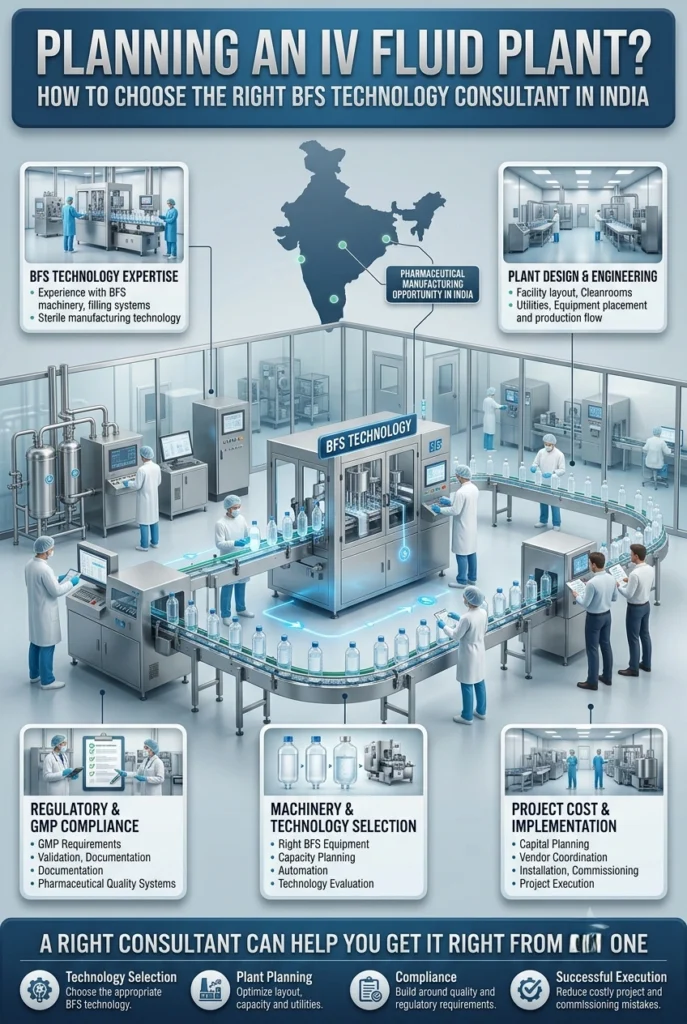
The first and most important filter is domain depth. A niche area of pharmaceuticals, parenteral technology is a process of Blow-Fill-Seal (BFS) manufacturing which has little overlap with general manufacturing consulting. The consultant who has no experience with IV fluid facilities is not a good fit for the food processing or API plant. Request a portfolio of DPRs and feasibility studies particularly for LVP or SVP plants. Inquire about the team having people who have experience in BFS manufacturing in the pharmaceutical industry. The presentation of a consultant’s techno-economic feasibility document for an IV fluid project will immediately give clues as to whether they have practical experience in IV system designs, cleanroom grades and in sourcing BFS machines.
DPR and Feasibility Track Record
It’s very important that a consultant has a DPR track record in the pharmaceutical industry. DPRs for IV fluid are closely reviewed by the State FDAs and CDSCO officials, bank loan officers and potential equity partners. Inquire from the consultancy about the number of DPRs that they had prepared and if any of them had manufacturing licences from CDSCO or bank financing. Also check if their DPRs contain the Schedule M GMP compliance design basis, site master file guidance and the standard operating procedure (SOP) framework outline. The financial projections are not enough for a pharmaceutical project – a DPR to stop there is not enough.
Regulatory Knowledge: CDSCO, Schedule M, and State FDA Compliance
Becoming adept at navigating the regulatory landscape is a unique skill. The Ministry of Health and Family Welfare has the Central Drugs Standard Control Organisation (CDSCO) which works in collaboration with the State FDA authorities to license IV Fluid manufacturing units in India. The requirements for pharmaceutical manufacturing premises are given in Schedule M of the Drugs and Cosmetics Act. A leading IV fluid Consultant in India will be aware of the detailed requirements of the Schedule M cleanroom, WFI system design, environmental monitoring and documentation required for the inspection readiness of CDSCO. Apart from CDSCO, the consultant must also help you in obtaining the clearances from the State Pollution Control Board, factory licences under the Factories Act and registering with the GST based on pharmaceutical manufacturing codes.
Read the Complete Book Here: Drugs & Pharmaceutical Technology Handbook
Engineering and EPC Capability
Process plant consultants and EPC consultants have different roles but complementary. A process engineering consultant designs the manufacturing process, specifies equipment and prepares process flow diagrams and layout plans. An engineering, procurement and construction (EPC) consultant carries out the detailed engineering, equipment procurement and supervises civil construction and installation. A consultant that provides integrated EPC capability or works with reliable EPC implementation partners will be required for an IV fluid plant. The plant requires substantial civil works to construct a cleanroom and install utilities such as purified water, WFI systems, chilled water, and compressed air, along with a BFS machine. Specifically, ask the consultant if they will support the project beyond the DPR and handle the commissioning.
Client Base and Sector References
The most reliable quality signals are provided by references from the pharmaceutical manufacturers, MSME entrepreneurs who have got financing from the banks on the basis of the feasibility report prepared by the consultant or those who have already filed feasibility reports and obtained funds from investors. Outside the IV fluid and parenteral space, it is important to have some client references that can tell you that the consultant’s work is good enough to pass the regulatory test in reality, not just in theory.
Role of NPCS in IV Fluid (BFS Technology) Project Consultancy
New Delhi based Niir Project Consultancy Services (NPCS) has successfully established its presence in pharmaceutical and parenteral manufacturing sector among established industrial project consultancy services in India. Founded in 1994, NPCS has helped entrepreneurs and investors in 85 countries to complete more than 1,50,000 successful project consultancy engagements in manufacturing industry. For IV fluid and parenteral manufacturing, NPCS prepares detailed project report (DPR) and techno-economic feasibility studies which include the entire manufacturing process for BFS technology right from the selection of polymer granules, to extruder configurations, to aseptic filling, hermetic sealing to the finished product inspection.
NPCS DPRs (IV fluid) comprise a manufacturing process description, design basis for WFI and purified water systems, plant layout and area zoning plans based on WHO and GMP, a list of machinery with indicative costs, raw material sourcing and costing, market research with demand analysis of LVP and SVP products, product mix and capacity planning (bpd and lpd), and a complete project financial model including balance sheet, profitability projections, IRR, and payback period. This degree of completeness allows applicants to prepare bank loan applications under MSME financing schemes like CGTMSE and pre-licensing applications directly from NPCS’s DPRs. Applicants can also use the same DPRs for CDSCO pre-licensing documentation.
Discover business ideas that actually make money
NPCS has a comprehensive catalog of project profiles available on its website, covering the entire spectrum of IV fluid, LVP and SVP projects, ranging from plants producing Normal Saline and Ringer’s Lactate to dialysis fluid plants to specialty parenteral products. Intravenous fluids, intravenous solutions, IV volume parenterals (IVP/SVP) and dialysis products are available for the readers to browse at NPCS IV Fluid and Parenteral Project Profiles. It’s especially helpful for investors who are still in the project identification stage; the catalog serves as a sort of blueprint to help them determine which product segment in the parenteral market is better suited to their investment budget and approach to market entry.
In addition to preparation of DPR, NPCS helps IV fluid entrepreneurs with Dossier preparation for CDSCO/State FDA, interacting with regulatory authorities, and guiding in preparing Documentations for compliance with GMP in Schedule M. With their decades of experience in the consulting industry and their expertise and experience with MSME and industrial entrepreneurs in India, they are a real-world and down-to-earth reference point for both large and small corporate investors, not just for first-generation pharmaceutical plant promoters.
Regional Focus: IV Fluid Industry Consultants in Delhi and India’s Consultancy Landscape
IV (Intravenous) Fluid/Pharmaceutical Plant Consultants in India in the most dense area is the Delhi NCR. The benefits of the capital region are many, including its proximity to the Ministry of Health and Family Welfare, and CDSCO headquarters at FDA Bhawan, a large pool of pharmaceutical technologists and regulatory affairs professionals and its connectivity to the main states of investment in pharmaceutical plants in India, including Himachal Pradesh, Uttarakhand, Gujarat and Andhra Pradesh.
The most effective IV fluid business consultants in Delhi have both central regulatory availability as well as plant engineering capabilities. A number of boutique management consultancy firms in Delhi NCR have carved out niche specialisations related to parenterals, from the MSME entrepreneur establishing his first 500 bags per day BFS unit to a large pharmaceutical company venturing into the LVP segment. In addition, there are robust pharmaceutical consulting companies in Mumbai and Hyderabad, especially with international regulatory affairs experience with regards to WHO-GMP and USFDA certification (very useful for IV fluid manufacturers going to export markets).
In the meantime, the Government of India’s national investment promotion body Invest India is actively promoting investment in the pharmaceutical value chain, where IV fluid plant promoters are also a major category of investors, by facilitating the process, facilitating land identification, and assisting investors in navigating the regulatory process for large-scale investments. Invest India is a valuable point for NRI investors and foreign collaborators to consider during the analysis of IV fluid market in India, along with expert process plant consultants.
Consulting Service Types for IV Fluid Projects: A Comparison
| Consulting Service Type | Core Focus | Key Deliverables | Best-Fit Client |
| Techno-Economic Feasibility Consultant | Market analysis, product mix, capital cost estimation, financial viability | Feasibility Report, Market Study, IRR & NPV Analysis, Capacity Recommendation | First-generation investors, NRI promoters, pre-investment decision makers |
| DPR / Project Report Consultant | Comprehensive project documentation for bank financing and licensing | Detailed Project Report, Process Flow Diagrams, Machinery List, Financial Model | Entrepreneurs applying for bank loans, MSME scheme financing |
| Process Engineering Consultant | Manufacturing process design, equipment specification, plant layout | PFD/P&ID, Equipment Specs, WFI & Utility Design, Cleanroom Layout | Promoters finalising plant design before civil construction begins |
| Regulatory Affairs Consultant | CDSCO and State FDA compliance, Schedule M documentation, licensing | Drug Manufacturing Licence Dossier, Schedule M GMP Documents, Site Master File | Companies at pre-licensing and licensing stage |
| EPC Consultant / EPCM | End-to-end project execution: engineering, procurement, construction | Detailed Engineering Drawings, Equipment Procurement, Construction Supervision, Commissioning | Promoters wanting turnkey plant delivery with accountability |
| Boutique Management Consulting Firm | Business strategy, market entry, capacity planning, competitive positioning | Market Entry Strategy, Competitive Analysis, Channel Strategy, Investor Pitch Deck | Scale-up candidates, established pharma firms entering LVP segment |
The Indian Pharmaceutical Alliance and Sector Associations
It’s vital that IV fluid and parenteral entrepreneurs and consultants stay connected with industry associations. Indian Pharmaceutical Alliance (IPA), comprising India’s top pharmaceutical firms, is a leading voice in the regulatory policy, pricing, and manufacturing standards of the pharmaceutical industry. More than 85% of the pharmaceutical R&D investment in the private sector comes from IPA member companies, and they contribute more than 80% of pharmaceutical exports — thus their policy stands directly to influence the regulatory environment in which IV fluid plants operate.
Moreover, the Indian Drug Manufacturers Association (IDMA) reflects a larger segment of pharmaceutical manufacturers, such as smaller manufacturers of IV fluids. Pharmexcil continues to be the main source of support in the field of export promotion, introduction of buyers in the export destinations and support in helping find a WHO-GMP certification for IV fluid manufacturing plants intended for export. Indian Pharmaceutical Association, the national body of the pharmaceutical profession is a valuable networking and knowledge source for pharmaceutical entrepreneurs who are establishing their regulatory and technical team.
Conclusion: Practical Next Steps for Entrepreneurs
The Indian IV fluid (BFS technology) industry is at an exciting crossroads that includes structural demand growth, government initiatives and massive gaps in supply, especially in Tier-2 and Tier-3 markets. Entrepreneurs have a real opportunity to develop an industry here. But the requirements for manufacturing pharmaceutical grade, licensing by CDSCO and high investment in a BFS based IV fluid plant are essential.
Here are some action steps for any entrepreneur considering going into this field.
The first step is to do some preliminary market research around your target geography – which segments of the hospital market will you target, and what is the competitive supply situation for Normal Saline, Ringer’s Lactate and Dextrose in that geography? Second, hire a techno-economic feasibility consultant, not a pharmaceutical consultant, who has experience in IV fluid and parenteral technology. Third, review NPCS’s IV Fluid and Parenteral Project Profiles to determine the investment size category that most closely reflects your investment size.
Fourth, seek the assistance of a CDSCO regulatory affairs consultant early in the process, preferably concurrent with your design of the plant, to start laying out your document structure for licensing prior to plant construction. Last but not least, speak to Pharmexcil and the Department of Pharmaceuticals to get an understanding of the existing export incentive packages and eligibility for PLI scheme for export plans.
Any IV fluid consultant in Delhi, Mumbai or Hyderabad can tell you that the most common error made by novice pharmaceutical plant promoters is that they don’t realize how much documentation and compliance preparation is necessary before the first bag rolls off the BFS line. Forget financial projections and the mandatory elements – get it right with your partner by starting early in the consultancy process, selecting a partner that has the right parenteral technology depth, and ensuring your DPR meets the real needs of CDSCO during the actual inspection process.