Indian Pharma Market Growth 2026
One of the most interesting market messages just came from India’s pharmaceutical industry. In a new report released by Enquires Securities, the Indian Pharmaceutical Market (IPM) has been found to have grown by 12.1 percent year-on-year in May 2026 for six straight months of double-digit growth. This is the longest period of sustained high growth since the industry’s last period of sustained growth two-plus years ago.
This is not a far-out macro-trend for entrepreneurs, MSMEs or Startup Founders in India. It’s an active market indicator that requires action now. Nine out of 10 major therapy categories have positive double-digit growth simultaneously, creating a broad swath of opportunities in the business world from patient-care services to diagnostics, contract manufacturing to distribution.
The Economic Times reporting this is based on data from Equirus Securities and IQVIA, and represents a structural change, rather than a quarterly one. There is a huge opportunity in the Indian Pharma market due to its double-digit growth momentum; for detailed report, read the full report: Indian Pharma Market’s Double-Digit Growth Momentum | Economic Times
This article dissects the meaning of this boom to founders and MSME operators. It outlines five tangible business opportunities directly related to this growth wave, reviews government support mechanisms and provides a roadmap for all who are willing to venture into this area.
Get Detailed Insights from This Book: Business Ideas for Startup in Drugs & Pharmaceutical Industry with Project Profiles
What Recent Economic Times Reporting Means
The fact that the data in the Equirus Securities report is quoted in the Economic Times should not be ignored. Let’s look at the numbers:
The Core Data Points
- In May 2026, IPM increased by 12.1% YoY for the sixth consecutive month.May 2026 saw the rise in IPM for the sixth consecutive month at 12.1% YoY.
- Moving annual total (MAT) growth picked up to 10.7% from 7.7% a year ago.
- The volume increased by 3.2% (4 year high) versus 0.8% a year ago
- Price growth was responsible for 4.5 percentage points and new products were responsible for 3.0%,
- The chronic therapy segment grew a series-high 14.6%, and now represents 40.6% share of the market.
- The anti-diabetic segment rose by 14.5% while GLP-1 drugs such as Mounjaro and Tirzepatide were the key drivers.
- The GLP-1 (GLP) market alone is projected to grow from ₹565 crore to ₹1,906 crore (MAT basis) in May 2026.
- Nine of 10 categories of key therapies gained more than 10 percent
The Economic Times cautions that it is a true growth, not just driven by a single therapy or a single company. Pharma companies in India, which account for 83% of the stock holdings in IPM, rose by 11.9% in May. Multinationals grew 13.3%. Volume growth was also seen in companies like Lupin, Sun Pharma, Ipca Laboratories and Torrent Pharmaceuticals.
What This Means for Founders
The broad-based pharma demand surge provides opportunities throughout the value chain beyond just drug manufacturing. The distribution network, last mile delivery, cold chain, diagnostic support, adherence and contract services expand as the market expands. The Economic Times signal here is loud and clear that window is open; the market is growing rapidly enough to take in new players.(Indian Pharma Market Growth 2026)
Why the Indian Pharma Industry Is Growing This Fast
Equirus analysts called this “unusual” even by India’s “high standards” for the current growth cycle that is taking place simultaneously.
1. Rising Prevalence of Chronic Disease
Now, in India, there are more than 77 million diabetics, the second highest in the world. A combination of urbanization, changing food habits and aging populations are all contributing to the further increase of cardiovascular disease, respiratory illness and cancer. Chronic therapies — those that require patient long-term adherence of medicines — are the fastest-growing segment, just because the number of patients increases every year.
2. New Drug Launches and Innovation
New product introduction is the biggest factor in the overall growth of IPM in May 2026, accounting for 3.0% of the total. Post-patent launch of generic semaglutide has seen the category gain a tremendous surge in demand in India. The template will play itself out on several different molecules over the next 3-5 years — patent expiry, Indian generic launch, rapid market expansion.
3. Volume Growth, Not Just Price Inflation
Most important, the present growth is not simply attributed to inflation. Volume growth was 3.2 percentage points of MAT growth while one year ago it was 0.8 points. Increased number of people are receiving their prescriptions filled. Prescription rates are increasing. It’s a demand side expansion, as the patient population is actually growing, which means it’s a much better indicator of long-term market health.
4. Improving Rural Healthcare Access
More patients are being directed to the formal healthcare system by the government healthcare infrastructure programmes under Ayushman Bharat, Jan Aushadhi and PM-ABHIM. The more people who are diagnosed, the more will be prescribed. While the market penetration of rural pharma is still far behind the urban market, the runway is still a long way before it.
Get Detailed Project Report (DPR): Pharmaceuticals, Bulk Drugs & Specialty Chemicals Directory
Government Policies and Incentives for Pharma MSMEs
The Indian government has developed an extensive policy framework that caters to the entry of startups, the growth of MSMEs, and pharmaceutical manufacturing in this industry. Before creating their financial plan, founders should draw attention to the programmes of their business model.
Production-Linked Incentive (PLI) Scheme for Pharma
Manufacturers of pharmaceuticals are eligible for two types of incentives under the PLI scheme: a percentage of incremental sales (3% to 10% depending on the product) in three product categories. The information can be accessed through Invest India, the government’s body to facilitate investments.
Startup India for Pharma Innovators
The Startup India portal provides tax exemptions, expedient regulatory clearance and a Rs 10,000 crore fund-of-funds to pharma and health tech startups. Furthermore, recognition by the DPIIT opens up opportunities for IP fast-track filing and self-certification.
MSME Support Through SIDBI and NSIC
Pharma MSMEs are able to avail of priority sector loans from Small Industries Development Bank of India (SIDBI). After the registration of the business under the Udyam, the business can avail equipment financing, working capital funding, and technology upgrade schemes.
DPIIT and make in India
Make in India is being supported by the Department for Promotion of Industry and Internal Trade (DPIIT) in terms of regulatory ease for the pharmaceutical manufacturers. API parks, bulk drug clusters and medical device parks are being established in many different states with concessional land and infrastructure support.(Indian Pharma Market Growth 2026)
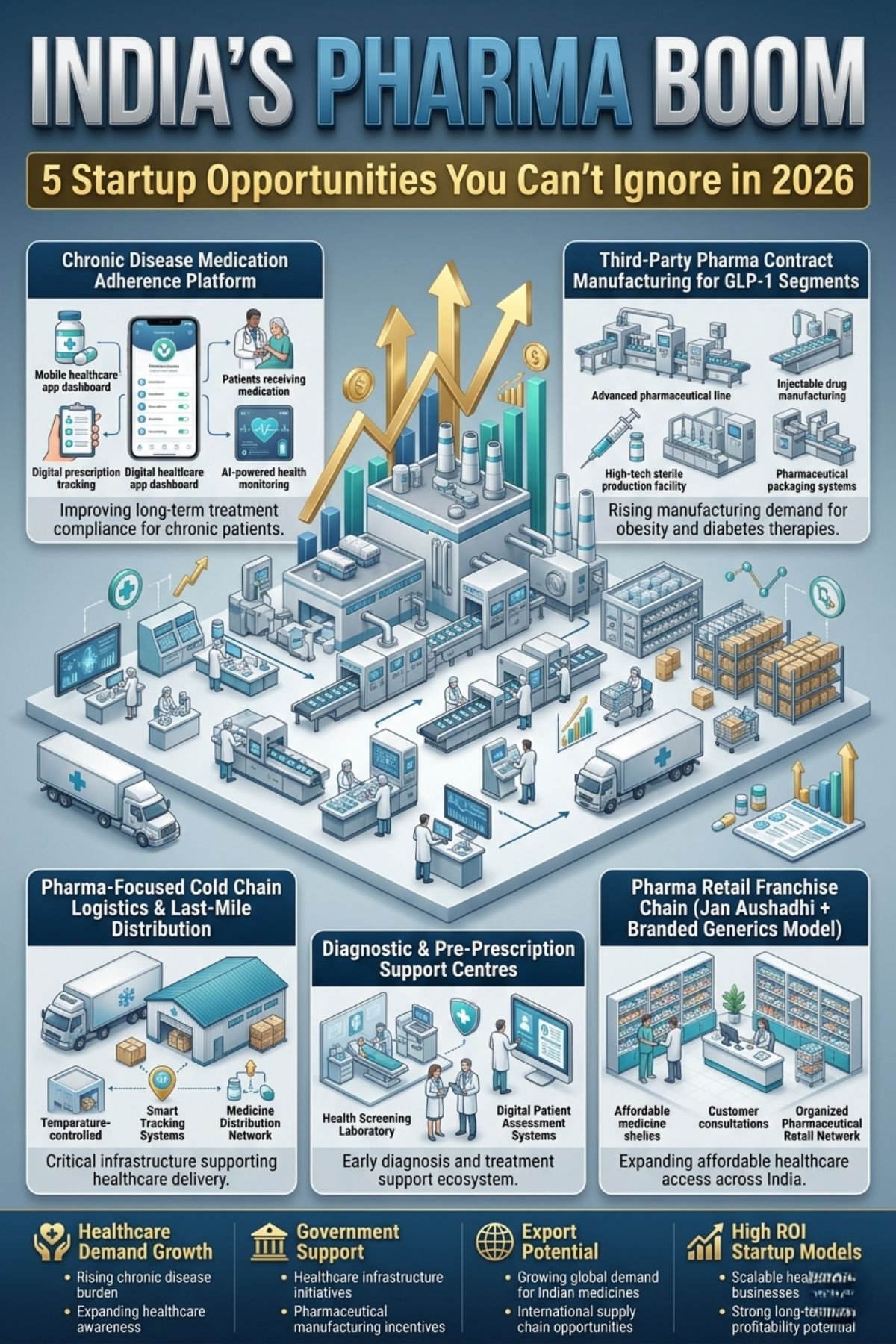
5 Business Ideas Directly Linked to India’s Pharma Boom
All the business ideas below have come out of what the Economic Times and Equirus data reveals are the areas in which the market is going. These are not universal advice: they are data-specific pieces of advice in the May 2026 growth report.
1. Chronic Disease Medication Adherence Platform
IPM growth is on track to hit 40.6% in the near future, with chronic therapies growing at 14.6%, meaning that the largest opportunity in the market is not drugs but adherence of patients. Patients with diabetes, cardiovascular diseases and hypertension frequently forget to take their medicines and refills and do not get a proper checkup in India. A medication adherence-related subscription application, physical medication refill reminder and a medication teleconsultation tie-up can directly address this. This is a high LTV business model because of the monthly recurring revenue from chronic patient subscriptions.
2. Third-Party Pharma Contract Manufacturing for GLP-1 Segments
The market for GLP-1 agonists rose from ₹565 crore to ₹1,906 crore in just a year. Branded manufacturers start to struggle when it comes to scaling up to meet the demand. This opens the door for the contract manufacturers, especially those that are WHO-GMP certified, have cold chain storage facility, and have capacity to manufacture injectable formulations. A startup would be ready to enter the market head-on with CDMO (Contract Development and Manufacturing Organisation) facilities.
3. Pharma-Focused Cold Chain Logistics and Last-Mile Distribution
GLP-1 injectables, oncology drugs, and biologics are among the many types of temperature-sensitive pharmaceuticals that need a tight cold chain. In India, the majority of tier-2 and tier-3 cities still don’t have the proper pharma cold-chain infrastructure. A logistics MSME with a specialist focus on pharma cold chain – refrigerated last-mile delivery vans, temperature-monitored storage as well as compliance documentation – can benefit by capturing distribution contracts from both domestic manufacturers and MNCs that are expanding their rural presence.
4. Diagnostic and Pre-Prescription Support Centres
The more prescriptions that are made the more diagnostics are needed upstream. If patients aren’t being diagnosed properly and consistently, growth in anti-diabetic and cardiac therapies are unlikely to take place. HbA1c testing centres, chemist clinics and chemical laboratories can be the pharma-referral feeders of the network of point-of-care diagnostic centres, which are located in residential areas and affordable. This business model has proven successful in the cities and is now replicable in Tier-2 cities in the wave of Ayushman Bharat.
5. Pharma Retail Franchise Chain (Jan Aushadhi + Branded Generics Model)
India has more than 14,000 Pradhan Mantri Bhartiya Janaushadhi Kendras, but they still do not meet the growing demand across the country. A chain of chain store operated generic pharmacies which combine Jan Aushadhi products with branded generic products at 30–50% cheaper than the MRP can cater to cost sensitive consumers as well as the rising middle class who are looking for quality generic products. It is one of the most fundable MSME models in the pharma retail space today due to its low cap-ex, government supported supply chains, and increasing prescription base.(Indian Pharma Market Growth 2026)
Identify high-growth industries before others do
Import–Export Opportunity Analysis
India’s export of pharmaceuticals continues to be one of the most compelling in the world. India is the biggest generic medicine supplier in terms of volume to more than 200 countries in the world. The domestic market boom does not diminish export opportunities; it enhances them through strengthening manufacturing capacity and capability.
Key Export Segments
- Formulations exports: India’s pharma exports crossed ₹2.5 lakh crore in FY2025–26
- The high value of the exports is dominated by exports of generic drugs to regulated markets (US, EU, UK).
- API exports are expanding due to diversification by global buyers from Chinese supply chains.
- The nutraceuticals and OTC health supplements are a rapidly expanding export product.
Emerging Export Opportunities Linked to IPM Growth
Generic versions of GLP-1 (semaglutide and tirzepatide) are coming to market around the world. Meanwhile, Indian manufacturers making for the local market are also developing export lines for GLP-1 related markets such as Southeast Asia, Canada, and the UK where demand for GLP-1 is growing at triple digits. Indian API manufacturers and formulators who have WHO-GMP certification can grab these export contracts now.
The Directorate General of Foreign Trade (DGFT), which handles export licenses and advance authorisations, as well as duty exemptions for pharma exporters, provides export registration and compliance support.
Indian MSME Success Stories in Pharma
Granules India: From API Supplier to Global Formulator
Granules India started as a small API and pharmaceutical ingredient manufacturer in Hyderabad in 1984. It has been consistently investing in WHO-GMP certification and export compliance, and scaled to become a global formulation supplier with revenue exceeding ₹5000 crore. It has taken it 20 years for a small MSME to turn into a vertically integrated export powerhouse.(Indian Pharma Market Growth 2026)
Eris Lifesciences: Chronic Therapy Specialist
Started in 2007, Eris Lifesciences decided to specialize in chronic therapy segments – cardiovascular, anti-diabetic and thyroid. This niche helped it establish good connections with specialist docs in Tier-2 and Tier-3 cities, because they entered the field before others did. Eris went from being a regional MSME to a publicly listed company with revenues over ₹1800 crore. Just the segment Eris was able to see in early days, which is now in the IPM boom.
Jan Aushadhi Network Franchisees
Jan Aushadhi Kendra of Pradhan Mantri Bhartiya Janaushadhi Pariyojana has enabled thousands of individual entrepreneurs to establish businesses with profit in the pharmaceutical industry. The government-subsidised generic medicines have boosted their businesses with minimal investment, and with a growing patient population, they now have sustainable local enterprises with profits ranging from ₹40,000 per month to ₹1,50,000 per month.
Related Article: API MANUFACTURING: Setting Up an Active Pharmaceutical Ingredient Plant in India: The Complete Guide
About NPCS
Entrepreneurs aiming to launch their pharmaceutical manufacturing or related businesses will require comprehensive feasibility reports, project profiles, and technical documentation for investor pitches, bank loans, and regulatory approvals. NPCS (Niir Project Consultancy Services) offers detailed industry specific project reports for pharma businesses across dosage forms, API production and herbal formulations that include capital investment, machinery specification, licensing route and financial projections.
An NPCS-prepared project report helps the founders of a pharma manufacturing project establish technical credibility with banks, NBFCs, and institutional investors from day one. This advantage saves significant time and effort during the initial capital-raising process.
Indian Pharma Market Data Snapshot — May 2026
| Metric | Value | Context |
| IPM Monthly Growth (May 2026) | 12.1% YoY | 6th consecutive double-digit month |
| IPM MAT Growth (May 2026) | 10.7% | Up from 7.7% a year ago |
| Volume Growth Contribution | 3.2% | Highest in 4+ years (was 0.8% in May 2025) |
| Price Growth Contribution | 4.5% | Stable, not the sole driver |
| New Introductions Contribution | 3.0% | Highest in the 5-period data series |
| Chronic Therapy Growth | 14.6% | Series-high; share now 40.6% of IPM |
| Acute Therapy Growth | 8.3% | Series-high for acute segment |
| Anti-Diabetic Segment Growth | 14.5% | GLP-1 drugs primary driver |
| GLP-1 Market (MAT, May 2026) | ₹1,906 crore | Up from ₹565 crore a year ago |
| Indian Pharma Co. Share of IPM | 83% | Grew 11.9% in May 2026 |
| MNC Pharma Growth | 13.3% | Outpaced Indian co. monthly growth |
| Therapies with Double-Digit Growth | 9 of 10 | Unusually broad-based expansion |
Frequently Asked Questions (FAQs) For Founders
Q1: Will Indian Pharma Market growth continues to be high or short-term bubble?
Economic Times reported that Equirus Securities sees the Indian pharma market’s growth as fundamentally broad-based, driven by volume growth, pricing, and new launches. When all these three-growth lever move up together it indicates a structural up-cycle rather than a short-term anomaly. New product launches, an improving rural penetration and rising burden of chronic diseases which have led to current trend of growth will play a significant role in the coming years.
Q2: What is the minimum capital needed to set up a pharma business in India?
Cost of setting up business depend on the type of business. (i) a Jan Aushadhi or Generic pharmacy requires capital in the range of ₹ 5-10 lakh, (ii) health tech startups developing medication adherence or chronic care platform requires ₹ 20-50 lakh for MVP, (iii) Pharma Contract Manufacturing & Cold Chain Logistics requires ₹1-5 crore depending upon the scale of operations. Majority of project costs could be funded through SIDBI/MSME loans.
Q3: What licenses required for starting a pharma distribution or retail business in India?
Drug Licence from the State Drug Controller of State required for any pharma distribution or retail business. The type of Drug Licence will depend upon whether the pharmacy will deal with prescribed products, such as Schedule H / H1 / X drug, or Over the Counter (OTC) products. GST Registration, Udyam MSME Registration and FSSAI registration (in case of nutraceutical or food health products) are also needed.
Q4: How can MSMEs start pharma exports in India?
To commence Pharma Exports, MSME firms will need manufacturing license, product registration in target market(s) (USFDA in USA, EMA in Europe etc.) and preferably WHO-GMP Certification. Guidance for market access, product registration and market development assistance is available at APEDA and The Pharmaceuticals Export Promotion Council of India (Pharmexcil). One can begin by focusing on API Exports in regulated markets or generic formulation exports to semi-regulated/emerging markets.
Q5: How does the GLP-1 growth story can open opportunities for MSMEs?
GLP-1 Agonists require cold chain for storage & transportation, ongoing patient monitoring & prescription. Each need presents significant downstream MSME opportunities – Cold chain delivery infrastructure, medication adherence platform, diabetes education and home monitoring device distribution, diet/nutrition consulting etc. You don’t have to be manufacturer to tap GLP-1 story; building support services for patients could be lucrative.
Q6: Where can I find government schemes and support for Pharma MSMEs?
Check msme.gov.in for schemes on credit guarantee like CGTMSE, schemes for technology up-gradation and cluster development. Get your business DPIIT recognition on startupindia.gov.in for benefits of tax holidays of 3 years and access to Fund of Funds, grants.
Conclusion: The Window Is Open — Move Now
Economic Times reporting of the India pharma market in May 2026 is not just a data point – it is the 6th consecutive double-digit growth for India’s pharma market – it reiterates that this a secular trend with a sustained upswing. Equirus Securities’ note points to Volume, launches, market, in nearly every therapy segment growing rapidly
This is precisely the kind of market environment where startups and small businesses should first to market and lock in lasting competitive advantages. Companies who forge partnerships, build patient equity, make logistic arrangements and form technology ecosystems during this boom-cycle phase, once this matures, they will have lasting competitive strengths.(Indian Pharma Market Growth 2026)
All five of these opportunities I have written about – chronic medication adherence, contract manufacturing, cold-chain logistics, diagnostic centres, and pharma retail franchises – ride on the very same trends fuelling the IPM boom. They are not guess-work based bets. These are market-signal based opportunities with existing demand pull.
There policy support is there. There is a market signal. Economic Times has drawn the attention on opportunity. The question is the are you late.