Introduction: Pharmaceutical Excipients Market
The biopharmaceutical excipients market is in a new phase of growth and structure in India. As the Indian pharmaceutical industry grows on the global scenario it is followed by the fast growing demand for high quality excipients. Excipients are the inactive ingredients added in the pharmaceutical formulations to make the medicines stable, effective and safe.
India has developed into one of the largest pharmaceutical producers in the world. The country exports medicines to over 200 countries, and is an important source of supply of generic drugs and vaccines to the world. Despite this good manufacturing ecosystem, India remains heavily reliant on imported specialty excipients. This dependency has generated a very clear demand-supply gap, which creates huge opportunities for domestic manufacturers.
As per the industry estimates, the Indian biopharmaceutical excipients market was worth USD 1.8-2.1 billion in 2025 and is projected to expand at a CAGR of 7.5 to 9 percent between 2026 and 2031. Increasing pharmaceutical production, stringent regulatory requirements, and expanding biologics production are some of the key factors that are contributing to this expansion.
Read More: Biotech & Pharmaceutical Handbook
What Are Pharmaceutical Excipients?
Pharmaceutical excipients are substances that are used in the preparation of formulations that help to support the delivery and performance of the active pharmaceutical ingredient (API). Although they do not impart the therapeutic effect, they are critical in ensuring that medicines are stable, effective and simple to manufacture.
Some of the major functions of pharmaceutical excipients are:
- Improving the stability of drug preparations
- Improving bioavailability of active ingredients
- Controlling release of medicines in the body
- Supporting manufacturing processes (tablet compression, etc.)
- Protecting sensitive biologic molecules from degradation
In biologics and vaccine formulations, excipients play a much more critical role. These advanced medicines contain complicated protein structures that are likely to break down without appropriate stabilization.
Key Factors Driving the Demand in Excipients Market in India
The rapid growth of the Indian pharmaceutical industry is the main factor which has led to growing demand for excipients. As drug manufacturers increase their production and shape their market to regulated customers, they need excipients that conform to international standards of quality.
Several industry segments are especially important in driving the consumption of excipients.
Growth of Generic Oral Solid Dosage Drugs
India has the largest supply of generic tablets and capsules in the world. These medicines are very dependent on excipients to maintain the tablet structure and to control the dissolution.
The following are common excipients used in tablet manufacturing:
- Microcrystalline cellulose (MCC)
- Hydroxypropyl methylcellulose (HPMC)
- Starch derivatives
- Magnesium stearate
- Crospovidone
As pharmaceutical companies export more medicines to United States and Europe, the demand for high purity regulated-grade excipients is growing.
Read More: Pharmaceutical (Biotech Traditional and Genetic) – Manufacturing Plant, Detailed Project Report, Profile, Business Plan, Industry Trends, Market Research, Survey, Manufacturing Process, Machinery, Raw Materials, Feasibility Study, Investment Opportunitiy
Expansion of Injectable Drug Manufacturing
Another major factor for the demand of excipients is rapid growth in the manufacture of injectable drugs from India. Injectable formulations must have very high excipient purity, and the smallest amount of impurity will lead to safety concerns.
Injectable drug formulations often demand:
- Buffering agents to ensure pH balance
- Worth noting: “Stabilizers to protect active ingredients”;
- In addition to the surfactants: – To enhance solubility
- At the top, there are following points: – Antioxidants to prevent degradation
Because of strict regulatory oversight, pharmaceutical companies prefer suppliers that are able to ensure consistent quality and validated manufacturing processes.(Pharmaceutical Excipients Market)
Increasing Biologics and Biosimilars Manufacture
India is a major hub for the manufacture of biosimilar drugs. Biosimilars are highly complex medicines and mimic original biologic drugs and can only be carried out using special excipients to keep the drug stable.
Important excipients for biologics are:
- Trehalose and sucrose to stabilize the protein
- Polysorbate 20 and 80 – surfactants
- Amino acids e.g. histidine for buffering
Methionine in its role as an antioxidant
Most of these excipients are still imported, which makes lucid the huge opportunity for domestic production.
Read More: Pharmaceutical, Drugs, Fine Chemicals, Bulk Drug Intermediates, Pharmaceutical Drugs, Pharma Drug Ingredients Intermediates, Drug Intermediates, Speciality Chemicals, Raw Materials, Fine and Specialty Chemicals Intermediates, Pharmaceutical Bulk Drugs
Expansion of Vaccines Manufacturing
India has the largest vaccine manufacturing industry in the world in terms of volume. Large-scale production of vaccines requires a number of functional excipients to ensure stability during storage and distribution.
These include stabilizers, preservatives and cryoprotectants that help vaccines to stay effective even under difficult transportation conditions.(Pharmaceutical Excipients Market)
Demand-Supply Gap In Excipients Industry In India
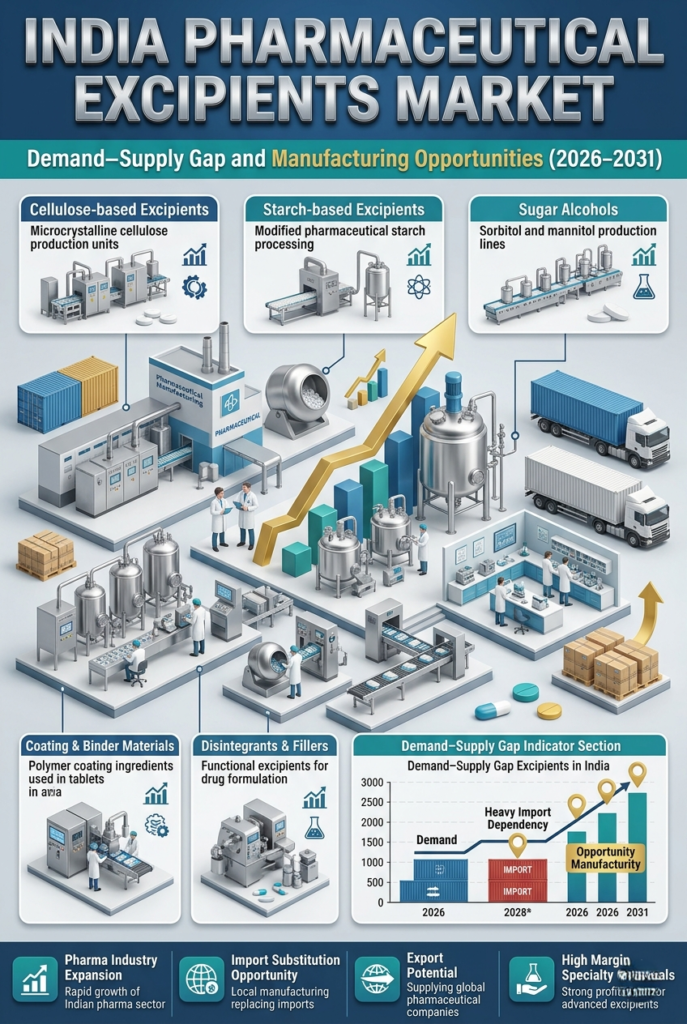
Despite a high growth rate of the pharmaceutical industry, India still imports a large portion of the excipients. Industry estimates put the import of pharmaceutical excipients at more than USD 600-750 million a year in the country.
The major sources of imports are as follows:
- China
- Germany
- United States
- Japan
- France
China dominates in supply of some basic excipients such as microcrystalline cellulose and polyvinylpyrrolidone. This over-dependence on imports poses a risk to their supply chain, particularly during global disruptions.
Another challenge is the gap in supplies according to grade. While some excipients are manufactured in the U.S., many pharmaceutical companies need high-purity grades that comply with USP or European pharmacopeia standards. Often these grades are imported due to limited local production capacity.
Read More: Drugs and Pharmaceutical Based Manufacturing Business Ideas
High Potential Manufacturing Opportunities
Because of the current demand-supply imbalance, there are several groups of excipients offering great prospects for entrepreneurs and investors.
Microcrystalline Cellulose MCC
MCC is one of the most popular excipients used in the manufacturing of tablets. India uses tens of thousands of tons annually and some specialized grades are even still imported.
Hydroxypropyl Methyl cellulose (HPMC)
HPMC is commonly used in the coatings of tablets, eye drops, and controlled-release drug systems. Domestic capacities to manufacture are limited, however, making this a sector attractive to investment.
Polysorbate 20 and 80
These surfactants play an all-important role in biologic drugs and injectable formulations. Demand is likely to see a huge jump due to the growth in the manufacture of biologic drugs in India.
Injection-Grade Mannitol
Mannitol is popularly used in freeze-dried injectable drugs as a stabilizing agent. The growing production of injectable medicines is driving up a demand for high purity mannitol.
Lipid Excipients Used in mRNA Technology
One of the most sophisticated options is that of lipid excipients for mRNA vaccines and liposomal drug delivery systems. These materials are currently imported and are a high value manufacturing opportunity.
Regulatory Requirements for Excipient Manufacturers
Pharmaceutical excipients manufacturing requires strict compliance with regulations. Because of this, companies need to have excellent manufacturing standards and detailed documentation for every production batch.
Important certifications for excipients manufacturers include:
- To comply with M GMP in India
- WHO-GMP certification
- US Food and Drug Administration (FDA) Drug Master File (DMF) registration
- European CEP certification
Obtaining these certifications takes a great deal of investment, and they also provide a solid competitive advantage in the market.
Read More: Phenol and Acetone Manufacturing in India: Business & Investment Opportunities
Export Opportunities for Indian Manufacturers
The global pharmaceutical excipients market is worth about USD 8-10 billion and is showing a steady growth. India has a rather small share of this market as of now, in spite of having a good chemical manufacturing base.
With appropriate quality certifications and regulatory approvals, Indian manufacturers can export excipients to regions like Southeast Asia, Africa, the Middle East and Latin America. Many pharmaceutical companies are also looking for dual sources of supply, which creates other opportunities for new suppliers.(Pharmaceutical Excipients Market)
Conclusion
The Indian biopharmaceutical excipients market from 2026 to 2031 is a huge industrial opportunity. Growing pharmaceutical production, increased biologics manufacturing, and increased regulatory standards all are contributing to increased demand for high-quality excipients.
Although the sector demands technical expertise and regulatory discipline, it has the great potential for long-term business for those manufacturers who can meet global quality standards. Domestic production of specialty excipients can help in reducing the import dependency while contributing to sustained growth of India’s pharmaceutical industry.
For entrepreneurs, investors and pharmaceutical suppliers, excipient manufacturing is becoming one of the most promising sectors within the life sciences industry.
Frequently Asked Questions (FAQs)
What are pharmaceutical excipients?
Pharmaceutical excipients are inert ingredients present in drug formulations that can be used to help ensure stability, bioavailability, and ease of manufacturing. They are essential components of tablets, capsules, injectables and biologic medicines.
What is Size of Excipients Market in India?
The Indian market for biopharmaceutical excipients is estimated to be about USD 2 billion and expected to grow at a rate of almost 8-9 percent per year till 2031.
Why India imports large numbers of excipients?
Many specialty excipients are complex manufacturing processes and have stringent regulatory requirements, which historically have limited domestic production capacity.
What excipients have the greatest opportunities for business?
High potential segments include microcrystalline cellulose, hydroxypropyl methylcellulose, polysorbates, injection grade mannitol and lipid excipients for advanced drug delivery systems.
Can Indian excipient manufacturers export?
Yes. With proper certifications and quality standards, Indian excipient manufacturers can provide pharmaceutical companies with these international markets.