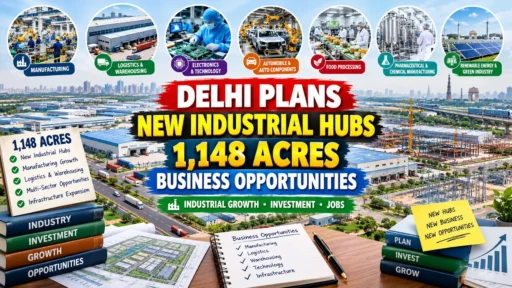
India Industrial Corridor Boom
India’s Manufacturing Backbone Gets a Major Upgrade
India is rapidly shaping its industrial destiny. The Central government has finished four of the largest projects under the National Industrial Corridor Development Programme (NICDP) and is pushing hard for the implementation of the remaining 16 projects, Swarajya Magazine reported on 5 August 2026. This is not only an infrastructure story, but rather a multi-billion-dollar business opportunity across a multitude of industries ranging from precision engineering, materials used in the construction industry, logistics, facility services, and specialty chemicals.
The government has sanctioned and released Rs 16,172.95 crore to the National Industrial Corridor Development and Implementation Trust (NICDIT). Of this, Rs 14,569.97 crore has already been disbursed to the Special Purpose Vehicles (SPVs) on the ground. Four smart cities – Dholera (Gujarat), Shendra-Bidkin (Maharashtra), Greater Noida (Uttar Pradesh), and Vikram Udyogpuri (Madhya Pradesh) – are already operational and have secured investments worth over Rs 2.02 lakh crore.
The signal for the entrepreneurs, MSMEs, manufacturers and investors can’t be clearer: plug-and-play industrial space is available, anchor tenants are coming in and supply chains are open. Early entry and long-term contracts are now open.
What Recent Reporting Means for Indian Business
According to Swarajya Magazine, the four projects are finished and provide world class infrastructure. Construction for the remaining 16 nodes is under way on a fast-track and the time frame is 36-48 months. This matters for two reasons: (1) the pace of execution shows the government’s commitment; and (2) the size of these nodes means thousands of vendors, suppliers, and service contracts will emerge over the next 3–4 years.
Why This Matters for Different Stakeholders
Entrepreneurs & MSME Founders
The most significant challenge for small manufacturers is eliminated with plug-and-play infrastructure – land acquisition and utilities. Industrial nodes provide ready-made roads, power, water and connectivity on day 1. Within months, not years, an MSME can lease a shed and start production.
Manufacturers
By investing in EVs, renewables and pharmaceuticals at these hubs, these sectors will create steady demand for ancillary products, materials, testing, and maintenance. Manufacturers of gaskets, precision castings, and special coatings can supply these anchor units directly.
Investors
The government’s commitment of Rs 28,602 crore for 12 projects approved in August 2024, and Rs 3,000 crore in the Union Budget 2026-27 for the 12 zones, reduces the risk of investments in these areas. In the past, land around and in NICDP nodes has historically increased in value at a higher rate than similar industrial land.
Exporters
The ‘walk-to-work ecosystem’ and ‘world-class infrastructure’ reported in recent months aim to attract MNCs that need to integrate Indian suppliers into global value chains. MSMEs that establish units at or near these nodes gain direct access to export-ready supply chains.
The big message from the Swarajya Magazine report is that four nodes are already creating economic activity and the next 16 will follow. Those who align themselves now as suppliers, contractors or manufacturers will be first in line if and when procurement decisions are made.
Identify high-growth industries before others do
Why Industrial Infrastructure Is India’s Growth Engine Right Now
The Make in India initiative aims to increase the contribution of manufacturing to the GDP to 25%. The NICDP provides the foundation needed to make this happen. Design of the programme, involving partnership between Centre and State, has led to rapid deployment of trunk infrastructure with State governments putting in land while the Centre is providing equity and debt.
Union Budget 2026-27 mentions a brand-new East Coast Industrial Corridor, which has Durgapur (West Bengal) as a key node, indicating broadened geographic scope. There is now a new frontier to explore in Eastern India, which has long lacked adequate industrial infrastructure and now offers fresh markets for construction, logistics, and manufacturing services.
There are several factors driving the realignment of the global supply chain including the China+1 strategy of multinationals and the increasing domestic consumption in India. Multinationals are following the China+1 strategy and India’s growing domestic consumption is leading to realignment of the global supply chain. It is this influx that is what is being sought in the industrial corridors. The four operating nodes are proof of concept. The other 16 are the commercial opportunity.
Government Policies & Incentives
There are several policy instruments to encourage businesses to enter NICDP-linked zones:
- National Industrial Corridor Development Programme (NICDP) – 20 industrial corridors with plug and play industrial plots, developed utilities, single windows clearances.
- Production Linked Incentive (PLI) Schemes – cash incentives for additional manufacturing output in 14 sectors such as pharmaceuticals, chemicals, electronics, textiles, etc.
- DPIIT Single-Window Portal – Invest India’s single-window approval, land allotment, and regulatory clearance system.
- MSME Credit Guarantee Fund Scheme (CGTMSE) – Credit up to ₹5 crore offered to micro and small businesses without any collateral.
- Additional capital subsidies, power tariff rebates, and employment generation incentives are provided under State Level Industrial Policies, each state being a host state (Gujarat, Maharashtra, UP, MP and West Bengal).
Key Government Links:
Invest India – National Single Window System
DPIIT – Department for Promotion of Industry and Internal Trade
MSME Ministry – Credit and Finance Schemes
6 Manufacturing Business Ideas Directly Linked to NICDP Development
All of these opportunities below are direct outcomes of the infrastructure development and anchor investment listed in Swarajya Magazine’s article on August 5. These are not just broadly applicable recommendations; they will be gaps within and beyond the operational NICDP nodes in the supply chain.
1 Construction Materials Manufacturing — Precast Concrete & AAC Blocks
There are 16 nodes being built, with construction timelines of 36–48 months, and the need for construction materials is now, and will be, great. In large scale industrial construction, cast in place concrete components (columns, slabs, boundary walls) and Autoclaved Aerated Concrete (AAC) blocks are the recommended choices for their speed and cost.
Minimum Investment: ₹1.5 Crore and Maximum Investment: ₹8 Crore. MSMEs within the radius of 100-150 km of a node can set up a precast unit and directly provide to the EPC contractor through long-term purchase orders. Locational advantage decreases freight costs and delivery time.
Get Detailed Insights from This Book: The Complete Book on Construction Materials
2 Industrial Fasteners & Precision Engineering Components
The confirmed areas found at the four running nodes, such as EV manufacturing, renewable energy, and pharmaceuticals, have several confirmed areas that need millions of fasteners, brackets, flanges, and precision-machined parts. India is currently importing considerable number of specialties fasteners from China, Taiwan and Germany.
An MSME who establishes a cold-forging or CNC machine shop within a radius of 50 km of any working node of NICDP can reduce imports, and also become a vendor of the anchor units. Loan Tenure: 5-10 years. Interest Rate: Starts from 11% p.a.
3 Industrial Painting, Coating & Surface Treatment Services
Galvanizing, powder coating, epoxy painting, phosphating of every steel, machine housing and industrial equipment installed in these corridors. These are services that have a lot of processes and are generally outsourced to anchor manufacturers.
The surface treatment plant operates near anchor and Tier 1 manufacturers, allowing multiple nearby Tier 1 manufacturers to share its facilities. Investment Size: ₹75 Lakh – ₹4 Crore. It’s a business where you have a recurring revenue stream and long-term contracts.
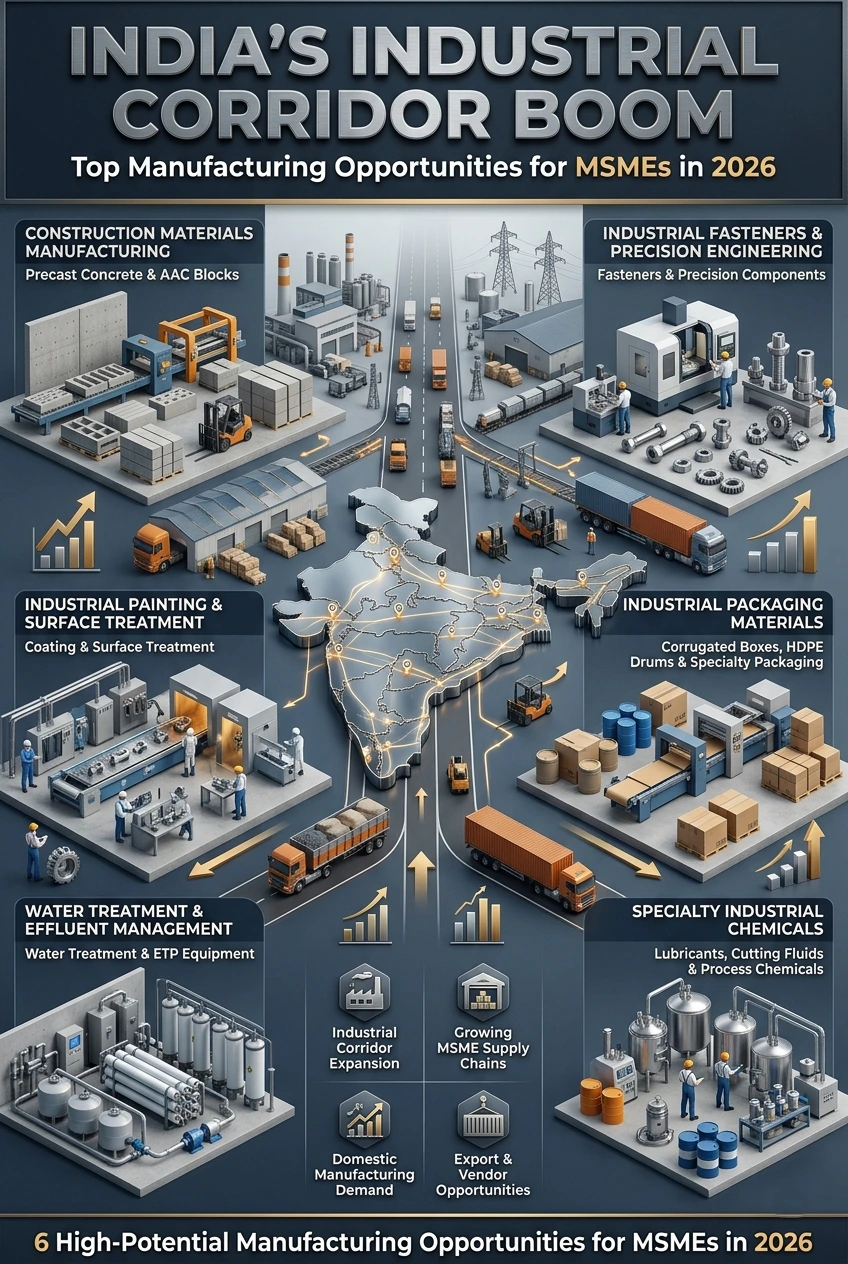
4 Industrial Packaging Materials — Corrugated Boxes, HDPE Drums & Specialty Packaging
Sustained demand for packaging comes from manufacturing clusters. At corridor nodes, pharmaceutical manufacturing relies on primary and secondary packaging that meets GMP standards. Custom corrugated packaging is required for engineering products. Chemical and specialty coating manufacturers use HDPE drums and intermediate bulk containers (IBCs) for packaging and storage.
The opportunity directly stems from pharma and industrial anchor investments reported at the four Operational Nodes. Project Value: ₹40 Lakh to ₹2.5 Crore.
Get Detailed Project Report (DPR): Packaging Industry: Technology, Products & Manufacturing
5 Water Treatment & Effluent Management Equipment Manufacturing
Industrial corridors at this scale need effective water management, from water intake treatment to zero liquid discharge (ZLD) treatment. An Indian MSME can produce filter housings, clarifiers, chemical dosing systems and membrane modules locally instead of importing them.
The government has invested in its own infrastructure network with water networks and utilities, generating a long-term procurement pipeline for these components. Investment Range: ₹1 Crore – ₹6 Crore. Significant export potential to Southeast Asia and Middle East.
6 Specialty Industrial Chemicals — Lubricants, Cutting Fluids & Process Chemicals
Specialty chemicals such as metalworking fluids, mold-release agents, industrial lubricants, rust preventives and cleaning agents are used by every manufacturing plant in an NICDP node. A high margin, repeat purchase item and low capital item based on the revenue potential.
A specialty chemical blending and formulation unit located within 200 km of several nodes can provide on a “vendor of record” basis to dozens of customers at their facilities. Investment Period: 1 year should be the minimum and up to 6 years. Products are also very exportable to the ASEAN markets.
Related Article: Specialty Chemicals Business in India: Complete Guide to Investment, Profit Margins, Licenses & Manufacturing Setup
Import–Export Opportunity Analysis
Export Potential
The industrial corridors place India in the world manufacturing stands. MSMEs that develop a vendor qualification process in these nodes have direct access to global supply chains to the anchor MNCs. Industrial fasteners and precision parts (substituting Chinese products in the EU and the US); specialty chemicals and process auxiliaries (ASEAN, Middle East, Africa); and pharmaceutical intermediates and APIs (generic drug markets in regulated economies) rank among the high-potential export sectors that NICDP manufacturing supports.
Import Substitution
The four operational nodes have already gained investments in import dependent categories such as EV components and renewables equipment. The MSMEs are actively involved in import substitution by producing inputs for these anchor units. Water treatment elements, special lubricants, industrial coatings and precast structural elements are all areas where domestic production is presently not meeting demand.
Trade Infrastructure Advantage
Logistics connectivity (road, rail, and in some instances, port access) supports NICDP nodes and enables export-oriented manufacturing. For example, the Special Investment Region at Dholera connects to JNPT and Kandla ports through multimodal transport, significantly reducing freight costs for exporters.
Indian MSME Success Stories in Industrial Corridor Ecosystems
Sterlite Power — Precision Conductor Manufacturing, Greater Noida
The Greater Noida industrial ecosystem helped Sterlite Power transform from a cable and conductor business, to becoming a global infrastructure firm with operations in India and Brazil. The path they’ve taken shows how near proximity to industrial clusters can allow for exponential growth in manufacturing-based businesses.
Lupin’s API Manufacturing, Shendra-Bidkin (Maharashtra)
Lupin Limited has invested in pharmaceutical manufacturing at the Swarajya Magazine’s four confirmed operational nodes at Shendra-Bidkin Industrial Area. They help to support a sub-ecosystem of API manufacturers, packaging suppliers, logistics providers and testing laboratory services, all of which are MSME business opportunities.
Dixon Technologies — Electronics Manufacturing Cluster, Noida–Greater Noida Belt
By locating itself in the industrial belt of Noida-Greater Noida, Dixon Technologies evolved from a contract manufacturer to India’s biggest electronics manufacturing services (EMS) provider. Their model shows how an MSME with a sound mindset of quality and delivery can secure an anchor brand deal and grow quickly when the industrial infrastructure is already available.
About NPCS — Niir Project Consultancy Services
The Niir project consultancy services (NPCS) is one of the most renowned industrial research and consultancy services of India. NPCS provides the following services for entrepreneurs and MSMEs who want to pursue NICDP related manufacturing sectors:
- Detailed Project Reports (DPR) – Bankable feasibility reports that SIDBI, NABARD, and leading commercial banks accept for loan applications.
- Market Research & Demand Analysis – Primary and secondary research of target markets, volumes of imports, competition etc.
- Feasibility Studies – Technical and Financial Feasibility of proposed Manufacturing Units.
- Technology Consultancy – Process Selection, Equipment Specification, Plant Layout & Plant Vendor Recommendations.
- Referral Assessments – Investor Readiness Assessments and incubator applications.
Visit NPCS for project reports in industrial manufacturing sectors: www.niir.org
Quick Reference: Industry Data Snapshot
| Parameter | Details |
| Industry | Industrial Infrastructure / Manufacturing Zones / NICDP |
| Market Driver | Rs 28,602 Cr NICDP allocation; 20 industrial nodes; Government plug-and-play policy |
| Investment Range | MSME: ₹25 Lakh – ₹5 Crore | Mid-scale: ₹5 Crore – ₹50 Crore |
| MSME Opportunity | Ancillary manufacturing, construction materials, facility management, logistics |
| Export Potential | High – industrial machinery, precision parts, pharma APIs, specialty chemicals |
| Government Support | NICDP grants, PLI schemes, DPIIT single-window, state-level incentives |
| Risk Level | Low–Medium (long-term government commitment; phased infrastructure rollout) |
| Growth Outlook | Strong – 16 nodes under construction, new East Coast corridor announced |
Conclusion: The Infrastructure Is Ready. Are You?
Indian industrial corridor programme is no longer a vision document but an operational infrastructure. Four world-class industrial smart cities have already attracted investments worth more than Rs 2.02 lakh crore. The government is also constructing 16 other smart cities at a fast pace and has committed Rs 28,602 crore, according to Swarajya Magazine, published on August 5, 2026.
This structural market change opens up generational business opportunities. The manufacturer of the anchors that reach the nodes, such as those in EVs, renewables, pharmaceuticals and precision engineering, will require thousands of vendors, suppliers, contractors and services. All these jobs will be created by the Indian MSMEs.
The six manufacturing sectors identified in this report — construction materials, precision components, surface treatment, industrial packaging, water treatment equipment, and specialty chemicals — directly support the infrastructure build-out and anchor investment inflows described in the Swarajya Magazine report. They offer realistic entry points at investment levels accessible to first-generation entrepreneurs.
Government support is comprehensive and committed. Infrastructure is in place. Demand is guaranteed. The only variable is whether you act before your competitors do.