
India UK FTA Pharma Manufacturing
Every pharma entrepreneur and MSME in India must read the recent development that has been reported in the Economic Times. Pharma Exports Promotion Council of India (Pharmexcil) estimates India’s pharmaceutical exports to the United Kingdom to rise 8.66% to $981.16 million in FY2026-27. This is an outlook on the impact of the India–UK Comprehensive Economic and Trade Agreement (CETA) which came into full force recently.
Not a policy statement made in the distant past. CETA is going live, tariffs are dropping to almost zero and the UK – already India’s biggest pharmaceutical export market in Europe, and the third largest world-wide – is now more accessible than ever. This is an open door for Indian manufacturers.
The Economic Times reported this news, which is bound to be a welcome development for startup founders and MSMEs considering manufacturing ventures, as well as pharma entrepreneurs. So is the change of market! Support for the policy is being provided. The missing component is action and, in this case, it’s your action.
Get Detailed Insights from This Book: Drugs & Pharmaceutical Technology Handbook
What Recent Economic Times Reporting Means for Your Business
Economic Times Manufacturing Desk explained that in detail on 16 July 2026. Here is the reality on the ground of these numbers.
The baseline is that India exported $902.96 million worth of pharmaceuticals to the UK during FY25-26. This is already quite a trade flow.
The FTA benefit: Tariffs for almost all goods will be eliminated. This directly cuts down the cost competitiveness of Indian generic drug manufacturers with European manufacturers.
Early momentum: Even before CETA’s full effect kicked in, pharma shipments to the UK rose 4.15% year-on-year to $152.14 million during April-May FY27 alone.
Product split: Out of the total pharma exports to the UK, 89.54% are accounted by the drug formulations and biologicals. APIs (Active Pharmaceutical Ingredients) added $72.66 million to last fiscal.
Pharmexcil Chairman Namit Joshi termed the FTA “a landmark development” and stated that “the shift towards zero tariffs will further boost competitiveness of Indian generic medicines. This is the best kind of market validation that MSMEs can achieve.(India UK FTA Pharma Manufacturing)
Why Indian Pharma Manufacturing Is Growing Faster Than You Think
India already supplies more generic drugs than any other country, and experts estimate that one in every five generic medicines sold worldwide comes from India. The nation is exporting to more than 200 countries, and enjoys a strong presence in the U.S., Africa, and now more than ever in Europe.
Indian exports of pharmaceutical products reached $30 billion in FY24-25, growing by 9%+ YoY. This is expected to be $65 billion by 2030. Under CETA, the UK will play a vital role in helping to shape that growth trajectory by itself.
There are 3 forces that are coming together. The first thing is that leading to the UK market without paying any tariff is a huge margin improvement for the Indian manufacturers under the CETA. Second, the UK’s NHS is actively seeking to diversify medicine supply chains from being reliant on a single country. Third, after the Production Linked Incentive (PLI) scheme, the domestic API and formulation capacity has grown tremendously in India.
For manufacturing entrepreneurs, what this implies is the structural set-up to run a profitable export-oriented pharma unit has been extremely conducive so far.
Government Policies and Incentives Supporting Pharma Manufacturers
The Indian government has established a robust framework to support pharmaceutical companies. Multiple schemes can be availed to MSMEs and new entrepreneurs at the same time:
- Production Linked Incentive scheme (PLI): The scheme provides 3-10% incentives to eligible pharma manufacturers based on incremental sales. Apply via the Department for Promotion of Industry and Internal Trade (DPIIT).
- Make in India for Pharma: Single window clearance and facility support in the sector for manufacturing expansion under Make in India.
- Collateral Free Credit: Collateral free credit given by Ministry of MSME under CGTMSE for units up to Rs. Along with technology upgradation schemes, 5 crores have been released.
- RoDTEP: The Directorate General of Foreign Trade (DGFT) is responsible for implementing RoDTEP and other export cost reduction measures like advance authorisation.
- SIDBI Lending: Small Industries Development Bank of India (SIDBI) provides direct lending to MSMEs, new to manufacturing, at competitive rates.
- Startup India: The Startup India portal is linked with BIRAC grants and tax exemptions, which help pharma startups connect with early-stage investors.
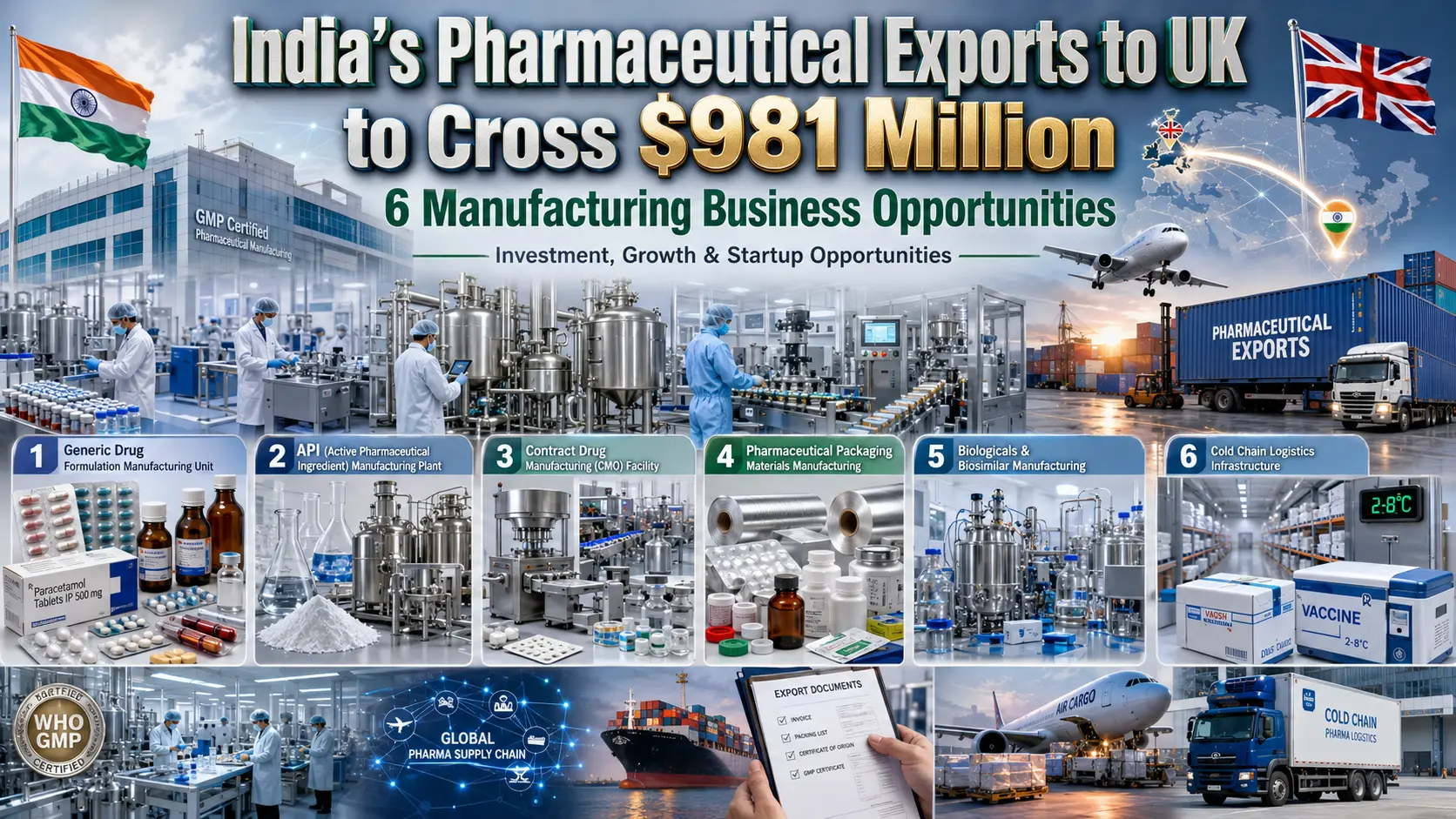
6 Manufacturing Business Ideas Emerging Directly from the India–UK FTA
These ideas stem from the informed reports Economic Times and Pharmexcil have released. Each is mapped to a true gap in the pharma supply chain for the UK.
1. Generic Drug Formulation Manufacturing Unit
Almost 90% of the exports to the UK are in drug formulations. The most direct use of this FTA is the establishment of a WHO-GMP manufacturing unit to produce tablets, capsules or liquid formulations for the UK market. Regulatory cooperation clauses in CETA simplify approvals of MHRA.(India UK FTA Pharma Manufacturing)
Investment range: Rs. Scale dependent 2-10 crore. Payback: 3-5 years. Period to be ready for export: 18 to 24 months after set up.
2. API (Active Pharmaceutical Ingredient) Manufacturing Plant
Last fiscal year, APIs accounted for $72.66 million of UK pharma exports. By concentrating on a specific API plant for 2-3 molecules of interest such as paracetamol base chemicals, cardiovascular APIs, or anti-infective bulk drugs, a focused API plant can establish itself as a direct supplier to formulation companies in the UK.
Investment range: Rs. 5-25 crore. Regulatory path: DMF filing, followed by MHRA audit is required.
Get Detailed Project Report (DPR): Active Pharmaceutical Ingredient (API) Products, Bulk API Manufacturing
3. Contract Drug Manufacturing (CMO) Facility
There are many brands in the UK that would like to get Indian manufacturing, but lack local partners having MHRA credentials. A Contract Manufacturing Organisation (CMO) facility helps fill this gap. CMOs do not have to build brands for their products or services and will be able to make a fortune from volume contracts while CETA will speed up the search by UK companies for CMO partners across India.(India UK FTA Pharma Manufacturing)
The major benefit: Recurring revenue model with multi-year supply contracts.
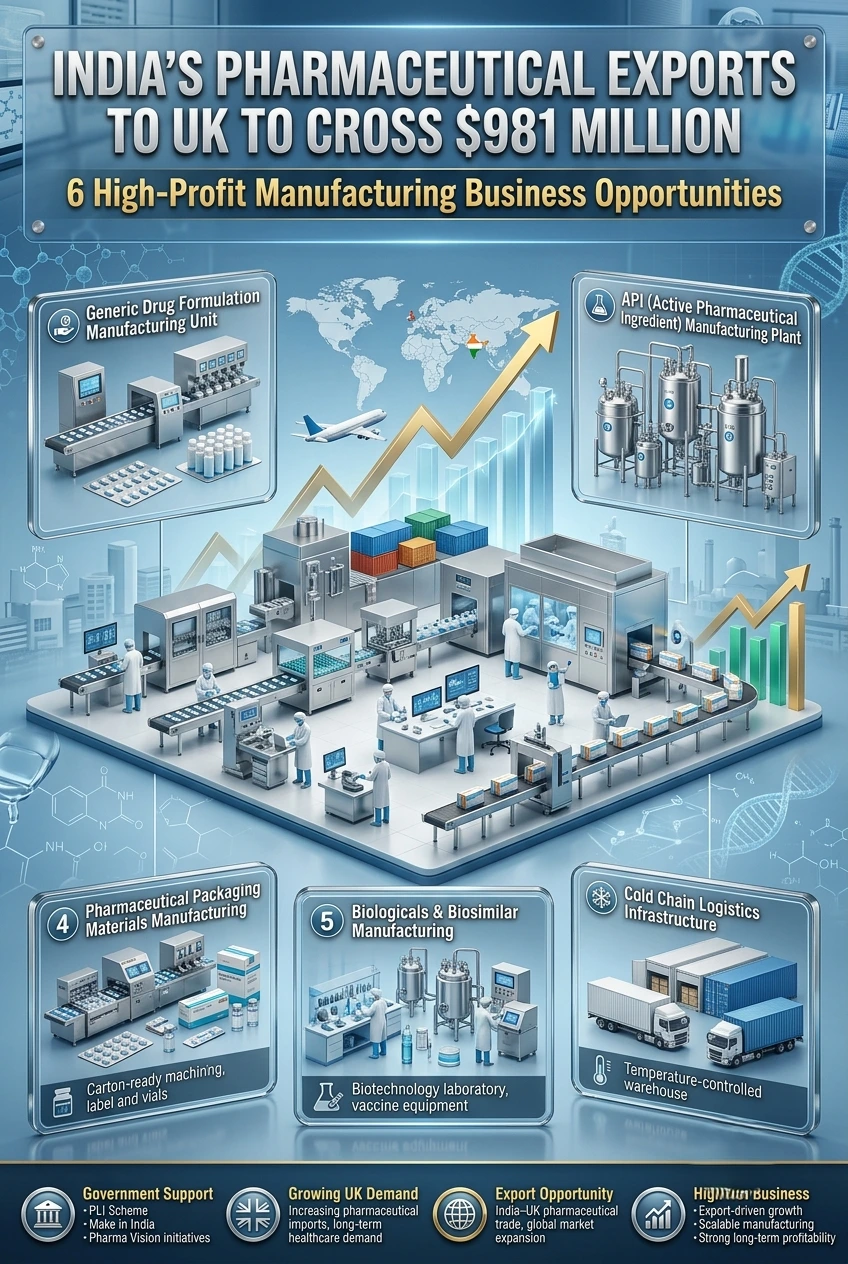
4. Pharmaceutical Packaging Materials Manufacturing
All exported drugs must comply with MHRA packaging standards, including child-resistant blister packs, tamper-evident closures, pharmaceutical-grade aluminium foil, and serialized labels. This is a clean manufacturing play, not about the drug itself, but rather goes above it. As export volumes increase, so does demand.
Investment range: Rs. 1-5 crore. Proximity to formulation clusters in Hyderabad, Ahmedabad or Pune.
5. Biologicals and Biosimilar Manufacturing
Biologicals are the fastest growing segment in the export basket of Indian pharma industry. There is a clear process for biosimilar approval for the UK market and there are measures in place to encourage cheaper alternatives. A small-scale biologicals manufacturing facility, dedicated to insulin biosimilar(s), monoclonal antibody(s), or growth hormone(s), puts a company on the high pricing end of the opportunity.
Investment range: Rs. 15-50 crore. Long-term Moat due to high Barrier to entry.
6. Cold Chain Logistics Infrastructure for Pharma Exports
Biologicals, vaccines and some formulations must be stored and transported under specific temperature conditions. A manufacturing company setting up and operating GDP compliant with cold chain units close to the pharma SEZs or air cargo hubs is addressing a significant logistical issue in the India export readiness.
It is a revenue model with warehousing fees, value-added handling fees and support for compliance documentation.
Related Article: Profitable Pharmaceutical Business Ideas for Startups in India
Import-Export Opportunity Analysis: The UK Pharma Trade Window
India-UK FTA establishes a bilateral trade relationship which savvy entrepreneurs on both sides can make the most of.
Exports to UK: Generic formulations, APIs, bulk drugs, biologicals, nutraceuticals with drug classification and veterinary pharma. CETA benefits all with zero or near zero tariffs.
Imports to India from UK: High value research chemicals, patented molecules under license, advanced diagnostics, pharmaceutical machinery. Indian manufacturers can now import the equipment and reagents from the UK at lower prices.
Licensing and tech transfer: CETA has provisions to encourage technology transfer deals between the innovators in the UK and Indian manufacturers, which will generate licensing revenue for Indian Pharma Companies who get the regulatory clearance from the UK.
Entrepreneurs should register with Pharmexcil and obtain an Import Export Code (IEC) from DGFT to meet export registration and compliance requirements. Following the same format, the MHRA is also publishing an Indian manufacturer directory that brings together vetted manufacturers and UK manufacturers seeking Indian manufacturing partners.
Indian MSME Success Stories in Pharma Manufacturing
New entrepreneurs can follow the export-readiness model that mid-sized pharmaceutical manufacturers have successfully implemented in major Indian pharma manufacturing clusters, including Hyderabad, Ahmedabad, Baddi, Sikkim, and Pune.
Ajanta Pharma: A small Mumbai based generics maker. It is currently exported to 30+ countries (including regulated countries in Europe). Its playbook of picking niche therapeutic areas, getting WHO-GMP certification early, building dossiers proactively is directly applicable for MSME founders aiming for the UK market.
Granules India: Granules was a Hyderabad-based firm that developed a strong API and formulation company, focusing on high volume molecules that are sold in large quantities in the UK and US markets. Their API paracetamol export business is a textbook learning of focused product selection leading to export scale.
Strides Pharma: An example of a mid-cap manufacturer where they have won approvals with the MHRA and are now direct suppliers to tendering by NHS. When the UK allowed market access, its investment in regulatory work paid off.
CETA has clearly de-risked all of these, and they share three common features: early regulatory investment, product focus, and a long-term export orientation.
How NPCS (Niir Project Consultancy Services) Can Help You Enter Pharma Manufacturing
Niir Project Consultancy Services (NPCS) offers comprehensive feasibility reports, plant layouts, manufacturing process documentation, regulatory tips, financial forecasts, and other services to help entrepreneurs seriously considering a pharma manufacturing business.
NPCS Reports include: Plant design per WHO GMP guidelines, API Synthesis route, Manufacturing process for formulation, Packaging requirements, Cost of production, Break-even analysis and working capital. Promoters utilize these reports to approach banks, investors, and government bodies for project financing.(India UK FTA Pharma Manufacturing)
NPCS is unique in this regard, as it has a repository of regulatory compliance requirements for various export markets, enabling the entrepreneurs to plan manufacturing infrastructure suitable for UK-ready product manufacture from the day one of the starting of the business.
API plants, biosimilar facilities, or pharma packaging businesses are ideal candidates for an NPCS feasibility report, as it can save you 6-12 months on the planning process.
Discover business ideas that actually make money
India-UK Pharma Export Data: Key Numbers at a Glance
| Metric | Value | Source |
| India-UK pharma exports FY26 | $902.96 million | Pharmexcil / ET |
| Projected exports FY27 | $981.16 million | Pharmexcil |
| YoY growth projection | 8.66% | Pharmexcil / CETA |
| Apr-May FY27 growth (YoY) | 4.15% | Pharmexcil |
| Formulations share in UK exports | 89.54% | Pharmexcil |
| API exports to UK (FY26) | $72.66 million | Pharmexcil |
| India total pharma exports FY25 | $30+ billion | Ministry of Commerce |
| India pharma export target 2030 | $65 billion | Bain & Co / IPA |
| UK rank in Indian pharma exports | 3rd globally, 1st in Europe | Pharmexcil |
| Tariff post-CETA | Near zero on most products | India-UK CETA |
FAQ: Founder Questions on India-UK FTA and Pharma Manufacturing
Q1. Is there any way to export pharma products without the need of MHRA approval to the UK?
Yes. The Medicines and Healthcare products Regulatory Agency (MHRA) must approve pharmaceutical products before companies can sell them in the UK. But there are measures in CETA to facilitate the process for Indian manufacturers who already have WHO-GMP or US FDA certification. Pharmexcil also conducts liaison programs for its members with the MHRA.
Q2. What will be the minimum investment to establish a pharma manufacturing unit for export?
The cost of a WHO-GMP compliant manufacturing unit for making tablets/capsules is of the order of: The total amount of plant & machine is Rs. 2-8 crore and additional working capital Rs. 1-3 crore. API plants are required to have higher requirements, usually Rs. 5-25 crore. Collateral free loans are available from the MSME Ministry, up to Rs. CGTMSE provides loans of up to ₹5 crore, while the PLI scheme offers a 3–10% incentive on incremental production.
Q3. What should be done by an MSME to make their product export to UK pharma sector?
Anti-infective generics, cardiovascular formulations, pain management generics and vitamins/supplements are the top four categories. There is a constant demand for APIs like Paracetamol, Metformin, Amoxicillin intermediates. The premium opportunity segment is the biosimilars one; it will take greater regulatory investment at the beginning but come with a premium.
Q4. How does CETA help in practice — beyond tariff reduction?
Even though CETA has reduced import duties on most pharma products to practically zero, its secondary benefits also deserve attention, including mutual recognition of GMP standards, faster customs processing, IP protection for Indian manufacturers in the UK, and a joint committee mechanism for quickly resolving trade disputes.
Q5. Could a small factory that has never exported begin to go for the UK market?
Yes, but in an organized way. The suggested route is: (1) WHO GMP Certification, (2) Pharmexcil Registration, (3) Product Dossiers of 2-3 molecules, (4) Application for product registration by MHRA, and (5) approach to the UK Distributors through Pharmexcil Trade Missions. The pathway is a long time, 18-30 months, but is justified by a single NHS supply contract.
Q6. Where can I obtain funding from Government for setting up a new Pharma manufacturing unit?
Several funding options are available, such as direct lending to MSMEs by SIDBI, credit guarantee coverage by the Ministry of MSME’s CGTMSE, PLI scheme incentives through DPIIT, and Startup India portal with credit, BIRAC grants, and early-stage investors, among others.
Conclusion: The Window Is Open — Act Before It Narrows
Economic Times has reported it. Pharmexcil has confirmed it. The India-UK CETA is operational, and pharma exports to the UK are on a trajectory toward $981 million in FY2026-27 — and significantly higher in the years beyond.
For Indian manufacturing entrepreneurs, this is not a story about large corporations. The UK market, with its NHS procurement system, actively sources from a diverse supplier base that includes mid-sized and smaller manufacturers. “With zero-tariff conditions, CETA will make Indian generic drug prices much more attractive in Europe compared to European medicines,” he added.(India UK FTA Pharma Manufacturing)
The argument is easy. Manufacturers who kickstart the process for WHO-GMP certification, MHRA dossier preparation and Pharmexcil registration today will be ready for production when the post-CETA demand bubble peaks in 2027-28. Manufacturers who delay will compete in a more cluttered space, at higher regulatory costs.