India PCB Manufacturing Business Opportunities
It’s been a game-changer for the Indian electronics industry. Union Minister Ashwini Vishnaw announced that the policy would reduce the dependency on imports by nearly ₹40,000 crore per annum for Printed Circuit Board (PCB) manufacturing in the country, which is one of the most impactful announcements in industrial policy of the last decade, according to Economic Times reports dated June 27–29, 2026.
This is not a background story for Indian entrepreneurs, MSMEs and startups. It’s a starter gun.
However, until now, the electronics story in India has been one of assembly. The Printed Circuit Board, or the heart of the product, continued to trickle in from China, Taiwan and South Korea, while the devices were being assembled on Indian factory floors. That time is quickly coming to a close. The government has approved a ₹6,750 crore investment cluster at Jewar, Uttar Pradesh, with Amber Enterprises in a joint venture with Korea Circuit Co. (KCC) of South Korea. For the first time, production of multi-layer HDI PCBs with 20-22 layers of circuits will be industrially manufactured in Indian territory.
Economic Times has been following this industry’s evolution closely and for founders the message is loud and clear — India is shifting from assembly to deep manufacturing. Those who develop supply chain, testing, design and support businesses for domestic PCB production today will capture markets that did not even exist 6 months ago.
The market opportunity: ₹40,000 Cr of imports that can be substituted with anchor investments in the supply chain which will be filled by Indian MSMEs and Start-ups in 2026-27.
Access Complete Business Plan: Printed Circuit Board Manufacturing Plant Report
What Recent Economic Times Reporting Means
The Economic Times Manufacturing Edition report of two ground stone laying ceremonies at Electronics YEIDA Manufacturing Cluster (EYMC) at Jewar Airport, Gautam Buddha Nagar, jointly held by CM Yogi Adityanath and Union Minister Ashwini Vaishnaw is available on the ET Manufacturing website.
The Two Anchor Projects
- Amber Enterprises + Korea Circuit Co. (KCC) Joint Venture – ₹3,250 crore in HDI PCBs, Flexible PCBs and semiconductor substrates.
- Amber Enterprises Standalone Plant – ₹3,500 crore on 100 acres for Copper clad laminates and components for RACs.
Why This Market Shift Matters
Prior to this, India’s PCB industry lacked a significant presence. The country manufactured 200 million smartphones year but got circuit boards from outside. The price of the PCB components in every ₹100 phone was approximately ₹18–25 imported from outside India. The new Jewar cluster takes direct aim at this structural defect.
The effects on the founders and MSMEs are revolutionary. Amber is one of the large anchor manufacturers that requires dozens of Tier-2 and Tier-3 suppliers – for PCB cleaning chemicals, precision drilling consumables, testing rigs, logistics, ESD-safe packaging, and much more. The Jewar cluster is likely to see more investments from the downstream by means of a reporting in the Economic Times. Business owners that come in now carve out first-mover advantages.
Why This Industry Is Growing
The production of electronics in India has been increasing from $75 billion in FY2020 to $155 billion in FY2025-26. Government’s goal is to reach $500 billion by 2030. PCBs are the largest imported sub-component of this value chain, and this is being fixed through the development of structured policy support.(India PCB Manufacturing Business Opportunities)
Five Macro Forces Driving PCB Sector Growth
- China+1 Strategy: OEMs in the world actively diversify their supply chains from relying on a single country. India is preferred.
- Approved Semiconductor Projects in India (India Semiconductor Mission 2.0): ₹1.64 lakh crore worth of projects leads to the demand for advanced PCBs and substrates as an upstream demand.
- 5G Rollout: The use of 5G base stations, routers and consumer devices requires Dense-layer HDI PCBs, which are produced domestically, thus reducing the import cost by 15-20%.
- Both the EV and Defence Electronics sectors require a domestic sourcing requirement. The Defence Indigenisation has been rolled out for PCBs for EV battery management systems and military-grade radios.
- Production Linked Incentive Scheme (PLI) for Electronics: Payouts based on domestic value addition, with PCB production covered under various sub-schemes.
The data from Economic Times reveal that India, in terms of exports, has always been in sixth position in the world and the Government aims to reach second position. Domestic PCB production is a key step in that regard — and Invest India includes this sub-sector in its investment corridors list of priority areas for foreign and domestic investment.
Related Article: Semiconductor & Electronics Manufacturing in India: MSME Entry Points, Realistic Costs, and Where the Real Money Is
Government Policies & Incentives
The policy framework for electronics and PCBs manufacturing in India has never been as strong as it is now. By matching their businesses to schemes, entrepreneurs substantially mitigate risks to their capital and shorten the break-even periods.
Key Schemes to Explore
- IT Hardware (MeitY): PLI Scheme for IT Hardware Direct Incentive of 4-5% on incremental production including PCB embedded devices.
- Electronics Manufacturing Clusters (EMC 2.0): Common facility centres with subsidised plug and play infrastructure, see Make in India portal for clusters.
- MSME Technology Upgradation Fund (SIDBI): Low-cost term loans for modernisation of machinery, especially for PCB testing and surface mount technology (SMT) line modernisation.
- Launching Startup India Seed Fund — provide up to ₹50 lakh to early-stage electronics hardware startups — on Startup India portal.
- Support for small PCB Manufacturers and sub-contractors for working capital & raw material procurement from NSIC.
Full scheme documentation has been provided to the entrepreneurs and application is through Startup India and DPIIT. The incentive matrices for electronics have been updated in both the portals after the Union Budget 2026-27 announcements.(India PCB Manufacturing Business Opportunities)
5 High-Growth Business Ideas for Startups & MSMEs
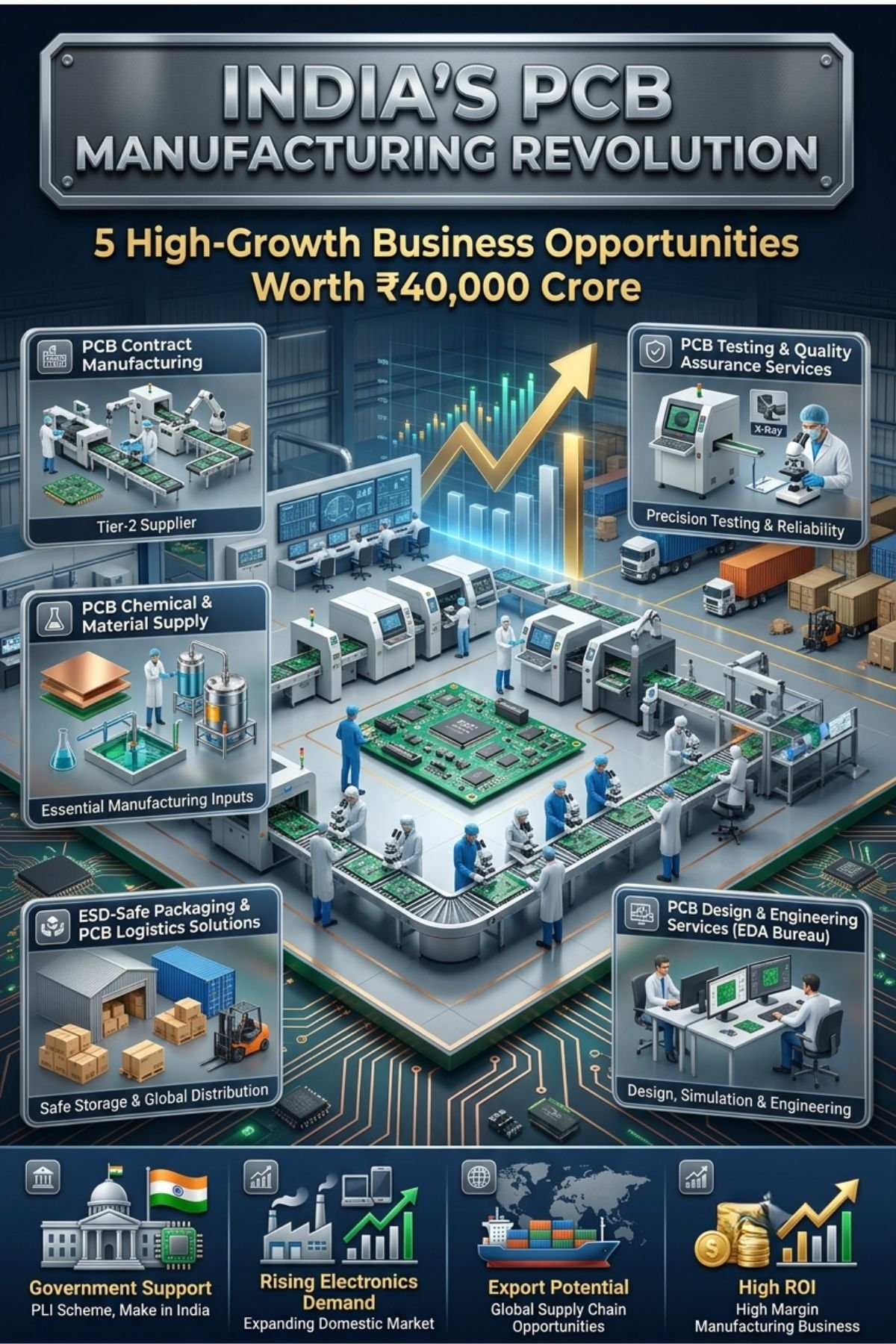
Import substitution is not just for big manufacturers and the opportunity is worth ₹40,000 crore. The PCB ecosystem is highly interconnected; each anchor facility generates 8 – 12 adjacent business opportunities. Read on to know about five ventures that Indian entrepreneurs can venture into in 2026-27.
1. PCB Contract Manufacturing (Tier-2 Supplier)
For lower complexity boards (4-layer to 8-layer) which do not meet the HDI requirement, Jewar cluster will require Tier-2 PCB manufacturers. An MSME that invests ₹2-5 crores in an Semi-Automated SMT line can supply to the OEMs that are involved in the lightings, industrial controls and appliances sector. Payback period of investment: 3-4 years. Main clients: white goods assembler, LED manufacturer, and domestic telecom equipment manufacturer.(India PCB Manufacturing Business Opportunities)
2. PCB Testing & Quality Assurance Services
With the domestication of PCB production in India third party testing will be introduced. Automated Optical Inspection (AOI) and X-ray inspection labs and functional test labs are mandatory throughout all the manufacturing process. A mini lab conducting PCB testing for 5-8 manufacturers can earn ₹1.5-2.5 crore per annum with a comparatively low investment of ₹80 lakh to ₹1.5 crore. This is a niche that Economic Times has singled out and identified as lacking in India’s electronics supply chain today, despite being a low-competition, high-margin niche.
3. PCB Chemical & Material Supply
Specialty chemicals, such as photoresist, etching solutions, plating chemicals, flux, and cleaning solvents are used in large quantities in the manufacture of PCBs. The majority of these are imported at the present time. If an MSME enters this market as an importer or an authorised importer and distributor of the product, it is the domestic manufacturer who demands the product as an anchor for the MSME. The Jewar cluster will need to be continuously supplied with chemicals valued at ₹40-80 crore every year. Partner with Indian Chemical Companies or license technology from CSIR institutes.
4. ESD-Safe Packaging & PCB Logistics Solutions
PCBs are sensitive to ESD. Before sending Jewar’s boards to OEMs, package each board in trays, bags, and moisture barriers to protect against electrostatic damage and moisture. This is a business where there are lots of repeat demand. An entrepreneur having capital of Rs. 50 – 80 lakh can set up a packaging unit for multiple PCB plants in a radius of 50 km. Proximity to the Jewar-Noida manufacturing corridor is a boon to the business.(India PCB Manufacturing Business Opportunities)
Identify high-growth industries before others do
5. PCB Design & Engineering Services (EDA Bureau)
India already has a Design Linked Incentive (DLI) Scheme which has supported 24 design projects and has already supplied Electronic Design Automation (EDA) tools to 105 companies. With the growth of the domestic manufacturing sector, demand for localised PCB design services, especially for Flexible PCBs and HDI designs, will also increase. An engineering services company that provides Gerber file generation, DFM analysis and prototype-to-production support can develop a revenue business of ₹2–4 crore in two years. Please register in DPIIT to get DLI Scheme support.
Import–Export Opportunity Analysis
However, India’s PCB journey is not just about replacing imports, it is also about creating export capacity. This cutting-edge manufacturing facility at Jewar positions India to offer OEMs, especially those in China, a viable alternative to Chinese-made PCBs.
Export Markets to Watch
- As the OEMs diversify, the ASEAN based electronics manufacturers such as Vietnam, Thailand, and Indonesia are looking out for the Indian PCB supplier.
- Strategic alliances with the United States and the European Union (EU) create preferential procurement opportunities for military quality PCBs in India.
- The Kenyan, UAE and Egypt electronics assembly industries are developing and are importing in growing quantities mid-complexity PCBs, which are being imported from China.
Exporters may access the market intelligence, tariff classification, trade facilitation tools provided by DGFT (Directorate General of Foreign Trade), which is implementing the benefits under MEIS/RoDTEP applicable to PCB exports under Chapter 85 of ITC-HS codes.
India’s electronics trade surplus is in constant focus on the Economic Times pages. From day one – even for small-scale exports – entrepreneurs can benefit from preferential duty drawback schemes and export credit from ECGC/EXIM Bank.(India PCB Manufacturing Business Opportunities)
Indian MSME Success Stories in Electronics Manufacturing
Indian electronics MSMEs have already created inspiring benchmark stories that make the viability of local manufacturing at scale possible.
Amber Enterprises — From Assembly to Deep Manufacturing
Amber Enterprises itself started as a contract manufacturer for room air conditioner assemblies. Over the last 10 years, it has grown to serve a range of applications from PCB assemblies to motors and, now, with the ₹6,750 crore investment in Jewar, it has made its way into the advanced PCB manufacturing space. It’s a textbook example of how MSMEs can go from being an assembler to an anchor investor.
Dixon Technologies — PLI-Powered Growth
Dixon Technologies used the PLI Scheme to increase its mobile phone production from 4 million to more than 50 million units per year.
. Localisation of PCBs is the next strategic horizon for them. Aligning early on Dixon’s supply chain, tier-2 suppliers saw their revenue grow 3–5x over three years.
Kaynes Technology — PCBA Focus
Kaynes Technology, listed in Indian exchanges in 2022, developed a revenue PC BA (PCBA) business for the aerospace, industrial and IoT customers, with an investment of ₹1.800 crore. Its success proved the investment thesis of the complex PCBA manufacturing in India and its supplier ecosystem generated more than 120 MSME jobs in Karnataka and Telangana.(India PCB Manufacturing Business Opportunities)
Get Detailed Insights from This Book: Technology Book on PCB, LCD, Battery & Cell Phone Recycling
About NPCS – Niir Project Consultancy Services
NPCS (Niir Project Consultancy Services) is a leading industrial consultancy and feasibility report service provider in the India. Entrepreneurs interested in joining the PCB manufacturing, testing, chemical supply or design services industry can find this at NPCS:
- Detailed Project Reports (DPRs) for PCB / Electronics Manufacturing Units – Market Research, Plant layout, Machinery, Financials.
- Feasibility Studies in keeping with PLI Scheme documentation, MSME loan documentation and requirement to banks for project financing.
- Technology Transfer Guidance on SMT line set up, PCB chemical processing and ESD packaging operations.
- MSME Registration and Government Scheme Application support for securing maximum available incentives to entrepreneurs.
NPCs have helped thousands of Indian entrepreneurs get their ideas from the conception to the commercial production phase with more than 10,000 project reports in over 500+ industrial sectors. With India’s PCB revolution gaining momentum — as Economic Times reporting has established — project report preparations by NPCS guarantee that founders don’t step into a market with financial models they haven’t verified.
Data Intelligence: India PCB Manufacturing at a Glance (2026)
| Parameter | Current Value | 2030 Target / Trend | Opportunity Signal |
| Annual PCB Import Value | ₹40,000 Crore | < ₹10,000 Crore (target) | ₹30,000 Cr localisation gap |
| Anchor Investment at Jewar | ₹6,750 Crore | ₹15,000+ Crore (cluster) | Tier-2 supplier demand opens |
| PCB Layers (Domestic Capability) | 4–8 Layer (legacy) | 20–22 Layer HDI (new) | Complex PCB design services |
| India Electronics Exports Rank | 6th Globally | 2nd Globally (target) | Export-ready PCB business |
| ISM 2.0 Investment Pipeline | ₹1.64 Lakh Crore | Phased 2026–30 | Substrate & advanced PCB demand |
| EMC Area (Jewar Cluster) | 206 Acres | Expandable | ESD packaging, logistics, chemicals |
| Startup India Seed Funding | Up to ₹50 Lakh | Ongoing | Electronics hardware startups |
| PCB Testing Labs in India | < 200 (estimated) | 500+ required by 2028 | Testing services high-growth niche |
| DLI Scheme Design Companies | 105 (EDA access) | 300+ by 2027 | PCB design bureau opportunity |
Frequently Asked Questions (FAQ)
Founder-focused questions about the PCB manufacturing opportunity in India.
Q1. Do I need deep technical expertise to start a PCB-related business?
That’s not always the case. PCB testing services, ESD packaging companies, chemicals distribution firms and logistics companies generally do not need you to be an engineer with a specialized degree. It needs operational efficiency and right equipment. NPCS project reports cover the technical and financial details in a step-wise fashion for those founders with less-than-technical backgrounds.
Q2. What is the minimum investment required to enter the PCB supply chain?
Entry can be anything from 50-80 lakh to an ESD packing startup, 30-60 lakh as working capital for chemical distribution business. For establishing an Ee tier 2 contract manufacturing PCB facility one would need to set-up a Semi- Automated Setline for Rs 2 to 5 crore. Testing facilities need a minimum Rs 80 lakh to 1.5 crore for setting a mid-level service lab
Q3. How do I access government incentives for a PCB-related MSME?
Register your entity with Startup India(startupindia.gov.in) & with the Udyam Registration portal for MSME & approach SIDBI for CGTMSE backed loans with the mappings to the relevant PLI subschemas with DPIIT. You get your choice of sector’s specific govt. Schemes’ matrix in your NPCS project report.
Q4. Is the Jewar location mandatory, or can I set up in other cities?
Since it provides maximum infrastructure density & proximity to end customers, Jewar will suit Tier-2 manufacturers and direct suppliers. PCB design bureaus, chemical suppliers and testing labs, on the other hand, can find adequate opportunity from any of the big electronic manufacturing centres of India – including Noida, Pune, Bengaluru, Hyderabad and Chennai.
Q5. How long before this market opportunity peaks — is it too early to enter now?
The Jewar anchor plants will begin commissioning in 2027–28. Anchor manufacturers are actively recruiting Tier-2 suppliers, testing labs, and component distributors, creating a supply chain opportunity window that will remain open through approximately 2026–27.
. As Economic Times reporting confirms, this is a first-mover market. Early entrants build supplier relationships, certifications, and track records that late entrants will struggle to replicate.
Q6. Can I export PCBs or PCB-related products from India?
Yes, DGFT has approved RoDTEP (Remission of Duties and Taxes on Exported Products) to cover Indian PCB exports. India is already in the mid-priority list for exports of PCBs in the lower and middle complexity range by countries such as ASEAN region, Africa and the Middle East regions. Exports-focused organizations can also receive MEIS related incentives and the ECGC export credit insurance products. To be precise, one can get more insight from the DGFT’s schedule of tariffs of India concerning Ch 85 (PCB ITC- HS Code 8534).
Conclusion: Act on the Signal, Not the Noise
The Economic Times reporting on India’s ₹40,000 crore PCB import substitution is more than a policy headline. It is a validated market signal that a structural shift is underway — one that creates real, bankable business opportunities for Indian entrepreneurs, MSMEs, and startups right now.
India’s move from electronics assembly to deep manufacturing is irreversible. The Jewar Electronics Manufacturing Cluster — backed by ₹6,750 crore in anchor investment — marks the beginning of a domestic PCB ecosystem that will need hundreds of Tier-2 suppliers, testing laboratories, design bureaus, chemical suppliers, and logistics specialists over the next three years.
The timing advantage is real and finite. Entrepreneurs who enter supply chains before anchor plants commission in 2027–28 lock in supplier relationships and certifications that define their competitive position for a decade. Those who wait will face a crowded, mature market with compressed margins.(India PCB Manufacturing Business Opportunities))
Economic Times consistently validates this sector’s momentum. The government has provided the policy architecture. Anchor investors have committed the capital. The only missing variable is the MSME and startup ecosystem that makes the supply chain complete.
| BOTTOM LINE: ₹40,000 crore of annual imports are being replaced. Build the business that helps India do it — and capture a slice of the most consequential industrial transformation of this decade. |
For detailed feasibility analysis, financial projections, and project reports aligned to the PCB manufacturing opportunity, visit MSME.gov.in for government scheme details, and consult NPCS for end-to-end project documentation support.