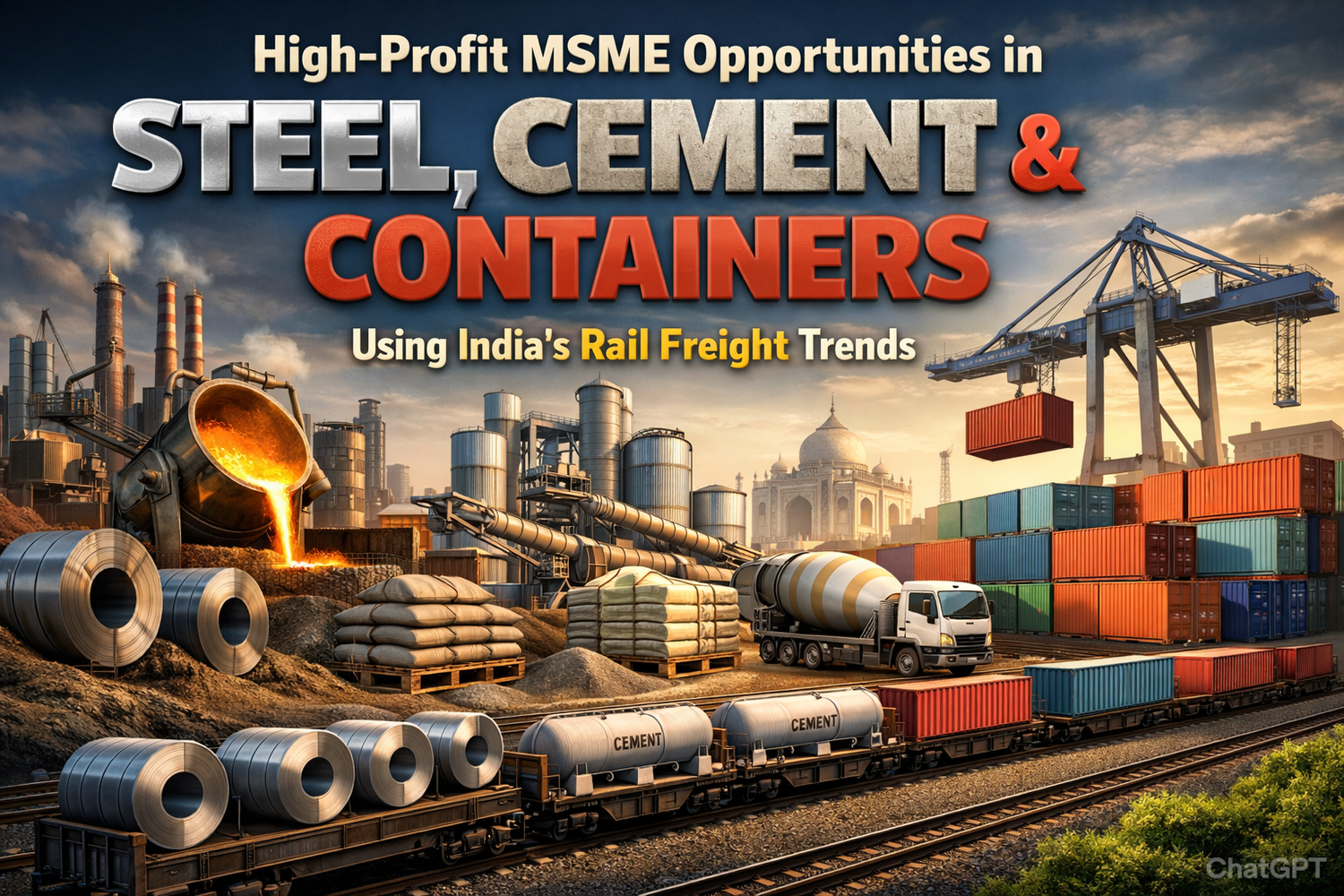

Introduction: High-Profit MSME Opportunities in India
For entrepreneurs and MSMEs looking for business opportunities with high potential, it can be difficult to distinguish between real demand and hype in the market. One of the surest measures of the industrial activity in India is rail freight movement. Unlike consumer products, goods rarely travel by train unless they are manufactured, consumed, exported or built at scale.
Indian Railways is the mirror image of the country’s industrial economy. Commodities that dominate freight – steel, cement, fertilizers, coal, iron ore and containers – emphasize the sectors that drive infrastructure, construction, manufacturing, agriculture and trade. For startups, rail freight data is a ready-made recipe for businesses that have the potential to succeed and make a dent in the market.
Read More: The Complete Technology Book on Hot Rolling of Steel (2nd Edition)
Rail Freight Growth: The Industrial Pulse
Rail freight growth is based on actual industrial production and consumption, and not on speculative projections. In the year 2023-24, India railways reported one of its best performances on the freight side, which was boosted by housing demand, infrastructure projects, industrial output, and exports.
Key numbers show the size of opportunity:
- Total Freight Carried: 1 588 million tones
- Freight earnings: ₹1,65,880 crore
- Coal loading: ~787 million tones
- Loading of iron ore: ~181 million tones
- Cement loading: ~153 million tone
- Fertilizer loading: ~59 million tone
- EXIM container traffic: More than 63 million tones
These figures point to high volume, recurring industries where the demand is proven and enormous.
Why Freight Linked Industries are Perfect for Entrepreneurs
Investing in industries that are freight driven has a number of benefits over consumer focused markets:
- Stable, infrastructure-linked demand
- High and recurring volumes
- Cost-efficient logistics by rail
- Relevance across different sectors
- Easier Financing due to Asset-Backed Projects
For MSMEs this means reduced risk, visibility and the ability to scale growth.
Steel & Steel-Based Products: The Backbone of the Industrial Growth
The reason why steel is dominating rail freight was due to the necessity of railways, bridges, stations, warehouses, and industrial plants. Both raw and finished steel is moving around the country, so there is a consistent demand.
Entrepreneurs are well placed to take advantage of downstream steel processing, instead of competing with large integrated mills:
- Structural steel fabrication
- Re rolling mills (TMT bars, sections)
- Pre-engineered building (PEB) components
- Railway and infrastructure steel parts|
Steel demand is directly related to the construction of railways and roads, housing and industrial growth. Processed steel also helps in the exports and import substitution, thus making it a highly profitable and resilient sector.
Cement & Construction Materials: Surfacing the Infrastructure Wave
Another rail freight giant is cement, at more than 150 million tones a year. Rail transport is the cheapest mode of transportation for bulk transport ensuring a continuous market for cement and allied materials.
MSMEs can look at opportunities in:
- Cement grinding units
- Precast concrete products
- Packaging and distribution
- Exports to neighboring countries
Compared to integrated plants, these downstream ventures are capital-light, and highly profitable, particularly with the Indian infrastructure boom now ongoing.(High-Profit MSME Opportunities in India)
Read More: Business Plans / Project Profiles
Containers & Logistics: The Hidden Growth Engine
The expansion of containerized freight – more than 63 million tones a year – is a measure of India’s growing role in global trade. Containers allow for inland movement, opening up options outside of tradition:
- Production of cargo containers (dry, refrigerated and special purpose)
- Repair and refurbishment services
- Manufacturing of pallets, crates and dunnage
- Sample activities include: – Warehouse racking & storage systems
Every container moved creates ancillary demand, so this is a high growth area for startups in both the manufacturing and logistics services sectors.
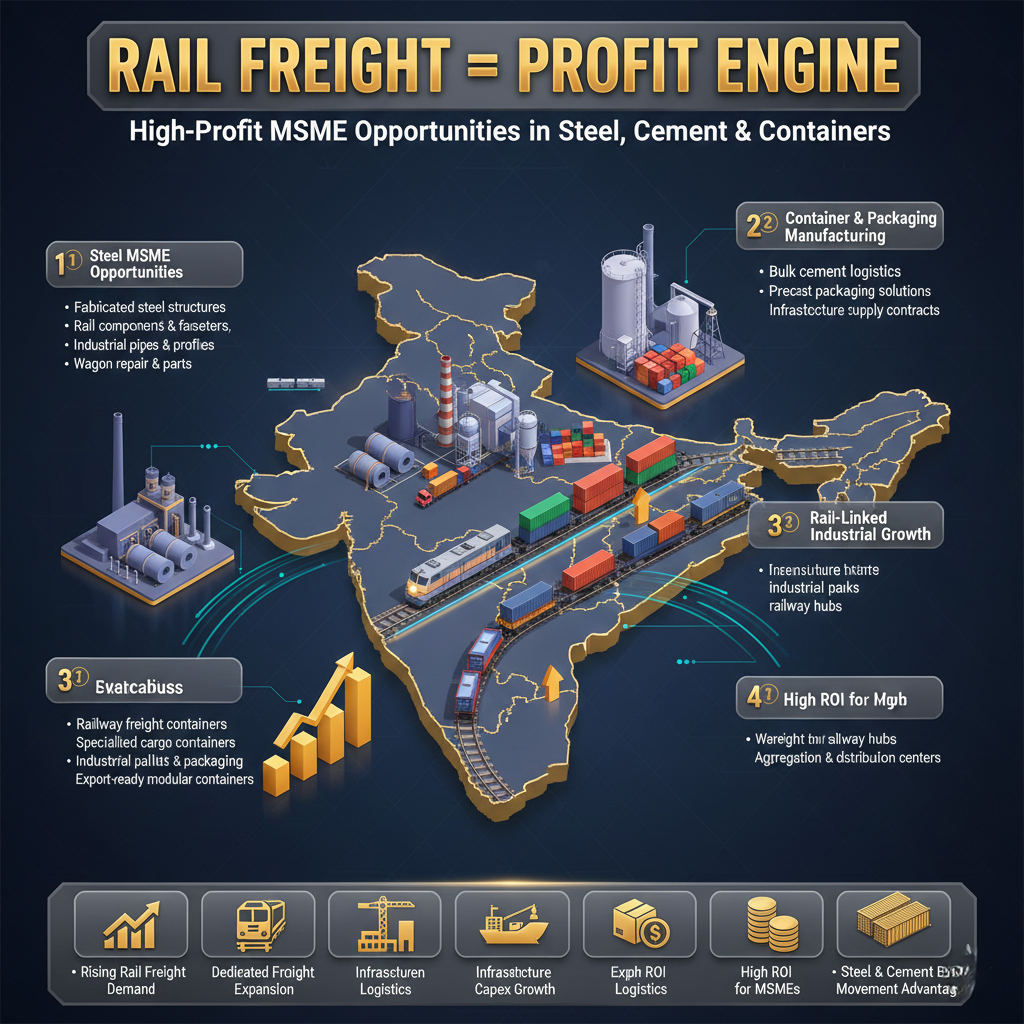
Fertilizers & Agri-Inputs: Promoting Food Security
Rail freight also transports almost 59 million tones of fertilizers each year, which highlights just how agriculture has become dependent on logistics. MSMEs can take advantage of opportunities in:
- Blending and Packaging of Fertilizers
- Micronutrients and bio-fertilizers
- Exports of agrarian products ready for
These businesses are low-capital and have a policy-based support and predictable demand, which makes them perfect for first-time entrepreneurs.
Iron Ore & Minerals: Fueling Industrial Growth
Iron ore movement 181 million tones Steel production, pelletize and export. Startups can focus on value added processing:
- Iron ore beneficiation
- Pellet manufacturing
- Mineral processing and utilization of by-products
This way entrepreneurs benefit from sustained industrial demand without getting involved in risky mining endeavours.
Read More: Project Reports & Profiles
Coal & Energy Linked Products: MSME Opportunities
Coal continues to be India’s largest freight commodity and is used for powering steel, cement and power sectors. MSMEs can explore:
- Coal washing and grading plants
- Fly ash products and Ash based Cement products
- Fuel briquettes and environment friendly energy solutions
Environmental regulations and sustainability trends are driving waste-to-value solutions leading to more profitability for MSMEs.(High-Profit MSME Opportunities in India)
Lessons Learned from Successful MSMEs
Many industrial leaders began in the bulk-demand industry, and not in the large-scale extraction or production sectors, but instead in the downstream processing field. Key takeaways:
- Follow high volume recurring demand
- Build around products pumped already consumed on scale
- Make alignment of businesses with logistics and infrastructure trends
This approach is good in two ways: it lowers market risk and gives emerging entrepreneurs more visibility.
Why Now Is the Right Time
The current environment is supportive of MSMEs and startups:
- Record-high rail freight volumes
- Good demand for infrastructure and construction
- Growth in the containerized trade and logistics
- Import substitution policies to promote domestic manufacturing
- Banks are willing to finance projects that are backed by assets
Entrepreneurs coming into these sectors have now the clarity, stability, and scalability.
Read More: Steel Shipping Containers Manufacturing in India
How NPCS Aids Entrepreneurs to Establish Profitable Ventures
Understanding the trends of rail freight is the first step. Niir Project Consultancy Services (NPCS) converts insights into working business plans by providing:
- Market research and analysis of demand
- Detailed diagrams of the manufacturing process
- Product mix and capacity planning
- Machinery specification and raw material sourcing
- Financial analysis and projections of profitability
NPCS ensures that projects are feasible, profitable and in line with proven freight demand, mitigating risk for MSMEs.
Read More: Container, Trailer & Flatbed Manufacturing Business in India: High-Profit MSME Opportunity
Closing Insight
Rail freight mirrors industrial momentum. Commodities like steel, cement, containers, fertilizers, coal, and iron ore represent high-volume, demand-driven sectors. Entrepreneurs aligning with these freight-heavy materials are not chasing trends—they are building businesses on proven demand, ensuring visibility, stability, and scalable growth.
For startups and MSMEs, understanding rail freight is not just a strategy—it is a blueprint for long-term success in India’s industrial landscape.(High-Profit MSME Opportunities in India)
Frequently Asked Questions (FAQ)
Q1. Are freight linked industries for new entrepreneurs?
Yes. Downstream and processing businesses are MSME friendly and have steady and predictable demand.
Q2. Is demand cyclical?
No. Freight demand is linked to infrastructure, agriculture, and trade and is therefore much more stable than consumer markets.
Q3. What is the Standard range of Investment?
Entrepreneurs can start MSME units with Rs 2-15crore, depending upon the products and scale.
Q4. Can MSMEs export products?
Yes. Rail-linked logistics are available for exports of bulks and semi-finished goods.
Q5. Are banks willing to invest in financing these projects?
Absolutely. Commodity-backed, asset-linked projects are said to be of low risk and are widely financed.