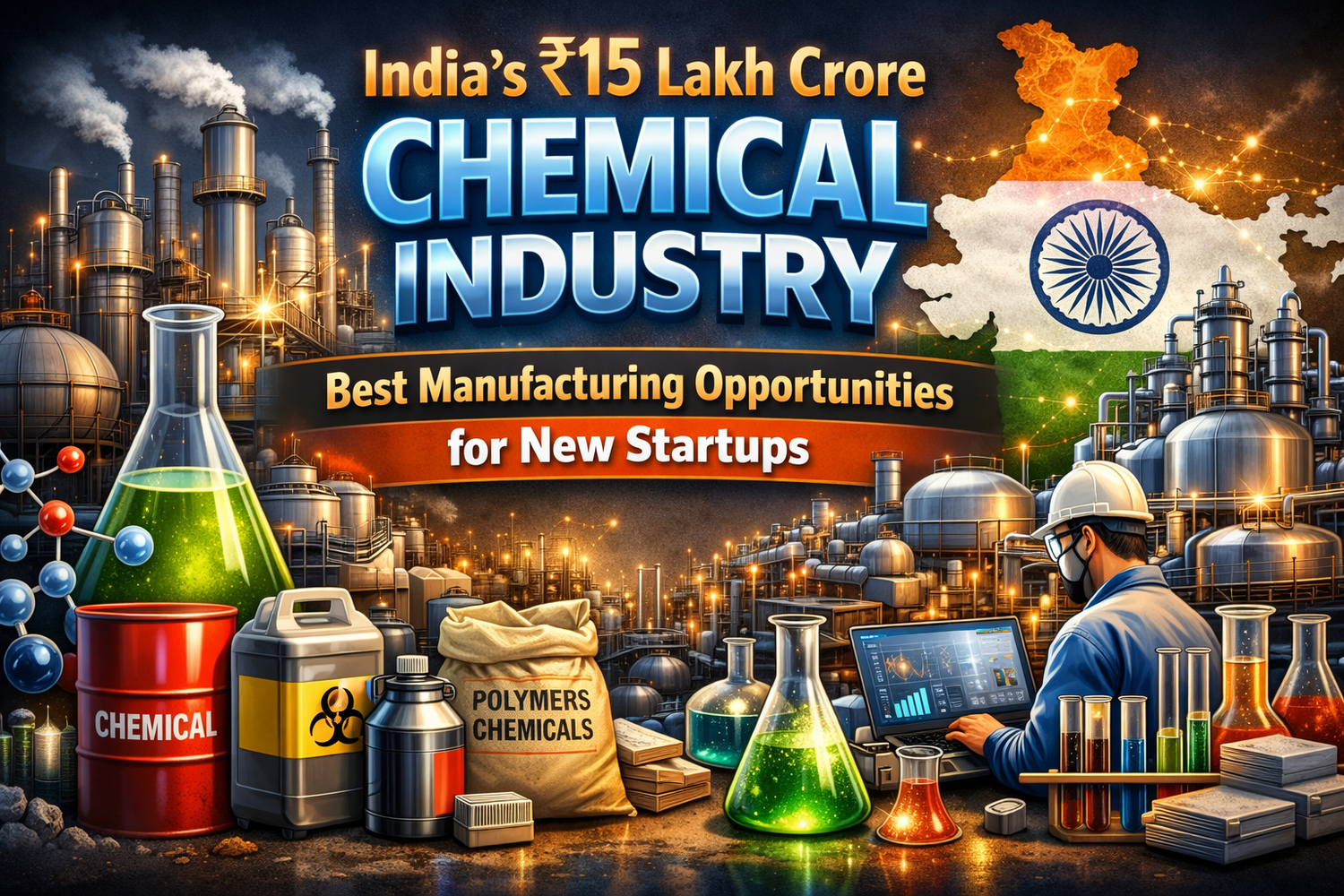

India chemical industry opportunities has gradually developed into one of the most important pillars of the national economy. While much focus is given to technology startups and digital platforms, the chemical industry is a quiet enabler of nearly every major industry-from agriculture and pharmaceuticals, to automobiles, construction, textiles, electronics and consumer goods.
As per the data released by the Ministry of Chemicals & Fertilizers, the value of the output of the chemical industry in India is somewhere around 15.14 lakhs crore with an average growth rate of 11.6% CAGR in the recent past. This degree of expansion is indicative of robust structural demand, not short-term cycles in the market.
For entrepreneurs and MSMEs, this expansion points to an important fact: India’s chemical industry is big, but it is not quite integrated, leaving great room for new manufacturing businesses.
Read More: Detailed Project Profiles On Chemical Industries (Vol II) (2nd Revised Edition)
Why the Chemical Industry is Good for New Entrepreneurs
At first glance chemical manufacturing looks complicated and capital intensive. This perception is partly true. Large refineries and bulk chemical plants do require heavy investment, but downstream and specialty chemical units are on a completely different scale.
India produces huge volumes of base chemicals, but is a major importer of finished and semi-finished products. This gap enables the new players to enter the market without having to compete directly with large corporations.
Important factors as to why this sector is good for first-generation entrepreneurs include:
- Moderate capital requirements of downstream processing units
- Stable industrial demand as opposed to seasonal consumption
- Better margins than for commodity chemicals
These factors make chemical manufacturing a practical and scalable option for startups willing to make careful plans.
India’s Chemical Production Structure: Where The Gap Lies
India’s output of chemicals is strongly skewed towards bulk segments. More than 70% of total output is accounted for by alkali chemicals, followed by organic and inorganic chemicals. On the other hand, segments such as dyes, pigments, pesticides and specialty intermediates make up a small proportion of domestic production.
This does not mean that demand is low. Instead, it shows that the processing of value addition is still not developed within the country. Many industries use imported intermediates and formulated chemicals despite the availability of raw materials in the country.
For startups, this imbalance is an opportunity to get closer to end-use industries to capture higher value.
Read More: Handbook On Chemical Industries (Alcohol Based)
Why Downstream Petrochemical Manufacturing is a High Potential Area
Petrochemicals have become critical raw materials throughout modern manufacturing. In addition to packaging plastics, they have been used in automotive parts, medical devices, insulation materials, agro-films, electronic housings and construction products.
India has built up considerable petrochemical capacity, however, most of the value is still created on the base-material level. Downstream processing is used to manufacture these materials into application-specific products for higher margins.
Startup-friendly downstream petrochemical project include:
- Polymer compounding and blending units
- Factors such as the following must be considered in detail: – Injection moulding and extrusion facilities
- speciality resin and plastic masterbatch production
These businesses are capable of operating profitably at mid-scales and growing at a slow pace according to the rising demand.(India chemical industry opportunities)
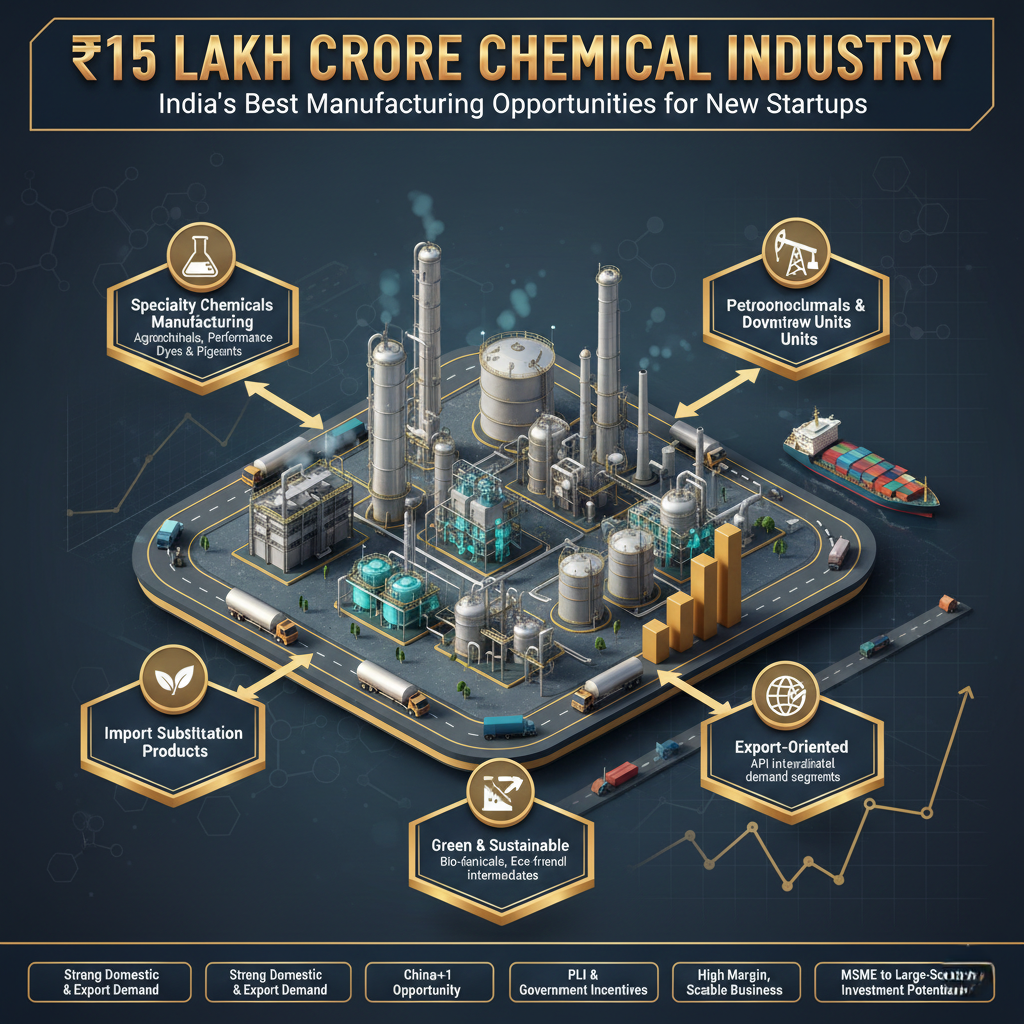
PCPIR Clusters: Reducing Risk for New Chemical Units
In order to accelerate investments in the chemicals and petrochemicals sector, India has introduced Petroleum, Chemicals and Petrochemicals Investment Regions (PCPIRs). These clusters provide integrated industrial infrastructure geared up to chemical manufacture.
For startups, the benefits of the PCPIRs include:
- Feedstock suppliers – this includes: – Ready access to feedstock suppliers
- Common effluent treatment and utility facilities
- Port connectivity to exports
- Reduced infrastructure and logistics costs
By operating within these kinds of clusters, new manufacturing units can greatly enhance the viability of the project and reduce payback periods.
Read More: Modern Technology of Industrial Chemicals
Import Substitution: A Strong Business Case
Despite having a huge industrial base, India still imports significant amounts of specialty chemicals, performance plastics, resins and industrial adhesives. These imports are based primarily on domestic processing gaps and lack of quality consistency.
Manufacturing products that are currently imported has obvious benefits:
- Domestic demand established
- Price benchmarks already available.
- Underlying government policies and incentives
Plastic parks and chemical clusters further improve the feasibility by providing capital subsidy and common infrastructure.
Lessons for Industrial Leaders from India
Successful industrial leaders in India prove the importance of moving downstream.
Mukesh Ambani, via Reliance Industries, diversified from refining to polymers and downstream petrochemical products and was taking value from many parts of the supply chain.
Similarly, Ramesh Juneja has made Mankind pharma by backward integration in the chemical intermediates, decreased the import dependence and enabled better control over the cost.
Their tactics achieve what was likely the most important lesson: the best margins in chemicals come with specialization and application-oriented manufacturing.(India chemical industry opportunities)
Read More: Specialty Chemical Industry in India: Growth, Margins, and Market
Why Feasibility Planning Should Not Be Skipped
Many of the chemical projects are experiencing problems not because of weak demand, but due to poor planning. Entrepreneurs tend to under-estimate compliance requirements, utility costs, or raw material risks.
Before investing, it is important to evaluate:
- Raw material sourcing/prices are volatile
- Environmental and effluent treatment compliance
- Energy and water consumption
- Product mix and capacity planning
- Capital recovery and profitability schedules
A structured feasibility study gives way to clarity and minimizes financial risk.
Professional Support of Chemical Manufacturing Projects
Niir Project Consultancy Services (NPCS) helps entrepreneurs by preparing the Market Survey cum Detailed Techno-Economic Feasibility Reports. These reports contain market analysis, manufacturing processes, details on machinery, financial projections, and compliance planning.
Such professional support is helpful for investors to make informed decisions and build scalable businesses.
Read More: Tata Chemicals Sodium Bicarbonate Success: Manufacturing Process
Conclusion
India’s ₹15 lakh crore chemical industry is not overcrowded—it is under-processed. The most attractive opportunities for new startups lie in downstream, specialty, and application-specific chemical manufacturing.(India chemical industry opportunities)
Entrepreneurs who focus on import substitution, leverage industrial clusters, and invest in professional feasibility planning can build profitable and sustainable chemical businesses with both domestic and global reach.
Frequently Asked Questions (FAQ)
Is chemical manufacturing business for first-generation entrepreneurs?
Yes. Downstream and specialty chemical units require moderate capital and have a stable industrial demand.
Which chemical segments have faster ROI?
Specialty intermediates, industrial adhesives and polymer compounding units tend to have a faster breakeven.
What are the key dangers of chemical production?
Environmental compliance and price volatility of raw materials are key risks, both of which can be controlled with good planning.
Is there a benefit of PCPIR clusters for startups?
Yes. They cut infrastructure expenses and enhance access to raw materials and export amenities.
How important is export potential to chemical startups?
Export oriented products offer scalability, foreign exchange, long-term stability.