India battery component manufacturing opportunities
A Rs 12,000 Crore Signal That Changes Everything
A big event has taken place in India’s clean energy sector. India is finalizing an incentive scheme of Rs 12,000 crore to set up the manufacturing of advanced battery components in the domestic market, said Economic Times. This is no ordinary policy statement. It’s a direct market signal — and, for those who are entrepreneurs, MSME owners, and startup founders, it could be one of the greatest signals for 2026.
India presently imports nearly all essential components of its batteries, such as cathode active materials (CAM), anode active materials (AAM), copper foil, electrolytes and separators. Comprising more than 60 percent of the price of each lithium-ion battery produced or composed in India, these materials are a major driver of the cost of the battery. Almost 80 percent of world-wide copper foil output is in China’s possession.
Such reliance is now a national priority in need of rectification. The new scheme will be in addition to the ongoing Rs 18,100 crore Advanced Chemistry Cell (ACC) PLI scheme, and will help India become a self-reliant battery manufacturing hub, by 2030. Early players in this value chain have the potential to receive a substantial portion of the government revenue, long term contracts and even export revenue.
This article explains the meaning of the Economic Times report, what business opportunities it presents and how Indian startups and MSMEs can hasten the pace of their journey.
Related Article: EV Revolution in India: Market Size, Battery Manufacturing & Business Opportunities
What Recent Economic Times Reporting Means
The ET report says that the scheme for providing incentives for the manufacture of batteries is in the final stages of government approval. Economic Times spoke to official directly: “We don’t want to see end products being imported or last-stage processing done and the companies claiming the incentives. That’s all you need to read in order to know what the government is up to.
The scheme will fund the following 5 key inputs to the battery industry: cathode active materials (CAM), anode active materials (AAM), electrolysers, copper foil and separators. These aren’t special materials. They form the core of all the EV batteries, grid storage, and portable energy devices produced in India today.(India battery component manufacturing opportunities)
Key Market Facts from Economic Times Reporting
- The Rs 12,000 crore incentive scheme is in its final stages of approval.
- Applies to CAM, AAM, electrolytes, copper foil and separators
- Rs 18,100 crore ACC PLI scheme is being complemented.
- India will need 4,00,000+ tonnes of CAM and 2,00,000+ tonnes of AAM by 2030
- 80% of the world’s copper foil manufacturing is in the hands of Chinese companies.
- India’s battery demand projected to grow from 28 GWh (2025) to 272 GWh (2030) at 36.5% CAGR
For MSME promoters and founders, this is a clear sign that the government is not just encouraging cell manufacturing, but a market shift. Now it is striving for the entire supply chain of upstream parts to be manufactured within the country. That brings an entirely different opportunity; one that demands chemistry, materials science, precision engineering, and process capability—assembly alone will not do the job.
Access Complete Business Plan: Battery Technology and Applications: From Lead-Acid to Lithium-Ion Systems
Why This Industry Is Growing at an Extraordinary Pace
The battery industry is one of the fastest growing demand accelerators in any industrial segment in India. Research from IEEFA and JMK Research estimates that battery demand will grow from about 28 GWh in 2025 to about 272 GWh by 2030, a compounded annual growth rate of 36.5 percent. Which is not an incremental increase. That’s a fivefold increase in the number of people in five years.
The structural and permanent drivers are the drivers. India has already reached 250 GW of renewable energy capacity and battery storage systems are becoming a critical component to ensure reliability of renewable generation. The PM E-DRIVE scheme is helping to accelerate electric two-wheelers, three-wheelers and buses. Government is giving direct funding to Grid Scale Battery Energy Storage Systems, Rs 5400 crore has been approved by the Ministry of Power for 30 GWh of BESS capacity.
But relatively little effort has been made in the upstream supply chain. Ola Electric and Reliance New Energy, among others, had said they were looking at the ACC PLI scheme and only 1.4 GWh of the 50 GWh has been made operational. It’s not demand that is the problem. The issue of domestic component manufacturing is what the new Rs 12,000 crore scheme aims to address: the bottleneck.
This is a challenge and a business opportunity. The first company to develop a scalable CAM processing unit, first company to establish a copper foil production unit, first company to formulate the electrolyte, will be supplying battery makers in India for the next ten years. The Economic Times report indicates that the government will make the first movers much more economically viable.(India battery component manufacturing opportunities)
Government Policies and Incentives You Must Know
This sector is now well encircled by a policy framework that is exceptionally robust. There are a number of levels of support available to business developers considering battery component manufacturing.
1. Rs 12,000 Crore Battery Component Incentive Scheme (Proposed)
The main point in the opportunity thesis of this article. Financial incentives based on real domestic value addition will be provided for the genuine manufacturing of upstream components. Import relabelling will not count. Real manufacturing will.
2. Rs 18,100 Crore ACC PLI Scheme
The Production-Linked Incentive scheme for 50 GWh capacity in the Advanced Chemistry Cell battery manufacturing is already in operation. ACC PLI beneficiaries have a guaranteed offtake pipeline, welcoming their component manufacturers to get the benefits right away.
3. Budget 2026-27 Customs Duty Relief
The Union Budget granted customs duty exemption on lithium-ion cells for battery storage systems to capital goods used in their production. This immediately eases the capex cost for new manufacturing units that enter the industry.
4. PM E-DRIVE and Critical Mineral Mission
The PM E-DRIVE scheme is driving EV uptake in the commercial and public transport sector. The Critical Mineral Mission is working on securing upstream lithium, cobalt, and nickel supply. These form a policy corridor, for which the component manufacturers can avail Startup India and make in India registration pathways.
5. MSME Credit and Scheme Support
Manufacturing startups can avail of credit guarantees from SIDBI, term loan support from MSME Ministry schemes, etc. Manufacturers registered under Udyam can continue to access Technology Upgrade funding under CLCSS and TUFS.
5 High-Potential Business Ideas Emerging from This News
The Economic Times report directly targets five categories in the pipeline that India has virtually no indigenous source of supply today. Each one is a start-up opportunity, supported by a government financial incentive scheme.(India battery component manufacturing opportunities)
Business Idea 1: Cathode Active Material (CAM) Processing Unit
The costliest part of a lithium-ion battery is the CAM. It comprises about 40% of cell material cost. India’s requirement is more than 400,000 tonnes per year by 2030 and Indian imports 100 per cent of it, mostly from China, Japan and South Korea. Domestic CAM processing units with lithium-nickel-manganese-cobalt (NMC) or lithium-iron-phosphate (LFP) chemistries will meet the new incentive criteria and provide to all cell manufacturers participating in the ACC PLI program. The entry cost of investment ranges from Rs 80 crore to Rs 300 crore, depending on the size of the investment, but government incentives greatly mitigate this cost.
Business Idea 2: Anode Active Material (AAM) and Graphite Processing
India requires over 2,00,000 tonnes of AAM by 2030. There are production opportunities for natural graphite processing and synthetic graphite production. Arunachal Pradesh, Andhra Pradesh, and Rajasthan contain the country’s graphite deposits. This creates an opportunity for an integrated raw material AAM supply chain in India. Those with a chemical background or access to graphite deposits are especially well suited for this market.
Business Idea 3: Battery-Grade Copper Foil Manufacturing
The manufacturing of copper foil used in batteries for anodes is a precision manufacturing problem. About 80 percent of global capacity is owned by Chinese companies. The proposed scheme focuses particularly on copper foil as a strategic priority of import substitution. The installation of a copper foil battery production unit in India, notably in those states that have significant industrial capacity such as Gujarat, Maharashtra or Telangana, may draw in government incentives and long-term contracts with battery cell manufacturers.
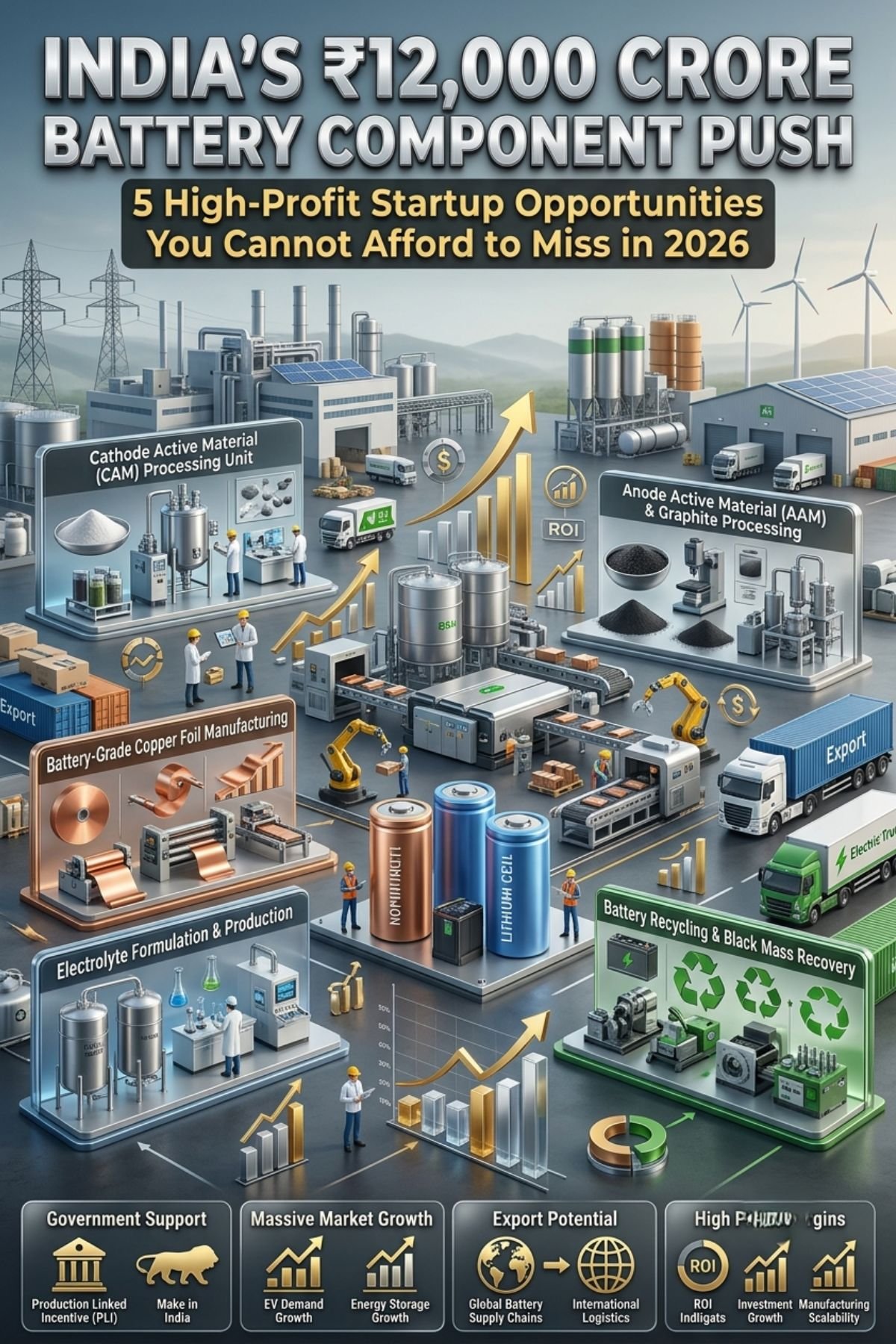
Business Idea 4: Electrolyte Formulation and Production
The flow of energy in a battery cell is carried by the electrolyte, which is an ionic substance. Today, most of these are imported, and manufacturers formulate them chemically with a high degree of accuracy. An electrolyte manufacturing startup with the LFP or NMC electrolyte chemistry would cater to all battery manufacturers in India. The capex entry barrier is less than the CAM or Copper Foil manufacturing, which makes it a good option for well-funded startups or MSMEs chemical manufacturing companies to diversify.
Business Idea 5: Battery Recycling and Black Mass Recovery
The first four concepts focus on new component manufacturing, while the circular economy opportunity lies in battery recycling. The proposed incentive framework implicitly includes this aspect. With the installation of increasing number of batteries in EVs, grid storage, and consumer electronics, end-of-life management is now a need under the extended producer responsible (EPR) norms in India. For OEMs, a business opportunity and regulatory compliance solution is a black mass recovery and lithium-cobalt refining unit that provides a re-supply of the battery supply chain domestically. This is another area where starting capital spending costs less than in upstream component manufacturing.
Get Detailed Insights from This Book: India Lithium-Ion Battery Recycling Market Report
Import-Export Opportunity Analysis
There’s an aspect of this that many overlook, as highlighted in the Economic Times report: “This is not an import-substitution game.” It’s also a possible export possibility. The whole battery value chain is facing a big challenge to de-risk from China. The Japanese, Europeans and the Americans all want other suppliers of alternative battery materials.
If it is done correctly, India’s Rs 12,000 crore scheme will not only benefit domestic cell manufacturers. These markets are all expanding in the use of batteries, which is creating export opportunities for Indian CAM, AAM, and copper foil manufacturers. DPIIT and Export Promotion Councils are already charting India’s potential export options in battery materials.(India battery component manufacturing opportunities)
For new companies looking to enter the battery component manufacturing space, their unit economics need to be based on both domestic demand and export preparedness. Incorporating registration for export benefits under various DGFT schemes and involving the relevant Export Promotion Council from the initial stages of the business will enhance the business model as a whole.
Indian MSME and Startup Success Stories in the Battery Space
Ola Electric — Cell Manufacturing Pioneer
Ola Electric was the first Indian company to showcase the operational production of battery cells under the ACC PLI scheme. Although it was a consumer brand, the upstream commitment from manufacturing proved the viability of the domestic supply chain and indicated to component manufacturers that offtakers are ready in India.
Hindalco — Copper Foil Ambition
The scheme proposes Rs 12,000 crore to set up a facility that will produce copper foil, one of the specific categories targeted under the scheme. Aditya Birla’s Hindalco is already doing that. ICICI Direct Research believes that this is one of the potential big winners of the new policy. It clearly shows that large industrial houses recognise the commercial value of getting into battery component manufacturing.
Greenfuel Energy Solutions — Recycling Pioneer
Greenfuel Energy Solutions is one of the startups in the early stages in India for lithium-ion battery recycling and black mass recovery. The increasing size of the installed base of batteries in India and the impending EPR regulations will create opportunities for batteries companies to swell their revenues and get access to raw materials from battery waste, originating from India.
How Professional Advisory Support Accelerates Your Entry
About NPCS — Your Feasibility and Advisory Partner
Niir Project Consultancy Services is a company that offers project feasibility reports, techno-economic analysis and business planning assistance to entrepreneurs who want to join the manufacturing business sector such as battery components, clean energy materials, and advanced chemistry production.
NPCS services include:
- Detailed Project Reports (DPRs) for bank loan and Incentive applications
- Market demand analysis and competitive landscape assessment
- Plant layout, machinery specifications and capex planning
- Extrusion and foam molding methods
- Registration and compliance information for PLI and government schemes
An entrepreneur entering the battery component business under the new ₹12,000 crore incentive regime can secure approvals, funding, and partnerships much faster and more easily because experts prepare the DPR.
Identify high-growth industries before others do
Battery Component Opportunity Matrix — Quick Reference
| Battery Component | Import Dependency | India’s 2030 Demand | Startup Opportunity |
| Cathode Active Material (CAM) | 100% Imported | 4,00,000+ tonnes | Material processing, coating |
| Anode Active Material (AAM) | 100% Imported | 2,00,000+ tonnes | Graphite processing, synthesis |
| Copper Foil | ~80% from China | High & growing | Precision rolling, plating |
| Electrolytes | Largely imported | Proportional to GWh | Chemical formulation units |
| Separators | Mostly imported | Significant | Polymer film manufacturing |
| Battery Recycling | Nascent stage | ~50 GWh to recycle | Black mass recovery, refining |
Frequently Asked Questions — Founder-Focused
Q1. Who is eligible to apply for incentives under the proposed Rs 12,000 crore scheme?
The plan should focus on the units setting up real local manufacturing plants in respect of any one such battery component – be it the cathode, the anode, copper foil, the electrolyte or separators. This is likely to be applicable for MSME scale manufacturers as well as those by large players, subject to minimum levels of investment and local value addition. Further details may be outlined in due course through a formal notice.
Q2. What is the minimum investment required to enter battery component manufacturing?
This varies significantly by component. Electrolyte formulation units can be established with a capex of Rs 10–30 crore at small scale. Copper foil or CAM processing units typically require Rs 80–300 crore. Battery recycling plants can start at Rs 5–20 crore depending on capacity. Government incentives are expected to partially offset these capital requirements.
Q3. How does this scheme complement the existing ACC PLI scheme?
The ACC PLI scheme supports battery cell manufacturing (the finished battery). The new Rs 12,000 crore scheme targets the upstream components used to make those cells. Together they aim to create a fully integrated domestic battery supply chain from raw materials to finished cells. Component manufacturers who qualify under the new scheme will supply directly to ACC PLI beneficiaries.
Q4. What government registrations does a startup need to access these incentives?
Initially apply for Udyam registration for MSME status and thereafter for DPIIT Startup Recognition scheme (if applicable). All the schemes such as PLI and component incentive are dealt by respective ministries. Mostly a Detailed Project Report (DPR) made by a professional must for scheme application.
Q5. Is there an export opportunity in battery components, or is this only a domestic play?
Both. Apart from serving the exponentially expanding domestic Indian battery manufacturers in the short term, the global battery supply chain is desperately scouting for alternative non-China sources for CAM, AAM, and copper foil. India-based manufacturers with world-class quality certifications will have the advantage of exporting to Japan, Europe and Southeast Asia. A well-prepared application for DGFT export benefit schemes, submitted from Day 1, should be considered.
Q6. How long does it typically take to commission a battery component manufacturing unit in India?
For a greenfield unit, the timeline from land acquisition to first production typically ranges from 18 to 36 months depending on component type, technology sourcing, and regulatory clearances. Working with experienced project consultants and having a ready DPR significantly reduces delays at each stage.
Conclusion: The Window is Open — Move Early
Economic Times has just flagged what could be the most important manufacturing policy development in India’s clean energy calendar for 2026. The Rs 12,000 crore battery component incentive scheme signals that India is serious about building a complete, integrated battery supply chain — not just cell assembly.
The market numbers make the case compellingly. A 36.5 percent CAGR in battery demand from now to 2030. Over six lakh tonnes of CAM and AAM needed annually by the end of the decade. Near-total import dependence across every component category. Government money on the table. OEMs ready to sign long-term supply contracts with domestic producers.
What India lacks — almost entirely — is the entrepreneur willing to build the battery component factory that everyone else needs. The government is now offering significant financial support to those who do. The export markets are watching. And the timing, as Economic Times reporting signals, is now.
Founders with chemistry, materials, or precision manufacturing backgrounds have a genuine first-mover window here. MSME owners in chemical processing, metallurgy, or advanced plastics can pivot into separator or electrolyte production with manageable capex. Battery recycling entrepreneurs can start smaller still and grow as India’s installed battery base expands.
Wherever you start, the principle is the same: act before the scheme is over-subscribed and the market fills up. For detailed project feasibility reports, techno-economic analysis, and government scheme application support, explore resources from DPIIT and register your intent through Invest India early. The Rs 12,000 crore opportunity is real. The founders who read this Economic Times signal and act on it in 2026 will look back at this moment as the one that defined their businesses.