Haryana Rooftop Solar Business Opportunities
There is something big going on in Haryana now. The state government has just announced a bold clean energy plan to which no entrepreneur in India can afford to ignore. The Economic Times Energy recently reported that the state of Haryana has set a goal of 2 lakh rooftop solar installations under the PM Surya Ghar Muft Bijli Yojana for the financial year 2026–27. In tandem with this aggressive deployment plan, the state has also made some major changes to regulatory norms, effectively removing red tape that was holding back the solar industry.
It’s more than an energy issue. This is a business opportunity story. The Haryana initiative on rooftop solarization is a window of opportunity for MSMEs, start-ups and young entrepreneurs. If the state government is willing to deploy 2 lakh installations in 2 years, it creates an entire value chain opportunity to be tapped — from the hardware supplier to the installation company, software solution provider, financing mechanism to the after-sales servicing and maintenance provider.
This is one of the biggest state level changes in renewable energy policy for 2026, in the Economic Times. The benefits might be tremendous for its founders who relocate early. The market may be full when you arrive. This article discusses the implications of the rooftop solar expansion in Haryana for Indian entrepreneurs, business opportunities that arise out of this policy change and how MSMEs can benefit from it.
What Recent Economic Times Reporting Means
The Economic Times Energy desk recently reported that the government of Haryana is aiming to install 2 lakh rooftop solar systems by 2027 under much lowered norms. There are several layers of business intelligence to absorb here on this single development – each and every founder and MSME owner must carefully imbibe.
The market signals that are actually taking place:
- Over 280 helpdesks have been established by the State in its DISCOM subdivisions to assist consumers with installation.
- Passive workforce development is already underway with 703 officials and vendors already trained through NPTI and NIESBUD.
- A centralized online platform has been established for ease of process flow and end-to-end.
- Central Financial Assistance will be given in 15 days, along with State Financial Assistance for the Economically Weaker Sections — both under the same category of subsidies.
- All 4,523 government buildings are being surveyed for solarisation with a total potential of 122 MW.
To the entrepreneur, this is one clear message, the government has already created demand. Construction of the pipeline is underway. Funding for the project is being secured. Awareness is in the hands of the consumers. The market’s need still is a surge of service providers, product manufacturers, financing intermediaries and technology enablers to fill the execution gap, and this report from ET confirms that there is indeed a need.
Get Detailed Insights from This Book: Solar PV Power and Solar Products Handbook
Why This Industry Is Growing — and Why Haryana Is the Epicentre
The growth of this industry and why Haryana is its epicentre.Why this Industry is Growing and why this is the epicentre of Haryana.
Rooftop Solar market has been one of the most stable in the last decade in India. However, 2026 is turning out to be a year of opportunities for those at the state level, led by Haryana.
National Tailwinds Are Strong
India has set the target of having 500 GW non-fossil fuel installed capacity by 2030. Rooftop solar is projected to be able to meet at least 40 GW of that target. National targets and implementation on the ground leave ample room for private companies, particularly at the state level where the length of the procurement process is shorter and policy support is more concrete, as Economic Times has reported on its energy coverage numerous times.(Haryana Rooftop Solar Business Opportunities)
Haryana’s Specific Advantages
Haryana has many small and medium-sized residential, commercial and industrial buildings, both in urban centres like Gurugram, Faridabad and Panchkula, as well as semi-rural areas. The state also has rather high grid tariffs, making solar payback even more appealing for consumers. When added to the new simplified norms, this puts us in near-perfect conditions for mass market adoption.
- More than 30,600 rooftop installations already done – Real market traction and not just paperwork.
- An institutional procurement pipeline identified 122 MW of solar potential at government buildings.
- Dual subsidies to lower financial barriers for consumers — expanding addressable market to lower income groups.
- Approval rates to rise in DISCOM booster schemes, with project turnaround time slashed.
Energy news agency, Economic Times, always puts Haryana in the spotlight as one of the most implementation-ready states in the country at present. That said, the consensus of the editors is a sign not to be ignored.
Government Policies and Incentives Supporting the Opportunity
It’s important that no businessman goes into this market without knowledge of the policy scaffolding. The Haryana rooftop solar expansion is a component of a national ecosystem of support schemes; taking the best advantage of it is a big competitive advantage for any business.
PM Surya Ghar Muft Bijli Yojana
Consumer bank accounts are paid with the national scheme subsidies in 15 days after approval. This quick cash flow solution has revolutionized consumer concerns about upfront solar investments.
MSME Government Support
Small and medium enterprise entrepreneurs can avail of various types of financing options on MSME India Government Portal such as credit linked capital subsidy schemes (CLCSS) for technology upgradation and term loans for green manufacturing entrepreneurs. Priority sector lending norms can also be welcomed by MSMEs entering into the solar component manufacturing space.
Startup India Recognition
Entrepreneurs, who start a business in the rooftop solar services, technology or financing domain, can register under Startup India and enjoy income tax benefits, expedient patent processing, and government tenders. This is especially true for fintech platforms that specialize in solar financing or aggregator models.
Make in India & PLI for Solar
The Make in India initiative and the Production Linked Incentive (PLI) scheme for solar modules makes a good business case for local manufacturing of solar panels, solar inverter, and mounting parts. The state’s 4,523-building solarisation plan will demand a lot of procurement for the local manufacturers who will be given preference in government tenders.
Get Detailed Project Report (DPR): Renewable Energy Sector: Green Power, Solar, Wind & Bioenergy
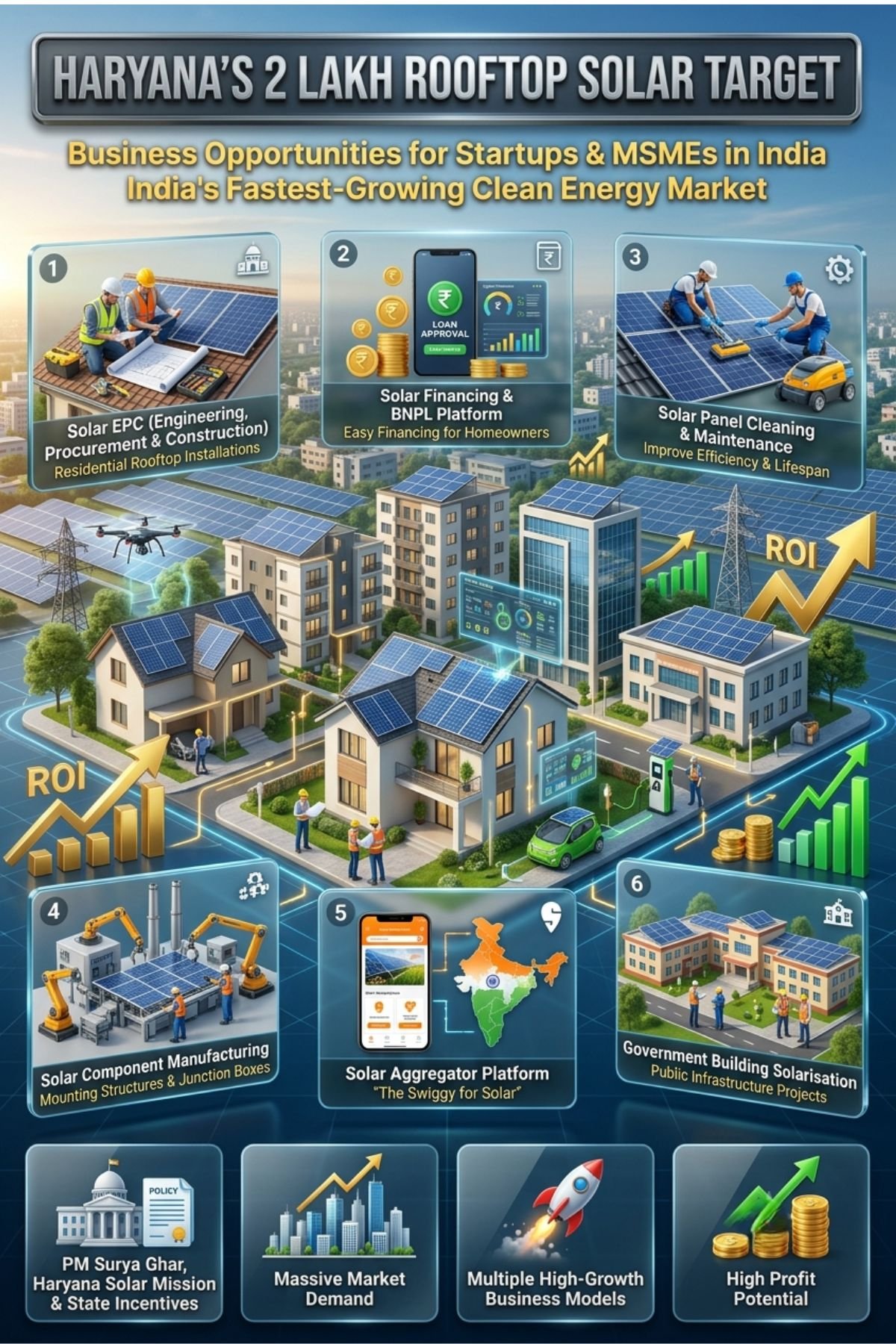
Business Ideas for Startups Emerging Directly from This News
The Economic Times report is an indicator of demand. Here are 6 business ideas that come straight out of the jigsaw 2 lakh rooftops that Haryana is aiming for — and their respective value proposition goes hand in hand with the market gap.(Haryana Rooftop Solar Business Opportunities)
Business Idea 1: Solar EPC (Engineering, Procurement & Construction) Company for Residential Rooftops
The easiest and most straightforward chance. The need of the hour is to have licensed solar installation contractors in huge numbers in Haryana. An EPC company with an established track record in the rooftop solar segment in the residential segment in Haryana can build a repeatable high-volume business, as more than 1.7 lakh installs are still pending. The relaxed requirements result in quicker approvals and more throughput per team. This market is quite accessible for the entrepreneurs having the basic background of electrical or civil engineering as they can enter with moderate investment. The Government subsidy model also makes it much easier for consumers to convert than in unsubsidised markets.
Business Idea 2: Solar Financing and BNPL Platform
In the rural and semi-urban areas of Haryana, many consumers are encountering up-front cost barriers, despite subsidies. There will be huge market opportunity for a fintech startup with a Buy Now Pay Later (BNPL) or micro-loan for solar products, tied to DISCOMs and NBFCs. Collateral trigger – 15-day subsidy disbursement from the government. Other than awareness, the single biggest challenge to solar adoption is affordability, which the Economic Times has highlighted and can be monetized.
Business Idea 3: Solar Panel Cleaning and Maintenance Service
In India, the solar industry manufactures hardware. There are already 2 lakh rooftop systems in Haryana and soon the number will reach that.The state of Haryana soon would have 2 lakh rooftop systems and each one of them will require periodic maintenance, cleaning and performance monitoring. A tech-driven O&M (Operations & Maintenance) start-up targeting the installed base in the State of Haryana could potentially create a recurring revenue model without much capex. Annual maintenance contracts are little explored in this field in a subscription model. As in the North Indian environment, the efficiency of panels decreases by 15-25% on soiling, customers have real ROI incentives to sign up.
Related Article: Solar Cell Manufacturing in India 2026: Market Size, Investment Cost & Profitability Analysis
Business Idea 4: Solar Component Manufacturing — Mounting Structures & Junction Boxes
While not every person can make solar panels, there are still niches which aren’t being met in manufacturing such as mounting structures, junction boxes, DC cables, and module-level power electronics. Geographic accessibility to the demand cluster, advantages of PLI scheme, and Government procurement eligibility are benefits of an MSME in this segment in Haryana. The capital requirement is significantly less than manufacturing panels, and still the import substitution is relatively high: a natural commercial moat.
Business Idea 5: Solar Aggregator Platform — The ‘Swiggy for Solar’
Imagine a digital marketplace where the verified solar installers are matched with residential consumers who are interested in rooftop solar energy installations in Haryana. The platform facilitates quoting, vendor matching, support for subsidy documentation, installation scheduling and post-installation feedback. This model is especially effective as the government moves towards streamlining processes: the platform can serve as the digital Facelift on the streamlined regulatory process. Sales model: Lead generation fees from EPC companies – commission for every completed installation.
Business Idea 6: Government Building Solarisation Contractor
Haryana has identified 122 MW solar potential in 4523 Government buildings across the State. Many times, founders only think about the residential market and this is an institutional B2G (Business-to-Government) opportunity. Government building solarisation tenders are open to MSME and startup, which are registered with DPIIT, have good financials, and have a solid technical team. The ticket sizes are bigger, margins are stable and payment security is assured with government guarantees.(Haryana Rooftop Solar Business Opportunities)
Import-Export Opportunity Analysis
The growth of rooftop solar in Haryana also unlocks significant trade potential, both in terms of import substitution and development of export potential.
Import Substitution Opportunity
India is dependent on a large extent on imports of solar cells and modules. The PLI scheme aims to address this issue, but the opportunity gap is significant, especially in specialist areas such as MPPT charge controllers, string inverters below 10 kW and high purity solar glass. MSMEs who are starting up a component manufacturing business in Haryana can avail both demand and import substitution incentives.
Export Potential
With the expansion of solar manufacturing in India, export markets in Southeast Asia, Africa and West Asia are also opening up. The Confederation of Indian Industry (CII) has been actively promoting Indian solar exporters through buyer-seller meets and trade facilitation. By 2027-28, start-ups that have developed a good manufacturing gland today will be manufacturing ready for exports in the future.
Raw Material Sourcing
Import of critical raw materials includes silicon wafers, silver paste and back sheet materials. For an MSME building a procurement aggregation business that buys bulk raw materials and supplies them to smaller solar manufacturers across Haryana and neighboring Punjab, you can build a B2B distribution model driven by repeat purchases and steady demand.
Indian MSME Success Stories in Rooftop Solar
The rooftop solar movement has already cultivated a generation of Indian entrepreneurs who have developed tangible businesses out of policy-driven tailwinds and their stories provide useful lessons for entrepreneurs today.
Amplus Solar — From Startup to Industrial Rooftop Leader
Amplus Solar started with a niche business model in rooftop solar power geared towards industrial and commercial buildings in North India. It gained extensive experience in EPC services and developed its own asset management software, which helped it become one of India’s leading commercial and industrial (C&I) rooftop solar companies before a global energy major acquired it. Now, with the residential push, Haryana has launched a new parallel framework for residential-based MSMEs.
Solar Square Energy — Digital-First Consumer Solar
Solar Square introduced a new consumer-focused rooftop solar brand that offers a complete service package, including financing, installation, and maintenance. Their model, which is simplifying the consumer journey and has robust after-sales service and support, is directly replicable in the environment of Haryana which is simplified. Solar Square told The Economic Times that consumer confidence, not just technology, is the key factor behind rooftop solar adoption, and the newspaper cited it as an example.(Haryana Rooftop Solar Business Opportunities)
Haryana-Based DISCOMs Vendor Ecosystem
Local MSMEs had been able to create sustainable businesses by keeping their DISCOM vendor registrations and ink a regular government contract with Haryana’s state DISCOMs (DHBVN and UHBVN). These are examples of companies that show that B2G solar contracting is both patiently slow, but predictable and with high retention.
Feasibility and Advisory Support: The Role of Project Consultants
If you are a serious entrepreneur looking to enter the rooftop solar market, the first key step is to conduct a credible project feasibility study. You can carry this out as an installer, manufacturer, platform provider, or financier. The National Productivity Council of India and professional project advisory companies help founders create bankable business plans, identify suitable government schemes, and complete the DISCOM vendor registration process. An advantage in Haryana’s institutional procurement pipeline is the DPIIT registration which provides for startup recognition and corresponding benefits of self-certification, ease of compliance, and priority access to Government solar tenders.
The Small Industries Development Bank of India (SIDBI) has announced green energy specific lending schemes and the National Small Industries Corporation offers credit facilitation for MSMEs entering manufacturing segments to finance. It’s important for founders to prepare a comprehensive project report before they go to these institutions.
Discover business ideas that actually make money
Key Data: Haryana Rooftop Solar Market at a Glance
| Parameter | Data / Status | Business Implication |
| State Target (FY 2026-27) | 2.2 Lakh Rooftop Installations | Massive installer demand — over 1.7 lakh units still to execute |
| Installations Completed So Far | 30,631 Systems | Proven demand; early movers already active |
| Government Building Pipeline | 4,523 Buildings | 122 MW Potential | B2G contracting opportunity for MSMEs |
| Helpdesks Established | 280+ Across Subdivisions | Consumer support infrastructure lowering barriers |
| Officials and Vendors Trained | 703 (NPTI & NIESBUD) | Skilled workforce gap — training startups can enter |
| Subsidy Disbursement Speed | CFA Within 15 Days of Approval | Consumer conversion easier; financing models viable |
| State Financial Assistance | 1 Lakh Antyodaya Families Targeted | Low-income segment now addressable |
| National Solar Target (2030) | 500 GW Total; 40 GW Rooftop | Long-term market certainty for investors |
Frequently Asked Questions (FAQs) for Founders
Q1: What is the best entry point into Haryana’s rooftop solar market for a first-time entrepreneur?
The EPC (installation services) segment is the most easily accessible and highest-yielding segment. The demand is created with government subsidies and the encouragement by DISCOMs. All you need is a reliable installation team, vendor registration with DHBVN or UHBVN, and basic project management skills. The suggested approach for beginning with residential installations, building a track record, and subsequently transitioning to commercial or institutional installations.
Q2: What is the amount of capital required to establish a Solar installation business in Haryana?
A startup company for installation of Residential solar system can be established with Rs. The capital investment of 10-25 lakh. This includes basic tools and equipment, working capital for first batch of installations, registration with DISCOM vendors and marketing. For manufacturing companies, the investment is much hefty — say, Rs. The price ranges from 1 crore to 5 crore depending on the type of the component.
Q3: Are government tenders for Haryana’s 4,523 government buildings open to small MSMEs?
Yes, with conditions. Smaller governments tenders (usually below Rs. The term 2 crore — is usually reserved for MSME bidders, based on the procurement policy of Government of India. But MSME registration, Udyam certificate and sometimes previous project experience are needed. The vendor empanelment process should start with the state DISCOMs right from the start so that the foundation could be laid for this pipeline.
Q4: What are the government schemes available for the funding of entry into solar manufacturing by an MSME?
The key schemes are the green energy lending scheme of SIDBI, Credit Linked Capital Subsidy Scheme (CLCSS) of MSME ministry on technology upgradation and PLI scheme for solar manufacturing. Fast-track compliances and exemptions from angel tax are also available for startups that have DPIIT recognition. Eligibility and application processes are mentioned in detail in the MSME India government portal.
Q5: Does the rooftop solar opportunity apply to Haryana or it’s a pan-India play?
Haryana is a beginning and not an end. The PM Surya Ghar Muft Bijli Yojana is an initiative across the country and states such as Rajasthan, Uttar Pradesh, Maharashtra and Gujarat have their own installation targets. A successful entrepreneur in Haryana with a good execution capability and vendor network will definitely be in a better position to expand the business beyond the state lines as the national market matures.
Q6: How do I find out more about licensing, compliance and scheme eligibility for my solar start up?
The Invest India portal provides a thorough information on facilitation and licensing for different sectors. The Startup India platform also has a helpline and regional facilitators to assist the founders in the process of the DPIIT registration and facilitation of government benefits for the solar scheme.
Conclusion: The Window Is Open — For Now
The entrepreneur ecosystem in India has received the clearer of business signals in 2026 so far, from Haryana. A state government has set a target to install 2 lakh rooftop solar systems by 2027. It has announced two subsidies. It has also eased regulations. The government is building infrastructure for consumers. It has started training workers as well. The Economic Times did well to describe it as a major market development. It involves four rare elements. These are demand creation by the government, willingness to support consumer purchases, ease of regulation, and an open market.
The question of timing is simple in case of startups and MSMEs. There is not much competition in the market. Government is constructing a pipeline for consumers. Preparation of financing infrastructure is in progress. Indian entrepreneurs face the greatest risk when they are uncertain about the market. The real danger comes when they are paralysed by poor timing decisions. As the 2027 deadline approaches, companies will prepare for vendor credentials and build technical teams. Those that start early and show results in 2026 will capture a larger share of the market.(Haryana Rooftop Solar Business Opportunities)
The economic times market signal is evident. The direction of the government policy is set. The opportunity is there for commerce. What’s left is the founder’s choice to make a conscious, credible and proactive move.
If you are ready to take action: The rooftop solar market in Haryana is not an option. It is a fact on the ground as the Economic Times piece confirms.