

Green Solvent Manufacturing Plant in Odisha
The Solvent Industry’s Sustainability Crisis Is a Business Idea
Solvents are used in every pharmaceutical plant, every paint factory and every electronics assembly line. Solvents dissolve, clean, extract, carry – they work unseen to help make hundreds of manufactured products. The problem is, most of the solvents currently being used are toxic volatile organic compounds from petroleum. They have a detrimental impact on workers, contaminate groundwater and are being phased out on a growing global basis by European, American and Asian environmental bodies. They are now one of the fastest-growing business ideas in Indian specialty chemicals — the replacement is green solvents. The global green and bio-based solvents market was valued at USD 5.37 billion in 2013 and is expected to grow at 7.3% CAGR during the forecast period.
The pharmaceutical and personal care sectors are the major domestic consumer markets in India. The place to establish this manufacturing capability is Odisha with its rice husk biomass and the feedstock advantage of IPA in Paradip coupled with the burgeoning pharmaceutical cluster.
Get Detailed Project Report (DPR): Best Business Opportunities in Odisha (Orissa)
Why Green Solvents Are Replacing Conventional Alternatives
It’s all about regulation. European Medicines Agency (EMA) and the US Food and Drug Administration (FDA) are increasingly demanding pharmaceutical manufacturers use Class 3 solvents (low-toxicity) in the manufacture of API’s. Toluene, xylene (dichloroethane), methyl ethyl ketone are most common solvents, and all are Class 1 or Class 2. Converted to ethyl lactate or furfural based solvents or bio-glycols – meets regulations and unlocks high dollar export orders.
Moreover, the safety laws are becoming more stringent in India. VOC (Volatile Organic Compounds) reduction is a priority for factory inspectors. Organizations that implement green solvents decrease their environmental footprint, reduce their insurance costs for the industry, and enhance their ESG metrics, which are gaining traction in the decision-making of buyers and for financing. So, green solvents are not simply a preference for sustainability. These are now a necessity in business.
Government Policies Supporting Green Solvent Manufacturing
PLI scheme is provided for specialty chemicals which enable manufacturers of high value products containing specialty chemicals manufactured from bio materials. The PCPIR at Paradip provides shared infrastructure for chemical manufacturers setting up in the zone — significantly reducing project capital costs. The industrial policy of Odisha provides for grant of capital subsidy ranging from 15-25% for new industrial unit, waiver of electricity duty for 05 years and single window clearance through SLSWCA. The isopropyl alcohol (IPA) production facility at the IOC Paradip complex can be used directly as feedstock at a cost advantage to the downstream green solvent producers located within or near the PCPIR area.(Green Solvent Manufacturing Plant in Odisha)
The Department of Biotechnology’s BIRAC scheme also provides support for fermentation based green chemistry ventures including lactic acid production, the precursor for the most important bio-based family of solvents (lactate esters). This is a dual policy support (industrial+ biotechnology) which provides green solvent entrepreneurs in Odisha a wider scope of funding and incentives than most of the chemical categories.
Source: Invest Odisha – Policy Framework
Business Ideas: Green Solvent Manufacturing Categories
Business Idea 1: Ethyl Lactate Plant — The Premier Green Pharmaceutical Solvent
Ethyl lactate is produced by esterifying lactic acid with ethanol. It is totally biodegradable, non-toxic and is used as a solvent in pharmaceuticals, coatings, electronics cleaning and industrial degreasing. Replaces two of the most regulated industrial solvents in India and around the world: toluene and methyl ethyl ketone. Pharmaceutical-grade ethyl lactate is a huge and expanding consumer of the domestic pharmaceutical industry. The rice processing industry in Odisha produces broken rice, the cheapest substrate for lactic acid fermentation unit that is used as feed for the esterification unit. An integrated broken-rice-to-lactic-acid-to-ethanol (ETHYL-LACTATE) plant of 3,000-8,000 TPA can need a capital investment ranging from ₹30-70 crore, and can generate a product of ₹80-200 per kg. The pharma cluster being developed at Khordha is just 60 km from the city of Paradip and has a captive and local customer base, hence there won’t be any distribution cost.
Business Idea 2: Furfural-Based Green Solvents — From Rice Husk to Industrial Solvent
Acid hydrolysis converts the hemicellulose fraction in rice husk into bio-based solvents, including furfural and its derivatives, furfuryl alcohol, and tetrahydrofurfuryl alcohol (THFA). Refiners use furfural directly as a solvent to refine lubricants and produce resins. THFA serves as a specialty green solvent for agricultural formulations, electronics cleaning, and pharmaceutical applications, and its premium grade costs ₹200–400 per kilogram. China is the current major producer of furfural. India produces a lot of rice husk while it is importing the majority of its rice husk requirement.
The plant technology for furfural from rice husk of the Odisha-based plant at 5,000–20,000 TPA scale of feedstock use can generate 500–2,000 TPA of furfural and downstream products with capital investment requirement ranging from ₹25–80 crore per plant and gross margin of 35–55%. It’s a direct import substitution play, and will have strong export optionality to Southeast Asia.
Related Article: Rice Husk Ash Silica Manufacturing in India: Market Demand, Plant Cost & Profit Outlook
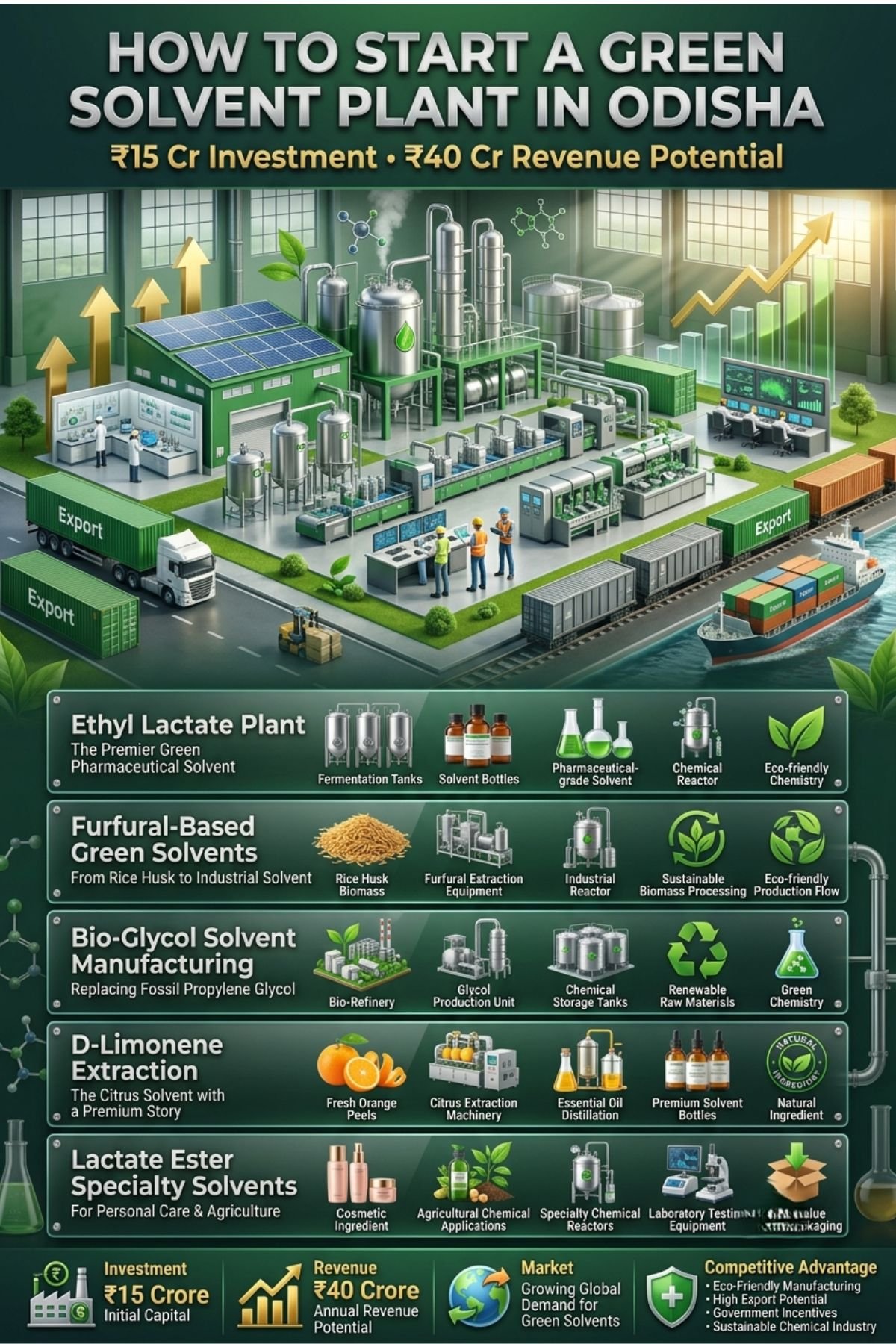
Business Idea 3: Bio-Glycol Solvent Manufacturing — Replacing Fossil Propylene Glycol
Business Idea 4: D-Limonene Extraction — The Citrus Solvent with a Premium Story
D-Limonene is extracted from citrus peel waste — a by-product of orange and lemon juice processing. It is a strong degreaser, paint remover and industrial cleaning solvent which is 100% biodegradable with a nice citrus smell. Manufacturers use D-Limonene in premium industrial cleaners, electronics degreasing solutions, and specialty paint removers. Juice processing centres either burn or compost Indian citrus peel waste, which serves as the raw material. Though citrus is not a prominent crop in Odisha, coastal shipping from Andhra Pradesh and Tamil Nadu would make citrus waste available to a citrus extraction plant at Paradip or Gopalpur. The selling price of the product is ₹80-180 per kilogram. Capital: ₹8-20 cr for a small extraction and purification unit.(Green Solvent Manufacturing Plant in Odisha)
Business Idea 5: Lactate Ester Specialty Solvents for Personal Care and Agriculture
In addition to ethyl lactate, there are other lactate esters, such as methyl lactate, n-butyl lactate and isopropyl lactate, each with its own solubility characteristics and uses. Methyl lactate used in coatings and inks, butyl lactate used in industrial cleaning formulations, isopropyl lactate used as a skin-feel enhancer and solvent in personal care formulations. These specialty lactate esters combine together to form a differentiated product mix with high margins which a lactic acid producer can offer based on esterification alcohol inputs. India’s specialty lactate ester market remains less developed, and importers supply most of the demand. A dedicated specialty ester unit co-located with a lactic acid plant can achieve margins of 40–65% from both pharma and personal care customers.
Get Detailed Insights from This Book: Profitable Agro Based Projects with Project Profiles (Cereal Food Technology)
Import–Export Opportunity Analysis
India imports considerable amount of greensolvents like ethyl lactate, furfural, THFA and bio-glycols from Europe and China. Either a liability on the supply-chain or a business opportunity. Domestic production displaces these imports and provides a cost-competitive advantage to Indian downstream manufacturers by using green solvents as inputs in their production processes.
Looking at exports, the market in Europe is the most obvious. EMA’s ICH Q3C guidelines are increasingly pushing manufacturers to use Class 3 (green) solvents for API manufacturing. Compliant solvents: Indian pharma API exporters have to use compliant solvents, which is the domestic supplier providing pharmaceutical grade ethyl lactate or THFA at competitive price displaces the current European and Chinese import.
Another large export market is the ASEAN agrochemical market. Vietnam, Indonesia and Thailand are seeing increasing growth of green (solvent based) pesticide and herbicide formulations due to stricter environmental laws. The exporter of green solvent from Odisha having a port at Paradip enjoys a cost advantage over any other Gujarat company in terms of freight charges.
Source: IBEF Chemicals Industry
Indian MSME Leaders in Specialty and Green Chemistry
Aarti Industries — Building Scale Through Chemistry Focus
Aarti Industries, run by the Gogri family of Vapi, Gujarat, is India’s biggest example of a specialty chemical MSME which has become a large-cap listed firm with a sustained chemistry focus, backward integration and export diversification. The model of theirs—namely, locating in a close proximity to a cluster of petrochemical feedstocks, develop product depth, and cater to export markets—is directly relevant to the green solvent manufacturer based in Odisha. In the case of Odisha, the feedstock segment is the Paradip PCPIR, the product segment is the lactate ester or furfural derivatives, and the export market is the pharma industry in Europe and the agro industry in the ASEAN countries.
Rossari Biotech — Proving Bio-Based Chemistry’s Commercial Value
The journey of Rossari Biotech from being an MSME in the textile chemicals to a speciality chemicals company listed on the BSE with a focus on bio-based products signifies that fermentation based green chemistry can lead to investor grade returns in India. For a green solvent entrepreneur with focus on the production of lactic acid and ester process, both of which are technologies based on fermentation like Rossari’s enzyme and specialty processes, Rossari’s success is a clear proof that the business model works and can attract institutional capital.
Niacet India — Specialty Organic Acid Pioneer
Newexcel (Niacet) has displayed the viability of organic acid and ester chemistry in the Indian pharma and food markets with specialty partnership offerings in India. It emphasized product purity, regular supply, and technical customer service, which led to premium pricing power that commodity chemical competitors lacked. This is the exact model that an Odisha-based green solvent manufacturer should follow— Technical, not price leadership.
How NPCS Can Help You Start Your Green Solvent Business
We prepare detailed Techno-Economic Feasibility Report (DPR) for entrepreneurs who are going into the business of manufacturing in the field of green and bio-based solvents at Niir Project Consultancy Services (NPCS). Therefore, our reports provide a complete manufacturing process, raw material sourcing strategy, selection of machinery and cost analysis, detailed market demand analysis and extensive financial projections, which involve revenue modelling, breakeven analysis and IRR calculation. For a ₹15 crore furfural extraction mill, or an integrated lactic acid to ethyl lactate plant that will cost ₹70 crore, we’re here to arm you with the in-depth analysis you need to gain the financing you deserve and make solid decisions with confidence.
Source: NPCS – Project Consultancy
Find high-return business ideas based on your budget & ROI
Green Solvents Market Snapshot — Business Opportunity Data
| Green Solvent | Primary Application | Price/kg (₹) | Capital (₹ Cr) | Raw Material |
| Ethyl Lactate | Pharma / Coatings | 80–200 | 30–70 | Broken Rice |
| Furfural & THFA | Agro / Electronics | 120–400 | 25–80 | Rice Husk |
| Bio-Propylene Glycol | Cosmetics / Pharma | 60–120 | 20–60 | Glycerol / Bio-Ethanol |
| D-Limonene | Cleaning / Paint | 80–180 | 8–20 | Citrus Peel Waste |
| Butyl Lactate | Coatings / Inks | 100–220 | 20–50 | Lactic Acid + Butanol |
Frequently Asked Questions (FAQ)
1. What makes ethyl lactate better than conventional solvents for pharmaceutical use?
Ethyl lactate is classified as a Class 3 solvent under ICH Q3C guidelines — meaning it carries the lowest safety risk profile of all industrial solvents. It is also biodegradable, has a pleasant odour, and is compatible with a wide range of pharmaceutical ingredients. These properties make it the preferred solvent for API synthesis in formulations destined for EU and US markets.
2. How does a rice-husk-based furfural plant compare to a corn-based one?
Rice husk contains 15–20% hemicellulose (xylose) — the furfural feedstock fraction. Corn cobs have a higher xylose content (30–35%), making them a more efficient feedstock. However, rice husk is available in Odisha in far larger quantities and at lower cost than imported corncobs. The trade-off favours rice husk for volume-based economics; corncobs suit a smaller, higher-purity operation.
3. Is green solvent manufacturing capital-intensive for an MSME?
To start-off the entry level of green solvent operations – D-limonene extraction ($8-20m) or mini furfural plants (around $25-40m), have options in terms of loan from MSMEs / SMEs with working capital requirements and interest subsidies. Large scale integrated plants ($50-100m) can take a term loan from SIDBI / Institutional players.
4. What certifications does a green solvent manufacturer need for export?
Important certifications involve ISO 9001 for quality management and environmental aspects, REACH registration to enable sale into the EU, GMP compliance for pharma grade qualities in sales of pharmaceutical solvent, and Bio-based content certification such as for USD Bio Preferred and for corresponding European quality systems, if these were important differentiators to market into premium markets.
5. Is IPA from the Paradip IOC complex available to downstream green solvent producers?
Yes. The IOC Paradip Petrochemical Complex has committed feedstock supply to downstream industries setting up within the PCPIR zone. IPA — a key intermediate for isopropyl lactate and other specialty ester solvents — will be produced at the complex. PCPIR participants can access this feedstock directly, reducing raw material logistics cost significantly.
6. Which state incentives apply specifically to bio-based solvent manufacturing in Odisha?
Odisha provides 15-25% capital subsidy with a five-year power duty waiver, stamp duty rebate, and a single-window clearance in its MSME and Large Industry policies. Bio-based units, that process agricultural waste, are eligible to receive incentives from either State or Central MSME schemes. The incentives also allow for benefits available under agro-processing policies.
Conclusion: Green Solvents Are the Chemistry of Tomorrow — Available to Build Today
The green solvents market is not a bubble. Export buyers regulate and require this annual USD 7.57 billion market, and the global trend toward sustainable manufacturing drives its growth. India has to import all its green solvent needs. Manufacturers in Odisha can produce these materials in-house using locally available raw materials such as rice husk, agricultural biomass, and IPA from Paradip.
The green solvent manufacturing entrepreneurs who will set the path for the first cluster of green solvent manufacturing in eastern India will not only be able to tap the domestic market but will also be able to tap into the global market.They will be the preferred suppliers to India’s fast-growing pharmaceutical and personal care export markets. Together, these sectors contribute billions of dollars in foreign exchange and actively seek compliant, domestically sourced green chemistry inputs. So it’s not simply a great business concept. It’s a timely, infrastructure-driven and regulatory opportunity for the first mover.