India Electrical Equipment Industry
India’s Electrical Equipment Sector Is Having Its IT-Industry Moment
It has already happened in India. The nation has created industries on a global scale from scratch in the fields of IT services and auto components. Now, according to McKinsey – in a groundbreaking report released and reported in Economic Times – the electrical equipment industry is on its way. Those figures are not to be ignored – production could reach as high as $235 billion by 2035, up from approximately $50 billion this year.
This week, Economic Times published a report detailing the study “Wired for Growth: India’s Electrical Equipment Opportunity” by the firm McKinsey & Company. The report, co-prepared by the Indian Electrical and Electronics Manufacturers Association (IEEMA), contains not only a golden opportunity, but a serious warning as well. India can enjoy a $235 billion wave — if it is ready to take a decisive action and move quickly.
It’s not an investment analyst slow-burn macro story. This is a very clear signal for entrepreneurs, MSMEs, and startup founders. The market deficit is clearly there, the demand is already increasing at 11% compound growth rate, government schemes are in operation and the early movers in the power electronics and battery manufacturing and localisation of solar PV will have structural advantages over the late movers which can only be emulated.
For anyone waiting for the right time to invest in manufacturing in India, this Economic Times-backed McKinsey signal could possibly be the best sign you get in the next ten years.
What Recent Economic Times Reporting Means
Indian manufacturers have recently been in the spotlight, as the Economic Times published McKinsey’s “Wired for Growth” report with a prominent mention of the incredible growth potential and the immediate structural challenges that need to be addressed. The reporting reveals the following to founders and investors:
The Headline Opportunity
The domestic production of electrical equipment in India is around $50 billion in 2025. McKinsey estimates this will be $195-235 billion by 2035. The cost to the domestic market is potentially between $170 and 205 billion. Exports could top $60 billion. This is a sector that is expanding by 11–13 percent a year for 10 years.
Read the Complete Book Here: Handbook on Electric Vehicles Manufacturing
The Warning That Founders Must Hear
The dependency of imports in electrical equipment has already increased from 22 per cent in 2020 to 33 per cent in 2025. If the organization continues on the path it has been taking, this could reach more than 70 percent by 2035, with a shortfall in production of more than $130 billion, McKinsey warns. The report specifically references the possibility of this bill being compared with India’s imports of oil and gas, which should give any individual with an interest in the manufacturing future of India a reason for concern.
The Four Critical Localisation Gaps
- Today power electronics are more than 90 percent import reliant.
- Batteries are over 60% import dependent, and the demand is growing by 15% CAGR.
- PV cells and modules: ~40% imported.
- Despite the ability to assemble components locally, 60%+ of sub-components for smart meters and grid equipment are imported.
The whole Economic Times report: India’s Electrical Equipment Industry to reach $235 Billion by 2035 is here.
Why This Industry Is Growing: The Structural Tailwinds
Not just one policy push is fueling India’s electrical equipment industry. Multiple structural forces are acting at once, which makes it grow. It’s precisely that convergence that makes the opportunity so lasting.
Urbanisation and Infrastructure Buildout
India is building thousands of kilometres of grid and hundreds of millions of urban consumers. Transformers, cables, switchgear and control systems are required in every new building, factory, data centre, public facility etc. The amount of money invested in urban infrastructure is at a multi-decade peak.
Renewable Energy Acceleration
India has set 500 GW target for renewable energy by 2030. There is a significant demand for large numbers of inverters, batteries, grid stabilisation equipment and high-voltage cables for solar parks, wind farms and green hydrogen plants. This one factor alone is bringing about a change in demand for the entire industry.
Data Centre Boom
The capacity of the data centres in India is growing at an accelerated pace to enable cloud adoption, AI application and digital government service. Data centres are a high-power environment with a high demand for high-margin UPS systems, precision cooling, power electronics, and energy management software.
Electric Vehicle Ecosystem
Power electronics converters and smart charging controllers are needed for EV charging infrastructure. The number of fast chargers, battery management systems, and equipment for energy storage grid integration will grow rapidly alongside the rising share of EVs.
Export Market Opportunity
The Economic Times report cited by McKinsey states that India exported almost $12 billion in electrical equipment in FY2024. The demand for renewable energy equipment and high quality cables alone in the world market could reach $350-400 billion by 2035. India’s contribution to the global trade is very low and thus any incremental increase in share is a huge opportunity.
Get Detailed Project Report (DPR): Electric Vehicles: E-Vehicles, E-Rickshaws & Hybrid Electric Scooters
Government Policies and Incentives Supporting This Sector
The policy framework has significantly improved in India for electrical equipment manufacturing. New entrants to this sector today have access to a wide range of of central and state government schemes.
Production Linked Incentive (PLI) Scheme
The PLI scheme for White Goods, Advanced Chemistry Cell Batteries, and Solar PV Modules covers several sub-segments of the electrical equipment sector. Incentives are given for incremental sales over five years to eligible manufacturers. Check out the details of the scheme at DPIIT – Make in India Initiative.
MSME Credit and Support Schemes
Collateral free credit, Technology upgradation fund, Cluster development support to electrical equipment manufacturers is provided by the Ministry of MSME and SIDBI. To register with and to view schemes at msme.gov.in.
Startup India Recognition
Tax exemptions, priority in patenting and easier access to public procurement are other privileges that startups can avail of through DPIIT certification in their Startup India programme, while entering the power electronics industry or battery manufacturing. Apply at startupindia.gov.in.
Make in India and PM Surya Ghar
PM Surya Ghar Muft Bijli Yojana is directly pushing the demand of solar equipment in the country with a solar rooftop installation target of 10 million homes. This is a government push that is helping manufacturing startups to provide solar inverters, mounting system and monitoring electronics.
Export Promotion Support
Market Development Assistance, export credit insurance and participation in trade fairs are special market development assistance schemes offered by the Engineering Export Promotion Council (EEPC India) and the Directorate General of Foreign Trade (DGFT).
Six High-Potential Business Opportunities Emerging from This McKinsey Signal
All the opportunities below are straight off the bat related to the structural gaps identified in the McKinley report and covered by Economic Times. They are not general concepts. They are data-driven and gap-driven entry points.
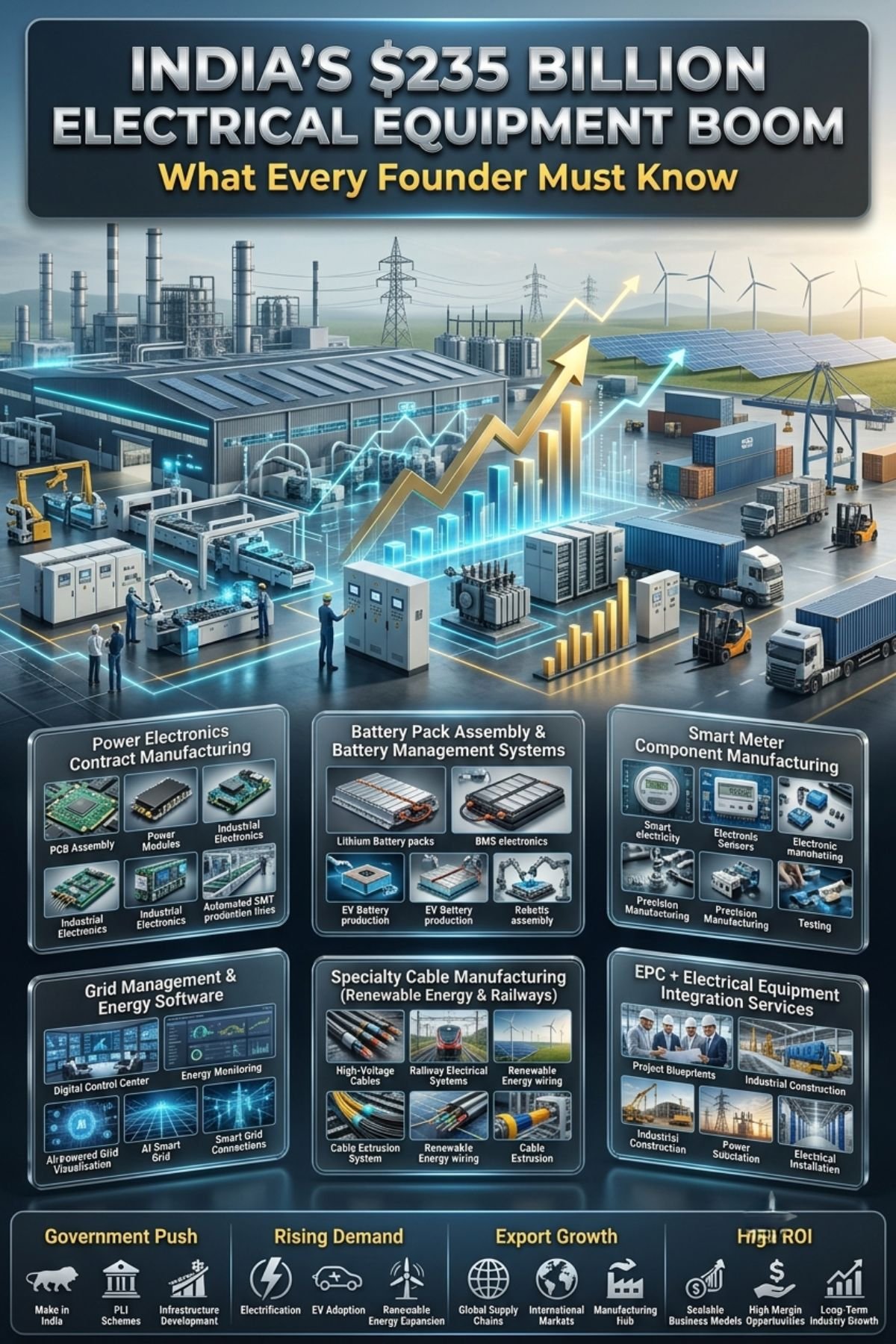
1. Power Electronics Contract Manufacturing
India is all but a 100 percent import dependent power electronics market, with a value of $4.7 billion in imports compared to only $400 million in domestic production value. By 2035, the value of domestic demand could surpass $17 billion. By having a focused contract manufacturing facility for inverters, converters and rectifiers for solar, EV and industrial applications, OEMs may rely entirely on the facility for their entire needs, even from China. The capital cost is Rs 5 – 20 crores, depending on the scale.
2. Battery Pack Assembly and Management Systems
Batteries are witnessing a high rate of growth of demand at 15% CAGR and the dependency on imports is over 60 percent. A local startup is building lithium-ion packs using imported cells, and working on a battery management system (BMS) software, catering to the immediate demand from the EV producers, telecom tower operators, and solar storage projects. India’s smart meter programme will need millions of internal batteries. This is a obvious manufacturing entryway.
Related Article: Battery Manufacturing Business in India: Cost, Profit, License & Complete Project Report
3. Smart Meter Component Manufacturing
India has Smart Meter National Programme where 250 million of conventional meters will be replaced with smart meters. Domestic value addition is compulsory at 60 per cent and there is subcomponent import dependence of more than 60 per cent. This is the opportunity that you have to fill. This is a relatively low capex B2B manufacturing play with assured demand driven by the government and is a product of display modules, communication chips housings and sensor sub-assemblies for smart meter OEMs.
4. Grid Management and Energy Software
In particular, Economic Times pointed to the grid stabilisation technologies and power software as high growth segments in the McKinsey report. One such SaaS startup working on grid monitoring dashboard, predictive maintenance software for transformers or demand response platform for commercial energy consumers is in a niche where there are hardly any local alternatives in India right now. It’s a tech play that has the potential to go overseas.
5. Specialty Cable Manufacturing for Renewable and Rail
The export opportunities identified by McKinsey include subsea and high-speed rail cables. A strategic cable company that makes XLPE insulated cables for solar energy, wind or metro rail projects caters to not only the domestic market infrastructure demand but also the emerging export market in south-east Asia and Africa. Cables and wires is already the most promising export product of electrical equipment industry in India.
6. EPC + Electrical Equipment Integration Services
Turnkey electrical contractors are in short supply, and developers of renewable energy projects are scrambling to secure the electrical contractors to provide and install the electrical switchgear, transformers, protection relays and SCADA systems. At the junction of supply scarcity and demand surge is an engineering procurement and construction (EPC) company that offers expertise in the electrical balance of plant for solar/wind.
Import-Export Opportunity Analysis
Current Export Position
India exported $12 billion worth of electrical equipment in FY2024. The most important export products are cables and wires, transformers, switchgear, generators and solar modules. Major markets include the United States, the UAE, the UK and the Southeast Asia markets. But the role of India in global trade of electrical equipment is quite small, thus marking the export potential.
Where the Export Opportunity Is Largest
- Cables and wires: India is already competitive, and now it is the time to move to undersea and high voltage cables.
- Transformers: Indian manufacturers such as BHEL and Siemens India, who export, can be a part of the value chain through tier-2 suppliers from the MSME industry.
- Ongoing diversification of sourcing is continuing to push business from Europe and USA for solar PV modules, especially post-China+1.
- A high growth export area with good domestic technology base is switchgear and protection relays.
- Power electronics: insignificant exports today and future export base through localisation
Import Substitution – Business Strategy.
McKinsey’s message on increasing reliance on imports is, remarkably, the strongest business message in the report. All import substitution plays have a known market size—the current import bill. A startup to replace 5 percent of India’s power electronics and batteries import bill of Rs 16+ billion annually is Rs 600+ crore revenue business.
Exporters should go on the Engineering Export Promotion Council (EEPC India) website and register yourself for market development assistance, Buyer-Seller meets and export credit facilitation.
Indian MSME Success Stories in Electrical Equipment
Genus Power Infrastructures
Genus Power began as a small metering company in Rajasthan, but has since expanded to become one of India’s biggest smart meter makers, having been successful in winning contracts of thousands of crores with the government under the AMI programmes. Their journey shows that MSME-origin companies can grow to become national suppliers of infrastructure.
KEI Industries
It started off as a tiny cable manufacturer in Delhi and slowly grew to include extra-high-voltage cables, winding wires and engineering procurement contracting. Today, KEI exports to more than 50 countries. Their take on depth-before-breadth for one product category is a template that is repeatable for new entrants.
Amara Raja Energy & Mobility
Amara Raja’s battery business began at telecom towers and has expanded to cover industrial batteries, EV battery packs and energy storage systems. Their growth curve is pretty much the demand curve that’s now being forecast by McKinsey for structurally growing sectors — firms that enter early grow disproportionately.
Identify high-growth industries before others do
How NPCS Can Help You Enter This Market
NPCS (Niir Project Consultancy Services) provides complete support to entrepreneurs and MSMEs in setting up electrical equipment manufacturing business in India. NPCS offers detailed project reports, Techno Economic Feasibility Studies, Plant & Machinery Sourcing Technical Advice, Government Regulatory Advice for Electrical Equipment Manufacturing Projects.
Capital Investment estimates, raw material sourcing strategies, market analysis, financial projections, and licensing requirements are covered by NPCS project report for every application such as the establishment of a power electronics manufacturing unit, cable extrusion factory, battery pack assembly factory or smart meter component manufacturing unit.
A feasible report in a sector where all three things—technical, regulatory and financial—are barriers to entry is the basis for every funding discussion, MSME loan application and PLI scheme registration.
Key Market Data: India Electrical Equipment Sector 2025–2035
| Segment | 2025 Market | 2035 Projected | CAGR |
| Power Electronics | $4.4B domestic | >$17B | 14%+ |
| Batteries | $8B | >$25B | 15% |
| Solar PV Equipment | $9B | >$30B | 14%+ |
| Cables & Wires | $12B | >$35B | 11-13% |
| Transformers | $8B | >$20B | 11% |
| Switchgear | $7B | >$18B | 11% |
| Total Industry | ~$50B | $195-235B | 11-13% |
| Exports | $12B (FY2024) | >$60B | 15%+ |
Source: McKinsey & Company ‘Wired for Growth’ Report, IEEMA, Economic Times 2026
Frequently Asked Questions (FAQs) for Founders & MSMEs
What is the total market size of India’s electrical equipment industry by 2035?
At present 5.5 billion people do not have reliable electricity, McKinsey stated in the ‘Wired for Growth’ report and added the Indian electrical equipment industry output size was estimated to grow to between $195-235 bn by 2035, up from $ 50 bn in 2025.
Which segments offer the highest growth opportunity for startups?
Power electronics, batteries, solar PV cells and modules, smart meters and grid software management have been found to be the four quickest growth localization possibilities within the report on the McKinsey case.
What government schemes support electrical equipment manufacturing?
The White Goods PLI Scheme, the PM Surya Ghar Scheme, the National Solar Mission and the Make in India initiative by DPIIT directly contribute towards the growth of electrical equipment manufacturers.
How big is the export opportunity for Indian MSMEs in this sector?
By 2035, India’s exports of electrical equipment may reach over USD 60 billion, estimates McKinsey. Cables and wires, switchgear, solar photovoltaic panels and power electronics, transformers are among the critical electrical component’s exports are likely to drive the overall growth.
What is the risk if India does not scale domestic manufacturing fast?
Import dependence could rise above 70 per cent by 2035 and result in an over USD130-billion production deficit, if trends continue. The import bill size could be comparable to India’s oil and gas imports.
Can a small MSME realistically enter power electronics manufacturing?
Yes. McKinsey specifically identifies subcomponent manufacturing, electronic assembly services, and smart meter component production as entry points accessible to well-funded MSMEs and early-stage startups.
Conclusion: The Window Is Open — For Now
The Economic Times-reported McKinsey study sends an unambiguous market signal: India’s electrical equipment sector is approaching a decade of structural transformation. The combination of rising domestic demand, government-mandated localisation, export tailwinds, and acute import substitution pressure creates a founder’s market.
But market windows close. The companies that enter the power electronics, battery assembly, smart meter component, and grid software spaces in 2025–2027 will be the ones commanding market share and customer relationships by 2030. Late entrants will face more competition, higher capital costs, and more crowded export pipelines.
McKinsey’s five-fold expansion prescription for domestic manufacturing capacity is not a forecast for incumbents alone. It is an invitation to the next generation of Indian industrial founders. The question is not whether this market will grow. The Economic Times coverage and McKinsey’s data make that abundantly clear. The question is whether you will be part of building it.
For entrepreneurs ready to act: explore government support at Invest India and begin your market entry planning. The infrastructure for scaling India’s next great manufacturing sector is already in place. What remains is the entrepreneurial will to build it.