
Abrasive Grinding Wheel Manufacturing
Many of the manufacturing-based business ideas that have a consistent demand are not given the recognition of attention that they deserve when experienced entrepreneurs look at the sector of abrasive grinding wheels. But this is one of the most stable markets in the industrial consumables sector in India. The grinding wheel is used on a regular basis in every metalworking shop, car factory, shipyard, railway workshop and precision engineering shop. It is not a choice — it’s a necessity. For a first-generation entrepreneur, with a focused capital plan, that is the type of structural demand that is just what you’re looking for.
India’s factory sector is growing at a fast pace. Defence manufacturing, auto parts, aerospace parts, and capital goods are expanding their production. All of these industries make use of abrasive tools for cutting, finishing and surface preparation. Furthermore, India is still one of the largest importers of precision abrasive products in which the local manufacturing can make a difference. This is one of the most underestimated business ideas in the industrial products category due to its ability to meet the rising demand locally and also having the possibility of import substitution.
Get Detailed Project Report (DPR): Abrasive Grinding Wheel
Why the Abrasive Grinding Wheel Industry Is Worth Entering Now
India’s abrasive products market, including grinding wheels, cutting discs, and allied products, is worth several thousand crore rupees and continues to grow at a healthy rate. Growth accelerators are not cyclical. With the government’s thrust on Make in India, PLI schemes for capital goods and encouraging defence production in the country is generating a long-term demand for metal processing equipment and consumables.
Grinding wheels don’t have a season. A grinding wheel is used up continuously by an auto component manufacturer at three shifts. The railway wheel reconditioning workshop cannot stop reconditioning railway wheels. Constant buyers include shipbuilders, construction equipment manufacturers and tool-and-die makers. This regular consumption allows manufacturers a predictable revenue stream, something that most other industrial product categories just don’t have.
In addition, the world’s OEMs are coming to India through joint ventures, thus providing an indirect opportunity. Tier-2 and Tier-3 suppliers might be more inclined to purchase locally, because of the speed and cost of procurement. Craft long-term contracts with these buyers, where a well-positioned domestic manufacturer has consistent quality, and reliable supply.(Abrasive Grinding Wheel Manufacturing
Government Policies and Incentives Supporting New Manufacturers
The Government of India has established a conducive policy for the new entrepreneurs in the field of abrasive manufacturing. There are various schemes available for new manufacturers based on their size and set-up.
MSME Registration and Priority Sector Lending
Once an MSME registers on the Udyam portal they can avail loans from public sector banks at a concessional rate of interest and loans from Credit Guarantee Fund Trust for Micro and Small Enterprises (CGTMSE) under the MSME Act along with protection against delayed payments. The Ministry of MSME has also provided cluster development support to the entrepreneurs, which is useful for entrepreneurs establishing units in the existing industrial cluster.
PLI Scheme for Capital Goods
The current Production Linked Incentive (PLI) scheme for capital goods, which is administered by the Department for Promotion of Industry and Internal Trade (DPIIT) includes the wider tooling and precision manufacturing category. For manufacturers of abrasive wheels that provide to capital goods industries, there are downstream benefits. Besides, brand building and export promotion support is offered to the eligible manufacturers under the Make in India scheme.
Technology Upgradation Fund Scheme (TUFS)
The Technology Upgradation Fund Scheme (TUFS) provides subsidised credit facilities for investments in modern machines and equipment like CNC wheel forming presses, automated kilns with vitrified bond etc. for entrepreneurs. This directly lowers the risk of capital deployment in the set-up process.
Explore This Book: Our Books
Multiple Business Ideas for Startups in the Abrasive Grinding Wheel Sector
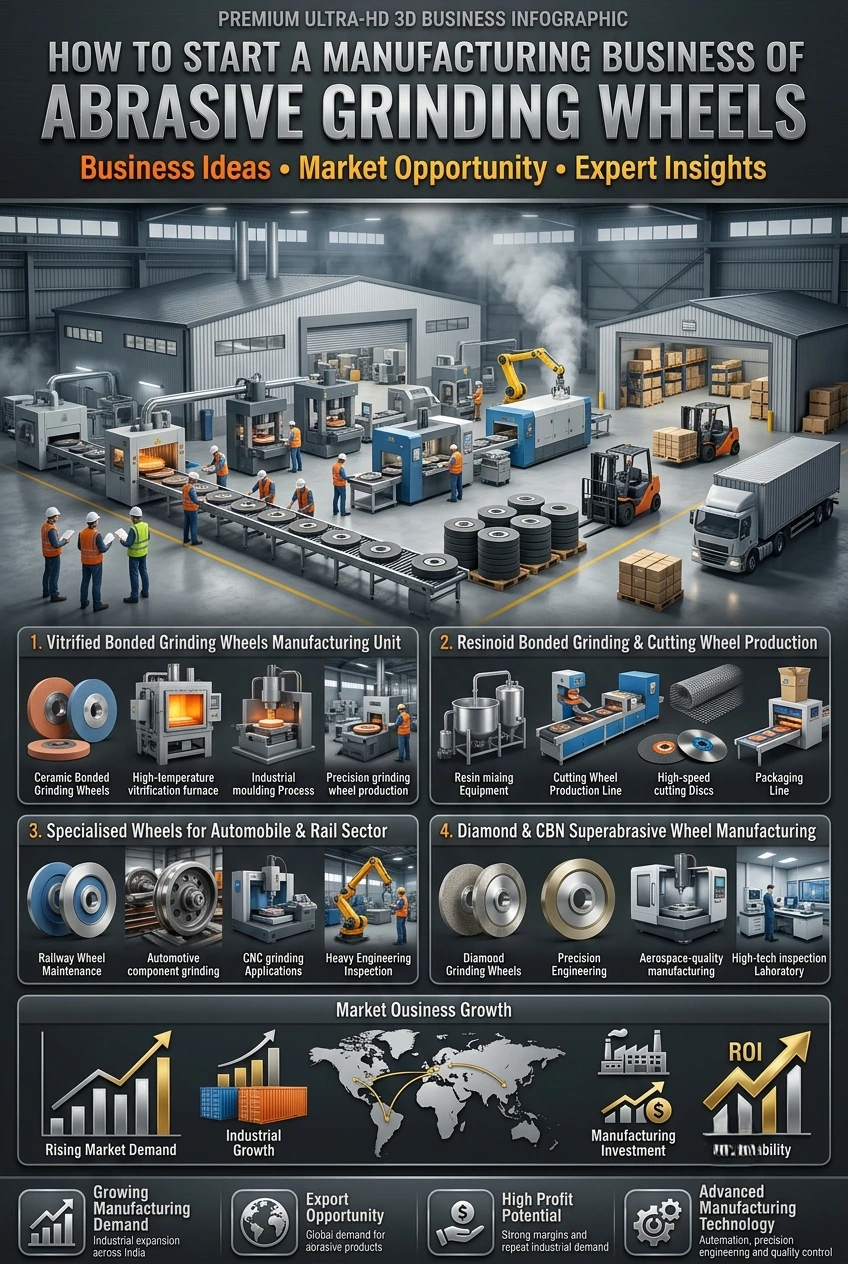
1. Vitrified Bonded Grinding Wheels Manufacturing Unit
Vitrified bonded grinding wheels are the backbone of precision grinding in the machine tool, bearing and automobile industries. The manufacturing technique in this model is to press a mixture of aluminium oxide or silicon carbide abrasive grains and ceramic vitrified bonds into shape and then high-temperature firing in tunnel kilns. The product resulting from this has excellent rigidity, dimensional accuracy and consistent cutting action. A startup in this area should purchase mixing equipment, hydraulic presses, kilns and quality testing lab. The capacity of ₹50 lakh to ₹1.5 crore is available with the capital outlay. One of the benefits of this model is that buyers in the precision engineering industry prefer domestic suppliers with traceable quality, making it easier to secure repeat orders once you establish your business.
2. Resinoid Bonded Grinding and Cutting Wheel Production
Industries commonly use resinoid bonded wheels (made with phenolic or epoxy resin) for rough grinding, fettling, and metal cutting in foundries, steel plants, and fabrication workshops. Resin-bonded wheels cost less to produce than vitrified wheels because manufacturers do not fire them at high temperatures. During production, manufacturers use cold pressing and oven curing at moderate temperatures. The cost of establishing a functional unit for a startup is less than ₹40 lakh and they can start providing jobs to the metalwork clusters in the local area. The market for cutting discs (angle grinder discs) in this market is especially strong, with the construction and infrastructure market, as well as the sheet metal fabrication industry, experiencing fast growth. There is also a good export potential, particularly into the Middle East and Africa.(Abrasive Grinding Wheel Manufacturing)
3. Specialised Wheels for the Automobile and Rail Sector
This is a more advanced, higher dollar model. Manufacturers require specialized abrasive wheels with tight specifications to grind, finish, and hone automobile cylinder bores and grind crankshafts. In Similarly, rail authorities regulate track maintenance items such as rail grinding wheels, and these products offer high profit margins. A new company trying to go into this area would most likely need technical assistance from an existing abrasive technologist or a retired industry professional who has expertise in this area. While the investment amount is more significant – it is usually a minimum of ₹1 Cr – the switching cost of the buyer is also high. With OEMs, after you’ve been a vendor for a few years, you can count on revenue visibility for several years.
4. Diamond and CBN Superabrasive Wheel Manufacturing
Manufacturers usually use superabrasive wheels made from synthetic diamond or cubic boron nitride (CBN) to ultra-precision grind hardened steel, ceramics, and carbide tools. The unit prices of these products are very high and as of now, they are mainly imported. The startup with technical expertise and adequate funding (₹2 crore and above) can carve a niche base for itself in the domestic market by supplying customised superabrasive wheels to the defence, aerospace and medical device manufacturing industries. New companies seeking to establish credibility in this segment can leverage on technical guidance and standards from the Indian Institute of Abrasives for a rapid establishment.
Related Article: Lab-grown diamonds from Graphite
Import–Export Opportunity Analysis for New Startups
India is a large importer of precision grinding wheels especially in the aerospace, bearing and defence industry. The reliance on imports thus opens up a direct opportunity for quality-oriented domestic manufacturers. Trade data available through the Ministry of Commerce shows that abrasives is an ongoing import product under HS Code 6804, which shows that the demand for the product is not being met by domestic supply.
The Indian manufacturers have a definite cost edge on export side. There are markets in Southeast Asia, Middle East, Africa, that are actively looking for low cost and reliable abrasive products. Several countries such as Bangladesh, Vietnam and Kenya have expanding metal manufacturing sectors, but limited local capacity to manufacture abrasives. Indian start-up acquiring BIS certification and establishing a reliable export supply chain can enter into these markets with competitive pricing. EEPC India proactively helps the engineering goods exporters like the abrasive manufacturers to access the market.
Apart from this, the Trade Receivables Discounting System (TReDS) and EXIM Bank facilities enable exporters to utilize the working capital efficiently, which is an important financial instrument that enhances working capital for the small abrasive exporters.
Indian MSME Success Stories in Abrasive Manufacturing
Grindwell Norton (Promoted by the Saint-Gobain Group in India)
The story of Grindwell Norton is one of abrasive products that dates back to several decades in India and boasts of being the largest producer of such products in the country. The capitalization on the success of the company rests on the strong quality investment, adoption of advanced manufacturing processes and a well-structured distribution system for the company that covers all the major industrial clusters in the country. The main takeaway for aspiring entrepreneurs is that product quality certification, particularly assessment by BIS and ISO, is not a cost of the business but a business enabler. Their business model proved that they can be global quality domestic manufacturers even in a competitive market.
Wendt India Limited
Wendt GmbH Germany and Carborundum Universal promote Wendt India as a leading manufacturer of super abrasive tools and precision grinding solutions. The company chose niches that were technically complex and had higher margins and avoided the mass market. In the case of the superabrasive sector, a clear message for the new entrepreneur is that specialisation and technical depth can typically result in greater profitability and customer loyalty than broad-based production, a fact demonstrated by Wendt’s case. Wendt’s model also shows how strategic partnerships with global technology partners can accelerate market entry without requiring decades of R&D investment.
Regional MSME Clusters: The Quiet Success Model
A few mid-scale Indian manufacturers, in the revenue bracket of ₹5 crore to ₹50 crore, have found a niche for themselves and have created sustainable businesses by catering to regional industrial clusters – the auto ancillary clusters in Pune, Coimbatore, Rajkot, and Faridabad. The ability to supply customised wheel specifications, more rapid delivery and direct technical support were the means these entrepreneurs, who were smaller customers, used to gain success — options which larger manufacturers typically don’t offer to smaller clients. For newcomers, the lesson is quite plain: A niche or industry-specific approach plus a service that responds to needs is a business that can be profitable and viable.
Build a profitable business with the right idea
How NPCS Helps Entrepreneurs Enter This Sector with Confidence
At Niir Project Consultancy Services (NPCS) we offer an expert service for the preparation of Market Survey cum Detailed Techno-Economic Feasibility Reports (DPRs) for setting up new industries or businesses. We are providing detailed manufacturing processes in our reports of Abrasive Grinding Wheel Manufacturing, Market Research and demand analysis, Process Flow Diagram of the product, product mix and capacity planning, detail of machines and raw material, and complete project financials with profitability analysis. We want to help entrepreneurs assess feasibility, profitability, and scalability before investing. A strong DPR is crucial for new players aiming to enter this field, as it enhances their bankability and provides clarity in operations.
Key Data Reference: Abrasive Grinding Wheel Manufacturing at a Glance
| Parameter | Small Unit (MSME) | Medium Unit |
| Estimated Project Cost | ₹30–75 Lakh | ₹1–3 Crore |
| Production Capacity | 10–30 MT/month | 50–150 MT/month |
| Raw Material (% of Cost) | 55–65% | 55–65% |
| Expected Gross Margin | 25–35% | 28–40% |
| Key Certifications Required | BIS, ISO 9001 | BIS, ISO 9001, OHSAS |
| Primary Market Segments | Local workshops, SME units | OEMs, Exports, Defence |
| Payback Period (Est.) | 3–5 years | 4–7 years |
FAQ: Starting an Abrasive Grinding Wheel Manufacturing Business
Q1. What is the minimum sum required for setting up a grinding wheel manufacturing unit?
The initial investment for a small resinoid bonded wheel unit ranges from ₹25 lakh to ₹40 lakh, which includes the cost of land lease, machinery, and working capital. The cost of the vitrified wheel plant is in the range of ₹75 lakh to ₹1.5 crore with the requirement of kiln infrastructure. As the manufacturing requires specialized equipment, the investment required for super abrasive is ₹2 crore or higher.
Q2. Do grinding wheels need to be BIS certified to be sold in India?
Yes. Abrasive grinding wheels are compulsory BIS certified according to IS 1234 and related standards. It is regulated by Bureau of Indian Standards (BIS). If a product does not have BIS certification, selling of such products in the Indian market is not legally allowed. It is thus very important to get this certification early on in the startup journey.
Q3. What raw materials are required and where will they come from?
Primary materials are aluminium oxide (white and brown fused), silicon carbide, reinforcing fibreglass mesh, used in resinoid wheels, ceramic bond materials, and phenolic resins. They are supplied by several domestic companies in Gujarat, Tamil Nadu and Maharashtra. But, high purity abrasive grains for precision applications are usually imported from China, Japan or the USA.
Q4. Is exporting possible for the MSME grinding wheel manufacturer?
Absolutely. Indian manufacturers are price competitive in the markets of south-east Asian, middle-east and Africa. Active promotion of export access for Abrasive Manufacturers by EEPC India and India International Trade Fair Platform. An ISO 9001 certificate greatly enhances the credibility of an export. Further, the Directorate General of Foreign Trade (DGFT) provides a number of export incentive schemes such as Remission of Duties and Taxes on Exported Products (RoDTEP) scheme.
Q5. What equipment would be needed to establish a simple unit?
Essential equipment for a basic resinoid wheel unit is a mixer, hydraulic cold press, curing oven, balancing machine and testing equipment. For a vitrified wheel plant, a tunnel or periodic kiln is also required. Domestic suppliers of machinery are available in Pune, Rajkot and Coimbatore. The Confederation of Indian Industry (CII) has a vendor directory which can come in handy to find machinery vendors.
Q6. How long does it take to become operationally ready?
A small resinoid unit can be operationally ready in 8–12 months from project initiation, including land, machinery procurement, BIS certification, and first production runs. A vitrified or specialised unit with kiln installation typically takes 18–24 months. Timeline planning and working capital buffer of at least 6 months of operating expenses are strongly recommended.
Conclusion: A Business Built on Industrial Necessity
Abrasive grinding wheels are not glamorous products — but they are indispensable. Every metal, every precision component, and every engineered surface passes through an abrasive tool at some stage of its manufacture. That industrial necessity is the foundation of a business that does not follow trends. It follows production.(Abrasive Grinding Wheel Manufacturing)
For entrepreneurs with a manufacturing mindset and a willingness to build technical depth, this sector offers a rare combination of steady demand, import substitution opportunity, and export scalability. Furthermore, government support through MSME schemes, PLI benefits, and export facilitation makes entry more accessible than ever. The business ideas covered in this article — from resinoid cutting wheels to superabrasive CBN products — represent a full spectrum of opportunity across investment sizes and market segments. The right model depends on your capital, technical background, and target market. But the opportunity itself is very real.