


EV Equipment Manufacturing Business in India
EVs are not just a future reality in India but the fastest-growing reality of today. Moreover, In the world of business ventures, there are opportunities that seem to be at the right time and EV equipment manufacturing is one of them. The Indian government has made EVs an area of mainstream policy priority. The demand for charging infrastructure, battery systems, motor and control units is growing rapidly. But manufacturing capacity has not been matched. It’s a space new business can fill and quickly establish themselves to long-term profitability.
India is expected to see a CAGR greater than 40% in its EV market. Domestic manufacturing, which is encouraged by policy support and increasing consumer demand, is establishing a domestic supplier base that must be rapidly scaled up. Among the rare windows this is one where a first-time entrepreneur or an MSME investor can enjoy significant competitive edge.
Why EV Equipment Manufacturing Is a Smart Business Entry Point
EV equipment manufacturers economics are attractive. This sector has several advantages over consumer electronics or FMCG: it is provided with multi-year procurement contracts, government supported demand and limited local competition. Most of the OEMs like Tata Motors, Mahindra Electric, Ola Electric and Ather Energy are actively looking for domestic component suppliers. Import substitution continues to be an objective of government policy, and domestic producers are both supported by government regulation and given preferential treatment when it comes to government procurement.
Moreover, the manufacturing expenses of EV components in India are also structurally low, rendering Indian suppliers interesting options for international procurement. The business proposition is based on three things: OEM buyers will always have a requirement; government subsidy backing is available; and the market is still in its infancy on the supply end, giving the entrepreneur a first-mover pricing advantage.
Get Detailed Project Report (DPR): Electric Vehicle & E-Rickshaw Guide
Government Policies and Incentives Supporting New Manufacturers
The policy framework for EV-making in India is one of the most elaborate in Asia. Under the Production Linked Incentive (PLI) Scheme for the Advanced Chemistry Cell (ACC) Battery Storage, incentives of up to ₹18,100 crore are being provided for battery manufacturers. This scheme aims to achieve domestic cell production and to promote localisation of the supply chain.
The FAME India Phase II (Faster Adoption and Manufacturing of Hybrid and Electric Vehicles) scheme offers demand side incentives that directly increases the production volumes of OEMs, which in turn increases the demand for sourcing components. As cars are being manufactured in larger numbers, so are EV equipment suppliers.
The Ministry of MSME’s Credit Guarantee Fund Scheme launched by the enables EVs component manufacturing companies to avail of loans of up to ₹2 crore free of collateral. In addition, the MSME technology upgradation scheme also offers a subsidy to eligible manufacturers in purchasing machinery.
The Make in India initiative has identified electric mobility as a priority sector to encourage more new manufacturers to set up in industrial areas and be provided easy access to land, utilities, and quick approvals.
In addition to the central schemes, a few state governments provide extra incentives for production of EVs such as stamp duty exemptions, electricity tariff rebates, and dedicated EV parks in Maharashtra, Gujarat, Rajasthan, Tamil Nadu, and Telangana. State schemes should be considered in addition to central incentives to maximise subsidy ‘stacks’ for entrepreneurs.(EV Equipment Manufacturing Business in India
Business Ideas: Specific EV Equipment Manufacturing Segments to Enter
1. EV Charging Station Equipment Manufacturing
One of the more direct avenues for scaling into the EV space is to manufacture chargers: AC slow chargers and DC fast chargers. India will need lakhs of charging points in the next 5–7 years, and imports currently supply most of the charging hardware. A dedicated manufacturing facility that builds Level 2 AC chargers (3.3kW to 22kW) or DC fast chargers (30kW+), can aim for both B2B fleet operators and retail charging network companies. The minimum investment required to assemble a small-scale charger starts from ₹ 50–75 lakh, and institutional contracts can generate revenue of over ₹ 3–4 crore per year. The business logic is simple: every charging station needs hardware, and as networks expand, the demand for hardware will grow. Electronics assembly experience offers entrepreneurs an edge here, but so can be a contract manufacturing arrangement with a PCB expert.
2. Lithium-Ion Battery Pack Assembly
Cell manufacturing is a capital-intensive process, but Battery Pack Assembly (BPA)—which includes sourcing cells, designing the Battery Management System (BMS), and manufacturing packs for specific vehicle applications—can operate at the MSME scale. OEMs often outsource customised battery pack assembly to specialised battery pack assemblers for EV two-wheelers, three-wheelers, and commercial vehicles. Setting up a battery pack assembly unit with a capacity of 200–500 units per month requires an initial investment of around ₹80 lakh to ₹1.5 crore. The main difference-maker in this area is BMS design capability. Businesses that supply customised pack configurations with consistent BMS performance will earn higher payments and will ultimately secure long-term supply contracts. The FAME II scheme and PLI for ACC directly aid this segment by providing demand incentives as well as provision of raw material.
Explore This Book: Handbook on Production, Recycling of Lithium-Ion and Lead-Acid Batteries
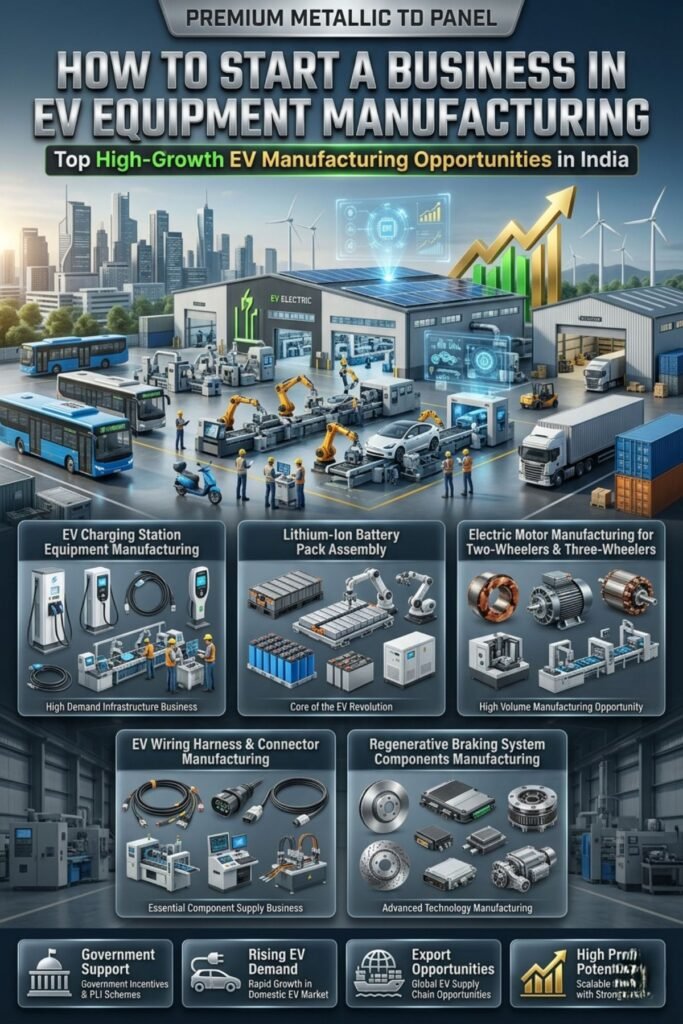
3. Electric Motor Manufacturing for Two-Wheelers and Three-Wheelers
The core of all EV powertrains is BLDC (Brushless DC) and PMSM (Permanent Magnet Synchronous Motor) motors. The Indian two and three-wheeler EV market is the fastest-growing globally, where the requirement for compact high efficiency motors is rapidly increasing. The dedicated motor manufacturing unit supports the 250W to 5 kW motor range and serves both EV OEMs and the aftermarket replacement market. The investment needed for a basic motor winding and assembly plant begins from ₹60–80 lakh.
Precision winding and quality control of the components and parts of the stators and rotors are the key technical needs. Prospective entrepreneurs who want to join the segment should think about working with IIT or NIT technology transfer programmes to obtain cost-effective technologies such as motor designs. Profits in this area come from the fact that commercial EV three-wheelers require replacement motors every few years, creating an annuity-type revenue stream in addition to the initial OEM supply.
4. EV Wiring Harness and Connector Manufacturing
The wiring harness systems in EVs are much more extensive than those in ICEs — an electric car can use up to 3 km of wiring, and hundreds of connectors keep all the parts connected. At present, the majority of the harness producers who cater to the Indian OEMs are big scale or subsidiaries of foreign companies.
The smaller OEMs in the two-wheelers and three-wheelers segments, however, are actively looking for harness suppliers who can provide in a short turnaround time, and can cater to MSME size. It involves precision cutting machines, crimping stations and quality testing equipment, which costs ₹40–70 lakh for a simple unit. There are generally good margins (18–25%) and supply contracts are usually 12–24 months long. Also, this segment has relatively low raw material risk because copper and PVC prices remain predictable, and suppliers source these materials locally.
5. Regenerative Braking System (RBS) Components Manufacturing
Most EVs and hybrids have regenerative braking as a standard feature. Today, the main components such as controllers, flyback diodes, energy recovery modules are virtually all imported. A person who has manufacturing skills and background in electronics can create a niche business to manufacture RBS subassemblies for EV OEM or tier-1 system integrators. A higher value, lower volume set, where the actual unit cost is considerably higher than mechanical components. The market opportunity is less fragmented than the battery/charger manufacturing market and is a great space for technically savvy entrepreneurs to differentiate.
Import–Export Opportunity for EV Equipment Manufacturers
The EV equipment industry in India is a dual trade opportunity both for substitution of imports and as an emerging exporter. India currently imports large quantities of lithium cells, power electronics modules, BLDC motor cores, and EV grade connectors, mainly from China, South Korea, and Japan. Each homegrown unit cuts into this import dependence and boosts the homegrown supply chain.
Indian EV components companies are gaining ground in South and Southeast Asian, African and Asian emerging markets in terms of competitiveness in the export markets. Bangladesh, Sri Lanka, Nepal and a few African countries are aggressively growing their EV two-wheeler and three-wheeler fleets and are making serious efforts to provide component suppliers with reliable sources of quality components that are also cost-competitive. The advantage for Indian manufacturers is that they are also technically capable, cost efficient and are located in close proximity to these markets.(EV Equipment Manufacturing Business in India)
Entrepreneurs are advised to avail export financing facilities of EXIM Bank of India and also support, market information and funding for participation in trade fairs from FIEO (Federation of Indian Export Organisations).
Related Article: Top Profitable Electrical and EV Manufacturing Business Ideas in India (Complete Guide)
Indian MSME Success Stories in the EV Equipment Sector
Greaves Electric Mobility (Ampere Vehicles) — Coimbatore
Greaves Cotton acquired Ampere Vehicles to create one of the most recognizable EV two-wheeler brands in India. The promoter reasoning seemed straight forward: Greaves knew how to make engines, had sufficient distribution capability, and had extensive retail networks. The shift to EVs is no coincidence, it’s a strategic move knowing that the powertrain in EVs is simpler, not more complicated. The key takeaway for MSMEs is that they can quickly transfer their existing expertise in precision engineering, electronics, and fabrication to EV applications. Greaves didn’t have to invent anything new; they applied what they had and had a new approach to moving.
Kabira Mobility — Goa
Jaibir Singh Siwach founded Kabira Mobility and built it from scratch into a vertically integrated EV motorcycle brand in India, making it a notable example of a successful businessman. In contrast, Kabira made investments in the development of its own motors and battery management, decisions that lent the company technical weight and control over its supply chain. For the novice entrepreneur, the message is that a fledgling industry’s value is in vertical integration. This is particularly true when the supply chain is less developed, and internal capability — even if more expensive — provides an enduring competitive moat that a fast-follower will be difficult to emulate.
Kinetic Green — Pune
Sulajja Firodia Motwani, CEO of Sulajja Firodia Motwani, built a viable enterprise at Kinetic Green focused on producing electric three-wheelers and cargo vehicles. She targeted commercial and last-mile delivery operators, a segment that companies had largely underserved. The strategy of Kinetic Green offers a compelling example of strategies that smaller players can use to outmanoeuvre larger firms in the EV market by targeting niche, less competitive applications, instead of being head-to-head in the more mainstream segments. In the world of MSMEs, that’s the most profitable and cost-effective route to success in the EV equipment and vehicle business, and it is the product-market fit-first, scale-second approach.
How NPCS Helps Entrepreneurs Enter the EV Equipment Manufacturing Sector
At Niir Project Consultancy Services (NPCS), we provide professional consulting for the preparation of Market Survey cum Detailed Techno-Economic Feasibility Reports (DPRs) for setting up new industries and businesses. Our reports provide a comprehensive analysis of the industry before you invest your money as an entrepreneur and start a new EV equipment business.
Our feasibility reports include detailed manufacturing processes and technology selection, detailed market research and demand analysis for particular EV parts, detailed process flow diagram, project product mix and capacity planning, machinery sourcing, raw material cost structure and complete project financials with profitability analysis and break-even projection. We ensure that we thoroughly consider and measure every element of feasibility, profitability, and long-term scalability—based on actual data rather than market sentiment. With a business as dynamic as EV equipment production, professional feasibility analysis is not a luxury; it’s essential to building a fundable and scalable business model.
Turn your budget into a successful business plan
EV Equipment Manufacturing: Market Opportunity at a Glance
| Business Segment | Est. Initial Investment | Revenue Potential (Annual) |
| EV Charger Manufacturing | ₹50 – 75 Lakh | ₹3 – 5 Crore |
| Battery Pack Assembly | ₹80 Lakh – ₹1.5 Crore | ₹4 – 8 Crore |
| BLDC Motor Manufacturing | ₹60 – 80 Lakh | ₹2.5 – 4 Crore |
| Wiring Harness Unit | ₹40 – 70 Lakh | ₹2 – 3 Crore |
| RBS Components | ₹50 – 90 Lakh | ₹2 – 4 Crore |
Note: These are indicative estimates of investment and revenue calculated on MSME-scale unit models and the industry norms, and the actual figures would differ depending on the location, capacity and technology choice.
Frequently Asked Questions (FAQ)
Q1: What is the minimum investment required to set up an EV equipment manufacturing business in India?
Ans: The required minimum investment amount would depend heavily on the selected segment While a wiring harness unit can start from as low as 40-50 lakh, battery pack assembly needs about 80 lakhs to 1.5 cr. Charger manufacturing would cost about 50-75 lakh for a small production unit. These represent tooling, machinery, working capital, and initial certifications.
Q2: Are there any government incentives for EV equipment manufacturing MSMEs?
Ans: Yes. A host of schemes are applicable – the PLI for ACC Battery Storage, FAME II, MSME Credit Guarantee Fund (collateral free loans of up to 2 cr), as well as various state-level incentives for EV equipment manufacturing. Most entrepreneurs combine central & state incentives in a way that reduces their net investment requirement significantly.
Q3: Do I need BIS certification for manufacturing EV components?
Ans: Some of the components in the EVs, namely chargers, BMS, and electric motors do need certification from BIS or following AIS (Automotive industry standards) by the MoRTH. Certification Time & Cost must also be accounted for.
Q4: How do I acquire customers for a new EV equipment manufacturing unit?
Ans: Easiest way to reach out for the first few customers will be through direct contact to the small & mid-sized EV OEMs with a sample product & a competitive quote; two-wheeler & three-wheeler OEM sector can be the initial focus areas. Sectoral associations such as SMEV, ACMA can act as the buyer-supplier connect platforms. Also, OEMs can be reached through EV expos and trade fairs.
Q5: Is exporting EV components viable from India?
Ans: Absolutely. Indian manufacturers stand competitive in markets across South Asia, Southeast Asia, & Africa. Both the EXIM Bank & FIEO provide help on financing & market information, but one would need product certifications matching destination markets (like CE marking for Europe). This would be built into manufacturing design from the onset for this kind of venture.
Q6: What is the typical payback period for an EV equipment manufacturing unit?
Ans: In case of a good organized MSME scale unit having agreements with offtakers for offtake, payback period is normally expected to be between 3-5 years. While higher ticket products like battery packs and chargers would pay back sooner due to recurring demand. However, payback highly depends on utilization, and securing prior off-take agreements before a full capex investment commitment is recommended.
Conclusion: The Manufacturing Window Is Open — Act Strategically
India is not talking of an EV transition – it is living it and breathing it. Policy landscape is on their side, OEM demand is concrete and component supply chain has a long way to go to match requirements of Indian market. For entrepreneurs willing and capable of investing intelligently, the opportunity in manufacturing EV equipment is a unique blend of government-driven demand, import substitution theme and export possibilities.
Enthusiasm rather than an analytical approach is what will not win. Picking a specific segment, scaling up the unit appropriately, managing certifications and securing off-take orders are the tactical actions that would mark the difference between success stories and poorly funded hypotheses. Detailed feasibility study before investing is not an option – rather it is your first and most crucial investment.
For further reference, entrepreneurs can also consult the DPIIT’s FDI and investment guidelines and the Bureau of Indian Standards (BIS) for product certification requirements relevant to EV equipment manufacturing.



Electric vehicle manufacturing New plant Established in tamilnadu, total cost of company manufacturing E bike