
Bamboo Wood Pellet Manufacturing Business Plan
A Green Business with Real Commercial Strength
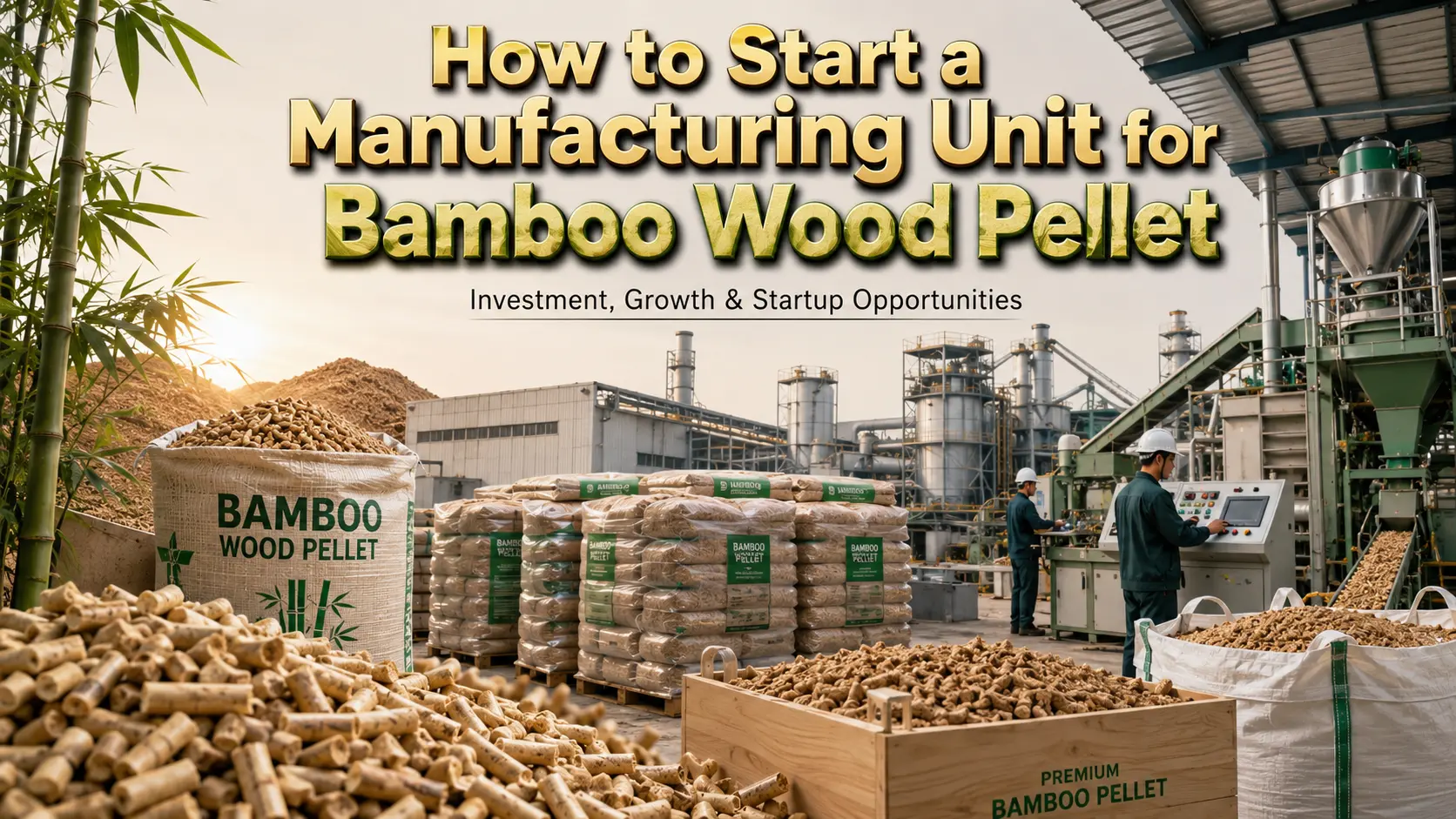
Bamboo wood pellets are definitely a business opportunity that can be considered for entrepreneurs interested in the renewable energy and biomass industry. This isn’t a product for the green-minded consumer. A fast-growing industrial product with genuine demand from power plants, industrial boilers, hotel chains and export markets from Europe and Asia. The bamboo wood pellet industry is perfectly poised to support India’s shift towards cleaner energy, leveraging its abundant resource, the bamboo, and the rising global demand for wood pellets as a substitute for coal and fossil fuels. This is an exciting, viable and investible opportunity for first generation founders and MSME investors.
Why the Bamboo Wood Pellet Industry Is Gaining Momentum
India has rich bamboo resource base. The nation has one of the largest bamboo forests in the world, distributed in the north-east states, Odisha, Chhattisgarh and some parts of the Western Ghats. This bamboo was used sparingly for many years. Today, it is increasingly being diverted to the production of pellets, which are dense, energy-rich pellets made from dried bamboo biomass that can be used as fuel.
The biomass pellet market is experiencing a rapid growth rate worldwide. The EU’s Renewable Energy Directive has ambitious targets for renewables in Europe, which will result in long-term demand for high quality wood pellets. India has a huge potential to meet this demand. The Ministry of New and Renewable Energy (MNRE) stated that biomass plays a major role in the energy mix in India and pellet-based energy is a priority area for scaling up clean energy supply. Locally, the industries that were using coal for energy generation, ranging from textile industry to ceramic industry, are shifting to pellets’ use under the pressure of the regulations. Bamboo pellet production is a viable business because of the demand from both domestic industry and export market.
One of the bamboo’s advantages as a raw material is different from ordinary wood. It is faster in growth, does not need to be replanted and is higher in calorific value per unit weight than many softwoods. These properties equate to increased energy production per pellet and reduced raw material cost to the pellet manufacturer. Moreover, the recent changes in the Indian Forest Act declassified bamboo as a tree and categorized it as grass, thus lifting the previous bans on bamboo harvesting and its transportation. The change in the regulations has made bamboo a viable raw material on a scale.
Get Detailed Insights from This Book: Bamboo Plantation and Utilization Handbook
Government Policies and Incentives Supporting This Business
Policy landscape for bamboo enterprises has greatly improved. The National Bamboo Mission (NBM), under Ministry of Agriculture, offers funding for bamboo farming, processing units and value addition to the bamboo products. In this mission, subsidies for machinery procurement and training are provided for the entrepreneurs.(Bamboo Wood Pellet Manufacturing Business Plan )
MSME Ministry’s Credit Guarantee Fund Trust for Micro and Small Enterprises (CGTMSE) provides an opportunity for entrepreneurs to avail working capital loans without any collaterals — a big help for the first-time manufacturers. Moreover, the Udyam-registered units can avail of priority sector loan facilities, low electricity rates in various states, and low interest rates under the Interest Subvention Scheme.
Make in India has encouraged the biomass manufacturing sector with facilities for investment and single window clearance. Capital subsidy under Prime Minister’s Employment Generation Programme (PMEGP) is available for 35% of project cost for units in the rural areas. The Directorate General of Foreign Trade (DGFT) provides export incentives to export units under RoDTEP scheme.
Dedicated bamboo industry parks have also been launched by the state government of Assam, Meghalaya and Odisha, where pre-developed infrastructure, power supply and logistical support are provided to the entrepreneurs. These parks are a major driver in lowering the capital costs and setup costs needed for new manufacturers.
Business Ideas for Entrepreneurs Entering the Bamboo Pellet Sector
1. Standard Bamboo Pellet Manufacturing for Industrial Buyers
This is the easiest place for new business owners to start. The business model is to purchase the dried bamboo biomass from the local cultivators/aggregators and then pass it through a bamboo pellet mill and sell the final product to the industrial buyers (mainly textile mills, paper factories, brick kilns and food processing units). An entrepreneur can start a small unit with a capacity of 10 to 20 tonnes per month by investing ₹25–40 lakh. The unit requires a pellet press machine, a pellet dryer, a hammer mill for size reduction, a cooling conveyor, and a packaging line. Operating margins are generally between 20% and 30%, and are largely attributable to the comparatively low raw material costs of bamboo compared to hardwoods.
Additionally, consistency of supply is key to the segment’s competitive edge. Reliability of supply and quality of pellets are more important to buyers than price in the industrial market. New entrepreneurs who establish good procurement relationship with bamboo farmers and have basic quality control system such as moisture meters or calorimeter testing are likely to get long-term purchase contracts. These contracts offer income certainty in the first year of use.
2. Export-Grade Bamboo Pellet Unit (ENplus Certified)
For the entrepreneurs with good access to capital and a medium-term export orientation, it is advisable to establish an ENplus certified pellet manufacturing plant. European power companies and district heating companies widely recognize and accept ENplus as the international quality label for biomass pellets. To achieve certification, the product must meet the specified limits for moisture content (less than 10%), bulk density, and ash content. The investment required for a unit which is certification-ready and exportable is in the range of ₹1.5 crore to ₹3 crore based on the capacity.(Bamboo Wood Pellet Manufacturing Business Plan )
The revenue premium is worth the investment, however. The export price of pellets ranges between USD 120 – 180 per tonne which is much higher than the domestic price. Germany, Denmark, the Netherlands and South Korea are some of the biggest importers of biomass pellets. Indian manufacturers who are certified by the ENplus can do so either via commodity trading or via long-term contracts with energy utilities in Europe. It is a capital-intensive enterprise with stable export income of 3 to 5 years payback period.
3. Bamboo Charcoal and Pellet Hybrid Unit
Bamboo pellet manufacturers can adopt a bamboo charcoal production line as a smart diversification strategy. Charcoal serves a completely different market, including water filtration, cosmetics manufacturing, barbecue fuel, and organic farming applications such as soil amendment. The business people benefit from higher use of raw material, lower dependency on the product category when both lines are from the same raw material base.
This hybrid option is especially appealing due to the higher per tonne value of charcoal, as well as the fact that charcoal is not as competitively priced as coal. Compared to a single-product unit, the hybrid unit that generates pellets and charcoal from the same biomass feed can boost the overall profitability of the unit by 40-60 per cent. The additional cost required for installing a carbonisation kiln with an existing pellet plant is approximately ₹8-15 lakh, making it a cost-effective option for the medium-sized pellet manufacturers.
Related Article: Bamboo Charcoal for a Healthier Future: Business Ideas, Market Opportunity & Startup Guide

4. Contract Pelletisation Services for Biomass Aggregators
All the biomass aggregators or farmers cooperatives are not able to invest in a pellet machine in India. If a pellet unit has excess capacity, the entrepreneur can provide contract pelletisation—a tolling service—for other biomass owners. In this scheme, the client delivers the raw bamboo or other biomass, while the manufacturer processes it and levies a charge per tonne. This service model eliminates the risk of procurement of raw materials entirely, and also offers revenue even if the entrepreneur’s own pellet sales are sluggish.
The contract pelletisation is suitable in the bamboo abundant area where farmer producer organisations (FPOs) and bamboo cooperatives have large bamboo biomass residues and lack processing facilities, like the northeastern states. The entrepreneur becomes a local processing partner, improving linkages with community, raw material supply and establishing another sustainable revenue stream in addition to selling pellets to local communities.(Bamboo Wood Pellet Manufacturing Business Plan )
Import–Export Opportunity Analysis
Western Europe, Japan, and South Korea are the major markets for biomass pellets. The potential for exports in this area is very great and significant, and remains largely underutilized in India. The Agricultural and Processed Food Products Export Development Authority (APEDA) has said biomass-based products are among the fastest-growing categories in the agri-processing segment in India’s exports. The EU Taxonomy for sustainable activities has set minimum biomass targets for energy supply in the energy mix of European utilities, which is a structural demand over several years for certified wood and bamboo pellets from Asia.
The other high dollar opportunity is Japanese industrial buyers. Japan has used compressed wood fuel as an energy source for residential heating and industrial applications for a long time, and it is actively exploring other biomass sources to diversify its supply chain. Indian bamboo pellet manufacturers organise B2B trade delegations and maintain stable quality standards, enabling them to access Japanese trade channels.
The Federation of Indian Export Organisations (FIEO). However, the market demand side shows that in the case of bamboo pellet manufacturers in India, there is negligible dependency on imports as the raw material is completely domestic. The major import dependent cost is machinery and some manufacturers have imported exclusive European machinery for more efficient presses.
The most secure market entry strategy for start-ups is to build their local customer base, gain quality certification and then go out to export markets via the help of an Export Management Company (EMC) or commodity aggregator. The first two years of exporting through an intermediary is a way to decrease compliance risks and increase experience in international trade.
Get Detailed Project Report (DPR): Bamboo and Bamboo Products, Value-Added Bamboo Products
Indian MSME Success Stories in Biomass and Bamboo Processing
Bamboo India — Sankalp Sharma (Assam)
Sankalp Sharma is the founder of Bamboo India, which has a definite thesis – “bamboo is an underutilised industrial resource in India”. Beginning with a small processing unit in Assam, he expanded his bamboo enterprise into a vertically integrated company that also encompasses the procurement of raw bamboo at multiple locations and manufacturing of bamboo products in various categories such as pellets, ply and furniture. His early quality certification and supply chain documentation enabled him to gain access to institutional buyers, such as government and large private sector. The bottom line for new business owners is that it is better to do documentation and certification first, then the volume. Where price competition will not open the door, quality credentials will.(Bamboo Wood Pellet Manufacturing Business Plan )
EcoSoul Home — Rahul Bali (Delhi NCR)
Rahul Bali started out with the idea of sustainable bamboo-based consumer products, and later added a complementary vertical in biomass-based energy inputs for the company, EcoSoul Home. He took a market-back approach and determined first what export markets were there and then developed manufacturing capacity to meet those markets. Once his unit was up and running, he had letters of intent from international distributors by then. This blueprint helps first-generation founders build a bamboo pellet manufacturing business. It is fully replicable because it reverse-engineers a proven business model—from verified demand to planned supply—rather than relying on speculation.
Green Gold Agro Products — G. Subbarao (Andhra Pradesh)
Subbarao’s business in Andhra Pradesh offers an example of a small MSME loan of ₹18 lakh that expanded to become a business providing 200+ tonnes of rice straw pellets per month to their domestic industrial customers. The advantage he had was geographical. He established the unit within 40 kilometres of the region’s largest bamboo-growing area, which reduced procurement costs by almost 30 per cent compared to other units that sourced bamboo from more distant suppliers. His story is reminder that besides financial investment, the location intelligence is one of the critical factors that defines the cost competitiveness in biomass manufacturing.(Bamboo Wood Pellet Manufacturing Business Plan )
How NPCS Helps Entrepreneurs Evaluate This Opportunity
Niir Project Consultancy Services (NPCS) offers one-stop professional consultancy services for preparation of industry-specific Detailed Techno Economical Feasibility Reports (DPRs) such as bamboo wood pellet industry. Our reports feature in-depth manufacturing processes, market research and demand analysis, process flow diagrams, product mix and capacity planning, machinery and raw material specifications, and full project financial analysis with a profitability analysis. We want to assist entrepreneurs in assessing the viability, viability and sustainability of a business venture before they invest. A good DPR reduces investment risk and increases your chances of getting a bank loan approved, whether you are developing a small MSME or running an export-based operation.
Build a profitable business with the right idea
Bamboo Wood Pellet Manufacturing Unit — Key Project Parameters
| Parameter | Small Unit | Medium Unit | Large Unit |
| Investment Required | ₹25–40 Lakh | ₹75 Lakh–1.5 Cr | ₹3–6 Crore |
| Monthly Production Capacity | 10–20 Tonnes | 50–100 Tonnes | 300–600 Tonnes |
| Key Raw Material | Bamboo Biomass | Bamboo Biomass | Bamboo Biomass |
| Land Area Required | 2,000–3,500 sq ft | 5,000–8,000 sq ft | 1–2 Acres |
| Primary Export Markets | EU, Japan | EU, South Korea | EU, USA, UAE |
| Estimated Revenue/Year | ₹40–70 Lakh | ₹1.2–2.8 Crore | ₹5–12 Crore |
| Payback Period | 2–3 Years | 2.5–4 Years | 3–5 Years |
| MSME Classification | Micro | Small | Medium |
Source: NPCS research estimates based on industry data and project consultancy experience.
Frequently Asked Questions (FAQ)
Q1. What is the minimum investment required to start a bamboo pellet manufacturing unit?
You can set up a small-scale bamboo pellet production unit with an investment of just ₹25–40 lakh, which includes the cost of machinery, simple civil work, initial raw material stock for the first cycle, and working capital. A medium-scale export-oriented unit requires an investment of ₹75 lakh to ₹1.5 crore for establishment.
Q2. Is a special licence required to manufacture bamboo pellets?
The entrepreneurs require normal MSME registrations through Udyam portal and consent to establish (CTE) with an approval from the concerned State Pollution Control Board (SPCB). In case the unit is oriented towards export then one requires the Import Export Code (IEC) from DGFT. There is no sector-specific industrial licence for producing wood pellets.
Q3. What is the calorific value of bamboo wood pellets compared to coal?
Good quality bamboo wood pellets deliver a calorific value in the range of 4,200 and 4,600 kcal/kg. While the quality specification of wood pellets is slightly less than coal, they perform competitively with some of the conventional biomass pellet types. They provide a clean combustion profile with very low Sulphur and Ash content, a benefit for their industrial buyer in terms of meeting emissions criteria.
Q4. Which states in India offer the best raw material access for bamboo pellet manufacturers?
These natural resources are heavily concentrated in Assam, Meghalaya, Tripura, Odisha, and Chhattisgarh. Maharashtra and Madhya Pradesh are the other states with substantial bamboo reserves. While states like Assam provide government support through sourcing, some states also have bamboo development boards. These boards help new manufacturers access bamboo at lower rates.
Q5. Can bamboo pellets be exported without ENplus certification?
Yes, most southeast asian and middle eastern markets will take bamboo pellets and will document basic quality criteria (without ENplus); European and Japanese markets though prefer it certified – an entrepreneur planning to export in these countries needs to get certification at an early date (within the first 18 months).
Q6. What is the expected profit margin in bamboo pellet manufacturing?
Net profit margins are usually between 18% and 28% for domestic operations. They can rise to 25%–35% for units focused on export markets. Raw material cost, energy cost, and logistics to port account for the largest share of operating expenses. Units located close to bamboo-growing clusters and port infrastructure tend to achieve the highest margins.
Conclusion
Bamboo wood pellet manufacturing combines resource availability, government policy support, and global market demand into one investable business proposition. For entrepreneurs evaluating business ideas in clean energy or green manufacturing, this sector offers a rare combination of low raw material costs, access to both domestic and export markets, and strong alignment with India’s long-term energy and environmental goals. The market is far from saturated. Only a few Indian states, mainly in the Northeast, have significant competitors. Entrepreneurs who enter early, establish standards, and build a strong procurement process can create highly scalable and profitable businesses. Find feasibility reports and project proposals at DPIIT, and browse for loans and funding at the SIDBI MSME financing portal. The opportunity is real. The market is ready.