Chlorinated Paraffin Wax Manufacturing Business
Chlorinated Paraffin Wax (CPW) is a business to consider if you’re looking to review specialty chemicals business ideas. An industrial compound powers a wide range of high-growth applications, including PVC cables, leather finishing, metalworking fluids, and flame-retardant plastics, without making an obvious splash. It is the backbone of the industrial economy in India, but manufacturing in India is inadequate to meet the demand. This space offers the potential to investors, MSME founders, and first-generation businessmen with an outlook beyond commodity chemicals.
CPW is a chlorinated paraffin which is manufactured by controlled chlorination of normal paraffin wax. It has significantly different performance properties depending on the amount of chlorine it contains (usually 30% to 70%). It’s useful in a wide range of industries, which are also expanding rapidly. The question isn’t whether there is demand, it is how much. The question is whether you have the insight and execution plan to meet it.
Why the CPW Industry Is Growing Fast
The Indian manufacturing sector is growing at a fast pace. Industries use CPW in bulk for PVC compounding, leather processing, lubricant production, and flame-retardant cable manufacturing. All these areas are registering strong order books owing to the activities of infrastructure, automotive, real estate and the increasing demand of exports.
The CPW market has been increasing consistently globally and Asia-Pacific is one of the primary production region with India being a notable one. Moreover, China’s stricter environmental standards have reduced the production of some of their lower quality CPWs, providing an opportunity for the Indian manufacturers to meet the standards and compete in terms of price. Today Indian producers that are constructing clean, compliant plants are setting themselves up for tomorrow’s export markets.
India’s specialty chemicals export industry is witnessing a satisfactory pace of growth, says CHEMEXCIL (Basic Chemicals, Cosmetics & Dyes Export Promotion Council). Exporters can market the CPW to the Asia Pacific, Middle East and Africa regions by matching the exported product grades with the CPW manufacturers.
Get Detailed Project Report (DPR): Chlorinated Paraffin Wax Manufacturing Plant Report
Government Policies and Incentives Supporting New Businesses
The policy landscape for chemical industry in India is as good as it is ever going to be. Government identifies specialty chemicals as a priority sector and offers several schemes directly to new CPW manufacturers.(Chlorinated Paraffin Wax Manufacturing Business)
Under the Credit Guarantee Fund Scheme of MSME, loans up to ₹2 crore can be availed for new manufacturing units without any need for collateral. In a CPW plant, the major capital investment comes from the cost of the machinery and reactor, and this scheme can be beneficial in bringing down the equity needs of a first-time entrepreneur.
The DPIIT Startup India initiative offers income tax exemption to eligible startups along with other benefits, such as simplified compliance. If the manufacturers of chemicals are the MSME category, they can avail benefits under both the schemes at the same time as long as they form their company appropriately.
Make in India programme has chemicals as one of the focus areas. The state governments of Gujarat, Maharashtra, Andhra Pradesh and Rajasthan have established industrial development corporations at the state level that provide land, power subsidy, and water supply concessions for chemical manufacturing clusters.
Further, the National Chemical Policy (Ministry of Chemicals and Fertilizers) provides a blueprint for India to become a formidable chemical center around the world. Cluster development, technology upgradation, and R&D support directly help CPW producers.
Business Ideas for Startups in the CPW Segment
1. Standard CPW Manufacturing for PVC Applications
The PVC industry is CPW’s most significant customer and uses it as a secondary plasticiser and flame retardant in cables, pipes, and profiles. A plant providing CPW chlorine grades of 52% is the most commonly used specification in industry and provides a rich and stable customer base. PVC cable manufacturers, plastic compounders, and wire harness producers have long procurement cycles, so once you achieve quality and consistency, they almost always place repeat orders. Grinding unit of 500–1,000 MT/year has proved to be a successful, bankable set up for an MSME unit with chemical industrial zone.
2. High-Chlorine CPW for Flame-Retardant Applications
Higher chlorine content levels (60–70%) command premium prices because niche specification-driven markets require them, such as flame-retardant coatings, fire-resistant textiles, and defence-grade plastic components. It’s a small but very loyal group of customers. After the qualification audits (3-6 months), you are basically in for long-term supply deals. The capital investment is comparable to regular CPW production, margins are quite good. Specialty chemicals or industrial testing lab entrepreneurs would be especially suited to this market.(Chlorinated Paraffin Wax Manufacturing Business)
Get Detailed Insights from This Book: Handbook On Chemical Industries (Alcohol Based)
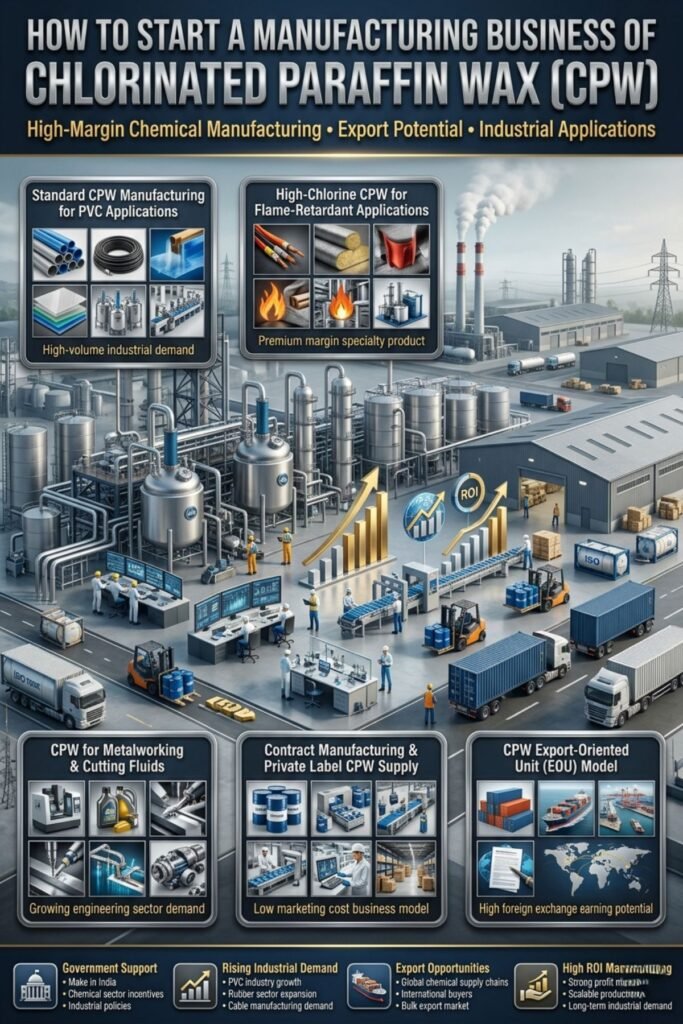
3. CPW for Metalworking and Cutting Fluids
Metalworking Lubricants is one of the rapidly expanding end markets in the CPW space, particularly with the growth of the auto-components and heavy engineering industries in India, which are increasingly becoming the hub of the country’s machining industry. Alternatives to CPW are not as lubricious or as thermally stable as it is in extreme-pressure metalworking (EP) fluids. A focused plant that manufactures custom blends of CPW to meet specific customer requirements can establish a niche in the metalworking fluids sector. The advantage of this model is the close proximity to industrial hubs in Pune, Chennai, Coimbatore, Faridabad and the customers are your neighbours.
4. Contract Manufacturing and Private-Label CPW Supply
Not all chemical companies are interested in operating their own reactors. Many mid-sized lubricant manufacturers, PVC compounders, and leather chemical suppliers prefer a trusted contract manufacturer for CPW procurement. This creates an excellent business model: You develop the production asset; they get the orders. Contract manufacturing can sometimes involve advance order agreements which greatly lessen your risk with the market. Plus, private-label packaging for trading companies or chemical distributors allows you to enjoy volume and do not have to create a brand from scratch.
5. CPW Export-Oriented Unit (EOU) Model
The advantage of registering as Export Oriented Unit (EOU) under Foreign Trade Policy is the duty-free import of capital goods, rebate on input costs, and export finance facility from EXIM Bank. In CPW, paraffin wax serves as the key raw material. We can import it at competitive rates from the Middle East and Southeast Asia, which significantly improves costs in this model. Import of mid-grade CPW is currently high in countries of sub-Saharan Africa, Southeast Asia and the Gulf. Indian EOU having good quality control systems and proper logistics can compete in these markets.
Related Article: Start a Chlorinated Paraffin Wax Business in India: High Demand, Multi-Industry Use
Import–Export Opportunity Analysis
CPW is traded both in and out of India and the dynamics of both the imports as well as exports indicate a clear strategic opening. Data available at the Directorate General of Foreign Trade (DGFT) indicates that imports of chlorinated paraffin products continue to be made due to the fact that there is a lack of supply of the premium grade products in the domestic market. This represents a space the new manufacturers can fill.
Gulf Cooperation Council (GCC), parts of ASEAN and East Africa are the active importers of CPW in the export market and the price of CPW from India is competitive in the markets. To unlock these markets, ensure consistent product quality, document REACH compliance for European-standard buyers, and maintain reliable shipment timelines. Businesses that export from the start, as opposed to meeting compliance standards later, have a lasting competitive advantage.(Chlorinated Paraffin Wax Manufacturing Business)
Not to neglect the China factor. Indian manufacturers have an opportunity to absorb some of the global demand that is rising because environmental enforcement in China has increased production costs for mid-grade CPW. This is not just a theory — Indian specialty chemical companies have already taken advantage of such a displacement in other segments.
Indian MSME Success Stories in Specialty Chemicals
Apar Industries
Apar Industrial is one of the most trusted and established brands for producing conductor and transformer oil in India, promoted by the Choksi family. They have been a textbook example for CPW entrepreneurs in their disciplined approach to specialty chemicals, investing in consistent quality, long-term customer relationships and vertical integration. The takeaway: Industrial chemicals are a currency of trust. Develop your quality systems before revenue comes in.
Munjal Showa and the Auto-Chemicals Model
Although not a pure CPW producer, the companies in the Munjal group ecosystem show how industrial chemicals used in the automotive supply chain can provide steady and recession-proof revenue. The captive demand, long procurement cycles, and pricing stability are all examples of the same that apply to CPW-based metalworking fluid suppliers to auto OEMs. Access over aspiration here, meaning: enter one OEM supply chain and business grows organically.
Anupam Rasayan India
Anupam Rasayan, promoted by Anand Desai, established a successful specialty chemicals business in Gujarat using a custom synthesis approach, compliance first manufacturing approach and development of export markets. Their strategy of consolidation in the domestic market and expansion elsewhere in the world is directly applicable to CPW manufacturers who are not targeting the Indian market. For the new entrepreneurs, the message is that international certificates and audits are an investment, not a cost.(Chlorinated Paraffin Wax Manufacturing Business)
Build a profitable business with the right idea
How NPCS Can Help You Start Your CPW Business
Niir Project Consultancy Services (NPCS) provides professional consulting for preparing Market Survey cum Detailed Techno-Economic Feasibility Reports (DPRs) for setting up new industries. The reports include the entire CPW manufacturing process & flow, sourcing information of machinery & equipment, raw material specifications & mapping supplier sources, market research & raw material demand analysis, capacity plan & product mix analysis, project financials with profitability projections for CPW manufacturing business.
We aim to be simple: we tell you whether there are solutions, it is profitable, and if it is possible to expand it. It’s a key component in a capital-intensive business-like specialty chemicals, and it’s what makes the difference between a sound investment and a costly error.
CPW Business at a Glance — Key Data Points
| Parameter | Small-Scale Unit | Medium-Scale Unit |
| Annual Capacity | 300–500 MT | 1,000–2,000 MT |
| Estimated Project Cost | ₹60–90 Lakh | ₹1.5–3 Crore |
| Land & Building | 2,000–3,000 sq ft | 5,000–8,000 sq ft |
| Raw Material (Paraffin Wax) | Primary input | Primary input |
| Key Machinery | Reactor, Chlorinator, Condenser | Reactor, Chlorinator, Condenser, Storage |
| Target Chlorine Grade | 30–52% Cl | 30–70% Cl (multi-grade) |
| Primary End Markets | PVC, Leather | PVC, Metalworking, Export |
| Approx. Gross Margin | 18–24% | 22–30% |
| Manpower Required | 8–12 persons | 20–35 persons |
| Payback Period | 3–5 years | 2.5–4 years |
Note: Estimates are indicative and vary based on location, machinery sourcing, and product mix.
Frequently Asked Questions (FAQs)
1. How much is the lowest investment cost to launch a CPW manufacturing unit?
The cost of a small scale CPW can be in the range of ₹60 to ₹90 lakh, depending on location, lease or ownership of land and selection of machinery sourcing strategy for a unit of 300-500 MT per annum. Chemical industrial zones offer benefits for entrepreneurs through lower infrastructure costs and shared utilities, which can make the initial start-up cost lower.
2. What licences and approvals are required?
CPW manufacturing requires Factories Act registration, Consent to Establish and Consent to Operate from the Pollution Control Board, MSME Udyam registration, and GST enrolment. Following the Manufacture, Storage and Import of Hazardous Chemicals (MSIHC) Rules is mandatory because the production process uses chlorine gas. Plant scale and state regulations may also apply for fire NOC and explosive storage permits.
3. What is the best site to establish a CPW plant?
The most preferred states for the production of CPW are Gujarat, Rajasthan and Maharashtra because of their established chemical industrial zones (GIDC, RIICO, MIDC), nearness of Paraffin wax suppliers and excellent logistic connectivity with ports. States should carefully consider power subsidies and other incentives for new MSME chemical units during the site selection process.
4. What is the main raw material used and how is it obtained?
The major raw material is paraffin wax, usually obtained from petroleum refineries. The Indian refineries mainly supply paraffin wax in the country, and imported wax from the Middle East and South East Asian countries helps to meet the domestic demand. Chlorine is obtained from chlor-alkali plant which is situated in various chemical centers in India. One of the key early activities of a new CPW manufacturer is the establishment of long-term supply contracts with wax manufacturers.
5. What are the principal qualities of CPW and their uses?
CPW is commercially available in three categories based on chlorine content. Low-chlorine grades (30–40%) act as secondary plasticisers for PVC. Mid-chlorine grades (50–52%) find use in cable jacketing, leather, and related applications. High-chlorine grades (60–70%) serve in flame-resistant formulations and extreme-pressure lubricants. Product mix decisions directly affect revenue and margin due to the different pricing for each grade as well as the different buyers.
6. Can export be done as a day one strategy?
In general, companies can start exporting from year two, once they develop domestic quality standards and prepare the required compliance documentation. At that stage, they should also obtain product safety data sheets, export lab certifications, and complete REACH compliance preparations for European buyers. Entrepreneurs who register as Export Oriented Units (EOUs) from the initial stage can import capital goods duty-free, which significantly reduces the cost structure, especially for units that generate 80–90% of their sales from exports.
Conclusion
Chlorinated Paraffin Wax is not one of the “catchy headlines” business; instead, it’s one of the few industries with a good structurally-sound, demand driven, policy supported business opportunity; it has various entry opportunities considering scale, grade and market focus. As the Indian infra-industrial economy gains momentum, demand for CPW will grow in size. The entrepreneurs entering early, building compliance-first facilities, focusing on steady product quality will discover one of the more sustainable business opportunities in the specialty chemicals sector.(Chlorinated Paraffin Wax Manufacturing Business)
A techno-economic DPR drafted by a professional agency like NPCS (Niir Project Consultancy Services) provides a sound feasibility base to any entrepreneur prior to investment. It converts any concept to a bankable project plan.