


Entrepreneurs have some of the most accessible and globally recognised agricultural export business ideas in the groundnut and oilseeds sector in India. India is the third largest producer of groundnut, also a major exporter of sesame seed and a significant supplier of castor oil, linseed and other oilseeds to the world. APEDA specifically includes groundnuts, peanuts, and walnuts in its list of scheduled products. Exporters of these products can access APEDA’s financial assistance, market development support, and quality certification programmes. There are several business opportunities within the value chain, ranging from raw groundnuts and blanched peanuts to groundnut oil, peanut butter and specialty peanut products, with differing levels of investments and margins.
Why Groundnut and Oilseeds Export Is a Strong Opportunity
Groundnuts rank among the world’s most widely traded agricultural commodities. Consumers use them in several forms, including roasted groundnuts for food, groundnut cake for animal feed, and groundnut oil for industrial applications such as biodiesel and cosmetic carrier oils. Gujarat, Andhra Pradesh, Tamil Nadu, and Rajasthan lead groundnut production in India. Their competitive production costs help Indian groundnuts compete in global markets. Foreign buyers also prefer Indian blanched groundnuts because they offer consistent quality.
Enhanced post-harvest operations, improved storage facilities, and strict testing procedures have helped address aflatoxin concerns, especially in groundnut exports. If Indian exporters invest in aflatoxin testing and storage measures, they’ll be able to access high-quality EU buyers who have strict aflatoxin MRL requirements. This compliance investment will allow them to differentiate themselves from exporters that don’t test as rigorously.
Get Detailed Insights from This Book: Fruits, Vegetables, Corn and Oilseeds Processing Handbook
APEDA and Government Support
The groundnuts, peanuts, walnuts and processed oilseed products have been included under the mandate of scheduled products by the Agricultural and Processed Food Products Export Development Authority (APEDA). APEDA registration opens up opportunities for financial assistance in the areas of processing equipment, quality testing infrastructure, packaging and market development. The export facilitation services provided by APEDA for groundnuts are buyer-seller meets, participation in international food ingredient fairs and market intelligence.
The Solvent Extractors’ Association of India (SEA) and the Groundnut Export Promotion Cell (GEPC) offer market intelligence, trade information and buyer linkage services to the exporters of groundnut and oilseeds respectively. The commodity pricing information and global buyer contacts of these industry associations benefit membership.
The DGFT Advance Authorisation Scheme relates to duty free import of certain food grade processing aids/ packaging material required in manufacturing of export groundnut products.
Agricultural and Processed Food Products Export Development Authority (APEDA) provides market access support to the Indian groundnut exporters at ANUGA (Germany) and SIAL (France) the world’s largest food ingredients trade fairs where the international food manufacturers are buying groundnuts and oilseed products.
Business Ideas in Groundnut and Oilseeds Export
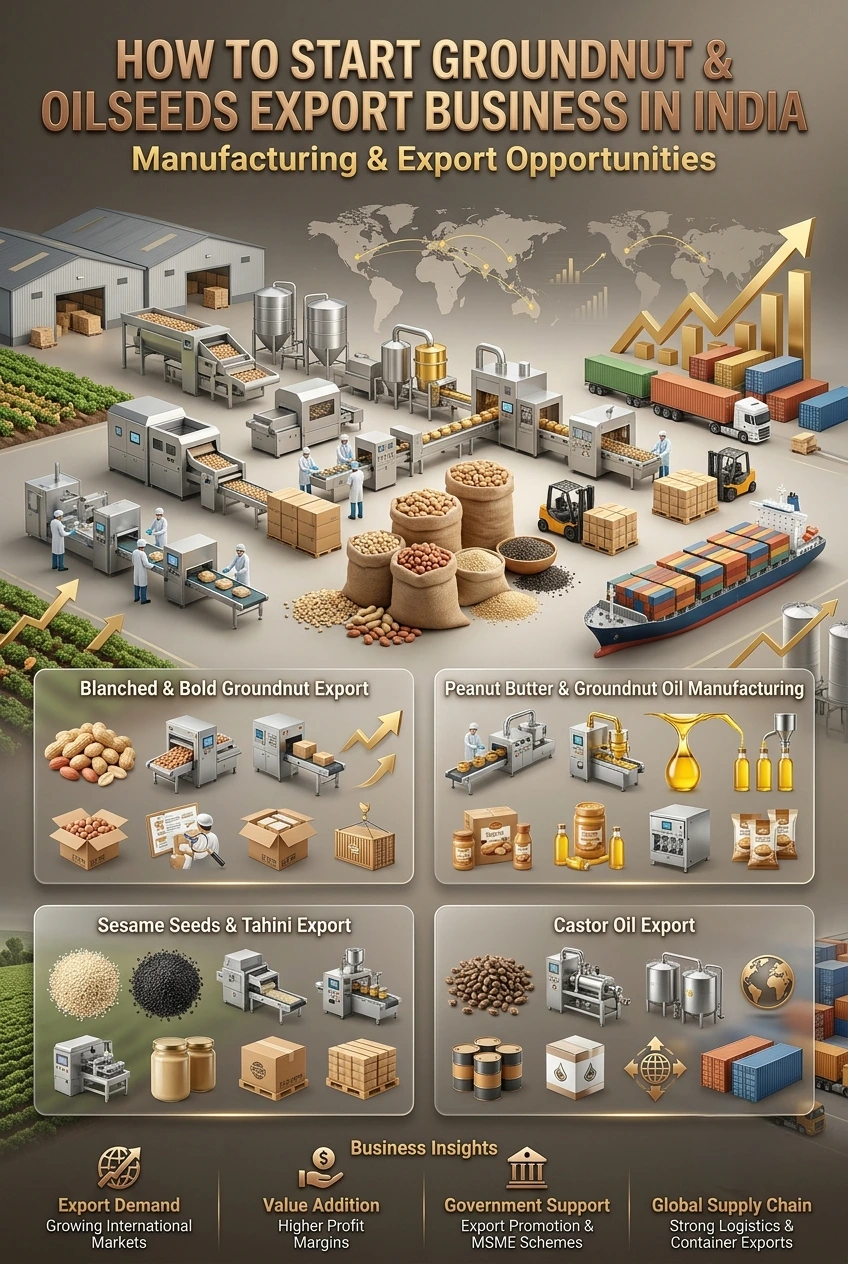
1. Blanched and Bold Groundnut Export
The blanched groundnuts, which undergo a blanching and hot water drying process, are exported for various applications, including confectionery, bakery, snack and food service. Bold groundnuts (bigger size from Gujarat) are especially in demand for confectionery. Setting up a groundnut blanching unit with investment of ₹25 lakh to ₹70 lakh which includes blanching lines, drying system, colour sorting and grading system, packaging infrastructure. EU buyers need aflatoxin testing (4ppb total aflatoxin for groundnuts for direct human consumption) and pesticide MRL compliance. To be sold in the U.S., buyers must register the facility with the FDA.For U.S. sale, FDA facility registration is required. The groundnut blanch prices are 20% to 35% up on the groundnut raw procurement price.
2. Peanut Butter and Groundnut Oil Manufacturing for Export
Value added products of groundnut like peanut butter and groundnut oil have huge margin as compared to the export of raw or blanched groundnut. Peanut butter made from natural ingredients (peanuts and salt) is in high demand in the health food sector around the world. The high-quality, cold-pressed expeller-pressed groundnut oil is a specialty food oil that is used in Japanese, Korean, and European markets. The investment required for setting up a peanut butter and groundnut oil manufacturing unit is in the range of ₹40 lakh to ₹1.5 crore. Peanut butter is recognized to be exported to the United States of America, Germany, United Kingdom and Canada. Requirements are FSSAI licensing, APEDA registration and compliance with the nutrition labelling requirements of the destination country.
Get Detailed Project Report (DPR): Peanut Butter Manufacturing Project Report
3. Sesame Seeds and Tahini Export
India is one of the world’s biggest producers and exporter of both natural and hulled (white) sesame to the Middle East, Japan and EU food manufacturers from Gujarat, Rajasthan and MP. Tahini, a sesame seed paste, is widely used in Middle Eastern and Mediterranean cuisine and offers excellent value-added export potential. The cost of establishing a sesame cleaning, sorting and hulling unit is ₹20 lakh to ₹60 lakh. There is a need for more grinding and mixing facilities for tahini production (₹15 lakh to ₹40 lakh incremental). There exists a large market for sesame and tahini in the Gulf and India is a trusted supplier of it. High-quality white sesame seeds are also very important to the Japanese confectionery industry.
View Full Project Details: Sesame Seed Hulling Manufacturing Guide
4. Castor Oil Export
India is the leading producer of castor oil in the world and contributes more than 85% of the world trade of castor oil. Industrial lubricants, cosmetics, pharmaceuticals, and bioplastics are all applications for castor oil and its derivatives, including hydrogenated castor oil, dehydrated castor oil, and methyl esters. The investment required for an extraction and refining unit for An castor oil is from ₹50 lakh to ₹1.5 crore. Castor oil is exported to the specialty industrial and cosmetic markets in the US, EU and Japan. India’s natural dominance in castor oil production gives the country a reliable supply base that other countries cannot easily replicate in the short term. The margins of refined castor oil are generally in range of 15-30%.
Access Complete Business Plan: Castor Oil & Its Derivatives Manufacturing Project Report
Import-Export Opportunity Analysis
India’s export performance of groundnut and oilseeds has been good. The APEDA Agri Exchange portal features blanched groundnuts, sesame seeds and castor oil being regular high value exportable commodities. Import destinations of oilseed/groundnut from India include the following countries: Indonesia, Vietnam, Netherlands, Germany and Japan.(Groundnut and Oilseeds Export Business)
The major problem and competitive edge in these markets is the regulatory compliance investment, especially for aflatoxin testing of groundnuts and pesticide residue testing of all oilseeds. Investment in the accredited laboratory testing infrastructure and a consistent history of compliance assure purchasers that the exporter will supply the highest quality products at the premium price, rather than the commodity product, and earn long-term business relationships.
Explore proven business ideas with high success potential
Indian MSME Success Stories in Groundnut Exports
Gujarat-based Galla Foods, a groundnut processor and exporter, invested in the technology for aflatoxin testing, EU compliant food safety systems, and direct buyer relations in Europe, and achieved significant growth in international business of blanched groundnuts and peanut butter. They felt it was essential that buyers must be compliant, at a time when many exporters of groundnut from India were facing EU rejection due to aflatoxin violations which had resulted in long-term buyer relationships that are competitive today.
Similarly, A few trading and processing businesses based in Junagadh have established export ventures of ₹30 crore to ₹100 crore in bold groundnuts and blanched peanuts to the manufacturers in Southeast Asian countries, indicating that quality, reliability and price continue to be the basic commercial needs for groundnut export success.(Groundnut and Oilseeds Export Business)
Moreover, Kisan Agro, an exporter of sesame and oilseeds from Gujarat, has established a considerable export business of white hulled sesame to Japan and Korea with the investment in optical colour sorting technology which provides the required purity standard for the Japanese confectionery and oilseed producers.
How NPCS Supports Groundnut and Oilseeds Business Planning
We at Niir Project Consultancy Services (NPCS) provide professional consulting for the preparation of Market Survey cum Detailed Techno-Economic Feasibility Reports (DPRs) for setting up new groundnut and oilseeds processing and export businesses. Our reports contain technology selection for processing, aflatoxin management planning, APEDA compliance guidance, market research, export demand analysis and full project financials including profitability projections.
Related Article: Starting Own Chilli Seed Oil Production
Groundnut and Oilseeds Export: Key Data Overview
| Product Category | Investment Range | Key Certification | Target Markets | Typical Margin |
| Blanched Groundnuts | ₹25L – ₹70L | APEDA + Aflatoxin Test | EU, Indonesia, Vietnam | 20–35% |
| Peanut Butter | ₹40L – ₹1.5 Cr | FSSAI + APEDA | US, UK, Germany, Canada | 30–55% |
| Sesame Seeds (White/Natural) | ₹20L – ₹60L | APEDA + MRL Testing | Japan, Korea, ME, EU | 18–35% |
| Castor Oil (Refined) | ₹50L – ₹1.5 Cr | APEDA + FSSAI | US, EU, Japan | 15–30% |
| Groundnut Oil (Cold-pressed) | ₹35L – ₹80L | FSSAI + APEDA | Japan, EU, SE Asia | 25–45% |
Frequently Asked Questions (FAQ)
1. What is the limit of aflatoxin in groundnut when it is exported to EU?
The limits for aflatoxin in groundnuts that are consumed directly by humans are specified in EU Regulation (EC) No 1881/2006, which states 4 ppb (micrograms/kg) for total aflatoxin and 2 ppb for aflatoxin B1. Limits are 15 ppb total and 8 ppb B1 for further processing before consumption for groundnuts. All export shipments need to be tested at an accredited laboratory prior to shipment.
2. How much investment is required to establish the capacity to test for aflatoxin?
A basic in-house setup to detect aflatoxin using enzyme-linked immunosorbent assay (ELISA) kit can be set up for ₹3 lakh to ₹8 lakh. The cost of HPLC based confirmatory testing infrastructure is in the range of ₹15 lakh to ₹40 lakh. For smaller export volumes, many MSME groundnut exporters opt for the NABL accredited third party labs for aflatoxin testing at a cost of ₹1,500 to ₹3,000 per sample.
3. Which Indian state produces the best quality groundnuts for export?
Gujarat produces the highest volume of bold groundnuts (G-20, G-76 varieties) preferred for European confectionery markets. Andhra Pradesh produces significant Java-type groundnuts for Southeast Asian markets. Rajasthan and MP produce groundnuts for domestic crushing and oil extraction. Gujarat’s Junagadh and Rajkot districts are the primary hubs for groundnut export processing.
4. Is it possible to export Sesame without APEDA registration?
Exporters of sesame seeds must obtain APEDA registration because sesame seeds are listed as scheduled products under APEDA. APEDA registration qualifies for financial assistance, market development assistance and quality programmes.
5. What makes Indian castor oil special in the international market?
India leads the world in castor oil production. Farmers mainly cultivate the castor plant (Ricinus communis) in Gujarat, Rajasthan, and Andhra Pradesh. The near-monopoly position allows the world’s buyers of castor oil and derivatives to have no other large-scale source. Indian castor oil contains a high percentage of ricinoleic acid, which makes it suitable for products where other vegetable oils may not perform effectively.
6. Where to find foreign clients for Indian groundnut and oilseeds?
International buyers mainly discover groundnuts and oilseeds through global buyer-discovery platforms, such as ANUGA and SIAL food ingredient trade fairs. APEDA supports the involvement of Indian exporters. There are industry associations such as SEA (Solvent Extractors’ Association of India) who have buyer databases. Initial buyer contact for commodity oilseed products is also via online B2B platforms such as Alibaba and Euro pages.
Conclusion
Groundnut and oilseed exports are among the most established and high-volume agriculture export business ideas. Additionally, India has natural production advantages and well-developed buyer networks across global markets. Moreover, The sector also offers strong value-addition opportunities, from raw commodities to processed products.
Aflatoxin testing and MRL compliance are major investment requirements. However, they also create a strong competitive advantage for exporters. Compliant, tested, and traceable supply chains can help entrepreneurs enter premium markets in Europe, Japan, and North America. These markets are often difficult for commodity-based exporters to access.
APEDA’s support system and India’s strong production base make groundnut and oilseed exports a profitable long-term business opportunity. Quality-focused entrepreneurs can benefit from growing global demand and value-added export opportunities.(Groundnut and Oilseeds Export Business)