Grey Hydrogen has been quietly fuelling the Indian industry for decades. However, surprisingly few business owners have considered it as a viable business. Hydrogen is used extensively by refineries, fertiliser plants, chemical producers and steel makers. Most of this hydrogen is captive produced or sourced via limited supply chains, however. The loophole allows the emergence of new investors and industrial startups that are small and medium enterprises (MSMEs). Grey hydrogen production is worth considering in the context of real industrial demand, when assessing energy sector business models.
Grey hydrogen is a hydrogen that is generated from natural gas or other fossil fuels via a process known as Steam Methane Reforming (SMR). Currently supplies most of the hydrogen produced in the world. It does not need the extensive renewable energy facility like green hydrogen. This is much more cost-effective small and medium-scale production. This cost is important for the industrial gas industry.
Why the Grey Hydrogen Sector Offers a Strong Market Entry
The demand for hydrogen in India continues to increase. The largest consumption is by the fertiliser industry. Hydrogen is the only essential input for ammonia synthesis, a process that is used for the production of urea and other fertilisers, and is virtually all dependent on the ammonia synthesis process. Further, hydrogen is employed in the petroleum refining industry in desulphurisation and hydrocracking processes. These two sectors represent a steady demand that is not related to the economic cycle.
Additionally, India has been striving to modernise the refining capacity, which has led to a rise in the consumption of hydrogen per barrel processed in the country. The number of refineries converting to heavier crude grades increases the amount of demand for hydrogen at the refinery. In the case of a new hydrogen producer in close proximity to a refinery concentration or a zone of fertiliser production, the market is almost laid out.
In addition to these sectors, the steel industry is testing the use of hydrogen for direct reduction of iron ore. The long-term target is to use green hydrogen, but a transitional feedstock is grey hydrogen. This transition could take more than a decade, providing a long window for producers of grey hydrogen to invest and earn a return on capacity development. Furthermore, hydrogen is used in the chemical industry, notably for methanol and specialty chemicals.
Related Article: Green Hydrogen Production in India: The Next Trillion-Rupee Opportunity for Entrepreneurs
Government Policies and Incentives Supporting Hydrogen Businesses
The Government of India has declared hydrogen a strategic fuel for industries. The government has announced a roadmap under the National Hydrogen Mission, which covers both green and grey hydrogen. The policy focus is on the transition to green hydrogen for the future, but the industrial infrastructure — pipelines, storage, safety, distribution etc. — is being developed around an existing grey hydrogen economy.
A number of support plans are available for MSME entrepreneurs. The Credit Guarantee Trust Fund Scheme of MSME Ministry offers collateral-free loans up to ₹2 crore to industrial gas manufacturers, as well as manufacturing startups. Likewise, the advanced chemical and energy practices where hydrogen infrastructure is applicable are covered under the Production Linked Incentive (PLI) scheme by the Directorate of Policy and Promotion of Industries (DPIIT).
Moreover, the National Hydrogen Mission has been initiated by the Ministry of New and Renewable Energy (MNRE) which offers a clear policy framework. At the state level, many industrial states provide capital subsidy on the plant and machinery, as part of their MSME industrial policies. Hence, the start-up ecosystem can leverage on the central and state government incentives suitably in Andhra Pradesh, Gujarat, Maharashtra and Rajasthan.
The Startup India scheme by DPIIT also provides income tax exemptions for three years to hydrogen startups who are eligible. These policy layers, together with the Make in India Policy, will give the Indian Hydrogen production an additional investor edge.
Business Ideas for Startups in Grey Hydrogen Production
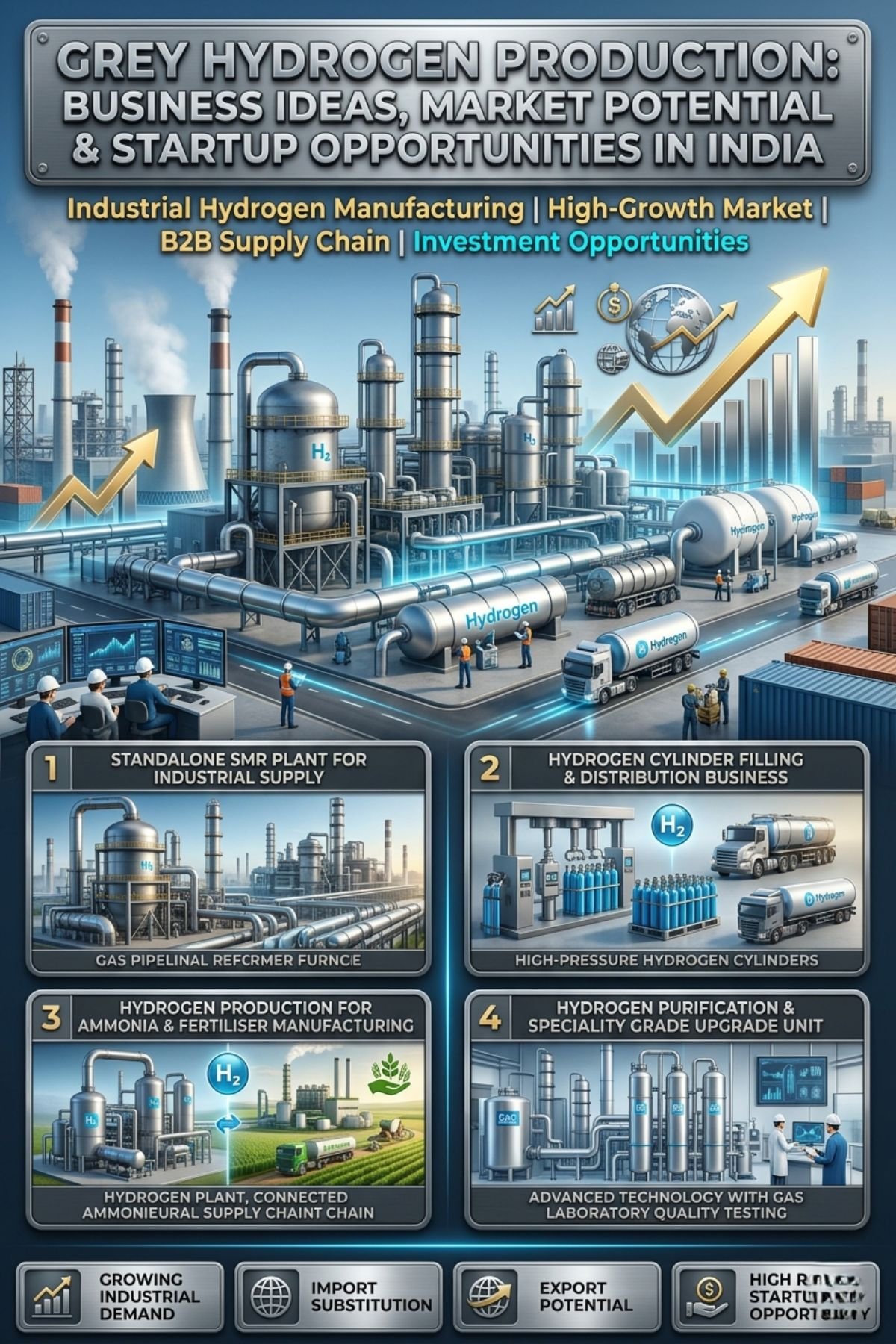
1. Standalone Steam Methane Reforming (SMR) Plant for Industrial Supply
The top business opportunity in this area is to establish a hydrogen production facility based on SMR technology. A plant that generates 500-2,000 Nm³/hr of hydrogen can be expected to supply mid-size industrial clients within a 100-kilometre supply radius. In short, the business model is straightforward — large hydrogen users rather prefer to rely on third-parties to supply them than invest in their own hydrogen production units, which have significant capital requirements. It forms a B2B supply model, which is sticky for customers.
Investment in a plant of this scale is generally between ₹1.5 crore and ₹4 crore with respect to capacity, availability of feedstock and purification technology. Having natural gas supply through city gas distribution (CGD) networks in Gujarat, Maharashtra or Andhra Pradesh reduces the complexity of feedstock procurement. Furthermore, PSA (Pressure Swing Adsorption) purification units enable the plant to produce high quality and purity hydrogen used in pharmaceutical, electronics and specialty chemical applications at premium prices.
2. Hydrogen Cylinder Filling and Distribution Business
Not all industrial hydrogen customers require a pipeline bulk supplier. Compressed cylinder hydrogen is used by many small and medium manufacturers, including heat treatment shops, glass manufacturers, cutting and welding fabricators and laboratory users. Therefore, it is a good business proposition for MSMEs to establish a filling station for hydrogen cylinders based on a grey hydrogen production unit with a wide base of customers.
This model is a mix of hydrogen production and distribution downstream. The economics are favourable, as the cost of the cylinder is realised on a per unit of hydrogen basis, which is better than bulk pipeline supply. Thus, a small capacity SMR plant with capacity range of 200 – 500 Nm³/hour, supplying the cylinder filling units, can earn a profit of ₹80 lakh to ₹1.5 crore per annum with a decent margin. This model, however, must take into account compliance and safety standards for cylinders, as well as licensing requirements from the Petroleum and Explosives Safety Organisation (PESO) in India under the Gas Cylinder Rules.
3. Hydrogen Production for Ammonia and Fertiliser Manufacturing
India is among the biggest consumers of fertilisers in the world. The ammonia production value chain is thus fully hydrogen based and is a large and stable demand pool. An integrated business model, with a grey hydrogen production unit feeding a downstream ammonia synthesis plant, is an appealing concept. It can be developed as a captive-supply joint venture between the entrepreneur and an existing ammonia producer, if the natural gas supply and land are available in the vicinity of a chemical cluster.(Grey Hydrogen Production Business)
Another option is to establish a small merchant hydrogen plant near a fertiliser park, for instance the one being encouraged by Chemicals and Fertilizers Ministry, which makes the startup a secure feedstock supplier. In such a position, long-term offtake agreements can be negotiated that can enhance the bankability of project financing. This is a model that generally needs between ₹3 crore and ₹8 crore of capital investment for scale, but offers stable, contracted revenues.
Get Detailed Insights from This Book: Modern Technology of Industrial Chemicals
4. Hydrogen Purification and Speciality Grade Upgrade Unit
Many industrial and manufacturing processes, such as the chlor-alkali process, coke ovens, and petrochemical plants, produce by-product hydrogen. However, this by-product hydrogen is not always pure enough for electronics manufacturing, pharmaceutical production, or fuel-cell testing applications. Therefore, the establishment of a hydrogen purification unit which can upgrade by-product streams to high purity grades (99.999% or above) is a differentiated and high-margin business idea.
Because the feedstock is an industrial by-product and often is available at little cost, this model does not involve SMR investments. The investment amount is significantly less, usually ranging from ₹50 lakh to ₹1.5 crore in a PSA purification unit. But it requires technical expertise in gas separation as well as quality certification processes (ISO 14687 for hydrogen quality) and extensive links with by-product producers. It is a great entry point into the hydrogen value chain for founders with a chemical engineering background, with low start-up capital.
Import–Export Opportunity Analysis for Hydrogen Entrepreneurs
The current Hydrogen trade profile of India is tilted towards imports of Hydrogen related equipment, catalysts and purification membranes. At the present time, there is no major export of hydrogen at a domestic level. As the trade of hydrogen expands in the region, however, India’s geographic and industrial endowment may come into play for export-led capacity development, if at all.
The more immediate practical is the import substitution opportunity. India is now importing a substantial amount of speciality hydrogen for electronics and pharmaceutical industries. A domestic high-purity hydrogen producer can therefore play on the lead time, logistics cost and currency stability advantage. Moreover, import of SMR catalysts and PSA adsorbents will give the chance to the chemical industry to have a localised alternative under the ‘Make in India’ initiative to MSME.(Grey Hydrogen Production Business)
Hydrogen derivative exports, such as ammonia and methanol made with grey hydrogen, are already a real export opportunity for entrepreneurs looking into exports. India is both an exporter of both the commodities and new players in the hydrogen production are able to participate in the downstream value chain of export. Export incentive frameworks are available in the Directorate General of Foreign Trade (DGFT) for chemical/energy product exporters to avail advance authorisation and duty drawback benefits.
Indian MSME Success Stories in the Hydrogen and Industrial Gas Space
INOX Air Products
INOX Air Products is one of the most successful industrial gas enterprises in India, promoted by the Jain family of the city of Vadodara. The company gained its reputation for investing in distributed air separation and gas production units, as opposed to centralising these facilities in one area. This decentralised approach, which MSME entrepreneurs can easily replicate, helped INOX secure long-term take-or-pay contracts and recover its capital investment. For new players, the message is simple: It’s about being near the customer and having a contract offtake rather than scale alone.
Gujarat Fluorochemicals and Hydrogen By-Product Monetisation
Gujarat Fluorochemicals Limited (GFL) is a part of INOX group and has one of the biggest chlor-alkali plants in Dahej, Gujarat. A significant amount of hydrogen is produced as a by-product of the chlorine production process at the facility. This by-product stream was systematically monetised by GFL, both internally and externally. This was a decision that resulted in a lot of extra income from a cost centre. For MSME entrepreneurs exploring the by-product purification model, the GFL approach demonstrates how a valuable waste stream can become a standalone profit centre through identification and optimization.
Hindustan Composites and Speciality Gas Supply Chain
A few chemical smaller players in Gujarat’s Dahej and Ankleshwar chemical cluster have developed their profitable MSME businesses by providing speciality and industrial gases such as hydrogen grades to the multinational chemical companies in Dahej and Ankleshwar. Most of these businesses began as trading and transportation enterprises before they began investing in captive production. Their growth model (which is to start lean, develop client relationships, and then invest in production) is a good model for MSME-scale entrepreneurs looking to enter the hydrogen space without making a massive up-front capex investment.
Access Complete Business Plan: Hydrogen Peroxide (50% Concentrate) Manufacturing Plant Report
How NPCS Helps Entrepreneurs Evaluate Grey Hydrogen Projects
At Niir Project Consultancy Services (NPCS) we assist entrepreneurs and investors make exactly these types of industrial project decisions. We do Market Survey cum Detailed Techno-Economic Feasibility Reports (DPRs) for grey hydrogen and industrial gas production projects. Our reports cover manufacturing process selection, evaluation of SMR and alternative technologies, raw material and feedstock planning, machinery sourcing, and comprehensive financial modelling, including capital costs, working capital requirements, profitability projections, and payback period analysis.
In addition, we offer demand analysis, competitor mapping and hydrogen pricing benchmarks in certain industrial sectors. For entrepreneurs looking to determine feasibility, profitability and scalability in the long-term, our consulting approach offers a reliable data-driven basis.
Grey Hydrogen Production: Indicative Project Parameters
| Parameter | Small Scale Unit | Medium Scale Unit |
| Production Capacity | 200–500 Nm³/hour | 1,000–2,000 Nm³/hour |
| Estimated Capital Investment | ₹1.5 Cr – ₹3 Cr | ₹4 Cr – ₹8 Cr |
| Technology Route | SMR / By-product Purification | SMR with PSA Purification |
| Primary Feedstock | Natural Gas / By-product H₂ | Natural Gas (Pipeline) |
| Hydrogen Purity Achievable | 99.5% – 99.99% | 99.999% (Ultra High Purity) |
| Target Market | Welding, Heat Treatment, Labs | Refineries, Fertiliser, Chemicals |
| Approximate Annual Revenue | ₹80 Lakh – ₹1.5 Cr | ₹3 Cr – ₹6 Cr |
| Payback Period (Indicative) | 4–6 Years | 5–7 Years |
Note: These are approximate numbers. True project costs and revenues vary by geographical location, availability of feedstock, technology vendor and market conditions.
Choose the right startup backed by real market demand
Frequently Asked Questions (FAQs)
1. What is grey hydrogen and how is it different from green hydrogen?
Brown hydrogen is derived from natural gas through Steam Methane Reforming (SMR) processes, currently representing the most produced and cost-effective form of hydrogen globally. The brown process uses an energy intensive Steam Methane Reformation process that releases carbon emissions as a by-product. As a cleaner alternative, the “green” hydrogen process relies on electrolyzers powered with renewable renewables (ie, solar and wind) to create pure hydrogen without the release of CO2. As of today, brown is much more economical and cost-effective to produce.
2. What is the minimum investment to start a grey hydrogen production unit in India?
A small-scale by-product purification unit can be set up for ₹50 lakh to ₹1.5 crore. A standalone SMR-based production unit starts at approximately ₹1.5 crore to ₹3 crore for a capacity of 200–500 Nm³/hour. A medium-sized plant providing refineries or fertilizer units could demand an investment between 4 crores to 8 crore. These investment figures are highly variable depending upon the location, selection of technology, and raw materials availability.
3. Which industries are the largest buyers of grey hydrogen in India?
The single biggest consumer by far is the fertiliser sector, in particular the production of ammonia. Next is oil and gas refining, utilising hydrogen in the process of desulphurisation and hydrocracking, with the third major industrial use by chemical companies in the production of methanol, specialty chemicals and plastics. Smaller volume users of hydrogen include heat treatment shops, glassmakers and research facilities in laboratories.
4. What licences and certifications are required to produce and sell hydrogen in India?
These Hydrogen production plants also need factory registration under the Factories Act and PESO (Petroleum and Explosives Safety Organisation) licence under Gas Cylinder Rules. Depending on the plant capacity, the project developer must obtain environmental clearance. For cylinder filling operations, the project developer must also obtain PESO approvals for gas cylinders. However, in the case of high-purity H2 gas for pharma use and electronics sector, the quality needs to conform to ISO 14687 standards. Consent of the State Pollution Control Board (SPCB) is also required to set up these plants.
5. Can MSME entrepreneurs access government funding for a hydrogen production startup?
Yes. There are numerous schemes. Some examples include: Collateral-free loan of Rs.2 crore for qualifying MSME manufacturing startup by CGTMSE. Subsidy on capital cost of plant and machinery from state industrial development corporations of Gujarat, Maharashtra, and Andhra Pradesh. 3 years of tax-free income after obtaining startup recognition. They can also explore the loan options from SIDBI’s technology upgrade scheme and National Bank for Agriculture and Rural Development (NABARD) in cases involving agri-linked hydrogen applications.
6. Is grey hydrogen production a viable long-term business given the transition to green hydrogen?
Yes, at least for the planning horizon considered. Today, costs of producing green hydrogen far exceed the price of grey hydrogen. We still have to invest on a massive scale on renewable capacity, electrolysis technology and hydrogen pipeline network to get to large-scale deployment. Meanwhile, India’s industrial hydrogen demand continues to grow. Entrepreneurs who establish grey hydrogen operations now can generate returns over a 7–10-year asset life while also positioning themselves to integrate green hydrogen feedstocks as costs improve.
Conclusion: Grey Hydrogen as a Practical Industrial Business for Indian Entrepreneurs
However, let’s first establish that grey hydrogen manufacturing isn’t some R&D, futuristic venture idea. It’s already an industrial activity that has technology readily available, identified customers who are willing to pay, and the right regulatory policy to encourage new market participants. Given India’s large and growing appetite for fertilizers, refining, and other industrial chemicals, a solid fundamental customer demand for hydrogen producers that can successfully penetrate the market already exists.
But success in this industry needs meticulous project planning. Location (distance from feed and customers) determines economic viability; technology selected influences capital efficiency and output quality; and offtake agreements bring revenue certainty. Of course, compliance with stringent health, safety and environmental regulations starts on day zero.(Grey Hydrogen Production Business)
For entrepreneurs that do their due diligence rigorously – with feasibility analysis, market assessment and technology benchmarking – grey hydrogen can be a truly attractive route into the industrial energy value chain in India. Now is the time to seize the opportunity. The demand exists. And the business case, made appropriately, makes sense.