Green Precipitated Silica Manufacturing Business
When you ask 10 entrepreneurs what their business is, 9 of them will say their business is pharma intermediates or agrochemicals. However, Very few, if any, will refer to green precipitated silica (GPS). That’s the opportunity that lies in the gap.
Green precipitated silica has been made by adding a mineral acid to sodium silicate to create a fine, white, amorphous powder, and is now increasingly done by cleaner methods, including the use of rice-husk-ash. Moreover, It is used in tyres, toothpaste, animal feed, agrochemicals and coatings. All of the tyres rolling on Indian roads today have this material, but there are few domestic manufacturers.
This piece explains why the sector is alluring now, what government schemes can back a new unit, some ideas for actual businesses that can be done in the sector, the import-export scenario and learnings from the Indian entrepreneurs who started silica and specialty chemical businesses from scratch.
Why Green Precipitated Silica Deserves a Serious Look
It’s facts, not fancies. The precipitated silica market size in India is estimated at USD 76 million and is projected to grow at over 10% CAGR until 2030. The estimated demand in volume is approximately 160 to 170 kilotons per year, and is on the rise.
Demand for rubber grade silica alone is more than half of total demand, as tyre makers rely on silica to reduce rolling resistance and increase fuel efficiency. Currently, India boasts of more than 41 tyre manufacturers with 62 plants, says the Automotive Tyre Manufacturers Association (ATMA). The BEE’s new fuel-efficiency rules push tyre manufacturers towards loading more silica into tyres and not less.
Related Article: Indian Precipitated Silica Market Report
The Demand-Supply Gap Is the Real Opportunity
This is the aspect that most new entrants do not realize. China’s domestic capacity has lagged behind demand, especially for silica grades which are highly dispersed (HDS) and are used in green and fuel-efficient tyres. A significant amount of these premium grades is still imported into India. There are already established players such as Tata Chemicals, Madhu Silica and AksharChem India, but the market has the potential for more than three players, particularly at the mid-size and regional scales.
The agrochemical carrier segment and animal feed premix segment is expanding even faster than the core rubber segment due to increasing number of pesticide registrations and approximately 8.5% annual growth in poultry production. That provides a newcomer with two or three product lines, rather than one.
Government Policies and Incentives Supporting New Entrants
Establishing a chemical manufacturing unit seems to be a lot of money. There are a few schemes by the Government for this particular group of first-generation entrepreneurs and MSMEs to ease that burden.
MSME and Credit-Linked Schemes
The Credit Guarantee Fund Trust for Micro and Small Enterprises (CGTMSE) is a scheme where if a founder has no industrial assets, he can avail loans up to a certain limit without having to provide any collateral. Additionally, Under the Prime Minister’s Employment Generation Programme (PMEGP), the Khadi and Village Industries Commission (KVIC) provides capital subsidy to new manufacturing units such as chemical processing. Further, the Credit Linked Capital Subsidy Scheme (CLCSS) provides assistance for technology upgradation of MSMEs implementing cleaner or more efficient production processes, which is applicable in case of a Green-route Silica Plant with MSMEs.
PLI and Chemical Sector Push
In addition to this, the government’s overall push for Atmanirbhar Bharat and the Production Linked Incentive (PLI) scheme for specialty chemicals clearly indicate a governmental thrust on minimizing reliance on imports in the specialty chemicals sector. Power tariff reductions, stamp duty exemption, and capital subsidy are also available in the two states, Gujarat and Tamil Nadu, which have the bulk of their silica capacity, at state level for new chemical units.
For more details of available schemes, the entrepreneurs should visit the Ministry of MSME portal and the Make in India portal, which also provides the process of applications by state and conditions of eligibility.
For verified, updated scheme information, see the Ministry of MSME official portal.
Multiple Green Precipitated Silica Business Ideas for Startups
The precipitated silica that is green is not a single product. It is a family of grades, each of which is oriented to a different industry. This provides a new entrepreneur with a number of options to choose from in terms of business ideas, instead of one narrow investment.
1. Rubber-Grade GPS Unit for the Tyre and Rubber Industry
This is the anchor business idea, and there’s a reason for that. The biggest demand is for rubber-grade silica and tyre producers have long-term agreements with suppliers after they gain qualification. A small to medium-size unit producing about 3,000 to 5,000 tonnes a year through the rice-husk-ash or sodium-silicate acidification route will be able to address the regional tyre retreading units, 2-wheeler tyre manufacturers and rubber goods manufacturers instead of competing directly with Tata Chemicals for large OEM contracts. It’s not a one-time chance for this sector as norms for rolling resistance continue to get tighter and tighter with every new fuel economy regulation.
Get Detailed Insights from This Book: The Complete Book on Rubber Processing and Compounding Technology
2. Agrochemical Carrier Grade Silica
The pesticide formulators require a carrier material which can ensure the stability, free flow and convenient dosage of active ingredients. Precipitated silica is capable of doing that and demand here is expanding at a rate faster than the rubber industry, partly because India continues to discover new agrochemical molecules and exports formulated ones to Africa and South-east Asia. This is one application that can generate a concentrated business for a founder with an existing knowledge and understanding of agro-inputs, or for one who collaborates with a formulator, without having to compete with the entire silica marketplace.
Read the Complete Book Here: Complete Guide to Agrochemicals Manufacturing
3. Oral Care and Personal Care Grade Silica
Precipitated silica is a mild abrasive and thickening agent for toothpaste and is experiencing growth due to the transition toward less volatile organic compounds (VOCs) and naturally positioned personal care products. This is a lower volume, higher margin business idea than rubber grade silica. It is appropriate for an entrepreneur who has FMCG or contract manufacturing relationships as oral care buyers prefer smaller batches of quality, certified by the manufacturer.
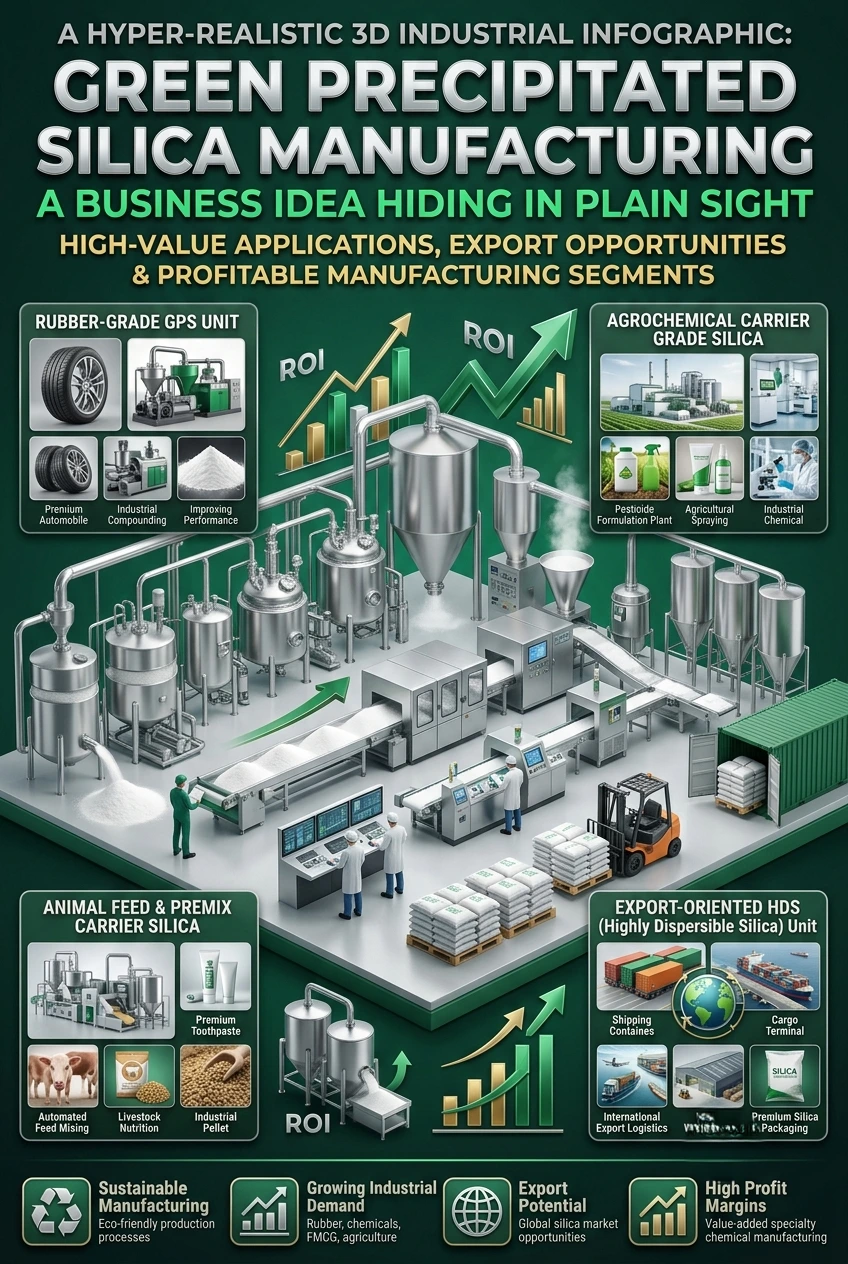
4. Animal Feed and Premix Carrier Silica
Anti-caking and carrier agents are required for poultry and livestock feed production industries, and the poultry industry of India is growing at nearly 8.5% annually. This segment is often overlooked in most feasibility discussions regarding silica, and that’s why it needs to be discussed. A founder who is located near a poultry or dairy feed cluster in any of the above-mentioned states of Punjab, Haryana or Andhra Pradesh can mix local demand with lower logistical costs as the requirement of purity is less for the feed grade as compared to the pharma and personal care grade.
View Full Project Details: Animal Feed Manufacturing from Date Pits & Discarded Dates
5. Export-Oriented HDS (Highly Dispersible Silica) Unit
This is by far the technically most challenging (and the most rewarding) idea on this list. Just a few producers in the country have qualified for HDS grades for green and fuel-efficient tyres and India still import a significant amount of HDS grades. A well-capitalized entrepreneur can build import substitution capacity by partnering with a technology licensor or an experienced process consultant. Increased investment, longer qualification cycle with the tyre makers and margins and long-term contract stability that make it more than worthwhile for a founder looking at a 5-year time horizon as opposed to a 1 year one.
Build a profitable business with the right idea
Import-Export Opportunity Analysis for New Entrepreneurs
The precipitated silica trade scenario in India is a two-way streets affair and a new entrant to the industry should take that as two opportunities and not one.
The sources of high-performance HDS grades remain mainly international, on the import side. Each tonne imported represents a tonne of demand that domestic producers can meet by complying with the tyre industry’s qualification specifications. As the government accelerates its drive to reduce import dependence, businesses can build a strong competitive moat by investing early in the certification and testing infrastructure required to secure access to tyre OEMs.
India’s agrochemical formulation industry exports substantial volumes to Africa, Latin America, and Southeast Asia. Every agrochemical shipment creates associated demand for functional silica, indirectly supporting the growth of the functional silica market. Indirectly, these formulators are also benefactors of that export growth, as the domestic silica producer doesn’t need to worry about export logistics. India regularly exports basic industrial chemicals directly to neighbouring markets such as Bangladesh, Sri Lanka and the Middle East. Competitive freight costs and the established trust in India’s industrial chemical exports make precipitated silica well suited to these trade routes.
Indian MSME Success Stories in Specialty Silica and Chemicals
Madhu Silica Pvt. Ltd.
Madhu Silica of Gujarat developed its business specifically on precipitated silica and silicate derivatives and not by diversifying its business from the beginning into other chemicals. This support was provided by the company’s founders through regular new capacity additions and export expansion to rubber, agrochemical and food-based applications. The lesson for a new founder is clear: build depth in one chemical family slowly instead of pursuing a dozen unrelated products too soon.
AksharChem India Ltd.
AksharChem increased its capacity of precipitated silica plant in Gujarat by 6000 tonnes per year, making total capacity to around 18,000 tonnes per year, mainly catering to tyre and rubber industry. The company’s decision-making logic was based on the proximity of the customers, as its plant is located near the chemical and rubber processing belt in Gujarat which not only reduces logistics cost but also helps to reduce the lead time for the customers in the tyre industry. If you are a new entrepreneur that is thinking about where to start your business, then you should carefully consider this pattern and come up with a plan that puts you in proximity to your buyer cluster rather than the lowest land price.
Tata Chemicals Limited
Recently, Tata Chemicals announced that it will invest approximately ₹775 crore to expand its silica capacity by 50,000 tonnes per annum (TPA) over the course of its operations in Gujarat and Tamil Nadu, comprising the Cuddalore plant. Even though this scale is well beyond what a first time entrepreneur might try, the decision logic is valuable at any scale: Tata Chemicals grew into an existing geography, not a new one, in which they had process knowledge and customer base. A first-time founder can apply this logic on a smaller scale by choosing a location near an existing rubber, agrochemical, or feed cluster instead of setting up in an unfamiliar region.
Get Detailed Project Report (DPR): Precipitated Silica from Rice Husk Ash Project Report
How NPCS Helps You Evaluate This Business Before You Invest
At Niir Project Consultancy Services (NPCS), we are able to compile Market Survey cum Detailed Techno-Economic Feasibility Report for an entrepreneur establishing a new industry including specialty chemical industry such as Green Precipitated Silica Plant. Our reports include detailed manufacturing process data, market research and demand analysis for the target grade and region, process flow diagrams, product mix and capacity planning, details about the machinery and raw material sources, and complete financial statements of the project with a profitability analysis.
Instead of making assumptions, a founder can use this type of report to try out capacity, cost structure and payback period on paper first. One step can make the difference between a business idea that lives the first two years and one that doesn’t.
Green Precipitated Silica: Key Market Data at a Glance
| Parameter | Current Position | Growth Driver | Business Implication |
| India market size | USD 76 million, growing at 10%+ CAGR through 2030 | Tyre, agrochemical, and oral-care demand | Room for regional and niche-grade entrants |
| Volume estimate | Roughly 160–170 kilotonnes per year, expanding steadily | Automotive filler demand plus FMCG premiumisation | Support for mid-size and small manufacturing units |
| Rubber-grade share | Largest single segment, well over half of demand | Tyre production, BEE rolling-resistance norms | Anchor product for a first plant |
| Fastest-growing use | Agrochemical carrier and animal feed premix grades | Rising pesticide registrations, poultry feed growth | Attractive diversification for a second product line |
| Import dependence | High-performance HDS grades still largely imported | Green-tyre technology, fuel-efficiency norms | Opportunity for import substitution units |
| Regional hub | Tamil Nadu and Gujarat lead capacity build-up | Proximity to tyre and chemical clusters | Favourable sites for new plant location |
Frequently Asked Questions on Starting a GPS Business
How much investment does a small precipitated silica unit need?
A small unit, roughly 2,000 to 3,000 tonnes per year, typically needs an investment in the range of ₹1.5 to ₹2.5 crore, covering reactor systems, drying and packing equipment, effluent treatment, and initial working capital. Actual figures depend heavily on chosen capacity and technology route, so a detailed feasibility study is essential before committing funds.
Which raw materials does a GPS plant require?
The core inputs are sodium silicate and a mineral acid, usually sulphuric acid, along with process water and, for the green route, rice husk ash as a silica source. Consistent raw material quality directly affects the final product’s purity and particle size, so sourcing reliability matters as much as price.
Is government approval required to start this business?
Yes. A GPS unit needs environmental clearance related to effluent and emission norms, a factory license, GST registration, and MSME (Udyam) registration to access subsidy schemes. Because the process involves acid handling, safety and pollution control board approvals typically take longer than for a simple assembly business, so founders should plan for that lead time.
Which industry should a first-time entrepreneur target first?
Rubber-grade silica for regional tyre retreading and rubber goods manufacturers is usually the most accessible entry point, since qualification requirements are less stringent than for OEM tyre supply or oral care grades. Once a plant proves consistent quality, expanding into agrochemical carrier or feed-grade silica is a natural second step.
How long does it take to break even?
Most small to mid-size specialty chemical units, when reasonably capacity-utilised, reach break-even within three to four years. Faster break-even is possible if the promoter secures offtake agreements with regional buyers before commissioning the plant, rather than seeking customers after production starts.
Can this business qualify for MSME credit and subsidy schemes?
Yes, provided the unit registers under Udyam and meets the applicable investment and turnover thresholds. Schemes such as CGTMSE for collateral-free credit, PMEGP for capital subsidy, and CLCSS for technology upgrades are all relevant to a new precipitated silica manufacturing unit, particularly one using a cleaner production route.
The Bottom Line on Green Precipitated Silica as a Business Idea
Green precipitated silica is a commodity that is experiencing steady and policy-driven demand growth, is in fact facing a domestic supply deficit, and has relatively few entrepreneurs actively looking at this as a manufacturing opportunity. This mix won’t work for the long haul. The easiest way for new, smaller manufacturers to break into the market is to get in the door year after year, as the larger companies expand capacity.
The industry is unique in a number of respects: policy support, real export opportunities and an under-claimed market, whether the company is a rubber grade silica supplier to regional tyre manufacturers or a carrier grade silica supplier to agro chemical manufacturers. Testing the numbers correctly is the next step, and then investing funds.
References and Data Sources
- Ministry of Micro, Small and Medium Enterprises, Government of India: msme.gov.in
- Department for Promotion of Industry and Internal Trade (DPIIT): dpiit.gov.in
- Make in India, Government of India initiative: makeinindia.com
- Federation of Indian Chambers of Commerce and Industry (FICCI): ficci.in
- Confederation of Indian Industry (CII): cii.in