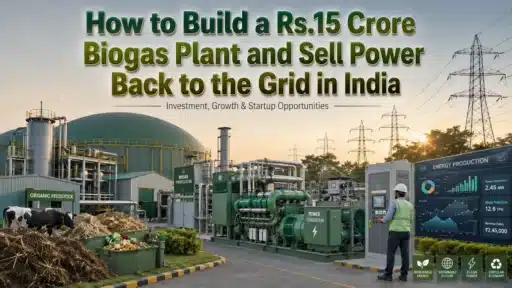


Biogas Plant in India
Biogas is one of the most promising business ventures in clean energy segment in India for a single reason, it is not dependent on the sun or wind. The biogas plant generates energy around the clock with organic waste which most industries and municipalities pay for to dispose of today for a total investment cost of Rs.15 Crore. The Ministry of New and Renewable Energy (MNRE) has facilitated biogas power projects under its biomass power programme by offering capital subsidy up to Rs.25 lakh per MW for grid connected biogas power projects. A game-changer for biogas project bankability is the SATAT Scheme launched by the Ministry of Petroleum and Natural Gas (MONPNG), giving assured off-take of Compressed Biogas (CBG) from the Oil Marketing Companies (OMCs) at fixed rates.
Why Biogas Power Generation Is a Smart Industrial Bet Right Now
India produces more than 550 million tonnes of biomass every year – crop residue, municipal solid waste, effluent from food processing industries, poultry waste, and dairy waste. Only less than 5% of this is currently used for energy generation. State electricity boards, on the other hand, face challenges in fulfilling their Renewable Purchase Obligations (RPOs), and biogas power can serve as a renewable energy source. Also, the production of biofertilizer from bio-gas digestion has high demand among the organic farmers. A successful biogas plant generates revenue on three fronts; sale of gas/power, fee from gate charge of waste suppliers, sale of biofertilizer. IBEF energy sector report offers market size details for the bioenergy potential in India.
Get Detailed Insights from This Book: Handbook on Biogas and Its Applications(from Waste & Renewable Resources with Engineering & Design Concepts)
Government Policies and Support for Biogas Projects
CBG producers will be able to sell compressed biogas to oil marketing companies (OMCs) at a fixed price of Rs.46 per kg under the SATAT Scheme. GOBAR-Dhan Scheme under the Ministry of Jal Shakti is providing technical assistance and viability gap funding for compressed biogas plant. The MNRE has been providing capital subsidy of up to Rs.25 lakh per MW for biogas power projects. State governments in Punjab, Haryana, and Maharashtra also offer additional state-level subsidies for biogas plants associated with poultry and dairy farms. NABARD offers subsidised loan for the biogas projects under the Priority Sector lending norms. SECI provides coordination and facilitation in Renewable Power Purchase including biogas generation for the State DISCOMs.(Biogas Plant in India
Top Business Ideas Within Biogas Plant Development
Grid-Connected Biogas Power Plant Supplying State DISCOM
For a 1 MW Biogas Power Plant, the requirement of feedstock is 25-30 tonnes per day and the annual production of electricity is about 18-22 lakh units.
The State DISCOM purchases the power generated under a long-term Power Purchase Agreement at Rs. 5.5–7 per unit, which provides a stable revenue stream. PPA tenders are made available by SECI or directly to the state DISCOMs. The PPA period is usually 10-15 years long, giving investors the certainty of income. Please check with your state DISCOM on MNRE portal for PPA tariff information specific to the state.
Compressed Biogas (CBG) Production Under the SATAT Scheme
The Government of India’s SATAT scheme enables CBG producers to supply compressed biogas to oil marketing companies at a pre-determined price of Rs. 46 per kg. A plant with a processing capacity of 50-80 tonnes of feedstock can produce 2,000-4,000 kg of CBG per day. This can generate daily revenue ranging from Rs. 92,000 to Rs. 1.84 lakh from CBG sales alone. Under the SATAT scheme, oil marketing companies issue Letters of Intent (LoIs) through the SATAT portal. These LoIs provide assured off-take before plant commissioning, significantly improving the bankability of projects and facilitating access to financing.
Get Detailed Project Report (DPR): Power Generation: Thermal, Hydro, Solar, Wind & Biogas

Integrated Waste-to-Energy Model for Food Processing Clusters
There are several clusters of food processing industries that generate large amounts of organic waste. These include sugar mills, rice mills, vegetable processing industries, and fish processing industries. Entrepreneurs can use these industries as a source of feedstock and provide waste management solutions. They can charge Rs. 200–500 per tonne for accepting waste and generate energy and biofertilizer through biogas plants. The Ministry of Food Processing Industries publishes a list of food processing clusters that can help identify potential feedstock sources for biogas plants.
Import-Export Opportunity Analysis
India is also promoting biogas technology, project skills and biofertilizer products to the African countries, Bangladesh and Sri Lanka. Operational expertise in the construction and management of biogas plants can be added to the skill sets of entrepreneurs who can tender/eat for EPC projects in these markets with the assistance of Exim Bank’s Lines of Credit. The advanced gas purification membranes and high-efficiency biogas engine-gensets from Germany and the Netherlands enhance the efficiency of plants – assess the upgrades as plant size grows on the import side.
Indian MSME Success Stories in Biogas Energy
GPS Renewables — Technology and Project Development in Biogas
Prabhat Singh and Abhijit Holkar developed a proprietary technology for biogas upgrading, and installed dozens of plants in India and overseas. By the integration of engineering innovation with commercial project development, the company was able to scale up from a technology start-up to a developed EPC player in the biogas market. GPS Renewables attracted marquee customers like large breweries, food processors and municipalities, and exported its technology internationally. They are involved in projects according to the SATAT framework, which shows that the scheme has commercial viability.(Biogas Plant in India)
Find high-return business ideas based on your budget & ROI
Bharat Biogas Energy Ltd — Scaling the SATAT Opportunity
Bharat Biogas Energy Ltd was one of the early startup companies in India’s CBG industry. The company established its plants under the SATAT scheme and obtained Letters of Intent (LOIs) from Oil Marketing Companies (OMCs) for the off-take of CBG. It demonstrated the commercial viability of the CBG business model through successful operations. The company also signed long-term agreements with poultry farms, dairy cooperatives, and food processing companies to ensure a reliable feedstock supply. Its success encouraged other entrepreneurs to view the SATAT scheme as a viable commercial opportunity. It also increased confidence among banks and NBFCs, leading them to provide financial support and incentives for such projects.
How NPCS Supports Biogas Project Development
At Niir Project Consultancy Services (NPCS) we offer professional and expertly designed Market Survey cum Detailed Techno-Economic Feasibility Reports (DPRs) for establishing new industries or businesses. Our reports also include manufacturing details, market research and demand analysis, process flow diagrams, product mix and capacity planning, details of machinery and raw materials, and complete project financials with profitability analysis. For detailed Project reports on Biogas Plant visit us at www.niir.org
Conclusion
A Rs.15 Crore biogas plant is one of the few energy investments in India today that combines government subsidy from MNRE, guaranteed off-take through SATAT, multiple revenue streams, and circular economy credentials. The entrepreneur who secures reliable feedstock supply and builds a technically competent operations team will find that a biogas plant is not just a good energy business, but one of the most resilient infrastructure assets an MSME can own in India today.
Related Article: Compressed Biogas (CBG) Plants: A Bankable Green Energy Business for New Entrepreneurs
Biogas Plant Project — Key Parameters
| Parameter | Details |
| Total Project Investment | Rs.12–18 Crore (1 MW or equivalent CBG plant) |
| Feedstock Requirement | 25–80 tonnes per day |
| Key Government Scheme | SATAT Scheme, MNRE Biomass Programme, GOBAR-Dhan |
| CBG Sale Price (SATAT) | Rs.46 per kg to OMCs |
| Power Sale Tariff (Grid) | Rs.5.5–7 per unit under PPA |
| Additional Revenue | Biofertiliser sales Rs.3,000–5,000 per tonne |
| Capital Subsidy Available | Up to Rs.25 lakh per MW (MNRE) |
| Payback Period | 5–7 years post subsidy |
| PPA Tenure | 10–15 years with state DISCOM |
Key References and Government Resources
- MNRE — Ministry of New and Renewable Energy — Biomass and biogas power programme, capital subsidies, RPO compliance
- SATAT Scheme — Ministry of Petroleum and Natural Gas — CBG off-take at Rs.46/kg from OMCs, LOI application portal
- Ministry of Jal Shakti — GOBAR-Dhan Scheme — Compressed biogas plant support, viability gap funding
- NABARD — Priority sector lending for biogas projects in rural areas
- SECI — Solar Energy Corporation of India — Renewable power purchase coordination including biogas
- EXIM Bank of India — Lines of credit for biogas technology exports to Africa and South Asia
Frequently Asked Questions (FAQ)
What is the SATAT scheme and how do I register?
SATAT, Government of India’s program, has guaranteed CBG offtake from OMCs at Rs46/kg. To apply for LOI from any OMC please log into SATAT portal available on MoPNG website. ThisLOIwill considerably improve your project bankability for lending.
What government subsidies are available for biogas plants?
The Ministry of New and Renewable Energy (MNRE) offers a capital subsidy of Rs 25 lakh/MW for grid connected biogas power plants. The ministry of Jal Shakti’s scheme – GOBAR-Dhan – provides viability gap funding and NABARD lends loans at concessional rates from its climate finance.
What feedstock can be used for a biogas plant?
A wide range of organic materials can serve as feedstock: crop residue, animal dung, food waste, vegetable market waste, municipal solid waste, and industrial organic effluent from breweries, dairies, and food processing plants. The MNRE publishes feedstock-specific biogas yield data that helps in plant sizing.
What environmental clearances are required for a biogas plant?
A biogas plant obtains the necessary approvals and registrations, including Consent to Establish and Consent to Operate from the State Pollution Control Board (SPCB), a No Objection Certificate (NOC) for grid connection from the DISCOM, an NOC from the local municipality, and registration under applicable waste management rules when handling municipal or industrial waste.
How do I sell biofertilizer from the biogas plant?
Farmers, farmer producer organisations, and organic farming networks can purchase biofertilizer—the digested organic matter output—directly at a price of Rs. 3,000–5,000 per tonne. For export of biofertilizer, register with APEDA and obtain DGFT IEC code.